How to verify that an Ex certificate is genuine
Abstract
Check IECEx certificates in the official online system, ATEX certificates through NANDO and the issuing notified body, and compare every detail with the product label. Certificate numbering, status, red flags and real cases of false Ex claims explained.
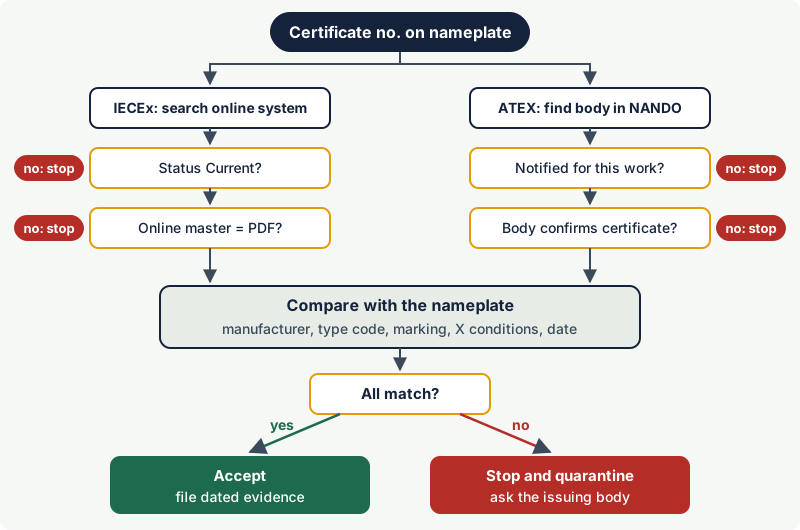
To verify an Ex certificate, never rely on the PDF you were sent. Look up an IECEx certificate in the official IECEx online certificate system, where the online version is the master copy, and check that its status is Current. For an ATEX EU-type examination certificate, which has no central public register, check the notified body in the European Commission's NANDO database and confirm the certificate with that body. Then compare every detail, manufacturer, type, marking, issue and conditions, with the product's nameplate: a genuine certificate for a different product is as useless as a forged one.
This article explains how certificate numbers are built, how to check each kind of certificate step by step, which red flags to look for, and what documented cases of false Ex claims show.
Key points
- The IECEx online certificate system holds the master version of every IECEx certificate; printed and PDF copies are uncontrolled, and the signature does not prove validity.
- An IECEx certificate is valid while its status is Current; it can be suspended or cancelled at any time, and products made after the suspension or cancellation date are not covered.
- There is no central public database of ATEX EU-type examination certificates: check the notified body in NANDO, then confirm the certificate with that body.
- The four-digit number after the CE marking identifies the notified body supervising production, which may differ from the body that issued the EU-type examination certificate.
- Category 3 and non-electrical category 2 ATEX equipment cannot have an EU-type examination certificate; a document claiming otherwise, with a notified body number, is a red flag.
- Most certificate problems are not forgeries but mismatches: a genuine certificate for another type, another manufacturer, an older issue or a different marking.
What can be wrong with a certificate
Not every problem is a forgery. In practice, buyers and inspectors meet five kinds of invalid evidence:
| Problem | Example | How it is found |
|---|---|---|
| Forged document | A certificate number that the issuing body never issued, or an invented body | Not found online; body denies it |
| Altered document | A genuine certificate with edited marking, gas group, type code or manufacturer | Online master differs from the PDF |
| Wrong certificate | Genuine certificate, but for another model, variant or manufacturer | Type code or manufacturer does not match the nameplate |
| Lapsed certificate | Suspended or cancelled, or a notified body whose notification was withdrawn | Status online; NANDO history |
| Wrong kind of document | A test report, a voluntary "ATEX compliance" statement or a quality system certificate presented as a product certificate | Document type and issuer checked against the scheme rules |
A counterfeit product can also come with a copy of a perfectly genuine certificate that belongs to the original manufacturer. Checking the document is therefore only half the job; the product must match it.
How genuine certificate numbers are built
Knowing the structure helps to spot invented numbers. The issuer code is the certification body's short code; the year is the last two digits of the year of issue.
| Document | Typical structure | Example | Notes |
|---|---|---|---|
| IECEx certificate of conformity | IECEx issuer YY.NNNN suffix | IECEx ABC 26.0123X | Issue number shown separately; X or U suffix where applicable |
| IECEx Ex Test Report (ExTR) | country / issuer / ExTR YY.NNNN / revision | GB/ABC/ExTR26.0123/00 | Listed on the CoC |
| IECEx Quality Assessment Report (QAR) | country / issuer / QAR YY.NNNN / revision | GB/ABC/QAR15.0042/03 | Listed on the CoC; covers the factory |
| ATEX EU-type examination certificate | issuer YY ATEX NNNN suffix | ABC 26 ATEX 0123 X | Issuer is a notified body |
| UKEX certificate (GB) | issuer YY UKEX NNNN suffix | ABC 26UKEX0123X | Issuer is a UK approved body |
| Notified body number on the label | four digits after CE | CE 1234 | Body supervising production, listed in NANDO |
The year in the number normally matches the date of the first issue. ATEX certificates issued before 20 April 2016 under the old Directive 94/9/EC were called EC-type examination certificates and remain valid under Directive 2014/34/EU; a certificate dated after that day that still claims to be issued under 94/9/EC is suspicious.
For the meaning of X and U see the X and U suffixes.
Checking an IECEx certificate
The IECEx scheme was built around public online verification. According to the scheme's own FAQ, the version on the official IECEx website is the master and controlled version, printed or PDF copies are uncontrolled, and using the website version is the industry's tool against fake certificates.
- Search the certificate number in the IECEx online certificate system, reachable from the IECEx website. Type the number exactly as it appears on the nameplate.
- Check the status. Current means valid. Suspended or Cancelled means the certificate no longer covers new production; products made before the date of suspension or cancellation may still be sold if it can be shown that they were made while the certificate was current.
- Check the issue. Certificates are reissued when products or standards change; later issues do not cancel earlier ones unless the certification body cancels them. Make sure the issue you rely on covers the product's type and date of manufacture.
- Compare the content of the online certificate with the nameplate and the PDF you were given: manufacturer and manufacturing location, equipment name and type code, marking, ambient temperature range, standards and editions, and the specific conditions of use.
- Check the reports. The certificate lists its ExTR and QAR references; their format should match the issuing body and country.
- Use the QR code carefully. Recent IECEx certificates carry a note that status and authenticity can be checked on the IECEx website or by the QR code. Make sure the code really leads to the official IECEx site; a forged PDF can carry a QR code to anywhere.
Checking an ATEX certificate
The ATEX directive does not create a public register of EU-type examination certificates. The certificate is held by the manufacturer and the notified body, so verification has two parts: is the issuer a real notified body for this work, and does that body confirm the certificate?
- Identify the bodies. The EU declaration of conformity names the notified body that issued the EU-type examination certificate and gives the certificate number. The label shows CE followed by the four-digit number of the notified body supervising production (for example under a QAN). These may be two different bodies.
- Check both bodies in NANDO. NANDO, the Commission's list of notified bodies, is now part of the Single Market Compliance Space; the old NANDO address redirects there. Search by number or by Directive 2014/34/EU and check that the body is notified for the relevant procedure (EU-type examination, production quality assurance) and product type, and that the notification was active on the certificate date.
- Confirm the certificate with the issuing body. Some notified bodies offer an online certificate check or answer enquiries; use contact details from NANDO or the body's official website, not from the document you are checking.
- Check the route makes sense. Category 3 equipment and non-electrical category 2 equipment are not covered by EU-type examination certificates. A notified body may issue a voluntary certificate for them, but it must not show a notified body number or the CE marking. See EU-type examination certificates and notified bodies.
- Compare with the product exactly as for IECEx.
For Great Britain, UKEX certificates are issued by UK approved bodies, which have four-digit numbers and are listed in the UK government's register of approved bodies; the official guidance on the 2016 Regulations links to it. Other national schemes, such as those described in Ex certification in other markets, are checked with the issuing body or the national regulator.
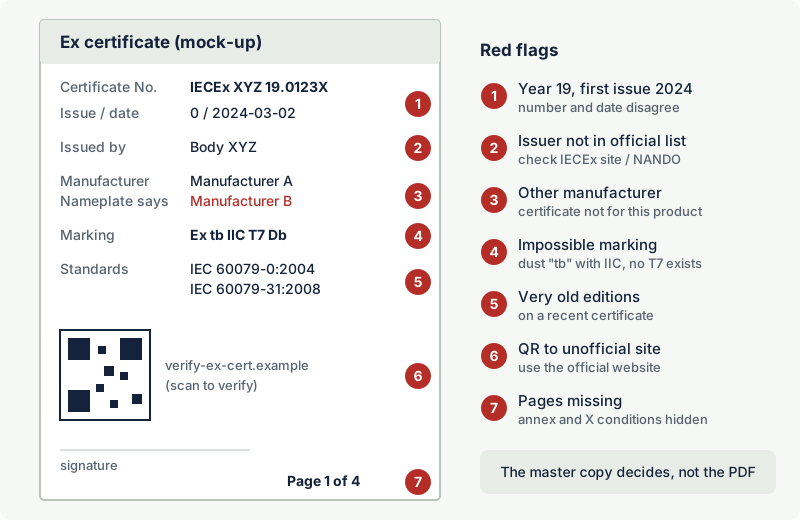
Red flags
| Red flag | Why it matters |
|---|---|
| Certificate not found online (IECEx) or body not in NANDO (ATEX) | The certificate or the body may not exist |
| Status Suspended or Cancelled, or manufacture after that date | New production is no longer covered |
| Online version differs from the PDF | The copy has been altered |
| Manufacturer or brand on the certificate differs from the nameplate | Own-brand products need their own certificate or a documented link to the original |
| Type code, rating or marking not covered by the certificate | The certificate is for something else |
Marking that cannot exist, for example temperature class T7, or a gas group with a dust protection type such as Ex tb IIC | The text was written or edited by someone without Ex knowledge |
| Notified body number on a category 3 product presented as an "EU-type examination certificate" | Not possible under the directive |
| Missing pages, annex or schedule ("page 1 of 4" supplied alone) | Specific conditions of use and the product description are hidden |
| Very old standards editions on a recently issued certificate | Inconsistent with current certification practice |
| A "certificate" from a testing laboratory, consultant or quality system registrar instead of a certification body | Not an Ex product certificate |
| QR code or verification link leading to a site other than the official one | Possible fake verification page |
Documented cases
False Ex claims are documented by public authorities, not only by industry anecdotes.
- Great Britain, 2022. The UK government's product safety alerts service published reports (one of them dated 13 May 2022), notified by the Health and Safety Executive, on two "explosion-proof" extractor fans sold for spray booths and industrial areas. The authority found that they had not been subject to an appropriate conformity assessment procedure under the 2016 Regulations and did not meet the requirements for markings, instructions and the declaration of conformity, so there was no evidence they were safe for explosive atmospheres. The risk was classed as serious (fire and explosion) and the products were withdrawn.
- Certification schemes. The IECEx scheme states in its FAQ that it made the online certificate the master version specifically as a tool to combat fake certificates. Certification bodies also publish public notices when they find a fraudulent certificate bearing their name. One such notice in 2016, in the related IECEE scheme for electrical equipment, stated that the product had never been tested by the body and asked anyone presented with the certificate to reject it and report it to the body and the scheme secretariat.
These cases have a common pattern: the documents looked plausible to a buyer, but either no proper assessment existed or it did not cover the product supplied.
Worked example: checking a supplier's documents
A contractor receives flameproof junction boxes for a Zone 1 area. The nameplate reads II 2 G Ex db IIC T6 Gb, IECEx ABC 21.0456, ABC 21 ATEX 0456, CE 1234, with a type code ending in -L. The supplier sends PDFs of both certificates.
- IECEx. The online system shows the certificate, issue 3, status Current. The marking matches. But the type code table in the online annex lists suffixes
-Sand-Monly;-Ldoes not appear in any issue. - ATEX. NANDO shows body 1234 notified under Directive 2014/34/EU for production quality assurance; the declaration of conformity names body ABC, also notified, as issuer of the EU-type examination certificate. The body's online check confirms the certificate, again without the
-Lvariant. - Comparison. The supplier's PDF does list
-L. The online master does not. - Action. The boxes are quarantined and the manufacturer and certification body are contacted. Either the variant was never certified, or a new issue exists that is not yet published; until the body confirms coverage in writing, the boxes are not installed.
Without step 1 and the comparison, the boxes would have passed a document review that only checked that "a certificate exists".
Common mistakes
- Accepting the PDF as proof. A PDF is an uncontrolled copy. The online master (IECEx) or the issuing body (ATEX) decides.
- Looking up the CE number and stopping there. The number after CE belongs to the body supervising production; it does not confirm the product certificate.
- Checking existence, not content. A genuine certificate for a different variant, manufacturer or marking does not cover the product.
- Ignoring status changes after delivery. For long projects, recheck status before installation and keep a dated record of the check.
- Treating a test report as a certificate. An ExTR or a laboratory report shows test results; certification also needs the quality system assessment and the certification body's decision.
- Using contact details from the suspect document. Always reach the issuing body through NANDO, the IECEx website or the body's own official site.
Frequently asked questions
How do I check if an IECEx certificate is valid?
Search the certificate number in the official IECEx online certificate system, reachable from the IECEx website, and check that its status is Current. Then compare the online certificate, which is the master version, with the PDF you received and with the product nameplate. A certificate that cannot be found online is not recognised by the scheme.
Is there a database of ATEX certificates?
No. The ATEX directive does not provide a central public register of EU-type examination certificates. Check the issuing notified body in the Commission's NANDO database and confirm the certificate directly with that body; some bodies offer online certificate checks.
What does the number after the CE marking mean?
It is the four-digit identification number of the notified body involved in the production phase, for example the body that issued the manufacturer's quality assurance notification. It can be checked in NANDO, but it is not the certificate number and may belong to a different body than the certificate issuer.
What should I do if I suspect a fake Ex certificate?
Do not install the equipment. Contact the certification body named on the document using contact details from NANDO or the IECEx website, and ask it to confirm the certificate and its scope. If it is confirmed fake, inform the supplier and, in the EU or UK, the market surveillance authority; certification bodies and scheme secretariats also want to be told.
Can a product made after a certificate was suspended still be used?
Products manufactured before the date of suspension or cancellation of an IECEx certificate may still be offered for sale if it can be shown that they were made while the certificate was current. Products made after that date are not covered, so the date of manufacture on the nameplate matters.
Related on excodex
- The IECEx scheme explained: CoC, ExTR, QAR and the online certificate database
- EU-Type Examination Certificates and Notified Bodies explained
- How to read an Ex marking: decoding II 2 G Ex db IIC T4 Gb step by step
- The X and U suffixes on Ex certificates
- Ex certification in other markets: UKEX, EAC, INMETRO, CCC, PESO and others
- Tool: Ex marking check; discuss a doubtful document in the forum; standards spaces: IECEx, ATEX 2014/34/EU
Standards and further reading
- IECEx online certificate system: iecex-certs.com
- IECEx, frequently asked questions on the certified equipment scheme (master online version, status, suspension): iecex.com
- European Commission, NANDO list of notified bodies in the Single Market Compliance Space: webgate.ec.europa.eu
- European Commission, ATEX 2014/34/EU Guidelines, 6th edition January 2026 (certificate content, transitional provisions, voluntary certificates): single-market-economy.ec.europa.eu
- UK Government guidance on the Equipment and Protective Systems Intended for Use in Potentially Explosive Atmospheres Regulations 2016, with the link to the register of UK approved bodies: gov.uk
- UK Office for Product Safety and Standards, product safety report 2205-0084 on an explosion-proof extractor fan, 13 May 2022: assets.publishing.service.gov.uk (PDF)
- US Coast Guard Outer Continental Shelf National Center of Expertise, The Drill Down issue 29 on hazardous location certificate numbers (number structure and online verification): dco.uscg.mil
- IEC 60079-0, explosive atmospheres: general requirements for equipment (marking and certificate references).
This article is general technical information prepared by the excodex editorial team. It does not replace the applicable standards, the equipment certificates and instructions, national regulations or the assessment of a competent person.