ATEX explained: the two EU directives 2014/34/EU and 1999/92/EC in plain language
Abstract
ATEX is two EU directives. 2014/34/EU sets what manufacturers must prove before Ex equipment is sold; 1999/92/EC sets what employers must do where explosive atmospheres can occur. Duties, CE marking, the EPD and national adoption explained.
ATEX is the common name for two European Union directives on explosive atmospheres. Directive 2014/34/EU, the product or equipment directive, tells manufacturers what equipment and protective systems must achieve, and how conformity must be proven, before they are placed on the EU market. Directive 1999/92/EC, the workplace or user directive, tells employers how to assess and control explosion risks where people work, including classifying zones and writing an Explosion Protection Document. One directive governs the product, the other governs the place, and they meet where the employer selects equipment of the right category for each zone.
This article explains both directives in plain language: who must do what, how CE marking fits in, what the Explosion Protection Document contains, and how the directives become national law, using Türkiye (Turkey) as a worked example of national adoption.
Key points
- ATEX (from the French ATmosphères EXplosibles) refers to two EU directives: 2014/34/EU for equipment and protective systems, and 1999/92/EC for the safety of workers.
- Directive 2014/34/EU has applied since 20 April 2016 and replaced Directive 94/9/EC. It covers electrical and non-electrical equipment, protective systems, safety devices and components.
- Under 2014/34/EU the manufacturer must meet the essential health and safety requirements of Annex II, complete the conformity assessment for the equipment category, draw up an EU declaration of conformity and affix the CE marking followed by the Ex symbol, group and category.
- Under 1999/92/EC the employer must assess explosion risks, classify hazardous places into zones, select equipment by category, and draw up an Explosion Protection Document before work starts and keep it up to date.
- The two directives connect through one rule: category 1 equipment in Zone 0 or 20, category 1 or 2 in Zone 1 or 21, category 1, 2 or 3 in Zone 2 or 22, unless the Explosion Protection Document justifies otherwise.
- Directives bind Member States, not companies directly. Each country turns them into national law; the product directive also applies in the EEA, in Switzerland through a mutual recognition agreement, and in Türkiye through the Customs Union.
Why there are two directives
The split follows the EU's legal toolbox. The product directive is a single-market measure based on Article 114 of the Treaty on the Functioning of the European Union (TFEU), formerly Article 95 of the EC Treaty. It is a "total harmonisation" directive: a product that complies may circulate freely in every Member State, and no country may add its own product requirements on top.
The workplace directive is a social-policy measure based on what is now Article 153 TFEU, formerly Article 137 of the EC Treaty. It sets minimum requirements for protecting workers, and national law may go further. This is why practitioners still say "ATEX 95" (or the newer "ATEX 114") for the product directive and "ATEX 137" for the workplace directive.
Both directives use the same definition. An explosive atmosphere is "a mixture with air, under atmospheric conditions, of flammable substances in the form of gases, vapours, mists or dusts in which, after ignition has occurred, combustion spreads to the entire unburned mixture". Each part matters; our companion article What is an explosive atmosphere? takes it apart.
| Directive 2014/34/EU | Directive 1999/92/EC | |
|---|---|---|
| Common names | ATEX product, equipment or manufacturer directive; ATEX 95 / ATEX 114 | ATEX workplace, user or worker directive; ATEX 137 |
| Main duty holder | Manufacturer (also authorised representative, importer, distributor) | Employer |
| Subject | Equipment, protective systems, safety devices, components | Workplaces where explosive atmospheres may occur |
| Core tools | Essential health and safety requirements (Annex II), equipment groups and categories, conformity assessment modules | Risk assessment, zones (Annex I), organisational and technical measures (Annex II) |
| Key documents | Technical documentation, EU declaration of conformity, instructions | Explosion Protection Document |
| Visible sign | CE marking, Ex symbol in a hexagon, group and category | Yellow triangular "EX" warning sign at entry points |
| Type of rule | Total harmonisation | Minimum requirements |
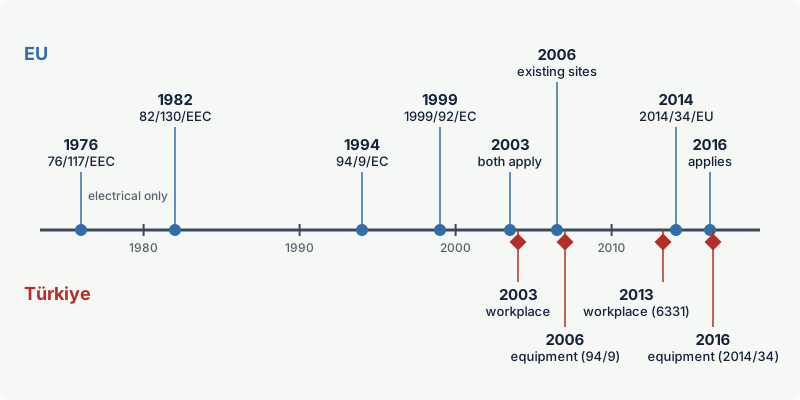
| Applies since | 20 April 2016 (predecessor 94/9/EC: 1 July 2003) | Transposition deadline 30 June 2003 |
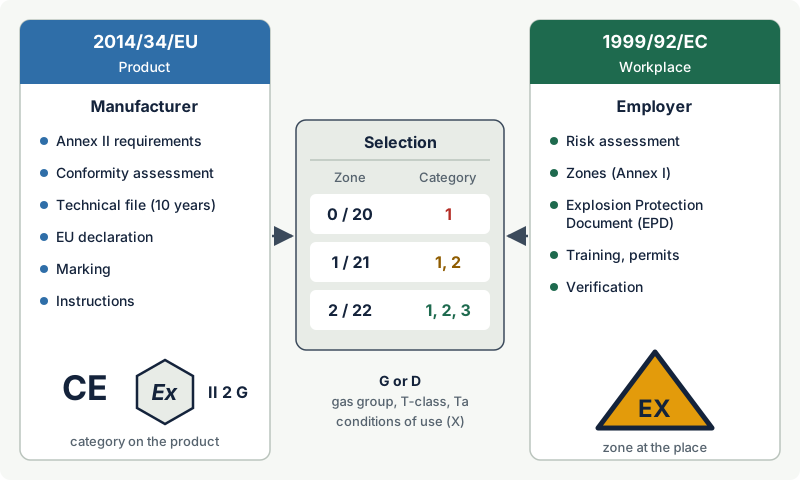
ATEX 2014/34/EU: the product directive
What it covers
Article 1 of the directive brings three kinds of product into scope: equipment and protective systems intended for use in potentially explosive atmospheres; safety, controlling and regulating devices that sit outside the hazardous area but are needed for the safe functioning of that equipment (an overload relay protecting an increased-safety motor is the classic example); and components intended to be built into equipment or protective systems.
"Equipment" is defined by its potential to cause an explosion through its own ignition sources. That includes non-electrical equipment such as pumps, fans, gearboxes and brakes. Before 94/9/EC, the European rules (Directives 76/117/EEC and 82/130/EEC and their amendments) covered only electrical equipment; bringing mechanical ignition sources into scope was one of the main changes ATEX made.
Exclusions include medical devices in a medical environment, products whose only hazard comes from explosives or unstable chemicals, domestic equipment where only an accidental fuel gas leak could create an explosive atmosphere, personal protective equipment, seagoing vessels and means of transport (vehicles intended for use in potentially explosive atmospheres stay in scope).
What the manufacturer must do
Article 6 lists the manufacturer's obligations; in practice there are five:
- Design to Annex II. The product must meet the essential health and safety requirements (EHSRs). Harmonised European standards such as the EN IEC 60079 and EN ISO 80079 series give a presumption of conformity, but the legal requirement is the EHSR, not the standard.
- Prepare technical documentation that shows how the EHSRs are met, and keep it, with the declaration of conformity, for 10 years after the product is placed on the market.
- Carry out the conformity assessment required for the product's group and category (Article 13), involving a notified body where the directive requires one.
- Draw up the EU declaration of conformity and affix the CE marking. Components do not receive the CE marking; they come with a written attestation of conformity instead.
- Mark the product and provide instructions in a language the users in the destination country can understand.
Importers must check that a non-EU manufacturer has done all of this; distributors must check the marking and documents.
Categories decide the conformity route
The directive sorts equipment into groups (I for mines, II for everything else) and categories. Category 1 gives a very high level of protection, category 2 a high level, category 3 a normal level, with M1 and M2 as the mining equivalents. The higher the category, the more independent checking the directive demands.
| Product | Conformity assessment under Article 13 |
|---|---|
| Category M1 and 1 equipment, and protective systems | EU-type examination (Module B) plus either production quality assurance (Module D) or product verification (Module F) |
| Category M2 and 2 electrical equipment and internal combustion engines | EU-type examination (Module B, Annex III) plus either conformity to type based on internal production control plus supervised product testing (Module C1, Annex VI) or product quality assurance (Module E, Annex VII) |
| Category M2 and 2 non-electrical equipment | Internal production control (Module A, Annex VIII) and the technical documentation sent to a notified body, which acknowledges receipt and keeps it |
| Category 3 equipment | Internal production control (Module A), no notified body |
| Any of the above | Unit verification (Module G) is an alternative for single items |
Our article on EU-type examination certificates and notified bodies explains each module and what the resulting certificates mean.
CE marking and the Ex marking
Article 16 and Annex II (point 1.0.5) set what goes on the product. Where a notified body is involved in the production control phase (Modules C1, D, E, F or G), its four-digit identification number follows the CE marking. Annex II then requires the specific marking of explosion protection, the letters "Ex" inside a hexagon, the equipment group and category, and for group II the letter G (gases, vapours, mists) and/or D (dusts). The manufacturer's name and address, type designation, serial number and year of construction complete the legal marking.
A typical label therefore carries something like CE xxxx (xxxx being the notified body number), the Ex hexagon, II 2 G, and then the marking required by the harmonised standard, for example Ex db IIC T4 Gb. The first part is the legal ATEX marking; the second describes the protection concept, gas group, temperature class and Equipment Protection Level. Our step-by-step guide on how to read an Ex marking decodes both parts, and you can check any string with the Ex marking check.
ATEX 1999/92/EC: the workplace directive
Who it applies to
The directive applies to every employer whose workers may be at risk from explosive atmospheres. It excludes medical treatment areas, gas appliances covered by their own EU rules, explosives and chemically unstable substances, mineral-extracting industries with their own directives, and transport (except means of transport intended for use in a potentially explosive atmosphere).
What the employer must do
Articles 3 to 9 and Annex II form a clear sequence:
- Follow the order of priority (Article 3). First prevent explosive atmospheres from forming. Where the process does not allow that, avoid their ignition. Then mitigate the effects of an explosion so that workers stay safe. These measures must be reviewed regularly and whenever significant changes occur. Our article on explosion protection strategy applies this hierarchy in practice.
- Assess explosion risks (Article 4), taking account at least of the likelihood and persistence of explosive atmospheres, the likelihood that ignition sources (including electrostatic discharges) are present and become effective, the installations, substances and processes and their interactions, and the scale of the effects. Places connected through openings to hazardous places must be included.
- Classify hazardous places into zones (Article 7 and Annex I) and mark their entry points, where necessary, with the triangular yellow "EX" warning sign of Annex III.
- Coordinate (Article 6). Where workers from several undertakings share a workplace, the employer responsible for the workplace coordinates the protective measures and records how in the Explosion Protection Document.
- Apply the minimum requirements of Annex II, which include training, written instructions and permits to work where the Explosion Protection Document requires them, working clothes that do not cause igniting electrostatic discharges, warnings and escape facilities, and verification of overall explosion safety by competent persons before a workplace is used for the first time.
Zones and equipment categories
Annex I defines six zones by how often and how long an explosive atmosphere is present: Zones 0, 1 and 2 for gas, vapour and mist, and Zones 20, 21 and 22 for dust clouds, with dust layers and heaps treated as sources that can form an explosive atmosphere. Annex II, Part B then links the zones to the categories of the product directive.
| Zone | Explosive atmosphere is... | Equipment categories permitted |
|---|---|---|
| Zone 0 / Zone 20 | present continuously, for long periods or frequently | Category 1 |
| Zone 1 / Zone 21 | likely to occur in normal operation occasionally | Category 1 or 2 |
| Zone 2 / Zone 22 | not likely in normal operation; if it occurs, only for a short period | Category 1, 2 or 3 |
The equipment must also suit the type of atmosphere (G or D). Note the opening words of Part B: the categories apply "if the explosion protection document based on a risk assessment does not state otherwise". The rule is the default, and any deviation must be justified in writing. Zone definitions are explained in detail in Hazardous area zones explained and Dust zones 20, 21 and 22.
The Explosion Protection Document
Article 8 requires the employer to ensure that an Explosion Protection Document (EPD) is drawn up and kept up to date. It must demonstrate in particular:
- that the explosion risks have been determined and assessed;
- that adequate measures will be taken to meet the aims of the directive;
- which places have been classified into zones;
- where the minimum requirements of Annex II apply;
- that the workplace and work equipment, including warning devices, are designed, operated and maintained with due regard for safety;
- that arrangements have been made for the safe use of work equipment.
The EPD must exist before work begins and must be revised after significant changes, extensions or conversions of the workplace, equipment or work organisation. It may be combined with other risk assessments. In practice a good EPD contains substance data, the area classification and drawings, an equipment register, the ignition source assessment, permits and training arrangements, and the inspection plan. That structure is common practice, not a legal template: the directive prescribes what the document must show, not its format. Our article on the Explosion Protection Document and area classification drawings goes through it section by section.
Existing equipment and workplaces
Article 9 contains a point that is often misunderstood. Work equipment already in use before 30 June 2003 had to meet the minimum requirements of Annex II, Part A from that date, but not the category rules of Part B. Workplaces in use before 30 June 2003 had three years, until 30 June 2006, to comply. Any modification, extension or restructuring after 30 June 2003 must comply with the directive. So older equipment without ATEX marking is not automatically illegal; it must be justified in the EPD, and replacements or modifications follow today's rules.
Where the two directives meet: a practical case
Example: A coatings plant mixes paint containing toluene (flash point 4 °C, temperature class T1, gas group IIA in the excodex library). The employer's risk assessment classifies the area around the mixing vessel openings as Zone 1 and the rest of the mixing room as Zone 2.
- The agitator motor is electrical equipment in Zone 1, so the employer buys a category 2 G motor. Its manufacturer needed an EU-type examination certificate plus a notified body's production module, so the label shows CE with a notified body number, the Ex hexagon and II 2 G, followed by a standard marking such as Ex db IIB T4 Gb.
- The agitator gearbox is non-electrical category 2 equipment. Its manufacturer applied internal production control and lodged the technical documentation with a notified body. There is no EU-type examination certificate, and that is correct.
- The room luminaires in Zone 2 are category 3. Their manufacturer self-declared conformity, and no notified body number follows the CE marking.
The employer records all three in the equipment register of the EPD, checks each marking against the zone, gas group and temperature class, and keeps the manufacturers' declarations and instructions on file.
The manufacturer answers "is this product safe for the category it claims?". The employer answers "is this the right product, correctly installed and maintained, for this place?". Neither directive details installation or inspection; in Europe these normally follow EN IEC 60079-14, EN IEC 60079-17 and national rules.
How the directives become national law
A directive is addressed to Member States, which adopt national legislation with the same effect; inspectors enforce that national law. For 1999/92/EC the deadline was 30 June 2003; for 2014/34/EU national measures had to be adopted by 19 April 2016 and applied from 20 April 2016. Certificates issued under the old Directive 94/9/EC remain valid under 2014/34/EU, although a certificate can lose its basis if the state of the art moves on.
The product directive also applies in the European Economic Area countries (Iceland, Liechtenstein and Norway), in Switzerland through a mutual recognition agreement, and in Türkiye under the EU-Türkiye Customs Union. In Great Britain the two directives were implemented as the Equipment and Protective Systems Intended for Use in Potentially Explosive Atmospheres Regulations 2016 and the Dangerous Substances and Explosive Atmospheres Regulations 2002 (DSEAR); after leaving the EU, Great Britain developed its own conformity marking, covered in Ex certification in other markets.
Türkiye as an example of national adoption
Türkiye shows how a country outside the EU adopts both directives as two separate regulations under two ministries:
- Product side. The Muhtemel Patlayıcı Ortamda Kullanılan Teçhizat ve Koruyucu Sistemler ile İlgili Yönetmelik (2014/34/AB) was published in the Official Gazette (Resmî Gazete) on 30 June 2016, No. 29758, by the ministry responsible for industry (today the Ministry of Industry and Technology). It transposes Directive 2014/34/EU and replaced the earlier regulation based on 94/9/EC, published on 30 December 2006, No. 26392. Products placed on the Turkish market follow the same EHSRs, categories, modules and CE marking as in the EU, with instructions in Turkish.
- Workplace side. The Çalışanların Patlayıcı Ortamların Tehlikelerinden Korunması Hakkında Yönetmelik was published on 30 April 2013, No. 28633, by the Ministry of Labour and Social Security under Article 30 of Occupational Health and Safety Law No. 6331. It was prepared in parallel with Directive 1999/92/EC and replaced a 2003 regulation (26 December 2003, No. 25328). It requires the employer to prepare the explosion protection document (patlamadan korunma dokümanı) before work starts and to revise it after significant changes. The ministry has published an implementation guide on the regulation.
- Notified bodies. Under the Customs Union, Türkiye designates its own conformity assessment bodies; they are notified to the European Commission through the NANDO system (now part of the Commission's Single Market Compliance Space) and receive EU identification numbers.
Common mistakes
- "Our site is ATEX certified." Neither directive certifies sites or people. Products go through conformity assessment; workplaces are assessed by the employer in the EPD. Personnel competence is separate, see competence of people working in hazardous areas.
- Treating CE plus the Ex hexagon as "suitable everywhere". Gas group, temperature class, ambient range and specific conditions of use must still match the location.
- Asking for a notified body certificate for category 3 equipment. Category 3 is self-declared. A certificate for it may exist, but it is voluntary and is not an EU-type examination certificate.
- Forgetting non-electrical equipment. Pumps, fans, couplings and gearboxes in hazardous areas need ATEX conformity too, see non-electrical equipment in hazardous areas.
- Writing the EPD once and filing it. It must be revised after significant changes; an EPD that does not match the plant is an inspection finding.
- Assuming all pre-2003 equipment must be scrapped. Article 9 allows equipment in use before 30 June 2003 to stay if it meets Annex II, Part A and the risk assessment supports it.
Frequently asked questions
What does ATEX stand for?
ATEX comes from the French ATmosphères EXplosibles, explosive atmospheres. It is the informal name for Directive 2014/34/EU on equipment and protective systems and Directive 1999/92/EC on the protection of workers; neither legal title uses the word.
Is ATEX a law or a standard?
ATEX is law: the two directives bind EU Member States and apply through national legislation. Standards such as the EN IEC 60079 series are voluntary; when harmonised under 2014/34/EU, they give a presumption of conformity with the requirements they cover.
Who is responsible for the Explosion Protection Document?
The employer. Consultants or competent staff may write it, but the duty to have it before work starts and keep it up to date stays with the employer. Where several companies share a site, the employer in charge of the workplace coordinates.
Does ATEX apply outside the EU?
The product directive applies in the EEA, in Switzerland through a mutual recognition agreement and in Türkiye through the Customs Union. Elsewhere it has no legal force, although many buyers request ATEX equipment. The international alternative is compared in ATEX vs IECEx.
Do I need ATEX equipment in Zone 2?
Yes. Annex II, Part B of 1999/92/EC requires category 3 or better in Zone 2 and Zone 22, unless the Explosion Protection Document justifies a different choice. Category 3 equipment is self-declared by the manufacturer.
Are certificates issued under the old directive 94/9/EC still valid?
Yes, Article 41 of 2014/34/EU keeps them valid. An EU-type examination certificate can still lose its basis when harmonised standards change substantially, so manufacturers should keep certificates under review.
Related on excodex
- What is an explosive atmosphere? Fire triangle, explosion pentagon and why ATEX exists
- ATEX equipment categories 1, 2 and 3 and how they relate to EPLs
- EU-Type Examination Certificates and Notified Bodies explained
- The ATEX Declaration of Conformity and the CE and Ex marking
- The Explosion Protection Document (EPD) and area classification drawings
- Standards spaces: ATEX 2014/34/EU, ATEX 1999/92/EC, Türkiye explosive atmosphere regulations; tool: Ex marking check
Standards and further reading
- Directive 2014/34/EU on equipment and protective systems intended for use in potentially explosive atmospheres (recast), full text: EUR-Lex
- Directive 1999/92/EC on minimum requirements for improving the safety and health protection of workers potentially at risk from explosive atmospheres: EUR-Lex
- European Commission, ATEX page with the ATEX 2014/34/EU Guidelines (6th edition, January 2026): single-market-economy.ec.europa.eu
- EU-OSHA summary of Directive 1999/92/EC and its non-binding guide to good practice: osha.europa.eu
- HSE (UK), ATEX and explosive atmospheres: hse.gov.uk
- Ministry of Labour and Social Security of Türkiye, implementation guide on protecting workers from explosive atmospheres (in Turkish): csgb.gov.tr
- Ministry of Trade of Türkiye, legislative framework built on the EU product safety system: trade.gov.tr
- EN 1127-1, explosive atmospheres: explosion prevention and protection, basic concepts and methodology
- IEC 60079-0, explosive atmospheres: general requirements for equipment
- IEC 60079-10-1 and IEC 60079-10-2, classification of areas for gas and for dust atmospheres
- IEC 60079-14 and IEC 60079-17, design, selection and erection of installations; inspection and maintenance
This article is general technical information prepared by the excodex editorial team. It does not replace the applicable standards, the equipment certificates and instructions, national regulations or the assessment of a competent person.