The Explosion Protection Document (EPD) and area classification drawings under ATEX 1999/92/EC
Abstract
What the Explosion Protection Document required by Article 8 of ATEX 1999/92/EC must show, how it links to the risk assessment, what goes on area classification drawings, who is responsible and when the EPD must be revised.
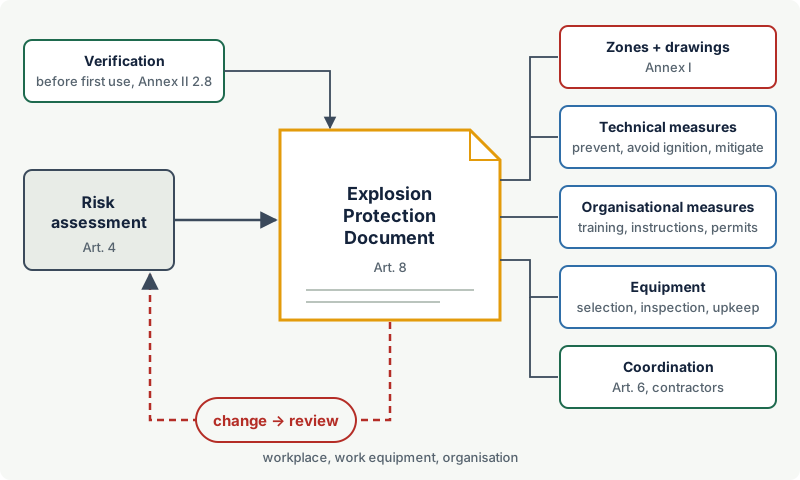
The Explosion Protection Document (EPD) is the written record that Article 8 of Directive 1999/92/EC requires from every employer whose workplace can contain an explosive atmosphere. It must show that the explosion risks have been identified and assessed, which places are classified into zones, where the minimum requirements of Annex II apply, which measures are taken, and that the workplace and its equipment are designed, operated and maintained safely. It is drawn up before work starts and revised whenever the workplace, the equipment or the organisation of work changes significantly; the area classification drawings are its central graphic part.
This article explains what the EPD must contain, how it grows out of the risk assessment, what a good hazardous area drawing shows, who is responsible for what, and how to keep the document alive, with a practical outline for a small solvent mixing room.
Key points
- The EPD is required by Article 8 of Directive 1999/92/EC (the ATEX workplace directive); national laws such as DSEAR in Great Britain or Turkey's 2013 regulation on explosive atmospheres at work transpose or mirror the duty.
- It must demonstrate six things: risks determined and assessed, adequate measures, zoned places, places where Annex II applies, safe design, operation and maintenance, and arrangements for the safe use of work equipment.
- It must exist before work starts and be revised after significant changes, extensions or conversions of the workplace, the work equipment or the organisation of work.
- The employer may combine existing risk assessments and reports, so the EPD can refer to other documents instead of repeating them.
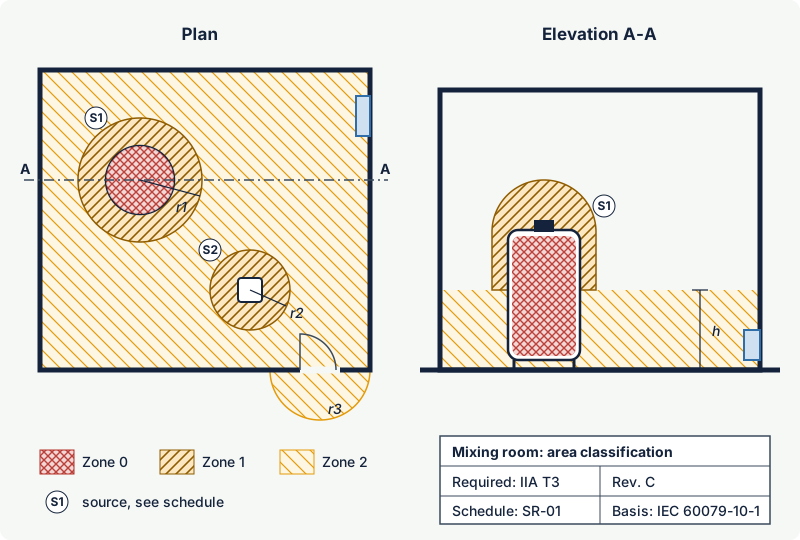
- Area classification drawings show every zone in plan and elevation with its extent, the sources of release behind it and the gas group and temperature class required, with a legend and a revision status.
- Before a workplace with hazardous places is used for the first time, its overall explosion safety must be verified by persons competent in explosion protection.
- Where workers from several employers share a workplace, the employer responsible for it coordinates the measures and states the aim and procedures of that coordination in the EPD.
What Article 8 requires
Directive 1999/92/EC sets minimum requirements for the safety of workers potentially at risk from explosive atmospheres. Article 8 turns the employer's risk assessment into a document. In plain terms, the EPD must show:
| Article 8 asks the EPD to demonstrate | What this means in practice |
|---|---|
| that explosion risks have been determined and assessed | the substances, processes and sources of release considered, and the method used |
| that adequate measures will be taken | technical and organisational measures, in the order of priority set by Article 3 |
| which places are classified into zones (Annex I) | zone drawings and the source schedule behind them |
| where the minimum requirements of Annex II apply | the hazardous places and any equipment in safe areas needed for safe operation in them |
| that the workplace and work equipment, including warning devices, are designed, operated and maintained safely | equipment selection, inspection and maintenance arrangements |
| that arrangements are made for the safe use of work equipment | the link to the work equipment directive (89/655/EEC, now codified as 2009/104/EC) |
Two further sentences of Article 8 matter in daily work. The EPD must be drawn up before work starts and revised when the workplace, work equipment or organisation of work undergoes significant changes, extensions or conversions. And the employer may combine existing explosion risk assessments, documents or equivalent reports produced under other EU acts, for example a major-accident safety report.
The EPD is also referred to elsewhere in the directive. Annex II says that written instructions and a permit-to-work system apply where the EPD requires them, that plant and equipment may only be brought into service if the EPD indicates that they can be used safely in an explosive atmosphere, and that escape facilities are provided where the EPD requires them. Annex II Part B lets the EPD, on the basis of a risk assessment, depart from the default link between zones and equipment categories. The document is therefore not paperwork beside the safety system: several obligations are switched on or off by what it says.
The link to the risk assessment
The EPD is the written outcome of the explosion risk assessment of Article 4. That assessment must consider at least:
- the likelihood that explosive atmospheres will occur and how long they persist;
- the likelihood that ignition sources, including electrostatic discharges, will be present and become active and effective;
- the installations, substances, processes and their possible interactions;
- the scale of the anticipated effects.
Explosion risks must be assessed overall, and places connected through openings to places where explosive atmospheres may occur must be included. A room next door, a drain line or a ventilation duct can carry the hazard beyond the process area.
Area classification answers only the first question, where and how often an explosive atmosphere can occur. The ignition source assessment, the consequence assessment and the choice of measures complete the picture. The measures follow the order of priority in Article 3: first prevent the formation of explosive atmospheres, then avoid their ignition, then mitigate the effects of an explosion. A good EPD makes this logic visible, for example by stating that a vessel is inerted (prevention), that the area around it is Zone 2 with Ex equipment (avoidance of ignition), and that the building has relief panels (mitigation).
What a good EPD contains
The European Commission's non-binding guide to good practice for implementing Directive 1999/92/EC proposes a specimen layout. It stresses that not every point must be included, that the document should be tailored to the establishment, well structured and not excessive, and that a loose-leaf or modular form helps where the plant changes often. The outline below follows that layout.
| Part | Typical content |
|---|---|
| 1. Workplace and working areas | site and layout plans, buildings, rooms, persons in charge, escape and rescue routes |
| 2. Processes and activities | process description and flow diagram, operating data, start-up and shutdown, cleaning, ventilation |
| 3. Substances and safety data | flammable gases, liquids and dusts, safety data sheets, explosion characteristics |
| 4. Risk assessment results | hazardous places inside and around plant, zones in text and drawings, normal operation, start-up, shutdown, cleaning, malfunctions, process changes |
| 5. Technical measures | prevention, avoidance of ignition sources, mitigation, process control measures, equipment requirements |
| 6. Organisational measures | instructions, competence and training, permit-to-work, protective clothing, mobile equipment rules, inspection and maintenance, marking of hazardous places |
| 7. Implementation and responsibilities | who does what, by when, and how effectiveness is checked |
| 8. Coordination | aim, measures and procedures where several employers work at the same site |
| Annex | equipment certificates and declarations, safety data sheets, operating instructions, maintenance plans |
Two practical points from the guide are worth adopting. For sites with several plants, split the EPD into a general part (structure, site-wide rules such as training and permits) and plant-specific parts (hazards and measures per unit). And where operating conditions change, for example in batch production, base the assessment on the most dangerous conditions.
Area classification drawings
Zone drawings are the part of the EPD that most people actually use: electricians select equipment from them, permit issuers check them before hot work, inspectors compare them with the installation. IEC 60079-10-1 expects the classification to be documented in drawings, data sheets and tables, and suggests preferred symbols for the zones and typical zone shapes in an annex.
What a drawing should show
- Plan and elevation (or sections), because zones are three-dimensional. A heavy vapour zone that is only 1 m high and a hydrogen zone under a roof look the same in plan.
- Every zone with its type and dimensions, including zones inside equipment (vessels, tanks, ducts, filters) and zones extending through doors, openings, drains and trenches.
- Reference numbers for the sources of release, linking each zone to the source schedule with grade, release rate basis, ventilation assessment and extent basis.
- The equipment requirements that follow from the classification: gas group and temperature class (and for dust, the dust group and maximum surface temperature), usually in a note or the title block.
- A legend, the drawing basis (standard or code and edition) and the revision status.
Symbols and colours
IEC 60079-10-1 suggests preferred hatching symbols for Zones 0, 1 and 2; dust zones 20, 21 and 22 are classified under IEC 60079-10-2 and need their own, clearly different symbols. Many companies add colours, for example red, orange and yellow for Zones 0, 1 and 2, but colour conventions vary between companies and countries and are lost on black-and-white copies. Whatever convention you use, put the legend on every sheet.
Marking hazardous places
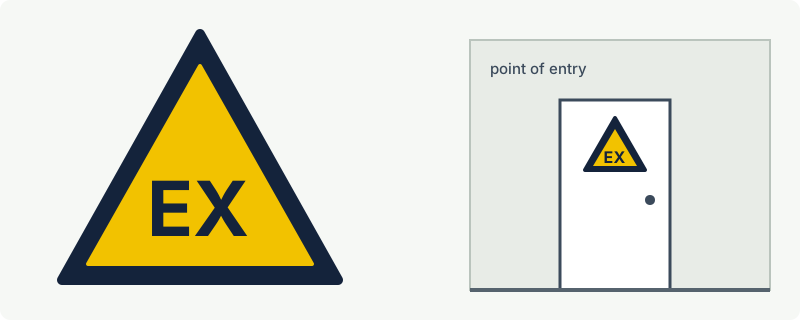
Article 7 requires the employer to mark places where explosive atmospheres may occur in quantities that endanger workers, where necessary, with a sign at their points of entry. Annex III defines the sign: a triangle with black edging and black letters "EX" on a yellow background, with the yellow taking up at least half of the area. Member States may add explanatory text.
Responsibilities
The employer is responsible for the EPD. In practice it is written by a team, and the directive and its guidance spread the tasks:
| Role | Contribution |
|---|---|
| Employer (operator) | owns the EPD, provides resources, approves the measures, keeps it current |
| Process and operations staff | real operating modes, maintenance practices, sampling, cleaning, upsets |
| Explosion protection specialist | area classification, ignition source assessment, equipment requirements |
| Competent person for verification | verifies overall explosion safety before first use (Annex II, point 2.8) |
| Contractors and other employers on site | follow the coordination arrangements; each is responsible for matters under their own control |
| Equipment manufacturers | supply equipment conforming to Directive 2014/34/EU with marking, declarations and instructions |
Three points cause most confusion:
- Verification before first use. Annex II requires that before a workplace containing hazardous places is used for the first time, its overall explosion safety is verified by persons competent in explosion protection through experience or professional training. The result belongs in the EPD.
- Coordination. Article 6 makes each employer responsible for matters under their control, and makes the employer responsible for the workplace coordinate all explosion protection measures and record the aim, measures and procedures of that coordination in the EPD. Shutdowns with many contractors are where this matters most.
- Equipment. Directive 94/9/EC, referred to in the text of 1999/92/EC, was replaced by Directive 2014/34/EU, and references to the old directive are read as references to the new one. By default, Annex II Part B requires category 1 equipment in Zone 0 or 20, category 1 or 2 in Zone 1 or 21, and category 1, 2 or 3 in Zone 2 or 22, suitable for gas or dust as appropriate.
Keeping the EPD up to date
An EPD that describes last year's plant is worse than none, because people trust it. Build these triggers into management of change:
- new or changed substances, including a new solvent supplier with a different flash point;
- new equipment, layout changes, new walls, enclosures or acoustic hoods that change ventilation;
- changes to ventilation, inerting, gas detection or interlocks that the classification relies on;
- changes in the organisation of work, such as a move from day shifts to unmanned night operation, or new contractors;
- incidents and near misses, including leaks larger or more frequent than assumed;
- findings from Ex inspections that show the installation does not match the drawings.
Use document control: a revision table, the date and reason for each change, and the name of the person who approved it. Short-term activities such as maintenance are normally handled through the permit-to-work system and a task risk assessment rather than by redrawing the zones.
The directive also contains transition rules: workplaces used for the first time after 30 June 2003 had to comply with it from the start, existing workplaces within three years of that date, and any later modification, extension or restructuring must comply.
Practical example: EPD outline for a solvent mixing room
A small coatings plant mixes inks in a room of about 8 m × 6 m. Solvents are ethyl acetate (flash point −4 °C, vapour density 3.04, T1, IIA) and n-heptane (flash point −7 °C, autoignition 204 °C, T3, IIA). Drums are decanted into a 1 m³ mixing vessel with a lidded manway and local extraction.
Example: EPD for the mixing room, plant-specific part.
1. Workplace: room layout, two doors, escape route, persons in charge.
2. Process: decanting, mixing, cleaning with solvent, normal working hours only; extraction runs before and during work.
3. Substances: both solvents above their flash points at room temperature; vapours heavier than air; equipment must suit IIA and, because of n-heptane, at least T3.
4. Risk assessment results: vessel interior Zone 0; Zone 1 around the open manway and the decanting point; Zone 2 over the whole floor area up to a stated height and outside the door; ignition sources assessed, including static from pouring and from people.
5. Technical measures: Ex equipment to the zone drawing; earthing and bonding of drums and vessel; extraction flow monitored with an alarm; spill trays and closed solvent containers.
6. Organisational measures: written decanting instruction, antistatic footwear and clothing, permit for hot work and for opening the vessel, training records, cleaning schedule.
7. Responsibilities and checks: production manager owns the EPD; Ex inspections to IEC 60079-17; annual EPD review and review after any change.
8. Coordination: contractor cleaning and maintenance only under permit issued by the plant.
Annex: zone drawing Rev. C, source schedule, equipment register with certificates, safety data sheets.
The value of the exercise is in the links: the T3 requirement on the drawing comes from n-heptane in section 3, the Zone 2 height comes from the extraction design in section 5, and the extraction alarm in section 5 is why the classification stays valid.
Common mistakes
- Treating the EPD as the zone drawing only. Article 8 also asks for measures, equipment, maintenance and the safe use of work equipment. A drawing without the basis and measures does not meet the requirement.
- Writing it once and filing it. The EPD must be revised after significant changes. Link it to management of change and to the findings of Ex inspections.
- Drawings in plan only. Without elevations, nobody can tell whether a luminaire at 4 m is inside the zone.
- No source schedule. Zones without traceable sources, grades and extents cannot be checked or updated, and reviewers have to start again.
- Ignoring contractors. Shutdowns and projects bring other employers onto site. Article 6 coordination must be planned, recorded and enforced through permits.
- Copying a template. The EPD must describe the real plant, its real operating modes and its real organisation. Generic text is quickly spotted by inspectors and is useless to operators.
Frequently asked questions
Is an Explosion Protection Document mandatory?
In the EU, yes, wherever explosive atmospheres may occur at a workplace in quantities that endanger workers: Article 8 of Directive 1999/92/EC requires it, through national law. In Great Britain, DSEAR requires employers with five or more employees to record the significant findings of the risk assessment, including the zoned places, the verification of explosion safety and coordination, which covers the same ground.
Who should prepare the EPD?
The employer is responsible, but the work needs a team: process and operations staff, maintenance, and a person competent in explosion protection for the area classification and ignition source assessment. External specialists can prepare parts of it, but the employer must understand, approve and maintain it.
How often must the EPD be updated?
The directive requires revision when the workplace, work equipment or organisation of work undergoes significant changes, extensions or conversions. It sets no fixed interval, so many companies add a periodic review, often yearly, and a review after incidents or inspection findings.
What should a hazardous area classification drawing include?
Plans and elevations with every zone and its dimensions, references to the sources of release and the source schedule, the gas or dust group and temperature class required, a legend for the zone symbols, the standard or code used, and a revision block. Zones inside equipment and zones passing through openings should also be shown.
Can the EPD be combined with other safety documents?
Yes. Article 8 allows the employer to combine existing explosion risk assessments, documents or equivalent reports produced under other EU acts. The EPD can refer to a major-accident safety report or a general risk assessment instead of repeating them, as long as the references are specific and kept up to date.
Related on excodex
- ATEX explained: the two EU directives 2014/34/EU and 1999/92/EC in plain language
- Explosion protection strategy: avoid the atmosphere, avoid ignition, limit the effects
- How to carry out a gas hazardous area classification step by step
- Hazardous area zones explained: Zone 0, Zone 1 and Zone 2
- Inspection of Ex installations under IEC 60079-17
- Hot work permits in hazardous areas
- Tools: Ex marking check, gas and solvent library, standards spaces ATEX 1999/92/EC, IEC 60079-10-1, IEC 60079-10-2, forum
Standards and further reading
- Directive 1999/92/EC on minimum requirements for improving the safety and health protection of workers potentially at risk from explosive atmospheres, Articles 3 to 9 and Annexes I to III: legislation.gov.uk copy
- European Commission, Non-binding guide to good practice for implementing Directive 1999/92/EC, with a specimen EPD layout and checklists: EU-OSHA page and EU Publications Office
- Directive 2014/34/EU on equipment and protective systems for potentially explosive atmospheres, which replaced Directive 94/9/EC: Article 43 on the repeal
- Dangerous Substances and Explosive Atmospheres Regulations 2002 (DSEAR), regulation 5 on risk assessment and recording: legislation.gov.uk; HSE overview: hse.gov.uk
- IEC 60079-10-1, classification of areas for explosive gas atmospheres, including documentation and suggested zone symbols; IEC 60079-10-2 for combustible dust atmospheres.
- IEC 60079-14 (design, selection and erection of electrical installations) and IEC 60079-17 (inspection and maintenance), which use the area classification as their starting point.
- Turkish Ministry of Labour and Social Security, implementation guide to the 2013 regulation on protecting workers from explosive atmospheres (in Turkish): csgb.gov.tr
This article is general technical information prepared by the excodex editorial team. It does not replace the applicable standards, the equipment certificates and instructions, national regulations or the assessment of a competent person.