Explosion protection strategy: avoid the atmosphere, avoid ignition, limit the effects
Abstract
Explosion protection follows a fixed order: prevent the explosive atmosphere, avoid effective ignition sources, then limit the effects of an explosion. Primary, secondary and constructive measures, examples for each and how the risk assessment chooses them.
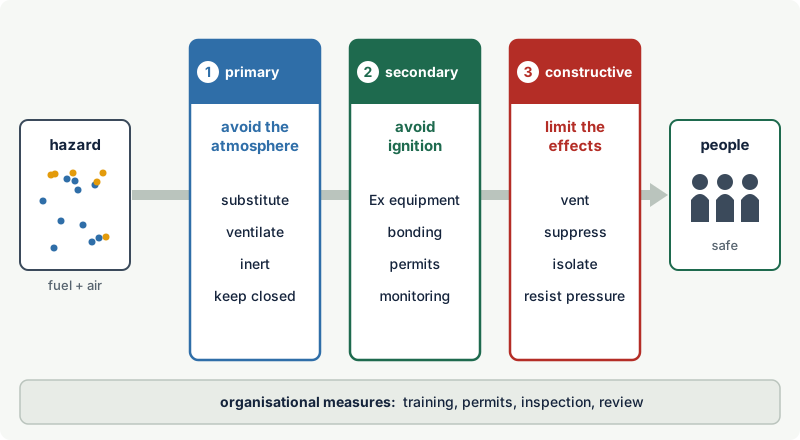
Explosion protection follows a fixed order of priority. First, prevent the formation of an explosive atmosphere (primary protection). Where that is not possible, prevent its ignition by excluding effective ignition sources (secondary protection). Where ignition still cannot be ruled out with enough confidence, limit the effects of an explosion so that people are not harmed (constructive or mitigating protection). This order is written into the EU workplace directive 1999/92/EC, the equipment directive 2014/34/EU and the basic standard EN 1127-1.
This article explains each level with practical examples, shows how the levels are combined on real equipment, and describes how the risk assessment decides which measures are needed.
Key points
- Directive 1999/92/EC requires employers to apply explosion protection in this order: prevent the formation of explosive atmospheres, avoid their ignition, and mitigate the detrimental effects of an explosion.
- Primary measures remove or reduce the fuel or the oxygen: substitution, keeping concentrations outside the explosive range, inerting, tight closed systems, ventilation and dust housekeeping.
- Secondary measures control the 13 ignition sources of EN 1127-1 to a depth set by the zone: normal operation in Zone 2 or 22, plus expected malfunctions in Zone 1 or 21, plus rare malfunctions in Zone 0 or 20.
- Constructive measures accept that an explosion can happen and make it harmless: explosion-resistant design, venting, suppression and isolation.
- Most real plants combine all three levels. Inside a dust filter the dust cloud cannot be avoided, so ignition control is combined with venting and isolation.
- The choice of measures comes from the explosion risk assessment, which must consider how likely and how persistent the atmosphere is, which ignition sources can become effective, and how severe the effects would be.
The three levels at a glance
German practice gave the three levels their common names: primary, secondary and constructive (sometimes called tertiary) explosion protection. The terms are not used in the directives, but they map directly onto them.
| Level | Aim | Typical measures | Typical standards and guidance |
|---|---|---|---|
| Primary | No explosive atmosphere, or less of it | Substitution, concentration limits, inerting, closed and tight systems, ventilation, gas detection with automatic action, dust housekeeping | EN 1127-1, IEC 60079-10-1 and -10-2 (classification), CEN/TR 15281 (inerting) |
| Secondary | No effective ignition source | Zoning and equipment categories, Ex equipment, earthing and bonding, hot work permits, tool rules, temperature monitoring | IEC 60079 series, ISO 80079-36 and -37, IEC TS 60079-32-1 |
| Constructive | Explosion without harm to people | Explosion-resistant design, venting, flameless venting, suppression, isolation, flame arresters, safe distances | EN 14460, EN 14491, EN 14994, EN 14373, EN 15089, ISO 16852 |
Where the order comes from
The workplace directive 1999/92/EC, Article 3, obliges the employer to take technical and organisational measures in a stated order of priority: preventing explosive atmospheres, avoiding their ignition, and mitigating the detrimental effects of an explosion. Where necessary these must be combined with measures against the propagation of explosions, and they must be reviewed regularly and whenever significant changes occur.
For manufacturers, Annex II of the equipment directive 2014/34/EU sets out the principle of "integrated explosion safety": equipment and protective systems must above all, where possible, prevent the formation of explosive atmospheres, then prevent their ignition, and, should an explosion nevertheless occur, halt it immediately or limit the range of flames and pressure. Venting devices, suppression systems and isolation devices are "protective systems" in the sense of this directive and carry their own conformity assessment.
EN 1127-1:2019 turns this into a method: risk assessment first, then risk reduction by avoiding or reducing the explosive atmosphere, avoiding effective ignition sources, and reducing the explosion effects, supported by measuring and control systems, emergency measures and information for use. National rules follow the same logic. The UK regulations on dangerous substances and explosive atmospheres (DSEAR), for example, put elimination and substitution first, then control measures, then mitigation.
Primary protection: avoid the explosive atmosphere
Primary measures act on two sides of the fire triangle, fuel and oxygen. They are the most effective because a place with no explosive atmosphere needs no Ex equipment, no zone and no explosion relief.
Substitution
The first question is whether the flammable substance is needed at all. Water-based coatings and cleaners, solvents with a flash point well above the working temperature, and powders supplied as granules or pastes instead of fine dust all reduce the hazard at source.
German guidance (TRGS 721) estimates the lower explosion point of a liquid, the temperature above which its vapour can reach the LEL, at about 5 K below the flash point for pure non-halogenated liquids and 15 K below for solvent mixtures without halogenated components; it is an estimate for air at atmospheric pressure only. If the highest process temperature stays below that, no explosive vapour atmosphere is expected. This only applies to vapour: a liquid that is sprayed or atomised can form an explosive mist far below its flash point.
Keeping the concentration outside the explosive range
Ventilation and extraction can keep the concentration well below the lower explosive limit (LEL). Dryers, ovens and fume extraction systems are designed so that the solvent concentration stays at a fraction of the LEL, often with gas detection that raises ventilation or shuts down the solvent supply. Operating above the upper explosive limit (UEL) is sometimes used inside closed tanks, but it is fragile: every filling, emptying, leak or start-up passes through the explosive range.
Inerting
Replacing part of the oxygen with nitrogen, carbon dioxide, steam or another inert gas keeps the oxygen concentration below the limiting oxygen concentration (LOC) at which combustion can no longer propagate. Inerting is common in centrifuges, mills, dryers, reactors and silos. It needs a safety margin below the LOC, continuous or reliable oxygen monitoring, and a plan for maintenance entry, because an inerted vessel is an asphyxiation hazard. CEN/TR 15281 gives guidance; see oxygen concentration, enrichment and inerting.
Closed and tight systems
Welded pipework, fewer flanges, sealless pumps, closed sampling and vapour return lines reduce how often and how much flammable material escapes. EN 1127-1:2019 distinguishes "normal tightness" from "enhanced tightness" of equipment. In area classification, fewer and smaller sources of release mean smaller zones, or a non-hazardous area.
Dust: keep it inside
For dust the main primary measures are keeping the product in closed equipment, local extraction at transfer points, and housekeeping. Settled dust is a hidden explosive atmosphere: a primary explosion can raise it and feed far larger secondary explosions. At the 2008 sugar refinery explosion in Port Wentworth, Georgia, the US Chemical Safety Board found that the first explosion started in an enclosed steel belt conveyor, then lofted accumulated sugar dust that propagated explosions through the buildings, killing 14 workers.
Note: Primary measures change the zone. Good ventilation can make a Zone 1 into a Zone 2 or a non-hazardous area; inerting can remove the zone inside a vessel. That is why area classification is part of the strategy, not a separate exercise. See ventilation in area classification.
Secondary protection: avoid effective ignition sources
Where an explosive atmosphere remains, the next step is to make sure nothing ignites it. The area is classified into zones according to how often and how long the atmosphere is present, and every one of the 13 ignition sources is assessed to the depth the zone requires:
| Zone | Ignition sources excluded in | Equipment category / EPL |
|---|---|---|
| 0 / 20 | Normal operation, expected and rare malfunctions | 1 / Ga, Da |
| 1 / 21 | Normal operation and expected malfunctions | 2 / Gb, Db |
| 2 / 22 | Normal operation | 3 / Gc, Dc |
Typical secondary measures are:
- Equipment: electrical and non-electrical equipment of the right category or EPL, gas group or dust group, and temperature class. See Ex protection concepts at a glance.
- Static electricity: earthing and bonding, dissipative materials, flow velocity limits, antistatic footwear; see static electricity as an ignition source.
- Hot surfaces and mechanical sources: temperature and vibration monitoring on pumps, fans and conveyors, belt slip and misalignment detection on bucket elevators, magnets and stone traps before mills.
- Organisational controls: hot work permits with gas testing, rules for tools and portable electronics, maintenance and inspection of Ex installations.
Secondary protection always carries a residual probability of failure. Equipment can be damaged or wrongly installed, permits can be ignored, and some sources cannot be excluded at all in certain processes: a mill grinds, a filter charges dust, a dryer is hot. This is why constructive protection exists.
Constructive protection: limit the effects
Constructive measures accept that an explosion may occur and design the equipment and plant so that people are not harmed and the explosion does not spread.
| Measure | How it works | Typical use |
|---|---|---|
| Explosion-pressure-resistant design | Vessel withstands the expected explosion pressure without permanent deformation | Small vessels, mills, pressure-rated equipment |
| Explosion-pressure-shock-resistant design | Vessel withstands the explosion without rupturing but may deform | Filters, cyclones, mills; often combined with venting or suppression |
| Explosion venting | A panel or membrane opens at low pressure and releases flame and pressure to a safe place | Dust collectors, silos, bucket elevators, buildings |
| Flameless venting | Venting through a device that cools and retains the flame and burning dust | Vented equipment indoors where a vent duct is impractical |
| Explosion suppression | Pressure or optical sensors trigger fast injection of extinguishing agent within milliseconds | Mills, dryers, enclosed equipment that cannot be vented |
| Explosion isolation | Valves, chemical barriers, rotary valves or flame arresters stop flame passing through connecting ducts | Inlet and outlet ducts of protected equipment, vent lines of tanks |
With venting and suppression, the vessel only has to withstand the much lower reduced explosion pressure, not the full closed-vessel pressure. Isolation is essential because an explosion that travels down a duct into the next vessel arrives with turbulence and pressure piling, which makes the second explosion more violent than the first. Constructive design also includes plant layout: venting away from walkways and buildings, keeping people out of the danger area during operation, and building design that limits damage. The physics behind these pressures is explained in deflagration, detonation and overpressure; dust-specific methods are covered in dust explosion protection.
How the risk assessment chooses the measures
Directive 1999/92/EC, Article 4, requires the employer to assess explosion risks overall, taking account of at least:
- the likelihood that explosive atmospheres will occur and their persistence;
- the likelihood that ignition sources, including electrostatic discharges, will be present and become active and effective;
- the installations, substances used, processes and their possible interactions;
- the scale of the anticipated effects.
The result is recorded in the explosion protection document (EPD). In practice the assessment is worked through in a loop:
- Characterise the substances: flash point, LEL, AIT, MIE, gas group, and for dusts the explosion characteristics such as maximum pressure, rate of pressure rise, minimum ignition energy and ignition temperatures.
- Try primary measures first: can the substance, concentration, oxygen or release be changed so that no explosive atmosphere forms? Record why not, where it cannot.
- Classify the remaining areas into zones and identify every ignition source that could become effective in normal operation and in malfunctions.
- Apply secondary measures to the depth required by the zone.
- Judge the residual risk: if ignition still cannot be excluded with enough confidence (for example inside a mill or filter), or if the consequences would be severe (people nearby, large volumes, connected equipment), add constructive measures.
- Add organisational measures: training, permits, marking of hazardous areas, inspection and maintenance.
- Review after changes, incidents and at regular intervals.
Severity matters as much as likelihood. A small, well-ventilated laboratory fume cupboard and a 500 m³ flour silo may both have a dust or vapour atmosphere inside, but the consequences of ignition differ by orders of magnitude, and so does the protection needed. See the explosion protection document.
Practical case: a dust collector on a sugar grinding line
A bag filter collects fine sugar dust from a grinding mill and a packing line. The assessment works through the three levels.
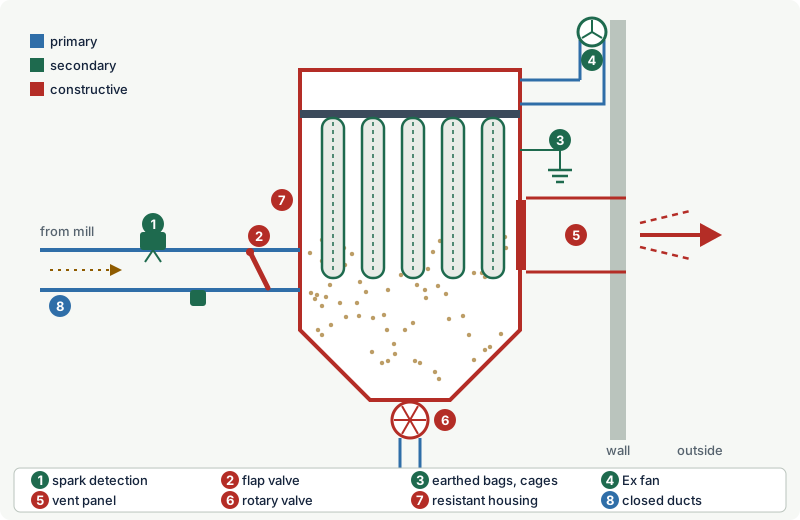
Primary. Inside the filter a dust cloud is present during normal operation whenever the bags are pulsed, so the interior is often classified as Zone 20 and the atmosphere cannot be avoided. Primary measures act outside it: closed ducts, extraction at transfer points and housekeeping keep the surrounding room free of dust clouds and layers.
Secondary. Ignition sources inside are controlled: conductive or dissipative filter bags with earthed cages, earthed metal parts, a fan of the right category outside or downstream of the filter, and spark detection and extinguishing in the duct from the mill, because a mill can produce glowing particles. These reduce the likelihood of ignition but cannot exclude it to the level required for a permanent dust cloud.
Constructive. An explosion vent panel on the housing discharges to a safe area outside the building, where nobody stands; if the filter were inside, flameless venting would be an option. A non-return flap valve in the inlet duct stops the explosion running back to the mill and packing room, and a rotary valve tested as a flame barrier isolates the hopper outlet. The housing is built to withstand the reduced explosion pressure.
Organisational. Inspection of vent panels and isolation devices, cleaning schedules, and hot work permits complete the package.
The same reasoning applied to a solvent mixing vessel often ends differently: closed charging, nitrogen inerting of the vessel headspace and oxygen monitoring (primary) may remove the explosive atmosphere inside the vessel altogether, leaving only small zones around openings and secondary measures for the room.
Common mistakes
- Starting with Ex equipment. Buying certified equipment before asking whether the explosive atmosphere could be avoided often leads to larger zones and more cost than needed.
- Relying on secondary measures where ignition cannot be excluded. Mills, filters and dryers can generate ignition sources from the process itself; they normally need constructive protection as well.
- Venting without isolation. A vented filter can still send the explosion through its inlet duct into the building.
- Venting into a work area. Flame and burning dust from a vent can reach far beyond the panel; vent discharge areas must be kept clear or flameless devices used.
- Treating inerting as permanent. Inerting fails during maintenance, gas supply loss or air ingress; it needs monitoring, alarms and procedures.
- Forgetting the review. New products, higher throughput or a changed layout can invalidate the original assessment.
Frequently asked questions
What is primary, secondary and constructive explosion protection?
Primary protection prevents or reduces explosive atmospheres. Secondary protection prevents their ignition by controlling ignition sources. Constructive protection limits the effects of an explosion by resistant design, venting, suppression and isolation so that people are not harmed.
Is explosion venting a primary or secondary measure?
Neither. Venting is a constructive (mitigating) measure: it does not stop the explosion from happening but limits the pressure in the vessel and directs flame and pressure to a safe place.
Can I skip secondary measures if I install explosion venting?
No. The directive requires the order of priority to be followed: ignition sources must still be controlled as far as possible. Constructive measures handle the residual risk; they do not replace ignition control.
When are constructive measures required?
When the risk assessment shows that an explosive atmosphere and an effective ignition source cannot both be excluded with enough confidence, and the consequences would harm people. Typical examples are mills, dust collectors, dryers, silos and bucket elevators handling combustible dust.
Does gas detection count as explosion protection?
Gas detection that automatically starts ventilation, shuts off a release or isolates power can be part of primary or secondary protection, if it is reliable enough for the purpose. Detection that only raises an alarm supports organisational measures. See fixed gas detection systems.
Related on excodex
- Ignition sources in hazardous areas: the 13 ignition sources and how to control them
- Dust explosion protection: venting, suppression, isolation and containment
- Oxygen concentration, enrichment and inerting
- The Explosion Protection Document (EPD) and area classification drawings
- What is an explosive atmosphere? Fire triangle and explosion pentagon
- Standards spaces: EN 1127-1, ATEX 1999/92/EC, ATEX 2014/34/EU; forum
Standards and further reading
- EN 1127-1:2019, explosion prevention and protection: basic concepts and methodology
- EN 14460, explosion-resistant equipment; EN 14491, dust explosion venting protective systems; EN 14994, gas explosion venting protective systems
- EN 14373, explosion suppression systems; EN 15089, explosion isolation systems; ISO 16852, flame arresters
- CEN/TR 15281, guidance on inerting for the prevention of explosions
- IEC 60079-10-1 and IEC 60079-10-2, classification of areas for gas and dust atmospheres
- Directive 1999/92/EC, Articles 3, 4 and 8: legislation.gov.uk
- Directive 2014/34/EU, Annex II, integrated explosion safety: legislation.gov.uk
- UK DSEAR 2002, regulation 6, elimination and reduction of risks: legislation.gov.uk
- German technical rule TRGS 721, assessment of explosion hazards (flash point margins): bgn-branchenwissen.de
- US Chemical Safety Board, 2008 sugar dust explosion, Port Wentworth: csb.gov
This article is general technical information prepared by the excodex editorial team. It does not replace the applicable standards, the equipment certificates and instructions, national regulations or the assessment of a competent person.