Ex protection concepts at a glance: d, e, i, p, m, o, q, n and t
Abstract
The Ex types of protection d, e, i, p, m, o, q, n and t stop equipment igniting gas or dust by containing an explosion, keeping the atmosphere out, avoiding sparks and hot spots, or limiting energy. Overview table with EPLs, typical equipment, standards and how to choose.
Ex protection concepts (formally "types of protection") are the design methods that stop equipment from igniting an explosive gas or dust atmosphere. They work in one of four ways: contain an internal explosion (flameproof d), keep the atmosphere away from ignition sources (pressurisation p, encapsulation m, liquid immersion o, powder filling q, dust protection by enclosure t), avoid sparks and hot spots in the first place (increased safety e, type n), or limit the energy in a circuit so that it cannot ignite anything (intrinsic safety i). Each concept is built to a level of protection (a, b or c) that gives an equipment protection level (EPL) matched to the zone.
This page summarises all nine concepts in one table, explains the levels and how they map to zones, and gives a practical method for choosing between them. Each concept has its own detailed article in this chapter.
Key points
- There are four protection principles: containment (d), segregation (p, m, o, q, t), prevention (e, n) and energy limitation (i).
- The letter after the concept symbol is the level of protection: for example
dbgives EPL Gb (Zone 1),ecgives EPL Gc (Zone 2) andiagives EPL Ga (Zone 0). - Only a few concepts reach EPL Ga for Zone 0: intrinsic safety ia, encapsulation ma, and combinations of two independent concepts; flameproof "da" (EPL Ga) is limited by IEC 60079-1:2014 to catalytic sensors of portable gas detectors.
- Intrinsic safety, encapsulation and pressurisation are used for both gas and dust; Ex t is for dust only; d, e, o, q and n are for gas only.
- The former type nA (non-sparking) is now increased safety level ec; type n today covers only nC and nR.
- Flameproof d and intrinsic safety i depend on the gas group (IIA, IIB, IIC); the others mainly do not.
The four principles
Every explosion needs a flammable atmosphere and an ignition source at the same time and place. Ex equipment breaks that link in one of four ways.
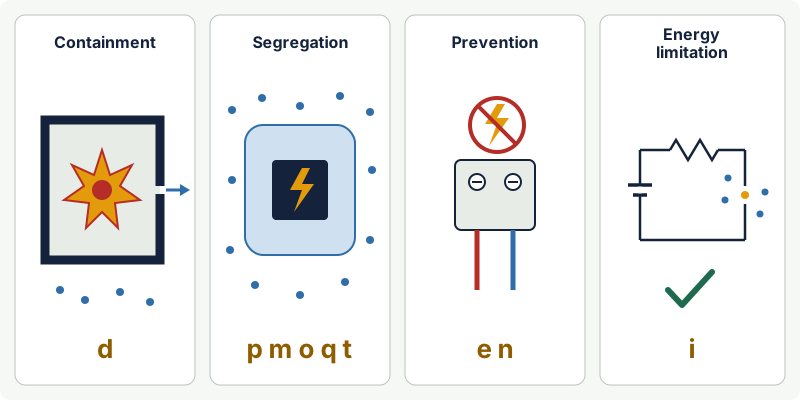
- Containment. Ignition is allowed to happen inside the equipment, but the enclosure withstands the explosion and cools the escaping gases so the flame cannot reach the outside. This is the flameproof enclosure, Ex d.
- Segregation. The explosive atmosphere is kept away from the ignition source by a barrier: protective gas under overpressure (p), a solid compound (m), a liquid (o), a powder filling (q) or a dust-tight enclosure with surface temperature limitation (t).
- Prevention. The equipment is built so that sparks, arcs and excessive temperatures do not occur in normal operation (n) or in normal operation and expected malfunctions (e). There is nothing to contain because no ignition source should exist.
- Energy limitation. Voltage, current and stored energy in the circuit are kept so low that no spark or hot surface can ignite the atmosphere, even with faults. This is intrinsic safety, Ex i.
Overview table
| Concept | Principle | Levels and EPL | Typical equipment | Standard |
|---|---|---|---|---|
Flameproof enclosure d | Contains an internal explosion; flamepaths cool escaping gas | db: Gb; dc: Gc; da: Ga, only for catalytic sensors of portable gas detectors | Motors, switchgear, control stations, luminaires, junction boxes, detector housings | IEC 60079-1 |
Increased safety e | Extra measures against arcs, sparks and excessive temperature | eb: Gb (and Mb); ec: Gc | Terminal and junction boxes, cage induction motors, luminaires | IEC 60079-7 |
Intrinsic safety i | Limits energy so sparks and hot surfaces cannot ignite | ia: Ga, Da; ib: Gb, Db; ic: Gc, Dc | Transmitters, sensors, analysers' signal circuits, portable devices | IEC 60079-11 (systems: IEC 60079-25) |
Pressurisation p | Protective gas at overpressure keeps the atmosphere out | pxb, pyb: Gb, Db; pzc: Gc, Dc | Analyser cabinets, large motors, control panels, operator stations | IEC 60079-2 (rooms: IEC 60079-13) |
Encapsulation m | Ignition source sealed in compound | ma: Ga, Da; mb: Gb, Db; mc: Gc, Dc | Solenoid coils, sensors, small electronic modules, drivers | IEC 60079-18 |
Liquid immersion o | Ignition source submerged in protective liquid | ob: Gb (and Mb); oc: Gc | Transformers, switching devices | IEC 60079-6 |
Powder filling q | Ignition source embedded in fine solid filling | q: Gb (and Mb) | Capacitors, small transformers, electronic components in luminaires | IEC 60079-5 |
Type of protection n | Sealed or restricted breathing construction for normal operation | nC, nR: Gc | Relays and sealed contacts, restricted breathing enclosures, luminaires | IEC 60079-15 |
Dust protection by enclosure t | Dust-tight enclosure plus surface temperature limit | ta: Da; tb: Db; tc: Dc | Motors, luminaires, junction boxes in dust areas | IEC 60079-31 |
All of these standards supplement IEC 60079-0, which sets the general requirements (materials, temperature classes, marking, impact and other tests) for every concept. Two further electrical concepts complete the family: optical radiation protection op is, op pr and op sh (IEC 60079-28) for lasers and optical fibres, and special protection s (IEC 60079-33) for designs that do not fit any other standard. Non-electrical equipment such as pumps, gearboxes and fans is covered by ISO 80079-36 and ISO 80079-37 and marked Ex h (see non-electrical equipment).
Levels of protection and the link to zones
Most concepts come in up to three levels. Level "a" must not become an ignition source in normal operation, in expected malfunctions or in rare malfunctions; level "b" in normal operation and expected malfunctions; level "c" in normal operation (for intrinsic safety this is expressed as two faults, one fault and no fault). The level gives the equipment protection level (EPL), and the EPL is what the zone asks for.
| Zone | Required EPL | Examples of acceptable levels |
|---|---|---|
| Zone 0 | Ga | ia, ma, two independent Gb concepts (IEC 60079-26) |
| Zone 1 | Ga or Gb | db, eb, ib, pxb, pyb, mb, ob, q, and all Ga levels |
| Zone 2 | Ga, Gb or Gc | dc, ec, ic, pzc, mc, oc, nC, nR, and all Ga and Gb levels |
| Zone 20 | Da | ia, ma, ta |
| Zone 21 | Da or Db | ib, mb, tb, pxb, pyb, and all Da levels |
| Zone 22 | Da, Db or Dc | ic, mc, tc, pzc, and all Da and Db levels |
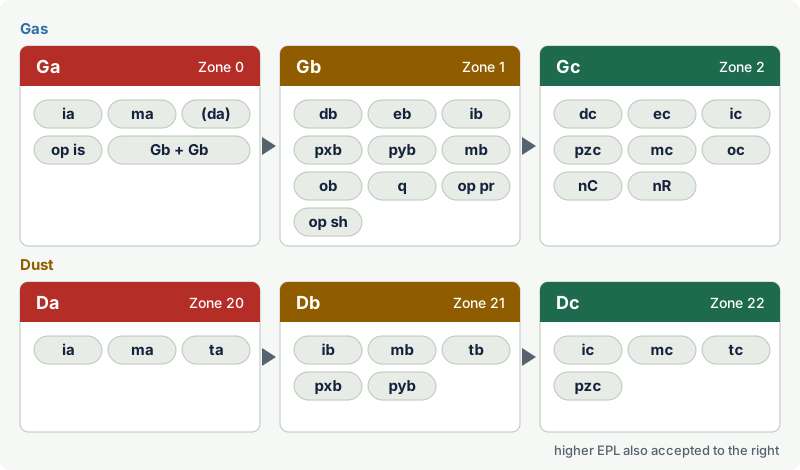
The mapping between zones and EPLs is the default in IEC 60079-14. Under the ATEX directive, equipment categories 1, 2 and 3 correspond to EPLs Ga/Da, Gb/Db and Gc/Dc. These relationships are explained in EPLs and how they match zones and ATEX categories.
Each concept in a few sentences
Flameproof "d"
The enclosure is strong enough to withstand an explosion of the gas inside it, and every joint is a flamepath: a narrow, long gap that cools the escaping hot gases so they cannot ignite the outside atmosphere. Anything can be placed inside, including sparking switchgear and high power circuits. The price is weight, careful flamepath maintenance and dependence on the gas group. See flameproof enclosures.
Increased safety "e"
The equipment must not produce arcs or sparks in normal service, and extra measures (generous creepage and clearance distances, secure terminals, limits on temperature rise, tested insulation) keep it that way. In the 2015 edition of IEC 60079-7, level eb excludes semiconductors and electrolytic capacitors, while ec allows them. Ex e is the most common concept for terminal boxes and is widely used for cage induction motors. Its scope runs up to 11 kV for eb and 15 kV for ec. See increased safety.
Intrinsic safety "i"
The energy in the circuit is limited by design and by an interface (a barrier or isolator) in the safe area, so that even sparks from a short circuit or broken wire cannot ignite the gas. It is the only concept for which live working in the hazardous area is normally permitted, under the conditions of IEC 60079-17 and site rules. It suits low-power instrumentation, not motors or heaters. See intrinsic safety.
Pressurisation "p"
Clean air or inert gas keeps the inside of the enclosure at a small overpressure. Before power is applied, the enclosure is purged to remove any gas that entered while it was off. Level pxb allows ordinary equipment inside a Zone 1 enclosure and disconnects power if pressure is lost; pyb is for contents that are themselves suitable for Zone 2 (EPL Gc); pzc (Zone 2) may rely on an alarm. See pressurisation.
Encapsulation "m", liquid immersion "o" and powder filling "q"
These three surround the ignition source with a material so the atmosphere cannot reach it: a casting compound for m, a protective liquid for o, and a fine solid such as quartz sand for q. Encapsulation reaches Ga and is common for small coils and electronics. Liquid immersion suits transformers and, since the 2015 edition, sparking contacts at levels ob and oc. Powder filling is limited to Gb and to supplies up to 1000 V, 16 A and 1000 W under its current standard. See encapsulation, oil immersion and powder filling.
Type "n"
Type n is a family of simplified Zone 2 techniques. It now consists of nC (sealed devices, hermetically sealed devices and non-incendive components) and nR (restricted breathing enclosures, which slow gas ingress so that a short release does not reach the inside). The former non-sparking nA was transferred into increased safety as level ec, and energy-limited nL was replaced by intrinsic safety ic. Older certificates and nameplates still show nA and nL. See Ex ec, Ex nA and Ex nR.
Dust protection by enclosure "t"
Dust is kept out by a dust-tight or dust-protected enclosure, and the outer surface temperature is limited and marked in °C so that dust clouds and layers do not ignite. Levels ta, tb and tc give EPL Da, Db and Dc. See Ex t.
How to choose a protection concept
Choosing is mostly a process of elimination. Work through these questions in order.
- What EPL does the zone need? Zone 0 rules out everything except ia, ma and specially designed Ga equipment. Zone 2 opens up the c levels and type n, which are often lighter and cheaper.
- What does the equipment do? Low-power signals point to intrinsic safety. Sparking contacts and high power in normal operation (switchgear, contactors, slip-ring machines) point to flameproof or pressurisation. Non-sparking power equipment (cage motors, terminals, luminaires) can use increased safety.
- Gas group and temperature class. IIC atmospheres make flameproof equipment heavier and restrict intrinsically safe cable lengths. A low autoignition temperature may exclude equipment that runs hot, whatever its concept. See gas groups and temperature classes.
- Installation consequences. Flameproof equipment needs certified flameproof glands or sealed conduit and attention to obstruction of flamepaths. Intrinsic safety needs a documented loop check and separation from other circuits. Pressurisation needs a reliable protective gas supply, purge control and interlocks.
- Maintenance and inspection. Flamepaths corrode and are easily damaged; increased safety terminals need correct torque and must not be overfilled; pressurisation systems need functional testing; intrinsically safe loops need their documentation kept current. Choose what the site can actually maintain.
- Environment. Corrosive, wet, dusty or vibrating locations favour some designs over others (for example Ex e enclosures with good ingress protection, or encapsulated electronics).
| Typical item | Zone 1 common choices | Zone 2 additional options |
|---|---|---|
| Pressure transmitter | ia or ib loop; db housing | ic |
| Junction box | eb | ec, nR |
| Cage induction motor | eb, db, db eb (flameproof motor with increased safety terminal box) | ec |
| Luminaire | db, eb with mb or q components | ec, nR |
| Process analyser | pxb cabinet or analyser house | pzc |
| Control station with switches | db (or db eb with flameproof switch elements) | ec with nC contacts |
Practical case: a pump skid in Zone 1, IIA T3
A skid pumps hexane (IIA, AIT 225 °C, T3) in a Zone 1 area.
- Motor: an
Ex eb IIC T3 GborEx db eb IIB T4 Gbmotor is acceptable; if it is fed by a variable speed drive, the certificate must cover converter supply, because the temperature class of a converter-fed machine is assessed with the drive. - Pressure and temperature transmitters:
Ex ia IIC T4 Gainstruments with isolators in the control room give the most freedom (they can even be used if the zone around the tank nozzle is Zone 0), and they allow live work on the loop under the conditions of IEC 60079-17 and site rules. - Junction box for the motor and lighting circuits:
Ex eb IIC T6 Gb. - Local control station with start and stop buttons: an increased safety enclosure with flameproof (
db) switch elements, markedEx db eb.
Every item is at least Gb, IIA or higher, and T3 or cooler, so the selection is complete. Where items are marked with combined concepts, see combined protection concepts.
Common mistakes and misconceptions
- "Ex d is the safest, so use it everywhere." Flameproof equipment is EPL Gb, the same as Ex e or ib. It is not acceptable in Zone 0 (apart from the very limited "da"), and badly maintained flamepaths make it less safe, not more.
- Treating the concept letter as the whole story.
Ex dalone says nothing about Zone 0, 1 or 2: the level (db, dc) and the EPL decide. - Assuming intrinsically safe instruments are safe on their own. An Ex i instrument is only part of a system; without the right associated apparatus and a verified loop, it is not intrinsically safe.
- Opening Ex d or Ex e enclosures live. Both rely on the enclosure being closed and the equipment de-energised (or gas-free conditions) for work; only intrinsic safety tolerates live work under site rules.
- Reading old nA or nL markings as invalid. Installed equipment certified to earlier editions does not become unsafe because the standard changed; new equipment is simply certified as ec or ic instead.
- Forgetting dust. Gas concepts d, e, o, q and n do not give a dust EPL; dust areas need Ex t, Ex i, Ex m or Ex p equipment marked for Group III.
Frequently asked questions
What is the difference between Ex d and Ex e?
Ex d (flameproof) lets an explosion happen inside a strong enclosure and stops the flame from escaping. Ex e (increased safety) prevents the arcs, sparks and hot spots that could cause ignition in the first place. Both give EPL Gb at levels db and eb, but they differ in weight, cable entry methods, maintenance and suitability for sparking equipment. See Ex d or Ex e.
Which protection concepts can be used in Zone 0?
Zone 0 needs EPL Ga. The usual choices are intrinsic safety ia and encapsulation ma; equipment can also reach Ga by combining two independent Gb concepts under IEC 60079-26. Flameproof "da" exists but is limited to catalytic sensors of portable gas detectors.
What does "Ex db eb" mean?
It is a combined marking: part of the equipment is protected by a flameproof enclosure (db) and another part by increased safety (eb), for example a flameproof motor with an increased safety terminal box. Both parts give EPL Gb, so the product is suitable for Zone 1.
Is Ex nA still valid?
Equipment certified as Ex nA remains valid for Zone 2 under its certificate. For new designs, the nA requirements were transferred into IEC 60079-7 as level ec, and IEC 60079-15 now covers only nC and nR. New products are therefore marked Ex ec rather than Ex nA.
Which protection concepts are used for dust?
Dust atmospheres use Ex t (ta, tb, tc), intrinsic safety (ia, ib, ic), encapsulation (ma, mb, mc) and pressurisation (pxb, pyb, pzc), with Group III marking and a maximum surface temperature in °C. The gas-only concepts d, e, o, q and n do not give a dust EPL.
Can one product use several protection concepts?
Yes, and many do. A luminaire may combine an increased safety housing with an encapsulated driver and powder-filled components, or a gas detector may combine a flameproof housing with intrinsically safe outputs. The marking lists each concept used, and the lowest EPL among them sets where the whole product can be installed.
Related on excodex
- Flameproof enclosures (Ex d)
- Intrinsic safety (Ex i)
- Ex d or Ex e? Choosing between flameproof and increased safety
- Equipment Protection Levels (EPL)
- How to read an Ex marking
- Tools: Ex marking check, forum, standards spaces IEC 60079-0 and IEC 60079-14
Standards and further reading
- IEC 60079-0, general requirements for Ex equipment (edition 8 published in 2026).
- IEC 60079-1 (d), IEC 60079-2 (p), IEC 60079-5 (q), IEC 60079-6 (o), IEC 60079-7 (e), IEC 60079-11 (i), IEC 60079-15 (n), IEC 60079-18 (m), IEC 60079-31 (t), IEC 60079-28 (op), IEC 60079-33 (s).
- IEC 60079-26, equipment with EPL Ga; IEC 60079-25, intrinsically safe systems; IEC 60079-13, pressurised rooms.
- IEC 60079-14, design, selection and installation; IEC 60079-17, inspection and maintenance.
- ISO 80079-36 and ISO 80079-37, non-electrical equipment.
- IEC 60079-7 (2015) text with scope and levels eb and ec, incorporated by reference in US federal regulations: law.resource.org; IEC webstore (current edition, IEC 60079-7:2015+AMD1:2017): webstore.iec.ch
- IEC 60079-6 abstract (levels ob and oc): webstore.iec.ch
- IEC 60079-31 abstract: webstore.iec.ch
- IEC 60079-15 abstract (nC and nR): scc-ccn.ca
- HSE (UK), Hazardous area classification and control of ignition sources: hse.gov.uk
This article is general technical information prepared by the excodex editorial team. It does not replace the applicable standards, the equipment certificates and instructions, national regulations or the assessment of a competent person.