Ex ec, Ex nA and Ex nR: protection for Zone 2
Abstract
Ex ec, Ex nA and Ex nR are Zone 2 (EPL Gc) protection types. How type n was split, why nA became increased safety ec, how restricted breathing nR works, sealed and non-incendive nC, typical uses and how to read old and new markings.
Ex ec, Ex nA and Ex nR are types of protection for Zone 2, where an explosive gas atmosphere is not expected in normal operation and, if it occurs, lasts only a short time. All give EPL Gc. Ex nA ("non-sparking") was part of type of protection n until IEC 60079-7:2015 took it over as increased safety level ec (IEC 60079-15 dropped it in 2017); Ex nR ("restricted breathing") is still type n and works by sealing an enclosure so tightly that a short gas release outside cannot build up an ignitable mixture inside.
This article explains how type n grew and was split up, what Ex ec, nC and nR each require, where they are used, and how to read old and new nameplates.
Key points
- Zone 2 equipment must have EPL Gc: it must not ignite gas in normal operation, and some regular expected occurrences such as a lamp failure are also considered.
- Since IEC 60079-7:2015, the former non-sparking type
nAis increased safety levelec; new products are markedEx ec, while existingEx nAequipment remains valid under its certificate. - IEC 60079-15 (edition 5, 2017) now contains only two sub-types:
nC(sealed devices, hermetically sealed devices and non-incendive components) andnR(restricted breathing enclosures). - Energy-limited
nLwas removed from IEC 60079-15 in 2010 and is covered today by intrinsic safetyic; enclosed-breaknCdevices became flameproof leveldc. - A restricted breathing enclosure does not keep gas out forever: it slows ingress so much that a short Zone 2 release passes before an ignitable concentration can form inside.
- nR enclosures containing sparking devices, or with frequent temperature cycles, must not run more than 20 K above ambient on the outside, because heating and cooling make an enclosure "breathe".
What Zone 2 equipment has to achieve
Zone 2 is the place where an explosive gas atmosphere is not likely in normal operation and, if it occurs, persists only briefly, typically after a leak from a flange, seal or valve stem (a secondary grade of release). The chance that gas is present at the same moment as a fault in the equipment is low, so Zone 2 equipment only has to be safe in normal operation. That is EPL Gc, and under the ATEX directive it is equipment category 3G. See hazardous area zones and EPLs.
Many concepts offer a Gc level: flameproof dc, intrinsic safety ic, pressurisation pzc, encapsulation mc, liquid immersion oc, increased safety ec, and type n (nC, nR). Of these, ec and nR are the workhorses for everyday Zone 2 equipment such as motors, luminaires, junction boxes and control enclosures, because they are light and close to industrial construction.
Under ATEX, category 3 equipment may be placed on the market on the basis of the manufacturer's internal production control, without a notified body type examination, so many Zone 2 nameplates carry no EU-type examination certificate number. Within the IECEx scheme there is no such relaxation: Gc equipment is certified like any other EPL and carries an IECEx Certificate of Conformity.
From type n to ec, nC and nR
Type n began as a simplified approach for Zone 2. IEC first published it as a technical report in 1987; in Europe it appeared as EN 50021 in 1999 and was replaced by EN 60079-15 in 2003. Over the following editions, IEC 60079-15 grew into a collection of sub-types, each identified by a second letter:
- nA, non-sparking: equipment that does not produce arcs, sparks or hot surfaces in normal operation (motors, luminaires, terminal boxes).
- nC, protected sparking: sparking parts protected by enclosed-break devices, hermetically sealed devices, sealed devices, encapsulated devices or non-incendive components (encapsulated nC devices were dropped in 2010).
- nR, restricted breathing enclosures.
- nL, energy-limited apparatus, and the associated energy-limited apparatus that fed it.
Most of these duplicated other concepts at a lower level, and the IEC committee moved them into the "parent" standards as level c:
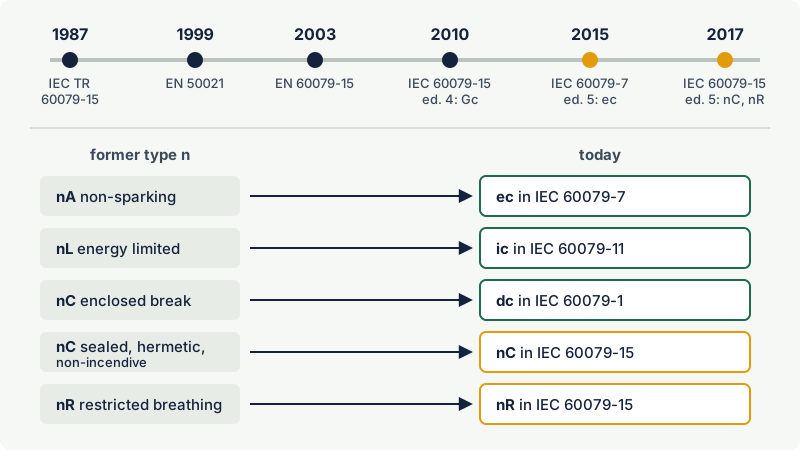
| Former sub-type | Moved to | Standard | When |
|---|---|---|---|
| nL energy limited | ic | IEC 60079-11 | Removed from IEC 60079-15 in 2010 |
| nC enclosed-break devices | dc | IEC 60079-1 (2014) | Removed from IEC 60079-15 in 2017 |
| nA non-sparking | ec | IEC 60079-7 (2015) | Removed from IEC 60079-15 in 2017 |
| nC sealed, hermetically sealed, non-incendive | nC | IEC 60079-15 | Still current |
| nR restricted breathing | nR | IEC 60079-15 | Still current |
The current IEC 60079-15 is edition 5 (2017); a committee draft for vote (CDV) of a new edition circulated in 2026. IEC 60079-7 is at edition 5 with Amendment 1 (2017), with a new edition also in draft.
Ex ec: increased safety for Zone 2
IEC 60079-7 now has two levels. Level eb (EPL Gb) is the classic increased safety for Zone 1; level ec (EPL Gc) is the former nA, rewritten in the increased safety format. Both prevent arcs, sparks and excessive temperatures rather than containing or limiting them; ec does so for normal operation and regular expected occurrences, eb also for expected malfunctions. See increased safety (Ex e).
The main practical differences:
- Electronics are allowed. eb excludes semiconductors and electrolytic capacitors, because a failure could produce heat or sparks. ec allows them, so LED drivers, electronic ballasts and power electronics can be built to ec without extra protection of the components.
- Smaller spacings. Creepage and clearance distances are smaller for ec, with a minimum of 1.5 mm for field wiring terminals instead of 3 mm for eb.
- Voltage. ec covers equipment up to 15 kV, eb up to 11 kV.
- Motors. An ec motor is assessed for normal running; the standard assumes that an explosive atmosphere and a motor start do not happen at the same time, and it is not intended for locations where they are likely to coincide.
- Enclosures. The same ingress protection applies as for eb: at least IP54 where there are bare live parts and IP44 where all live parts are insulated.
For the IEC committee, moving nA into IEC 60079-7 was largely a change of home and name: the 2015 edition notes that a product formerly marked nA must now be marked ec, even where its construction is unchanged and complies.
Ex nC: protected sparking
Where a Zone 2 product contains contacts that spark in normal operation (relays, switches, thermostats), the sparking part can be protected as nC in one of three ways:
- Hermetically sealed device: sealed by fusion (glass to metal, welding, brazing) so the outside atmosphere cannot get in.
- Sealed device: cannot be opened in normal service and is sealed to prevent entry of the atmosphere; it is leak-tested.
- Non-incendive component: contacts designed so that the arc or spark they make or break in a specified circuit cannot ignite the specified gas. It is valid only for the circuit it was tested in.
nC components are often found inside ec equipment, for example a sealed relay in an ec control unit, and the product then carries a combined marking such as Ex ec nC IIC T4 Gc.
Ex nR: restricted breathing
The principle
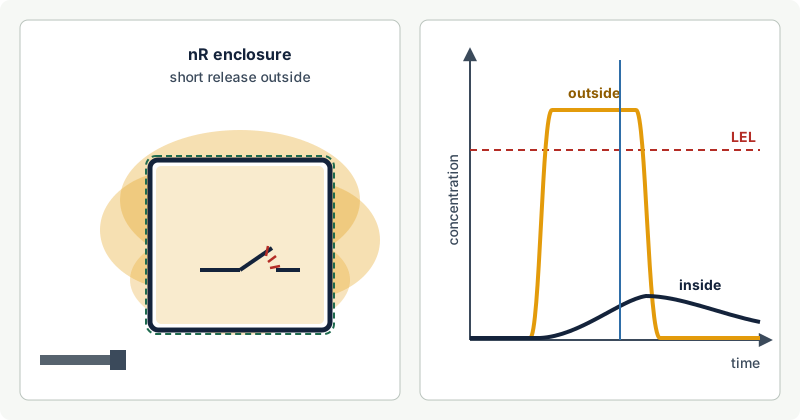
Any enclosure "breathes": when it warms up the air inside expands and leaves, and when it cools, outside air is drawn in through gaps in the seals. A restricted breathing enclosure is built so tightly that this exchange is very slow. In Zone 2, a gas cloud is expected to be present only for a short time. If the enclosure lets in so little gas during that time that the concentration inside stays far below the lower explosive limit (LEL), the ordinary, sparking equipment inside cannot ignite anything.
What the standard requires
- Leak-tightness, proven by test. In the type test, a small depression of about 0.3 kPa (30 mm water gauge) is created inside, and the time for it to fall to half must not be less than a set minimum: 360 s for a type test alone, 90 s where every unit is also routine tested, and 180 s for enclosures without a test port. An alternative test measures the air flow needed to hold a small overpressure.
- Limited heating. The outside surface must stay within the temperature class. If the enclosure contains normally sparking devices, or has hot surfaces with frequent temperature cycles, the outside must not exceed ambient by more than 20 K, because strong heating and cooling pumps air in and out.
- Complete equipment. An nR enclosure is assessed as a complete product, including all options and accessories, and the instructions must define the cable entry devices to be used.
- Test port. A test port lets the restricted breathing be checked after installation, at initial inspection and during maintenance. Luminaires and some other equipment may be exempt under conditions, in which case they must pass the breathing test both as a type test and as a routine test on production units.
- Fans and batteries. Internal fans must not create a depression at a leakage point, and the breathing test is done with the fan running and stopped. Cells and batteries must be of the sealed type.
Installation and maintenance
Restricted breathing depends on every seal. Cable glands, stopping plugs and any accessories must be those specified for the enclosure, gaskets must be in good condition, and covers must be fully closed. IEC 60079-14 has specific requirements for cables entering restricted breathing enclosures directly, and where a test port is fitted it is there so the breathing properties can be re-tested at inspection. A missing plug or a damaged gasket turns an nR enclosure into an ordinary box.
Typical uses in Zone 2
| Equipment | Common Zone 2 choices | Notes |
|---|---|---|
| Cage induction motors | Ex ec | Not where gas and motor starts are likely to coincide; check the certificate for converter supply |
| Luminaires (LED, fluorescent) | Ex ec, Ex ec nR, Ex nR | Electronics allowed in ec; nR keeps gas away from drivers |
| Junction and terminal boxes | Ex ec | Terminal ratings and loading as for Ex e |
| Control stations, small panels | Ex nR, Ex ec nC | nR allows ordinary switches inside if heating is limited |
| Instruments and transmitters | Ex ic, Ex ec, Ex nR | ic gives the most flexibility for live work |
| Analyser or PLC cabinets | Ex pzc, Ex nR | Pressurisation for larger heat loads |
Reading old and new markings
| Marking seen | What it is | Status |
|---|---|---|
EEx nA ... | Non-sparking, CENELEC EN 50021 era (prefix EEx) | Valid for installed equipment under its certificate |
Ex nA IIC T4 Gc | Non-sparking to IEC 60079-15 before 2017, with EPL | Valid under its certificate; new products are ec |
Ex ec IIC T4 Gc | Increased safety level ec, IEC 60079-7 | Current |
Ex nL IIC T4 | Energy-limited type n | Superseded by Ex ic |
Ex nC on an enclosed-break device | Enclosed-break, now flameproof level dc | Superseded by Ex dc |
Ex nR IIC T4 Gc | Restricted breathing, IEC 60079-15 | Current |
Ex ec nR IIC T4 Gc | Combination, for example a luminaire | Current |
Under ATEX the gas part is preceded by the category, for example II 3 G Ex ec IIC T4 Gc. Old certificates do not expire because a standard is revised: installed equipment remains acceptable under the certificate it was supplied with, provided it is maintained and its conditions are met. Spare parts and replacements are normally supplied to the current standard and marking. See how to read an Ex marking.
Practical case: a control station in Zone 2
A pump area is classified Zone 2, gas group IIA, temperature class T3, with propane as the main substance. A local control station needs start and stop buttons, a selector switch and an indicator lamp.
- Option 1, nR enclosure with ordinary switches. The buttons spark in normal operation, so the enclosure must be restricted breathing with a surface temperature rise of no more than 20 K, cable glands and plugs as specified in the instructions, and a test port so the seal can be checked. Marking for example
Ex nR IIC T6 Gc. - Option 2, ec enclosure with nC switch elements. An increased safety housing with sealed or non-incendive switch elements, marked for example
Ex ec nC IIC T6 Gc. No breathing test is needed in service, but each switch element must be the certified type. - Option 3, a Zone 1 product. An
Ex db ebcontrol station is also acceptable in Zone 2, because a higher EPL is always allowed. It costs more, but may simplify spares if the site already stocks Zone 1 designs.
All three options are Gc or better, IIA or higher and T3 or cooler, so each is a valid selection. The choice depends on maintenance: nR relies on every seal staying intact, while ec with nC elements is less sensitive to a gland fitted slightly wrong.
Common mistakes
- Using Ex ec or Ex nR equipment in Zone 1. Both give EPL Gc only. Zone 1 needs Gb or better.
- Treating ec as identical to eb. An ec motor or terminal box is not designed for the expected malfunctions that eb covers, and the spacings are smaller.
- Replacing a gland or plug on an nR enclosure with a non-specified part. The breathing test only covers the specified entry devices.
- Leaving a cover loose after maintenance on an nR enclosure, or forgetting to refit the test port plug.
- Rejecting installed Ex nA equipment because the standard changed. A revision does not make certified, well-maintained equipment unsafe; new purchases are simply marked ec.
- Putting a heater or a large power supply into an nR enclosure without checking the 20 K limit and the temperature class.
Frequently asked questions
Is Ex nA still allowed?
Yes, installed Ex nA equipment remains valid under its certificate. Since the 2017 edition of IEC 60079-15, the nA requirements live in IEC 60079-7 as level ec, so new certificates and new products use the Ex ec marking instead.
What is the difference between Ex ec and Ex nA?
Technically very little for most products: ec is the former nA, moved into the increased safety standard and aligned with its structure. The marking changed, and some requirements were clarified, so a product has to be assessed to IEC 60079-7 to carry Ex ec.
What does restricted breathing mean?
A restricted breathing enclosure (nR) is sealed so tightly that gas outside can only enter very slowly. Because a Zone 2 release is short, the concentration inside stays far below the lower explosive limit, so ordinary sparking parts inside cannot ignite it. It is suitable only for Zone 2.
Can Ex ec equipment be used in Zone 1?
No. Ex ec gives EPL Gc, which is only for Zone 2. For Zone 1 you need increased safety level eb or another concept giving EPL Gb or Ga.
What replaced Ex nL?
Energy-limited nL was removed from IEC 60079-15 in 2010. Its role is taken by intrinsic safety level ic (IEC 60079-11), which gives EPL Gc and uses the same entity parameter approach as ia and ib. See intrinsic safety.
Does every nR enclosure need a test port?
Not always. A test port lets the breathing properties be checked in the field and is the normal arrangement. Luminaires and some other equipment can be exempted under conditions set by the standard; they must then pass the breathing test at type test and on every production unit.
Related on excodex
- Increased safety (Ex e)
- Ex protection concepts at a glance
- Hazardous area zones explained
- ATEX equipment categories 1, 2 and 3
- How to read an Ex marking
- Tools: Ex marking check, gas library, forum, standards spaces IEC 60079-15, IEC 60079-7 and IEC 60079-14
Standards and further reading
- IEC 60079-15, equipment protection by type of protection "n" (edition 5, 2017; a new edition is in draft).
- IEC 60079-7, equipment protection by increased safety "e", levels eb and ec (2015 with Amendment 1 of 2017).
- IEC 60079-11, intrinsic safety (level ic); IEC 60079-1, flameproof enclosures (level dc).
- IEC 60079-14, installation; IEC 60079-17, inspection and maintenance.
- IEC 60079-15:2017 text with the list of changes, incorporated by reference in US federal regulations: law.resource.org; IEC webstore (current edition, IEC 60079-15:2017): webstore.iec.ch
- IEC 60079-7:2015 text with the nA to ec change tables: law.resource.org; IEC webstore (current edition, IEC 60079-7:2015+AMD1:2017): webstore.iec.ch
- IEC 60079-15:2010 abstract and list of changes (removal of nL): standards.iteh.ai
- IEC TR 60079-15:1987, the first IEC publication on type n: scc-ccn.ca
This article is general technical information prepared by the excodex editorial team. It does not replace the applicable standards, the equipment certificates and instructions, national regulations or the assessment of a competent person.