Equipment Protection Levels (EPL): Ga, Gb, Gc, Da, Db, Dc and how they match zones
Abstract
EPLs rate how likely Ex equipment is to become an ignition source: Ga, Gb, Gc for gas, Da, Db, Dc for dust, Ma, Mb for mines. Learn the definitions, the default zone mapping, the link to ATEX categories and when risk assessment may change the EPL.
An equipment protection level (EPL) is a rating, marked on Ex equipment, of how unlikely it is to become an ignition source. There are three levels for gas (Ga very high, Gb high, Gc enhanced), three for dust (Da, Db, Dc) and two for mines (Ma, Mb). By default Zone 0 requires Ga, Zone 1 requires Ga or Gb, and Zone 2 accepts Ga, Gb or Gc; the dust Zones 20, 21 and 22 map to Da, Db and Dc in the same way. IEC 60079-14 also allows the required EPL to be set by a documented risk assessment that considers the consequences of an ignition, not only the zone.
This article explains what each EPL means in terms of faults, how EPLs relate to zones, ATEX categories and types of protection, and how the risk-based route works in practice.
Key points
- The EPL describes the equipment, not the area: it states whether the equipment remains a non-ignition source in normal operation (c), also during expected malfunctions (b), or also during rare malfunctions (a).
- Default selection: Zone 0 needs Ga; Zone 1 needs Ga or Gb; Zone 2 accepts Ga, Gb or Gc. Zones 20, 21 and 22 follow the same pattern with Da, Db and Dc.
- A higher EPL can always be used in a lower-risk zone: Gb equipment is acceptable in Zone 2, Da equipment in Zone 22.
- Mining equipment has only two levels: Ma remains safe and may stay energised when firedamp is present; Mb is intended to be switched off when firedamp is detected. There is no Mc.
- EPLs correspond to ATEX categories: Ga, Gb, Gc to 1G, 2G, 3G; Da, Db, Dc to 1D, 2D, 3D; Ma and Mb to M1 and M2.
- EPLs were introduced by the IEC in 2006 and became part of the IEC 60079-0 marking in 2007, so equipment certified earlier has no EPL on the label.
- Where the area classification gives only zones, the default zone-to-EPL table applies. A documented risk assessment may require a higher EPL, or exceptionally justify a lower one.
What an EPL is and why it exists
For decades, equipment selection in hazardous areas was a direct link between zones and types of protection: "Ex d and Ex e are for Zone 1, Ex ia is for Zone 0". That worked, but it hid the underlying logic. Zones describe how often an explosive atmosphere is present (likelihood). What really matters for safety is how likely the equipment is to ignite that atmosphere, and how bad the outcome would be.
The EPL concept, introduced by the IEC in 2006 and made part of the IEC 60079-0 marking in 2007, gives every piece of Ex equipment a level that expresses its inherent ignition risk, independent of the technique used. A flameproof enclosure, an increased safety terminal box and an intrinsically safe circuit can all be EPL Gb. The installer no longer needs to remember which technique belongs to which zone; the installer matches the EPL to the area. In Europe the EPL entered the harmonised marking with EN 60079-0:2009.
The EPL is the last element of the standards marking, for example Ex db IIC T4 Gb. How to read the rest of the string is explained in How to read an Ex marking.
The eight EPLs
| EPL | Atmosphere | Level of protection | Not an ignition source during | ATEX category |
|---|---|---|---|---|
| Ma | Mines (firedamp) | Very high | Normal operation, expected and rare malfunctions, even when left energised during a gas outbreak | M1 |
| Mb | Mines (firedamp) | High | Normal operation and expected malfunctions, in the time between a gas outbreak and de-energisation | M2 |
| Ga | Gas | Very high | Normal operation, expected and rare malfunctions | 1G |
| Gb | Gas | High | Normal operation and expected malfunctions | 2G |
| Gc | Gas | Enhanced | Normal operation (with some additional protection against regularly expected events) | 3G |
| Da | Dust | Very high | Normal operation, expected and rare malfunctions | 1D |
| Db | Dust | High | Normal operation and expected malfunctions | 2D |
| Dc | Dust | Enhanced | Normal operation (with some additional protection against regularly expected events) | 3D |
The letter tells you the atmosphere: M for mines susceptible to firedamp (equipment group I), G for explosive gas atmospheres (group II), D for explosive dust atmospheres (group III). The lower-case a, b or c tells you the level.
Gas: Ga, Gb and Gc
Ga equipment is not a source of ignition in normal operation, during expected malfunctions or during rare malfunctions. In practice this is achieved either by a type of protection that remains safe with two independent faults, such as intrinsic safety level ia or encapsulation ma, or by combining two independent Gb types of protection so that one remains effective if the other fails. IEC 60079-26 deals with Ga equipment of this second kind.
Gb equipment is not a source of ignition in normal operation or during expected malfunctions. A flameproof enclosure (db) contains an internal explosion that is assumed to happen; an increased-safety enclosure (eb) prevents arcs, sparks and hot spots even under the overloads and disturbances that must normally be expected.
Gc equipment is not a source of ignition in normal operation and may have some additional protection so that it stays safe during regularly expected occurrences, the standard illustration being the failure of a lamp in a luminaire. Typical types are ec, ic, nR and pzc.
Mines: Ma and Mb
In underground coal mines the approach is different: there are no zones in the industrial sense, and methane (firedamp) may appear suddenly. Ma equipment must stay safe even when it remains energised in an outbreak of gas, so it is used for equipment that has to keep working, such as gas monitoring and communication. Mb equipment is safe in normal operation and expected malfunctions for the period between a gas outbreak and the moment it is switched off, typically by methane monitoring that cuts the power. That is why there is no "Mc". See Coal mine methane: firedamp, monitoring and Group I equipment.
Dust: Da, Db and Dc
The dust levels follow the gas logic, applied to clouds and layers of combustible dust. Protection by enclosure is the typical dust technique: ta gives Da, tb gives Db, tc gives Dc, with the degree of dust tightness required depending on both the level and the dust group (see Dust ignition protection by enclosure (Ex t)).
Normal operation, expected and rare malfunctions
The key to the EPL system is how many things are assumed to go wrong. The figure steps through the three conditions.
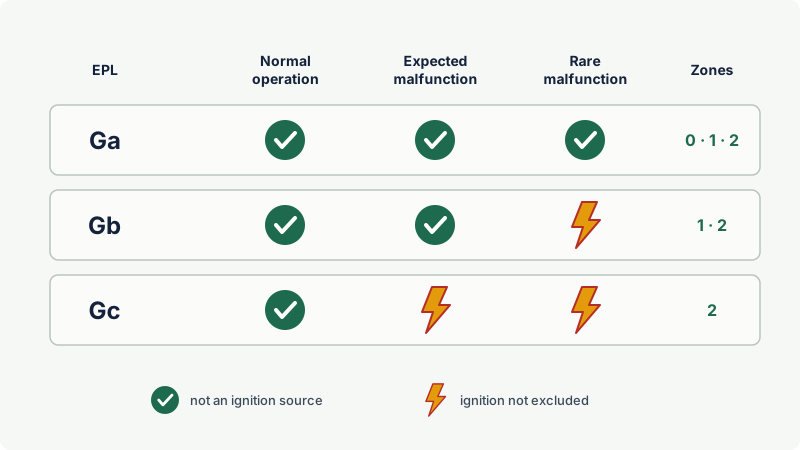
- Normal operation means working within the design ratings, including starting, stopping and normal switching. Every Ex equipment, even Gc, must be safe here.
- Expected malfunctions are faults that are known to happen in practice: a terminal that loosens, an overload, a single component failure. Gb and Ga equipment must stay safe.
- Rare malfunctions are faults that are unlikely but possible, such as two independent faults at the same time. Only Ga (and Da, Ma) equipment is designed for these.
The reasoning behind the zone mapping follows directly. In Zone 0 the atmosphere is present continuously or for long periods, so an ignition source that appears only under a rare fault is still likely to coincide with the atmosphere at some point. In Zone 2 the atmosphere is rare and short, so it is acceptable that the equipment is safe in normal operation only: two unlikely events (gas present and equipment faulty) would have to coincide.
Default mapping: zones, EPLs and categories
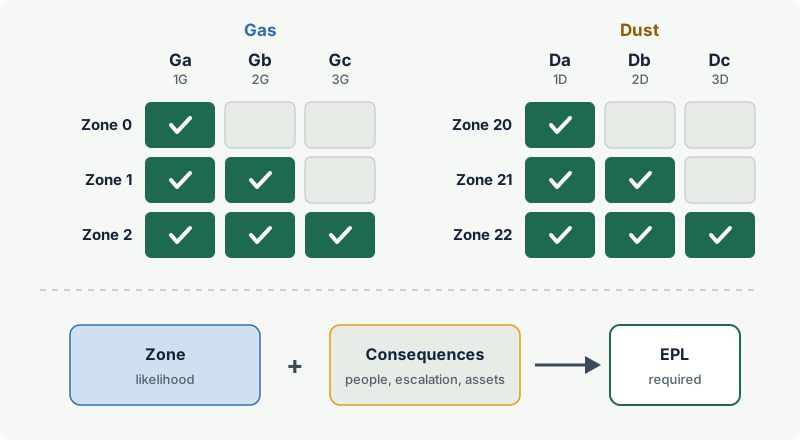
| Zone | Minimum EPL (default) | Also acceptable | ATEX category (1999/92/EC) |
|---|---|---|---|
| Zone 0 | Ga | none | 1G |
| Zone 1 | Gb | Ga | 2G or 1G |
| Zone 2 | Gc | Ga, Gb | 3G, 2G or 1G |
| Zone 20 | Da | none | 1D |
| Zone 21 | Db | Da | 2D or 1D |
| Zone 22 | Dc | Da, Db | 3D, 2D or 1D |
IEC 60079-14 contains the corresponding table for the case where the area classification assigns only zones, which is still the most common situation. The EU workplace directive 1999/92/EC sets the same default in terms of categories: category 1 equipment in Zone 0 or 20, category 1 or 2 in Zone 1 or 21, category 1, 2 or 3 in Zone 2 or 22, suitable for gases and/or dusts as appropriate. Background on the zones themselves: Hazardous area zones explained and Dust zones 20, 21 and 22.
The EPL is only one of the selection criteria. Equipment also has to match the gas group or dust group, the temperature class or maximum surface temperature, the ambient temperature range and any specific conditions of use.
Which types of protection give which EPL
| EPL | Typical types of protection |
|---|---|
| Ga | ia, ma, two independent Gb types combined (IEC 60079-26) |
| Gb | db, eb, ib, mb, pxb, pyb, ob, q, plus anything Ga |
| Gc | dc, ec, ic, mc, pzc, nR, nC, oc, plus anything Ga or Gb |
| Da | ia, ma, ta |
| Db | ib, mb, tb, pxb, pyb, plus anything Da |
| Dc | ic, mc, tc, pzc, plus anything Da or Db |
Non-electrical equipment to ISO 80079-36 and ISO 80079-37 is marked Ex h with the EPL stated at the end, for example Ex h IIB T4 Gb. An overview of each technique is in Ex protection concepts at a glance.
For intrinsically safe systems, the EPL of the loop is set by its weakest part. An Ex ia transmitter connected to an associated apparatus marked [Ex ib] forms an ib circuit, suitable for Gb but not for Zone 0.
Risk-based EPL selection
The EPL concept was designed from the start to allow a second route. The IEC 60079 series describes, in an informative annex, an alternative risk assessment method in which the required EPL is derived from the likelihood of an explosive atmosphere (the zone) combined with the consequences if it ignites. IEC 60079-14 reflects this: where the area classification documentation states the required EPLs, those apply; where it states only zones, the default zone-to-EPL relationship is used.
In Europe, Directive 1999/92/EC allows the same flexibility in its own terms: the default categories apply unless the explosion protection document, based on the risk assessment, provides otherwise. See The Explosion Protection Document (EPD).
When a higher EPL is chosen
Raising the EPL above the default is common and rarely controversial. Typical reasons are:
- People are regularly present close to the area, for example a Zone 2 next to an occupied workshop or control building.
- An ignition could escalate, for example by damaging equipment that holds toxic or large flammable inventories.
- The area classification has large uncertainties, or the release behaviour is poorly known.
- The asset is critical and long outages after an incident are unacceptable.
Many operators simply standardise on Gb equipment for both Zone 1 and Zone 2, which also simplifies spare parts.
When a lower EPL is considered
Lowering the EPL below the default (for example accepting Gc equipment in a small Zone 1) is exceptional. It needs a documented assessment showing that the consequences are genuinely limited, that the assumptions hold over the life of the plant, and that it is acceptable to the authority having jurisdiction. National regulations, client specifications or insurers may not allow it at all. In practice, it is usually easier and more defensible to reduce the zone (better ventilation, fewer release sources) than to argue a lower EPL.
How to apply the risk-based route
- Complete the area classification (zones and extents) in the normal way, for example to IEC 60079-10-1 or IEC 60079-10-2.
- For each zone, identify who and what could be affected by an ignition: people, adjacent plant, escalation paths, environment.
- Decide whether the default EPL is adequate, or whether a different EPL is justified, and record the reasoning.
- Show the required EPL on the area classification drawings or schedules, so that designers and inspectors do not fall back on the default.
- Review the decision whenever the process, layout or occupancy changes.
Worked example: a solvent tank and a flour silo
A fixed-roof tank stores toluene (gas group IIA, autoignition temperature 530 °C, temperature class T1, flash point 4 °C). The area classification shows Zone 0 in the vapour space, Zone 1 around the breather vent and Zone 2 over the bund.
| Location | Zone | Default EPL | Equipment chosen |
|---|---|---|---|
| Inside tank (level sensor) | Zone 0 | Ga | Ex ia IIA T4 Ga sensor, or a boundary-wall device marked Ga/Gb |
| Near the vent | Zone 1 | Gb | Ex db IIB T4 Gb junction box |
| Bund area | Zone 2 | Gc | Ex ec IIC T4 Gc luminaires acceptable by default |
The bund lies 10 m from a staffed workshop. The site's risk assessment decides that equipment in this Zone 2 should be Gb, so the luminaires are replaced by Gb types and the drawing is annotated "EPL Gb required". Nothing in the zone changes; only the required protection does.
In the same plant, a flour silo (non-conductive dust, group IIIB) has Zone 20 inside, Zone 21 around the bagging point and Zone 22 in the surrounding room. A level probe inside needs Da, the bagging motor Db, and the room lighting Dc by default, each with a surface temperature checked against the flour's ignition temperatures (see Surface temperature limits for dust).
Common mistakes
- Treating EPL as the whole selection. A Gb device for IIA gases is not suitable in a Zone 1 with hydrogen (IIC). EPL, gas or dust group, temperature and ambient range must all match.
- Confusing category numbers with zone numbers. Category 2 (EPL Gb) belongs to Zone 1, not to Zone 2. Zone 2 alone needs only category 3 (Gc).
- Assuming an "ia" device makes the loop Ga. The whole intrinsically safe circuit, including the associated apparatus and cable parameters, determines the level.
- Using risk assessment to justify cheaper equipment without documentation. A lower EPL without a written, reviewed assessment is simply a non-compliance.
- Forgetting that installation can destroy the EPL. Wrong cable glands, unused entries left open or a damaged flamepath reduce the real protection level whatever the label says. Inspection to IEC 60079-17 checks exactly this.
Frequently asked questions
What does EPL Gb mean?
EPL Gb is a high level of protection for explosive gas atmospheres. The equipment is not a source of ignition in normal operation or during expected malfunctions. By default it may be installed in Zone 1 and Zone 2.
Can Gb equipment be used in Zone 2?
Yes. A higher EPL can always be used where a lower one is required, so Ga and Gb equipment is acceptable in Zone 2. The reverse is not true by default: Gc equipment is not for Zone 1.
What is the difference between an EPL and an ATEX category?
The ATEX category is a legal classification under Directive 2014/34/EU; the EPL is defined in the IEC 60079 and ISO 80079 standards. They are designed to correspond (1G with Ga, 2G with Gb, 3G with Gc, and the same for dust and mines), and European equipment usually shows both, as in II 2 G Ex db IIC T4 Gb.
Why is there no EPL Mc for mines?
Mining equipment is either required to stay safe while energised in firedamp (Ma) or to be safe until it is de-energised when gas is detected (Mb). Mining practice does not provide for equipment that is safe only in normal operation, so no third level exists.
Can a risk assessment allow a lower EPL than the zone requires?
The standards and Directive 1999/92/EC allow the required EPL or category to be set by a documented risk assessment, so in principle yes. In practice a lower EPL is rare, must be well justified and may be prohibited by national rules or client specifications; a higher EPL is the more common outcome.
Do North American markings show an EPL?
Under the Zone system of NFPA 70 Article 505 an EPL may appear in the product marking but is not required, and the Division system of Article 500 does not use EPLs. See Zones vs Divisions.
Related on excodex
- How to read an Ex marking: decoding II 2 G Ex db IIC T4 Gb
- ATEX equipment categories 1, 2 and 3 and how they relate to EPLs
- Hazardous area zones explained: Zone 0, Zone 1 and Zone 2
- How to carry out a gas hazardous area classification step by step
- Ex installation basics under IEC 60079-14
- Ex marking check: /tools/ex, standards spaces: IEC 60079-14, IEC 60079-0, ATEX 1999/92/EC
Standards and further reading
- IEC 60079-0, Explosive atmospheres, Part 0: Equipment, general requirements (defines EPLs and their marking)
- IEC 60079-14:2024, Explosive atmospheres, Part 14: Electrical installation design, selection and installation of equipment, including initial inspection
- IEC 60079-26, Explosive atmospheres, Part 26: Equipment with equipment protection level (EPL) Ga
- IEC 60079-10-1 and IEC 60079-10-2, classification of areas for gas and for dust
- Directive 1999/92/EC, Annex II, criteria for the selection of equipment (legislation.gov.uk copy): https://legislation.gov.uk/eudr/1999/92/annex/II/data.xht
- Directive 2014/34/EU, Annex I, classification of equipment groups into categories: https://eur-lex.europa.eu/legal-content/EN/TXT/HTML/?uri=CELEX:32014L0034
- US Coast Guard Drill Down 28, hazardous location markings and equipment protection level: https://www.dco.uscg.mil/OCSNCOE/Drill-Down/DD-028/
- NSW TestSafe, Ex gas and dust grouping and EPLs: https://www.nsw.gov.au/business-and-economy/testsafe/electrical/explosive-atmosphere/electrical-non-electrical-0
This article is general technical information prepared by the excodex editorial team. It does not replace the applicable standards, the equipment certificates and instructions, national regulations or the assessment of a competent person.