Dust ignition protection by enclosure (Ex t): ta, tb and tc
Abstract
Ex t protects equipment in combustible dust by a dust-tight or dust-protected enclosure and a limited surface temperature marked in °C. Levels ta, tb and tc, the IP6X and IP5X rules per dust group, T85 °C and T200 320 °C markings, and how to select for Zones 20 to 22.
Dust ignition protection by enclosure, type of protection "t", stops electrical equipment igniting combustible dust in two ways: the enclosure keeps dust out (dust-tight IP6X or dust-protected IP5X, depending on the level and the dust group), and the outside surface temperature is limited and marked in °C so that dust clouds and layers on the equipment do not ignite. There are three levels: ta for EPL Da (Zone 20), tb for EPL Db (Zone 21) and tc for EPL Dc (Zone 22).
This article explains the principle, the levels, the ingress protection rules, the surface temperature markings such as T85 °C and T200 320 °C, and how to select and maintain Ex t equipment.
Key points
- Ex t combines two measures: an enclosure that keeps dust out, and a maximum surface temperature, marked in °C, that stays below what the dust can tolerate as a cloud or a layer.
- Levels: ta gives EPL Da (Zone 20), tb gives EPL Db (Zone 21) and tc gives EPL Dc (Zone 22); the standard is IEC 60079-31, currently edition 3 (2022).
- Conductive dust (IIIC) always needs a dust-tight IP6X enclosure; IIIB needs IP6X for ta and tb and accepts IP5X for tc; flyings (IIIA) need IP6X only for ta.
- Level ta is for low-power equipment: it is tested with a harsher dust test (at least 4 kPa depression for 8 hours), must be rated for supplies with a prospective short-circuit current of no more than 1.5 kA, and its marked temperature must also cover internal components.
- A marking such as
T200 320 °Cgives the maximum surface temperature when the equipment is covered by a dust layer of the stated depth (here 200 mm); a plainT135 °Cis measured without a layer. - Selection follows IEC 60079-14: the marked temperature must not exceed two-thirds of the dust cloud ignition temperature, nor the 5 mm layer ignition temperature minus 75 K, with more margin or specific assessment for thicker layers.
- Ex t replaced the former IEC 61241-1 type "tD" in 2008; old markings such as
Ex tD A21refer to that system.
How dust ignition protection by enclosure works
Combustible dust ignites in two ways that matter for electrical equipment. A dust cloud touching a hot surface can ignite if the surface is hot enough. A dust layer resting on equipment is more insidious: it insulates the surface, so the equipment runs hotter than in clean air, and the layer itself can start to smoulder at a lower temperature than a cloud. A smouldering layer can then ignite a cloud raised by any disturbance. See what makes a dust explosive.
Dust that gets inside equipment adds further hazards: it can be ignited by sparks or hot components, and conductive dust can bridge live parts and cause tracking and short circuits. Ex t answers all three:
- Keep dust out. Joints, gaskets, shaft seals and cable entries are built and tested so that dust cannot enter (IP6X) or cannot enter in harmful amounts (IP5X), even after the enclosure has been aged by heat and cold and impact tested.
- Limit the outside temperature. The highest temperature of any outer surface that dust can touch is measured and marked in °C.
- Leave the inside ordinary. For tb and tc, the components inside need no further Ex protection: relays, contactors, terminals and drivers are protected by the enclosure.
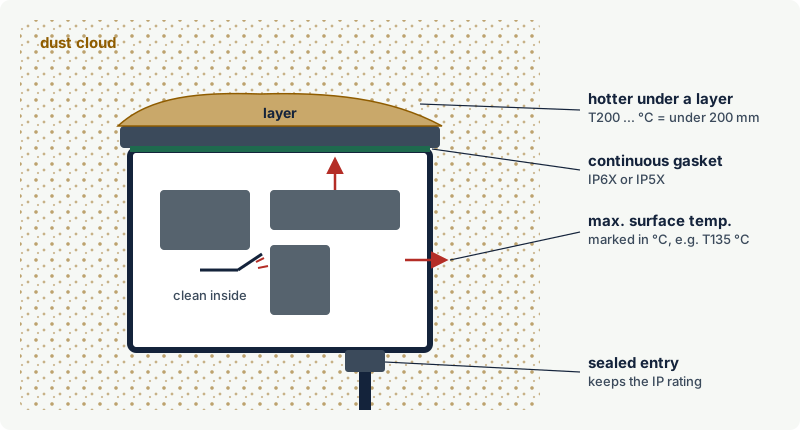
The standard is IEC 60079-31. Its first edition (2008) replaced IEC 61241-1, which had two "practices" (A and B) for type "tD"; the 2008 edition merged them and introduced the levels ta, tb and tc. The current edition 3 was published in January 2022. Ex t does not cover underground mines, dusts of explosives or pyrophoric materials, or flammable or toxic gas given off by the dust.
Levels of protection ta, tb and tc
Each level corresponds to an EPL, which defines how far the equipment must remain safe:
| Level | EPL | Zone | Not an ignition source in | ATEX category |
|---|---|---|---|---|
| ta | Da | 20, 21, 22 | Normal operation, expected malfunctions and rare malfunctions | 1D |
| tb | Db | 21, 22 | Normal operation and expected malfunctions | 2D |
| tc | Dc | 22 | Normal operation | 3D |
Level tb and tc
Most Ex t equipment is tb or tc: motors, luminaires, junction boxes, control stations, heaters and sensors in mills, silos, bagging lines and filter houses. The surface temperature is determined at the most onerous supply conditions; tb also takes account of expected malfunctions, and the 2022 edition added malfunction conditions for converter-fed motors at level tb. The 2022 edition also requires sealed cells or batteries where tb or tc equipment contains sparking contacts or hot surfaces, and sets rules for mains-connected equipment that must interrupt fault currents above 10 kA.
Level ta
Level ta must stay safe even with rare malfunctions, including partial rupture of the outer enclosure. That has several consequences:
- Internal temperatures count. The marked maximum surface temperature is the higher of the internal component temperatures (where there is no supplementary enclosure around them) and the outer surface temperature, because a damaged enclosure could expose them.
- Protective devices. If a malfunction could exceed the marked temperature, a thermal or overcurrent protective device is required; thermal devices must not reset themselves and must be duplicated unless they meet the relevant fuse or thermal-link standards.
- Supply limits. Since 2022, ta equipment must be rated for connection to a circuit with a prospective short-circuit current of no more than 1.5 kA.
- Harsher dust test. The IP6X test is made with a depression of at least 4 kPa held for at least 8 hours, after an internal overpressure test.
The standard notes that ta is typically applied to instrumentation where the available fault current is in the milliampere range and the normal dissipation is a few watts. Larger equipment for Zone 20 normally uses other concepts, such as intrinsic safety ia or encapsulation ma.
Ingress protection: IP6X or IP5X
The IP code's first digit describes protection against solid objects and dust, tested in a chamber of circulating talcum powder as defined in IEC 60529. IP5X is "dust-protected": some dust may enter, but not enough to interfere with operation or impair safety. IP6X is "dust-tight": no dust may enter. Ex t sets which one is needed from the level and the dust group:
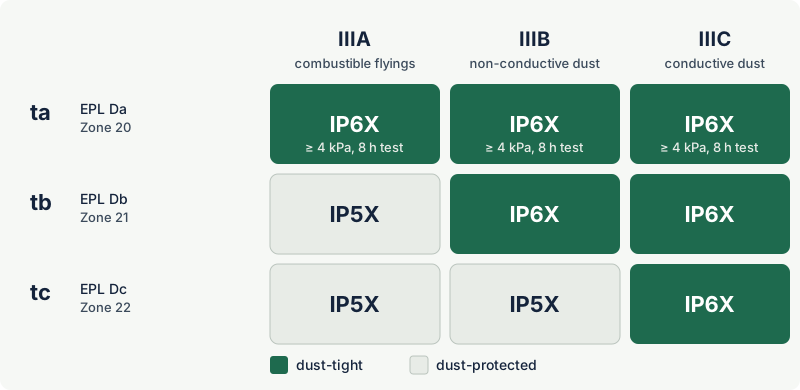
| Level | IIIA (flyings) | IIIB (non-conductive dust) | IIIC (conductive dust) |
|---|---|---|---|
| ta | IP6X | IP6X | IP6X |
| tb | IP5X | IP6X | IP6X |
| tc | IP5X | IP5X | IP6X |
Conductive dust is the strictest case because even a small deposit inside can create a conducting path between live parts. The dust group on the marking covers the less demanding groups: equipment marked IIIC can be used for IIIB and IIIA, and IIIB for IIIA. See dust groups IIIA, IIIB and IIIC.
The IP rating on an Ex t certificate means more than an industrial IP rating. The samples are first subjected to thermal endurance and impact tests, grease must be removed from joints before the dust test, so joints cannot rely on grease to seal, and gaskets must form an uninterrupted seal (one-piece or permanently joined; since 2022 also interlocking pieces that leave no gap under compression). The 2022 edition added an annex on entry devices, including cable transit devices. An enclosure with a good industrial IP66 rating is therefore not Ex t equipment unless it has been assessed as such.
Maximum surface temperature and the T200 320 °C marking
Gas equipment is marked with a temperature class T1 to T6. Dust equipment is marked with the actual maximum surface temperature in °C, because dust ignition temperatures vary continuously and depend on whether the dust is a cloud or a layer.
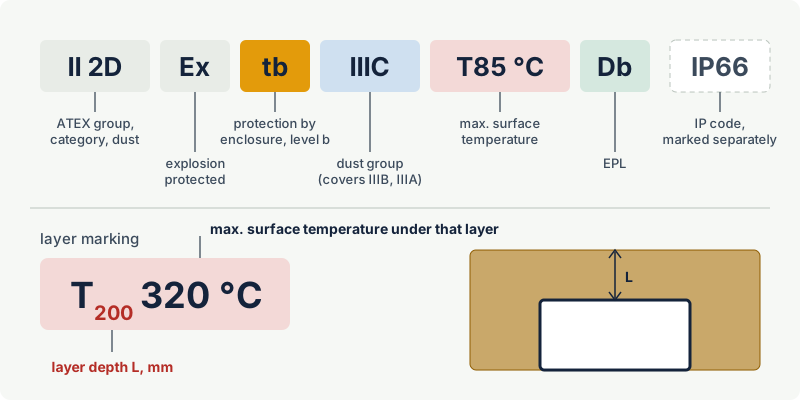
- Plain marking, such as
T85 °CorT135 °C. The maximum surface temperature measured in a dust-free test, at the most onerous rated conditions and the maximum ambient temperature. - Layer marking, written T with a subscript L, such as
T200 320 °C. The maximum surface temperature when the equipment is covered by a dust layer L millimetres deep, here 320 °C under 200 mm. Under a deep layer, heat cannot escape, so the value is much higher than the dust-free value. This marking is used where equipment may be buried in dust, and the 2008 edition of IEC 60079-31 required a test in at least 500 mm of dust for ta.
The marked temperature applies within the rated ambient temperature range, normally -20 °C to +40 °C. Older editions of IEC 60079-0 required the range to be marked only when it differed from this; edition 8 (2026) requires the rated ambient range to be marked on every Ex marking.
Selecting for the dust
IEC 60079-14 sets the margins between the marked temperature and the ignition properties of the dust:
- Clouds: the maximum surface temperature must not exceed two-thirds of the minimum ignition temperature of the dust cloud, in °C.
- Layers up to 5 mm: the dust-free maximum surface temperature must be at least 75 K below the minimum ignition temperature of a 5 mm layer.
- Thicker layers: the permitted temperature must be reduced further as the layer gets thicker (the standard gives guidance for layers up to 50 mm); beyond that, or where equipment can be buried, the assessment uses the layer ignition properties at the actual depth together with a TL value for the equipment.
The safest approach is to prevent thick layers by housekeeping. See surface temperature limits for dust and dust layers and housekeeping.
Worked example: a motor for a Zone 21 mill area
A mill room is classified Zone 21 for a non-conductive organic dust (IIIB). For this example, assume test data for the dust of 420 °C for the cloud minimum ignition temperature and 300 °C for the 5 mm layer (always use measured data for the real product).
- Cloud limit: 2/3 × 420 = 280 °C.
- Layer limit: 300 - 75 = 225 °C.
- The lower value governs: the motor's maximum surface temperature must not exceed 225 °C.
A motor marked II 2D Ex tb IIIC T135 °C Db with IP66 satisfies every point: tb gives EPL Db for Zone 21, IIIC covers IIIB, IP66 includes dust-tight IP6X, and 135 °C is well below 225 °C. A tc motor would not be acceptable, because Zone 21 needs EPL Db. If dust can build up more than 5 mm deep on the motor between cleanings, the margin must be reassessed, or better, the housekeeping improved.
Ex t compared with the other dust concepts
| Concept | Dust levels | Principle | Typical use |
|---|---|---|---|
| Ex t | ta (Da), tb (Db), tc (Dc) | Dust-tight or dust-protected enclosure plus surface temperature limit | Motors, luminaires, junction boxes, control stations |
| Ex i | ia (Da), ib (Db), ic (Dc) | Energy limitation | Sensors, transmitters, low-power instruments |
| Ex m | ma (Da), mb (Db), mc (Dc) | Encapsulation in compound | Coils, sensors, electronic modules |
| Ex p | pxb, pyb (Db), pzc (Dc) | Pressurisation; dust is cleaned out, not purged | Large cabinets, analysers, operator stations |
Many products carry both a gas and a dust marking, such as a flameproof motor that is also tb, marked for example Ex db IIB T4 Gb and Ex tb IIIC T135 °C Db. The gas-only concepts d, e, n, o and q give no dust EPL on their own. See Ex protection concepts at a glance.
Installation, inspection and maintenance
- Keep the enclosure closed and sealed. Every cover, gasket, stopping plug and cable entry is part of the protection. Use entry devices that maintain the certified IP rating, and refit covers fully after work.
- Do not open in a dust cloud. Open equipment only when the area is free of dust clouds and the equipment is isolated, and make sure no dust has got inside before closing it.
- Control layers. Equipment ratings assume the layer thickness considered in selection. Clean surfaces regularly, without blowing dust into the air with compressed air.
- Inspect seals. Under IEC 60079-17, check gaskets for hardening and damage, entries for tightness, and the inside for dust deposits, which are a sign the enclosure no longer seals.
- Watch the heat. Blocked cooling fins, a heavy layer on a motor or a changed load can raise the surface temperature above the value used in selection.
Common mistakes
- Treating an industrial IP66 enclosure as Ex t. Ex t requires certification, preconditioned IP tests and a marked surface temperature, not just a good IP code.
- Using a gas temperature class for dust. A T4 marking says nothing about dust layers; the dust assessment needs the marked maximum surface temperature in °C.
- Using IP5X equipment with conductive dust. IIIC needs IP6X at every level, including tc.
- Ignoring layers. A motor that is fine with a 5 mm layer may be too hot under 50 mm; thick layers need a specific assessment or better cleaning.
- Missing or wrong stopping plugs and glands. One unsealed entry defeats the whole enclosure.
- Putting tc equipment in Zone 21. tc gives EPL Dc, which is only for Zone 22.
Frequently asked questions
What is the difference between Ex ta, tb and tc?
They are the three levels of dust ignition protection by enclosure. ta gives EPL Da for Zone 20 and must remain safe even with rare malfunctions; tb gives EPL Db for Zone 21 and covers expected malfunctions; tc gives EPL Dc for Zone 22 and covers normal operation. The level also sets the required IP rating together with the dust group.
Is IP65 enough for Zone 22?
IP65 includes dust-protected IP5X, which meets the ingress requirement for level tc with flyings or non-conductive dust (IIIA, IIIB). For conductive dust (IIIC), even Zone 22 needs dust-tight IP6X. In any case, the equipment must also be certified for dust with a marked surface temperature; an IP rating alone is not enough.
What does T200 320 °C mean on a nameplate?
It is a layer temperature marking: the maximum surface temperature is 320 °C when the equipment is covered by a 200 mm layer of dust. The subscript gives the layer depth in millimetres. Compare it with the ignition temperature of the dust measured at that layer depth.
Can Ex t equipment be used in gas atmospheres?
Not on the strength of its Ex t marking. Ex t is a dust-only type of protection. Equipment for areas with both gas and dust must carry a suitable gas marking as well, for example a combined Ex db and Ex tb certification.
What replaced Ex tD?
IEC 60079-31 replaced IEC 61241-1 in 2008. The former type "tD" with practices A and B became type "t" with levels ta, tb and tc. Older equipment marked Ex tD A21 or similar remains valid under its certificate.
Why is conductive dust treated more strictly?
Because dust that gets inside can bridge live parts, causing leakage currents, tracking and sparks, in addition to the normal ignition hazards. For that reason, IIIC requires a dust-tight IP6X enclosure at every level of Ex t.
Related on excodex
- Dust zones 20, 21 and 22
- Dust groups IIIA, IIIB and IIIC
- Surface temperature limits for dust
- Equipment Protection Levels (EPL)
- How to read an Ex marking
- Tools: Ex marking check, forum, standards spaces IEC 60079-31, IEC 60079-14 and IEC 60079-10-2
Standards and further reading
- IEC 60079-31, equipment dust ignition protection by enclosure "t" (edition 3, 2022).
- IEC 60079-0, general requirements, including marking of maximum surface temperature for dust.
- IEC 60079-14, design, selection and installation, including surface temperature margins for dust.
- IEC 60079-10-2, classification of areas with combustible dust.
- IEC 60079-17, inspection and maintenance; IEC 60529, degrees of protection (IP code).
- IEC 60079-31:2022 abstract and list of significant changes: webstore.iec.ch
- IEC 60079-31:2008 abstract, merging practices A and B and introducing ta, tb, tc: webstore.iec.ch
- SafeWork NSW TestSafe, dust ignition protection by enclosure Ex t: nsw.gov.au
This article is general technical information prepared by the excodex editorial team. It does not replace the applicable standards, the equipment certificates and instructions, national regulations or the assessment of a competent person.