Dust layers and housekeeping: how thick is too thick?
Abstract
Less than 1 mm of settled dust can fill a room with an explosive cloud. How layers form and ignite, why they cause secondary explosions, the NFPA 1/32 inch (0.8 mm) layer depth criterion, safe cleaning methods without compressed air, and how housekeeping affects zoning.
There is no single safe thickness, but the order of magnitude is clear: a layer well under 1 mm thick, if it is thrown into the air, can fill a room with an explosive dust cloud. The most widely used benchmark, the layer depth criterion of the US standard NFPA 654 (2013 edition), is 1/32 inch (0.8 mm) for a dust with a bulk density of 1200 kg/m³, increased in proportion for lighter dusts; a dust explosion hazard exists when layers deeper than that cover more than 5 % of the floor area. European practice does not set a number but treats persistent layers as a source of release in the area classification, and equipment temperature rules assume layers of no more than 5 mm. The goal of housekeeping is no visible accumulation at all.
This article explains how layers form, how they cause fires and secondary explosions, the thickness criteria in use and their basis, how to clean safely without compressed air, and what poor housekeeping means for zoning and equipment selection.
Key points
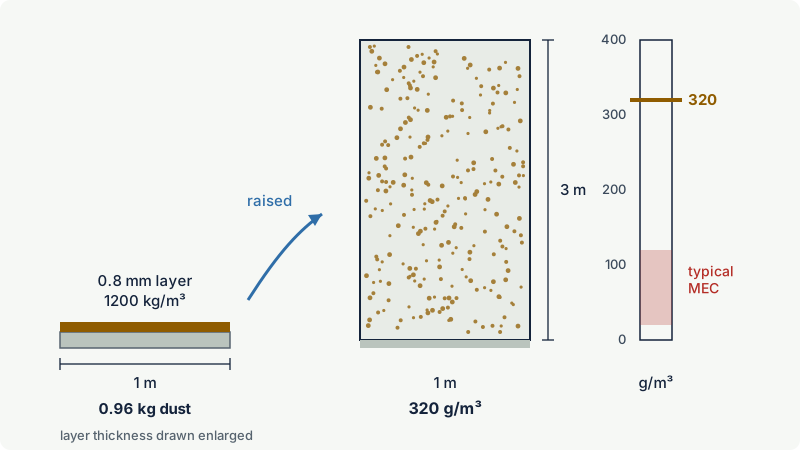
- A layer only 0.8 mm thick at a bulk density of 1200 kg/m³ contains enough dust to create about 320 g/m³ if it is spread through 3 m of room height, several times the minimum explosible concentration of most dusts.
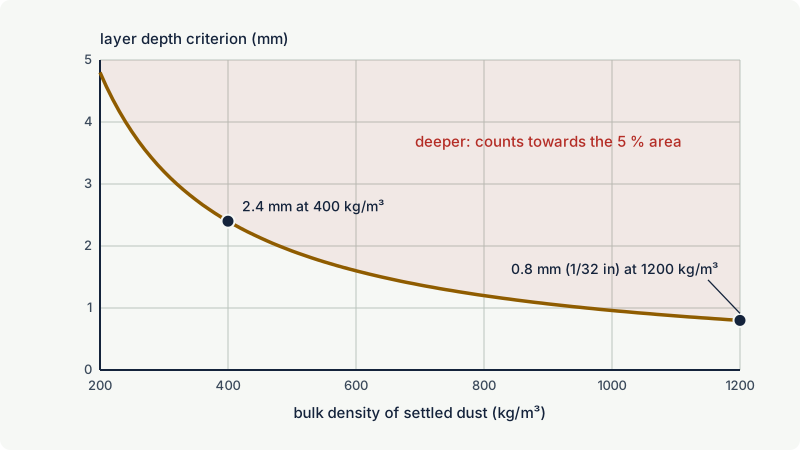
- The NFPA 654 (2013) layer depth criterion is 1/32 inch (0.8 mm) at 1200 kg/m³, scaled as 0.8 mm × 1200 / bulk density. A hazard exists when deeper layers cover more than 5 % of the floor area in total, or when a single such accumulation covers more than 1000 ft² (about 93 m²).
- Secondary explosions, fed by dust raised from floors, beams and ledges by a small primary event, cause most of the destruction in major dust explosions.
- Layers also ignite on their own: a layer on a hot surface can smoulder at temperatures far below the cloud ignition temperature, and thicker layers ignite at lower temperatures still.
- Vacuum cleaning with equipment suitable for combustible dust is the preferred method. Compressed air blowing raises clouds and should be avoided; where any code allows it at all, it is a last resort with ignition sources shut down.
- In IEC 60079-10-2, the housekeeping level (good, fair or poor) is part of the area classification. Layers that persist for more than a shift become a source of release in their own right.
How dust layers form
Combustible dust settles wherever air slows down. The sources are familiar: leaking flanges, flexible connections and seals, open transfer points, bag tipping and filling, overfilled bins, torn filters, and product carried out on clothing and vehicles. HSE guidance points out that layers can build up without any single release large enough to form a visible cloud, and that air currents carry the finest particles a long way and deposit them at high level. These fine particles are the most explosive fraction of the dust.
The places where layers grow unseen are the dangerous ones:
- High horizontal surfaces: roof beams, purlins, tops of ducts, light fittings, cable trays and the tops of enclosures. Dust that falls from height disperses well.
- Concealed spaces: above suspended ceilings, inside wall cavities and enclosures. In the 2003 explosion at a pharmaceutical plant in Kinston, North Carolina, polyethylene dust that had accumulated above suspended ceilings fuelled the explosion that killed six people, according to the CSB as summarised by OSHA.
- Around and on hot equipment: motors, lights, heaters, dryers and steam lines, where layers can ignite or block cooling.
Why a thin layer is dangerous
A settled layer contains dust at its bulk density, often hundreds of kilograms per cubic metre. When it is lifted into the air it is diluted into the height of the room. The average concentration of the cloud is:
concentration = bulk density × layer thickness / height of the cloud
The NFPA criterion is built on this calculation: a 0.8 mm layer at 1200 kg/m³ spread through 3 m gives 1200 kg/m³ × 0.0008 m / 3 m = 0.32 kg/m³, or 320 g/m³. Minimum explosible concentrations of many dusts lie roughly between 20 and 120 g/m³, so even partial lifting of such a layer produces an explosible cloud. HSE guidance gives a similar example: a layer of flour only 0.3 mm thick on the floor can in principle fill a room with an explosible cloud up to 3 m above the floor.
In practice the dust is never spread evenly, and that makes things worse, not better. A primary explosion or a pressure wave produces dense local clouds near floors, along beams and in corridors, through which the flame can run from room to room. This is the mechanism of the secondary explosion, explained step by step in What makes a dust explosive?. In the 2008 sugar refinery explosion at Port Wentworth, Georgia, the US Chemical Safety Board (CSB) found that a primary explosion in an enclosed conveyor dislodged dust and spilled sugar throughout the packing buildings and set off a cascade of secondary explosions; workers had testified that spilled sugar was knee-deep in places and dust coated equipment and elevated surfaces. Fourteen workers died.
How dust is lifted
A primary explosion is the most violent trigger, but not the only one. HSE guidance and published explanations of the NFPA criterion list everyday events that can raise settled dust: an opening door or window, a fan, a burst compressed air or steam line, equipment failure, a forklift striking a structure, and cleaning with compressed air or brooms. Each can create a local cloud that meets an ignition source.
Layers as an ignition source
A dust layer is also a fire hazard in its own right. On a hot surface, the layer insulates itself, heat builds up inside it and it can start to smoulder at a temperature far below the ignition temperature of a cloud of the same dust. The standard laboratory value is the minimum ignition temperature of a 5 mm layer, measured on a hot plate (see Dust explosion parameters explained). Thicker layers ignite at lower temperatures still. ASTM E2021 cites data for a pulverised bituminous coal whose hot-surface ignition temperature fell from 300 °C for a 6.4 mm layer to 210 °C for a 25.4 mm layer.
Three consequences follow:
- A smouldering layer is an ignition source for a cloud. If it is disturbed, by cleaning, vibration or a pressure wave, the glowing particles can ignite the dust cloud that forms around them.
- Layers on equipment raise its temperature. A layer insulates motors, lights and enclosures, so they run hotter. HSE guidance warns that deposits can block ventilation holes and interfere with cooling.
- Equipment selection assumes limited layers. IEC 60079-14 sets the maximum surface temperature of equipment from the cloud ignition temperature and from the 5 mm layer ignition temperature minus 75 K, and requires lower limits where thicker layers can form. HSE guidance notes that the electrical standards assume deposits never exceed 5 mm. The full rule is in Surface temperature limits for dust.
How thick is too thick? The criteria in use
| Source | Criterion | Status |
|---|---|---|
| NFPA 654 (2013); NFPA 660 (2025) has since replaced NFPA 654 | Layer depth criterion 1/32 in (0.8 mm) at 1200 kg/m³ bulk density, scaled for lighter dusts; hazard if exceeded over more than 5 % of the floor area, or by a single accumulation of more than 1000 ft² (about 93 m²) | US consensus standard; used by OSHA in enforcement (2015 memorandum) |
| OSHA 29 CFR 1910.272 (grain handling) | Fugitive grain dust in priority areas (floors within 35 ft (10.7 m) of inside bucket elevators, enclosed areas with grinding equipment or grain dryers) removed immediately when it exceeds 1/8 in (3.2 mm) | US regulation for grain facilities |
| IEC 60079-10-2 | No fixed thickness. Housekeeping level good, fair or poor, depending on whether layers are negligible and how long they persist | International standard for dust area classification |
| IEC 60079-14, HSE guidance | Equipment surface temperature rules based on layers up to 5 mm; thicker layers need lower temperatures or testing | Equipment selection, not a cleaning target |
| Often quoted shop-floor guidance | Clean when the colour of the surface underneath can no longer be seen | Rule of thumb only |
The NFPA layer depth criterion
The criterion comes from NFPA 654, the general standard for combustible particulate solids. In the 2013 edition the hazard conditions are in the main text on dust accumulation, and the calculation method with examples is explained in an annex. In December 2024 NFPA 654 was consolidated, with the other NFPA dust standards, into NFPA 660 (2025 edition), whose chapter for other combustible dusts takes its place. NFPA 660 still requires accumulation limits to be set for the facility, and the layer depth approach remains the common reference, but check the current NFPA 660 text before quoting a figure as an NFPA 660 requirement. The benchmark of 1/32 inch is tied to a bulk density of 75 lb/ft³ (1200 kg/m³). For lighter dusts the allowed depth increases in proportion:
layer depth criterion = 0.8 mm × 1200 kg/m³ / bulk density of the dust
According to the 2015 OSHA guidance memorandum on this method, a dust explosion and flash fire hazard exists in a room or building when non-separated accumulations deeper than the criterion cover more than 5 % of the floor area, or a single accumulation covers more than 1000 ft², or the total volume of such accumulations exceeds the criterion multiplied by those areas. NFPA also offers mass-based methods, one of which also takes account of the dust's combustibility and the building design, and a documented risk assessment, as alternatives. All of them describe a threshold that triggers action, not a target; the published guidance stresses that the aim is zero accumulation.
Worked example
A packing hall measures 30 m × 20 m (600 m²). The product has a bulk density of 400 kg/m³ when settled.
- Layer depth criterion: 0.8 mm × 1200 / 400 = 2.4 mm
- 5 % of the floor area: 0.05 × 600 m² = 30 m² (a single accumulation over 93 m² would also count, but in a hall of this size the 30 m² limit is reached first)
- Volume limit: 0.0024 m × 30 m² = 0.072 m³, which is about 29 kg of dust at 400 kg/m³
If layers deeper than 2.4 mm cover more than 30 m² of floor, beams and ledges in total, or the dust in such layers exceeds about 29 kg, the hall has a dust explosion and flash fire hazard under this method, and the layers must be removed or the risk addressed by other means such as building venting and flame-resistant clothing. A fine powder with a bulk density of 1200 kg/m³ would reach the criterion at 0.8 mm, a thickness that is easy to overlook.
Housekeeping: prevent, inspect, clean
Good housekeeping is a system, not a broom.
Prevent the dust from escaping. HSE guidance names a leak-tight plant as the first step: loosely bolted flanges, damaged flexible seals and propped-open hatches are common sources. Operating equipment under slight negative pressure, capturing dust at transfer points with local exhaust ventilation, and high-level alarms that stop bins overflowing all reduce the source. Designing buildings with few horizontal ledges, sloping tops on enclosures and good access to high places reduces both accumulation and the work of cleaning.
Inspect where dust hides. Inspection routes must include high-level surfaces, the space above suspended ceilings, cable trays and the tops of equipment, not only the floor. HSE guidance warns not to neglect the highest parts of buildings, where the finest dust collects. Recording measured layer depths and areas at fixed points turns housekeeping into something that can be audited.
Clean on a schedule and after spills. A routine schedule keeps general accumulation below the threshold, and a rule for unscheduled cleaning deals with spills and leaks. The 2013 edition of NFPA 654 required time limits for cleaning local spills and gave guidance values in an annex table, based on the accumulation on the worst single square metre:
| Accumulation, multiple of the threshold | Floor-accessible surfaces | Remote surfaces |
|---|---|---|
| more than 1 up to 2 times | within 8 hours | within 24 hours |
| more than 2 up to 4 times | within 4 hours | within 12 hours |
| more than 4 times | within 1 hour | within 3 hours |
The cleaning method, frequency, responsibility and the threshold that triggers action belong in the written housekeeping programme and in the explosion protection document; see The Explosion Protection Document (EPD).
Cleaning methods: what to use and what to avoid
| Method | Assessment | Conditions |
|---|---|---|
| Vacuum cleaning | Preferred | Fixed central system or mobile vacuum designed for combustible dust; conductive and earthed hose and nozzle; the unit itself suitable for the zone it is used in; collected dust handled as combustible |
| Soft sweeping, scraping, shovelling | Acceptable for heavy spills and coarse material | Gentle technique that does not throw dust into the air; dustpan rather than broom where possible; brooms tend to raise clouds |
| Water washing or wet wiping | Useful where the product and equipment allow it | Not for dusts that react with water, such as some metal powders; electrical equipment must be protected; wet residue may need drying before disposal |
| Compressed air blowing | Avoid | Raises exactly the cloud you are trying to prevent. Where allowed at all (see below), only after other methods, with ignition sources shut down |
| High-pressure water jets on smouldering material | Do not use | Can raise clouds and turn a fire into an explosion |
HSE guidance states that the preferred method is a vacuum system rather than brushes and shovels, which tend to raise dust clouds, and that compressed air lines should not be used to dislodge dust deposits. US codes take a similar line with narrow exceptions: the OSHA grain handling standard allows blowing down with compressed air only when all machinery that presents an ignition source in the area is shut down and other known ignition sources are removed or controlled, and NFPA 654 (2013) treated compressed air as a last resort after vacuuming, sweeping or washing, with pressure-limited nozzles. In practice, if compressed air is the only way to reach a surface, the area should be treated as a hazardous area during the work, with hot work and electrical ignition sources controlled.
A vacuum cleaner that collects combustible dust contains an explosive atmosphere inside it and must not become the ignition source. Industrial vacuum units built for combustible dust have earthed, conductive hoses and nozzles, internal parts that do not produce sparks or hot surfaces, and, where used in a classified area, the appropriate Ex marking. A domestic or general workshop vacuum is not suitable.
Warning: Do not try to clean up a smouldering or burning dust layer by sweeping or blowing. Disturbing it can produce a cloud and an explosion. Cool it with a fine water spray where the material allows, or follow the site emergency plan.
What housekeeping means for area classification
Directive 1999/92/EC requires layers, deposits and heaps of combustible dust to be considered like any other source that can form an explosive atmosphere, and IEC 60079-10-2 builds the housekeeping level into the classification:
| Housekeeping level | Layers | Consequence for the zones |
|---|---|---|
| Good | Negligible thickness or none, whatever the grade of release | Zones follow from the sources of release only |
| Fair | Not negligible but short-lived, removed within a shift | Layers are a limited source; the fire risk from layers on hot surfaces must be considered |
| Poor | Not negligible and persisting for more than a shift | Layers are a source of release in their own right; zones can grow and fire and secondary explosion risk can be significant |
The practical rule is that a dust zone drawing is valid only together with the housekeeping it assumes. If the drawing was produced on the basis of good housekeeping and the plant now has persistent layers on beams and cable trays, the classification is wrong: the area around those layers needs at least Zone 22, the installed equipment may no longer be suitable, and the secondary explosion hazard has to be addressed. Housekeeping can reduce Zone 22 areas that exist only because of settled dust; it cannot remove zones created by the process itself, such as Zone 20 inside a mill. See Dust zones 20, 21 and 22 explained.
Layer thickness also affects equipment. Where layers thicker than 5 mm cannot be prevented, for example on equipment that is hard to reach, the maximum surface temperature of electrical and non-electrical equipment must be reduced or established by testing, and equipment that may be buried in dust needs special assessment.
Common mistakes and misconceptions
- "It's only a thin film." A layer under 1 mm can be enough for an explosible cloud across a room. Judge layers by area and bulk density, not by how untidy they look.
- Cleaning only the floor. Beams, cable trays, light fittings and the space above suspended ceilings hold the finest dust and drop it from height. They need scheduled inspection and cleaning.
- Blowing down with compressed air. It moves the dust somewhere else and creates a cloud on the way. Use vacuum cleaning; treat compressed air as an exception under strict control, if at all.
- Using an ordinary vacuum cleaner. An unsuitable vacuum can ignite the dust it collects. Use units designed for combustible dust and the zone.
- Treating housekeeping as a substitute for fixing leaks. Cleaning that has to remove the same layer every day is a sign that the plant leaks. Fix the source first.
- Not linking housekeeping to the zone drawing. If the classification assumes good housekeeping, the cleaning frequency and responsibility must be written down and audited.
Frequently asked questions
How thick can a dust layer be before it is dangerous?
There is no universal safe thickness, but layers well under 1 mm can be enough for an explosible cloud if they are raised. The NFPA 654 (2013) layer depth criterion uses 1/32 inch (0.8 mm) for a dust with a bulk density of 1200 kg/m³, scaled up for lighter dusts, and considers a hazard to exist when deeper layers cover more than 5 % of the floor area.
What does the 1/32 inch rule mean?
It is the benchmark layer depth of NFPA 654 (2013 edition), the US standard that NFPA 660 replaced in December 2024, for a dust with a bulk density of 75 lb/ft³ (1200 kg/m³). A layer this thick, raised through 3 m of room height, produces about 320 g/m³, above the minimum explosible concentration of most dusts. For lighter dusts the criterion is increased in proportion to 1200 divided by the bulk density.
Can I use compressed air to clean combustible dust?
It should be avoided, because it raises the dust into a cloud. HSE guidance advises against it, and US rules allow it only in restricted cases: for grain facilities, only when all machinery that is an ignition source in the area is shut down and other ignition sources are controlled. Vacuum cleaning with equipment designed for combustible dust is the preferred method.
Does a dust layer make an area a hazardous zone?
A layer is not an explosive atmosphere by itself, but it is a source that can form one when disturbed, and it can ignite on hot surfaces. Directive 1999/92/EC and IEC 60079-10-2 require layers to be considered in the classification; where layers persist for more than a shift, the area around them is typically classified at least Zone 22.
What kind of vacuum cleaner is needed for combustible dust?
An industrial vacuum unit designed for collecting combustible dust, with conductive and earthed hoses and nozzles and no internal ignition sources, or a fixed central vacuum system with its own explosion protection. If it is used inside a hazardous area, the unit must also be certified for that zone. Ordinary domestic or workshop vacuums are not suitable.
Related on excodex
- What makes a dust explosive? Particle size, concentration and the dust explosion pentagon
- Dust zones 20, 21 and 22 explained with practical examples
- Surface temperature limits for dust: the two-thirds cloud rule and the 75 K layer margin
- Dust collectors, silos and bucket elevators: where dust explosions start
- The Explosion Protection Document (EPD) and area classification drawings
- Standards spaces: IEC 60079-10-2, IEC 60079-14, ATEX 1999/92/EC; questions in the forum
Standards and further reading
- IEC 60079-10-2, classification of areas, explosive dust atmospheres, including the informative annex on dust layers and housekeeping levels.
- IEC 60079-14:2024, electrical installations in explosive atmospheres, including the correlation between dust layer thickness and maximum permissible surface temperature: catalogue entry
- NFPA 660 (2025), standard for combustible dusts and particulate solids (consolidating NFPA 652, 654 and the commodity standards): nfpa.org
- OSHA, standard interpretation of 21 April 2015 on dust accumulation and the layer depth criterion: osha.gov
- OSHA 29 CFR 1910.272, grain handling facilities, housekeeping and compressed air rules: osha.gov
- OSHA Safety and Health Information Bulletin on combustible dust in industry: osha.gov
- Explanation of the NFPA 654 (2013) housekeeping requirements and the layer depth criterion: ohsonline.com
- HSE, HSG103 Safe handling of combustible dusts (housekeeping, cleaning methods, layers): hse.gov.uk (free PDF)
- HSE, guidance for inspectors on dust area classification (layers, high ledges, Zone 22): hse.gov.uk
- US Chemical Safety Board, final report on the 2008 Port Wentworth sugar dust explosions: csb.gov
This article is general technical information prepared by the excodex editorial team. It does not replace the applicable standards, the equipment certificates and instructions, national regulations or the assessment of a competent person.