Dust groups IIIA, IIIB and IIIC: combustible flyings, non-conductive and conductive dusts
Abstract
Group III Ex equipment is divided by dust type: IIIA combustible flyings, IIIB non-conductive dust, IIIC conductive dust. Definitions, the 500 µm and 10³ Ω·m criteria, examples, marking, and why conductive dust demands dust-tight IP6X enclosures.
Equipment for explosive dust atmospheres belongs to Group III, which is divided into three subgroups according to the kind of dust. IIIA is for combustible flyings: solid particles, including fibres, larger than 500 µm. IIIB is for non-conductive dust: combustible particles of 500 µm or less with an electrical resistivity above 10³ Ω·m. IIIC is for conductive dust: combustible particles of 500 µm or less with a resistivity of 10³ Ω·m or less, which includes all metal dusts. The subgroup is part of the Ex marking, for example Ex tb IIIC T85 °C Db, and the hierarchy runs one way: IIIC equipment is suitable for all three subgroups, IIIB equipment for IIIB and IIIA, IIIA equipment only for flyings.
This article explains what the subgroups are based on, gives typical materials for each, shows how resistivity is determined, explains why conductive dust is the most demanding case and how the subgroup affects marking, IP ratings and equipment selection.
Key points
- Dust subgroups are based on particle size and electrical resistivity, not on how easily the dust ignites or how violently it explodes. Ignition sensitivity is handled separately through the maximum surface temperature and other measures.
- IIIA: combustible flyings larger than 500 µm, such as cotton, jute, sisal and other fibres. IIIB: non-conductive dust such as flour, sugar, starch, wood, most plastics and many chemicals. IIIC: conductive dust, including every metal dust.
- The limit of 10³ Ω·m is measured with the resistivity test in ISO/IEC 80079-20-2. Metal dusts are always treated as conductive, because a surface oxide layer cannot be relied on to keep their resistivity high.
- Conductive dust is the most demanding because, besides igniting, it can get inside an enclosure and create conductive paths between live parts, leading to leakage currents, tracking, short circuits and sparks.
- For protection by enclosure
t, dust-tight IP6X is required for IIIC at every level (ta,tbandtc), whereas IIIB accepts IP5X at leveltcand IIIA accepts IP5X attbandtc. - The subgroups entered the European general requirements standard in its 2009 edition, when the dust requirements of the former IEC 61241 series were transferred into the IEC 60079 series. Older dust equipment may carry no subgroup at all.
Why dust has subgroups
Gas subgroups IIA, IIB and IIC describe the gas itself: how easily its flame passes through a narrow gap and how little electrical energy ignites it. Dust subgroups answer a different question: how does the dust interact with the equipment?
- Particle size decides how easily the material penetrates gaps and joints. Fibres and coarse flyings are stopped by a dust-protected enclosure; fine dust is not always.
- Electrical resistivity decides what the dust does once it is inside. A non-conductive dust deposit insulates; a conductive deposit can carry current between parts at different potentials.
The explosion properties of the dust, such as its minimum ignition temperatures, minimum ignition energy and Kst, are deliberately not part of the subgroup. They are handled by the maximum surface temperature marked on the equipment, by the installation rules and by explosion protection measures. That is why a strongly explosible St 2 dust such as some cellulose or wood dusts is IIIB, while a weakly explosible metal powder is still IIIC.
The three subgroups defined
| Subgroup | Definition (paraphrased) | Criterion | Typical materials |
|---|---|---|---|
| IIIA | Combustible flyings: solid particles, including fibres, larger than 500 µm nominal size that can form an explosive mixture with air | particle size above 500 µm | cotton, flax, jute, sisal, hemp and other textile fibres; fibrous plant material |
| IIIB | Non-conductive combustible dust | 500 µm or less, resistivity above 10³ Ω·m | flour, grain dust, sugar, starch, milk powder, wood dust, most plastic and resin powders, many pharmaceuticals and organic chemicals |
| IIIC | Conductive combustible dust | 500 µm or less, resistivity of 10³ Ω·m or less | aluminium, magnesium, titanium, zinc and iron powders and other metal dusts; carbon-rich dusts whose measured resistivity is low |
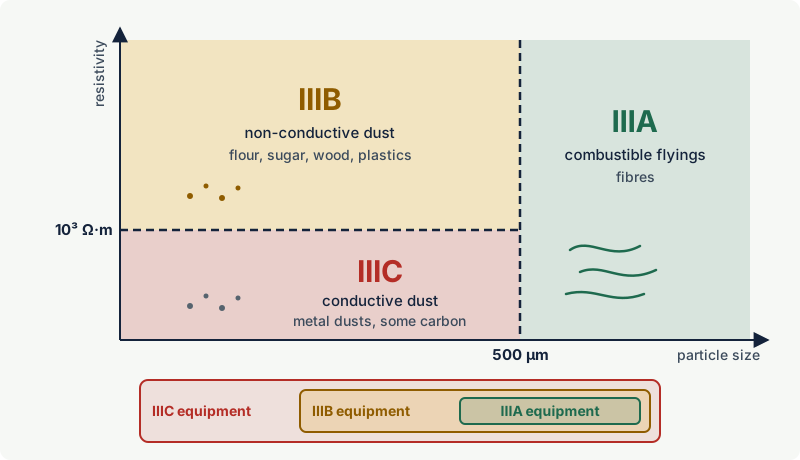
IIIA: combustible flyings
Flyings are fibres and other combustible particles that are too large to be "dust" in the IEC sense but can still burn rapidly and form explosive mixtures when suspended. They are typical of textile mills, cotton gins, flax and jute processing, rope making and some woodworking and paper processes. Their large size means they do not readily penetrate small gaps, so IIIA equipment needs less dust tightness than IIIB or IIIC equipment at the same protection level.
Flyings are often accompanied by fine dust. Fibre processing produces short fibres and fragments, and the material that collects in filters and on ledges can be much finer than the product. Where a significant fine fraction is present, the dust must be assessed as IIIB (or IIIC), and IIIA equipment is no longer enough. ISO/IEC 80079-20-2 includes screening methods for deciding whether a fibrous material behaves as combustible flyings.
IIIB: non-conductive dust
Most combustible dusts are non-conductive: practically all food, agricultural, wood, plastic and organic chemical dusts. Their resistivity is normally well above 10³ Ω·m. IIIB is therefore the subgroup of most dust applications in the food, feed, wood, plastics, pharmaceutical and chemical industries.
Non-conductive does not mean electrically harmless. Deposits of non-conductive dust can hold electrostatic charge, insulating layers on hot equipment cause overheating, and moisture can lower the resistivity of some hygroscopic dusts. These effects are dealt with by other requirements, not by the subgroup.
IIIC: conductive dust
The International Electrotechnical Vocabulary defines conductive dust as combustible dust with a resistivity of 10³ Ω·m or less, and adds that metal dusts are classed as conductive, because surface oxidation cannot be relied upon to keep their resistivity consistently above that value. No resistivity test is needed to classify aluminium, magnesium or iron powder as IIIC.
Carbon-rich dusts are the grey area. Some grades of carbon black, graphite, coke and similar materials have a low resistivity and are IIIC; others are not. The measured resistivity of the actual dust, not its name, decides.
How dust resistivity is determined
The resistivity test is one of the combustible dust test methods collected in ISO/IEC 80079-20-2, which replaced the earlier IEC 61241-2-2 method. In principle, a test cell of defined geometry is filled with the dust, a voltage is applied between two electrodes and the resulting current is measured. The resistivity follows from the measured resistance, the electrode area and the electrode spacing:
resistivity (Ω·m) = resistance (Ω) × electrode area (m²) / electrode spacing (m)
Practical points:
- Test the dust as it occurs in the plant, in particular its fineness and moisture. Moisture and compaction can lower the measured resistivity; for non-metallic dusts close to the limit, it is prudent to use the more demanding subgroup.
- Mixtures follow the most demanding component in practice. A powder coating containing aluminium flake, or a plastic powder with a significant metallic or carbon black content, should be treated as IIIC unless tests show otherwise.
- The test answers only the subgroup question. It does not replace the explosibility, ignition temperature and MIE tests described in Dust explosion parameters explained.
Why conductive dust is the most demanding
Ingress and conductive bridges
Every enclosure has joints, gaskets, shaft seals and cable entries through which very fine dust can migrate, especially when the enclosure "breathes" as it warms up and cools down. A small amount of non-conductive dust inside is mainly a thermal and fire concern. A small amount of conductive dust inside is an electrical problem: it can settle across terminals, between tracks on a circuit board or over insulating surfaces and form a path for current. The result can be leakage currents, tracking across insulation, short circuits and sparks inside the enclosure, exactly what the protection concept is meant to exclude.
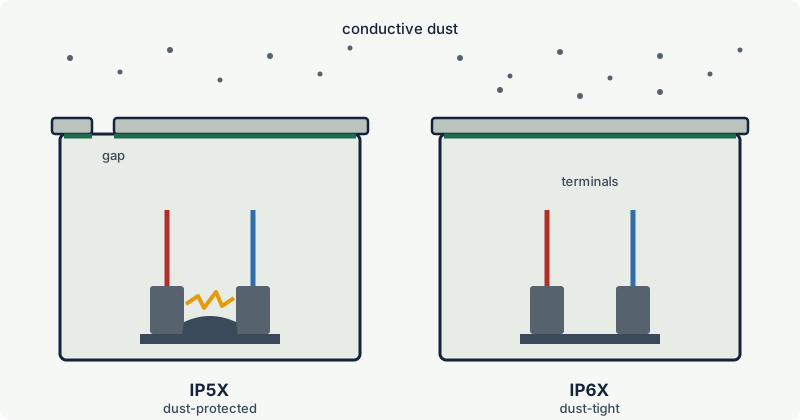
IP requirements for protection by enclosure "t"
The difference shows most clearly in protection by enclosure (Ex t, IEC 60079-31), where the enclosure itself is the protection. IEC 60529 defines IP5X as dust-protected (ingress not totally prevented, but not in a quantity that interferes with safe operation) and IP6X as dust-tight (no ingress of dust).
| Subgroup | Level ta (EPL Da) | Level tb (EPL Db) | Level tc (EPL Dc) |
|---|---|---|---|
| IIIA | IP6X | IP5X | IP5X |
| IIIB | IP6X | IP6X | IP5X |
| IIIC | IP6X | IP6X | IP6X |
The bottom row is the key point of this article: for conductive dust, even the lowest protection level needs a dust-tight enclosure. A luminaire marked Ex tc IIIB T80 °C Dc with an IP5X enclosure is acceptable in Zone 22 with flour dust, but not in Zone 22 with aluminium dust.
Other protection concepts
The subgroup also matters outside Ex t. The intrinsic safety standard IEC 60079-11 relates its separation distances to the enclosure that protects them from dust, and its 2023 edition clarified the enclosure requirements for IIIC equipment whose separations rely on an IP5X enclosure. Encapsulation, pressurisation and the other concepts used for Group III likewise carry the subgroup in their marking, and the certificate states which dust the equipment has been assessed for.
Installation, inspection and maintenance
In IIIC areas the dust tightness of the installed equipment is safety-critical every day, not only at certification. Damaged gaskets, a missing blanking plug, a cable gland that does not seal on the cable, or a cover left loose after maintenance can turn an IP6X enclosure into a path for conductive dust. Inspection to IEC 60079-17 checks these points, and maintenance should treat any dust found inside an enclosure in a IIIC area as a finding to investigate.
Metal dusts often bring further hazards that are not part of the subgroup but tend to coincide with it: very high explosion severity (fine aluminium powders are often St 3), high flame temperatures, and in some cases reaction with water that releases hydrogen.
Marking and selecting equipment by subgroup
Reading the subgroup in the marking
| Marking example | Meaning |
|---|---|
Ex tb IIIC T85 °C Db | Protection by enclosure, level tb; suitable for conductive dust and therefore also IIIB and IIIA; maximum surface temperature 85 °C; EPL Db |
Ex ia IIIC T135 °C Da | Intrinsic safety, level ia; suitable for all dust subgroups; maximum surface temperature 135 °C; EPL Da |
Ex tc IIIB T120 °C Dc | Protection by enclosure, level tc; suitable for non-conductive dust and flyings only; EPL Dc |
II 2D Ex tb IIIC T85 °C Db | European marking: ATEX group II (non-mining), category 2 for dust, followed by the IEC-style marking |
Dust equipment is marked with a maximum surface temperature in degrees Celsius rather than a gas T-class. Some equipment also carries a temperature for a specified layer thickness, for example a value for a 500 mm layer, when it has been assessed for installation in thick layers. The eighth edition of IEC 60079-0, published in 2026, requires the ambient temperature range to be marked in every case.
Note the two different "groups" in the European marking: II in II 2D is the ATEX equipment group (everything other than mines), while IIIC is the IEC dust subgroup. Both are correct in their own system; see Equipment groups I, II and III.
Dust equipment certified to the former IEC 61241 series, before the subgroups existed, carries markings without IIIA, IIIB or IIIC, for example Ex tD A21 IP65 T80°C. For such equipment the IP code shows the dust tightness, and suitability for a conductive dust has to be judged from it (IP6X) and from the certificate.
Which subgroup is acceptable?
| Dust present | Acceptable equipment subgroup |
|---|---|
| Combustible flyings only (IIIA) | IIIA, IIIB or IIIC |
| Non-conductive dust (IIIB) | IIIB or IIIC |
| Conductive dust (IIIC) | IIIC only |
The subgroup is one of four checks, together with the EPL required by the zone, the maximum surface temperature derived from the dust's ignition temperatures, and the ambient temperature range. See Dust zones 20, 21 and 22 and Surface temperature limits for dust.
Worked example: one site, three dusts
A factory spins and weaves cotton yarn in one hall, mills wheat flour for a bakery product line in another, and applies aluminium-pigmented powder coating to finished parts in a third.
| Area | Dust | Subgroup | Zone (from the assessment) | Minimum equipment |
|---|---|---|---|---|
| Spinning and weaving hall | cotton fibre and lint | IIIA, but filters and floor sweepings also contain fine dust | Zone 22 | Treat as IIIB because of the fine fraction: Ex tc IIIB Dc or better |
| Flour handling | wheat flour | IIIB | Zone 21 around the bag tipping point | Ex tb IIIB Db, or IIIC |
| Powder coating booth | coating powder with aluminium pigment | IIIC (metal content) | Zone 21 inside and near the booth openings | Ex tb IIIC Db, IP6X |
Many operators standardise on IIIC equipment throughout a site, because the extra cost is usually small and it removes the risk of a IIIB item being installed in a IIIC area during maintenance. The surface temperature limit must still be checked for each dust.
IEC subgroups and North American groups
North American practice uses two systems for dust. The Class and Division system of NEC Article 500 groups dusts into Class II, Groups E (metal dusts), F (carbonaceous dusts) and G (other dusts such as flour, grain, wood and plastics), with fibres and flyings in Class III. The Zone system of NEC Article 506 uses IIIA, IIIB and IIIC, and its informational notes equate IIIC with Group E, IIIB with Groups F and G, and IIIA with Class III.
The definitions are therefore not identical. In NEC Article 506, IIIC is defined by material (combustible metal dust), whereas IEC uses resistivity. A conductive carbonaceous dust can be IIIC under IEC rules but IIIB (Group F) under the NEC Zone system. Equipment must be selected under the system that applies to the installation; see Zones vs Divisions.
Common mistakes
- Assuming IIIB because a dust "looks organic". Pigments, fillers and additives can make a mixture conductive. Check the composition and, near the limit, the measured resistivity.
- Classifying metal powder by test result. Metal dusts are IIIC by definition; an oxide film measured as high resistivity on one sample is not a reliable basis for IIIB.
- Using IIIA equipment where fibres shed fine dust. Lint and filter dust are often fine enough to be IIIB.
- Reading
IIinII 2Das the dust group. It is the ATEX equipment group. The dust subgroup is the IIIA, IIIB or IIIC in the IEC part of the marking. - Thinking the subgroup reflects explosion violence. St class, MIE and ignition temperatures are separate properties; the subgroup is about particle size and conductivity.
- Forgetting that IP6X must survive maintenance. In a IIIC area an open entry, a worn gasket or a loose cover defeats the reason the subgroup exists.
Frequently asked questions
What is the difference between IIIA, IIIB and IIIC?
IIIA covers combustible flyings, meaning fibres and particles larger than 500 µm. IIIB covers non-conductive combustible dust of 500 µm or less with a resistivity above 10³ Ω·m. IIIC covers conductive combustible dust of 500 µm or less with a resistivity of 10³ Ω·m or less, including all metal dusts.
Can IIIC equipment be used for IIIB dust?
Yes. IIIC is the most demanding subgroup, so IIIC equipment is suitable for IIIC, IIIB and IIIA dusts. IIIB equipment may be used for IIIB and IIIA, but never for conductive dust. The EPL, maximum surface temperature and ambient range must still be checked.
Is coal dust IIIB or IIIC?
It depends on the measured resistivity of the actual dust, which varies with the type of coal and its processing. Carbon-rich materials range from non-conductive to conductive; some cokes, carbon blacks and graphites are conductive. Without test data, use IIIC equipment or have the resistivity measured.
Why does conductive dust need IP6X?
Conductive dust that enters an enclosure can form current paths between terminals and live parts, causing tracking, short circuits and sparks. An IP5X enclosure limits ingress but does not prevent it, so for conductive dust protection by enclosure requires dust-tight IP6X at every protection level, including tc for Zone 22.
Is aluminium dust always IIIC?
Yes. Aluminium and other metal dusts are classed as conductive because their surface oxide cannot be relied on to keep the resistivity above 10³ Ω·m. Fine aluminium powders are also among the most violently explosive dusts, so the area usually needs strong explosion protection measures as well.
Related on excodex
- Equipment groups I, II and III: mining, gas and dust
- Dust ignition protection by enclosure (Ex t): ta, tb and tc
- Dust zones 20, 21 and 22 explained with practical examples
- How to read an Ex marking: decoding II 2 G Ex db IIC T4 Gb step by step
- Dust explosion parameters explained: Kst, Pmax, St classes, MIE and minimum ignition temperatures
- Tools and spaces: Ex marking check, standards spaces IEC 60079-0, IEC 60079-31, NEC 500 to 506, forum
Standards and further reading
- IEC 60079-0, Equipment, general requirements: equipment Group III and subgroups IIIA, IIIB and IIIC, marking. The eighth edition was published in June 2026 and replaces the 2017 edition.
- IEC 60079-31, Equipment dust ignition protection by enclosure "t", with the IP requirements per level and subgroup.
- ISO/IEC 80079-20-2:2016, Material characteristics, combustible dusts test methods, including the resistivity test and the screening of flyings: catalogue entry
- IEC 60079-11, intrinsic safety, edition 7 (2023), including enclosure requirements for Group III equipment.
- IEC 60529, degrees of protection provided by enclosures (IP code).
- International Electrotechnical Vocabulary, IEV 426-02-19 "conductive dust": electropedia.org, and IEV 426-02-30 "non-conductive dust": electropedia.org
- NSW TestSafe, dust ignition protection by enclosure, IP requirements by dust group and level: nsw.gov.au
- Health and Safety Authority (Ireland), ATEX delivery guide on combustible dust, including definitions of the dust groups: hsa.ie
- NFPA 70 (National Electrical Code), Articles 500 and 506, Class II groups and Zone 20, 21 and 22 dust groups.
This article is general technical information prepared by the excodex editorial team. It does not replace the applicable standards, the equipment certificates and instructions, national regulations or the assessment of a competent person.