Zones vs Divisions: IEC and ATEX zones compared with NEC Class I Division 1 and 2
Abstract
Division 1 roughly equals Zone 0 plus Zone 1, and Division 2 roughly equals Zone 2, but groups, temperature codes and equipment rules do not map one to one. NEC Articles 500, 505 and 506 compared with IEC and ATEX zones, with tables and pitfalls.
The Division system of the US National Electrical Code (NEC, NFPA 70) splits a Class I hazardous location into two parts: Division 1, where flammable gas or vapour can be present in normal operation, and Division 2, where it is present only under abnormal conditions such as a leak. The IEC zone system, used by ATEX in Europe and by most of the world, splits the same space into three: Zone 0, Zone 1 and Zone 2. As a first approximation, Division 1 equals Zone 0 plus Zone 1, and Division 2 equals Zone 2. The NEC itself offers both methods: Article 500 for Classes and Divisions, Article 505 for Class I Zones and Article 506 for dust and fibre Zones.
The approximation stops there. Gas groups, dust groups, temperature codes, equipment markings and the rules for using equipment from one system in the other all differ in ways that matter on site. This article lays the two systems side by side and lists the traps.
Key points
- Class I Division 1 covers both Zone 0 and Zone 1; Class I Division 2 corresponds to Zone 2. The zone system adds resolution where the hazard is greatest.
- Under the NEC, equipment listed for Zone 1 (for example
AEx dborAEx eb) may be used in Division 2 but not in Division 1. Of the zone-listed equipment, only Zone 0 equipment may go into a Division 1 location. - Division 1 equipment may be used in Zone 1 and Zone 2, and Division 2 equipment in Zone 2, for the same gas group and a suitable temperature class. Neither is automatically suitable for Zone 0.
- Group letters run in opposite directions: Group A (acetylene) is the most severe in the Division system, while IIA is the least severe in the zone system. IIC corresponds to Groups A and B, IIB to Group C, IIA to Group D, but the MESG boundaries are not identical.
- The Division system uses 14 temperature codes (T1 to T6 plus T2A to T2D, T3A to T3C and T4A); the IEC and NEC Article 505 systems use only T1 to T6.
- On one site, a Zone 2 area may abut a Division 2 area but not overlap it, and Zone 0 or Zone 1 areas must not abut Division areas.
- Canada adopted zones for Class I in its 1998 electrical code; the Canadian Electrical Code (CEC) Section 18 uses zones, with the Division rules kept in an appendix for existing facilities.
Two languages for the same hazard
Both systems answer the same question: how likely is it that an explosive atmosphere is present at a given point, and therefore how good must the electrical equipment there be? The Division system grew up in North American codes and was the only method in the NEC until the 1996 edition introduced Article 505 for Class I Zones. Zones come from the IEC (International Electrotechnical Commission) standards, IEC 60079-10-1 for gases and IEC 60079-10-2 for dusts, and in Europe they are written into law by the workplace directive 1999/92/EC. See hazardous area zones explained for the zone definitions themselves.
In the United States both systems are legal. The federal OSHA electrical rules allow the zone system as an alternative to the Division system for Class I locations, and the NEC contains complete rules for both. The owner chooses, and many US sites still use Divisions while others classify in Zones. Canada went further: since its 1998 code, new Class I installations are classified in zones.
NEC Articles 500 to 506: what each one covers
| NEC article | System | Covers | Groups used |
|---|---|---|---|
| 500 | Class and Division | General rules, definitions, groups, marking for Classes I, II, III | A, B, C, D; E, F, G |
| 501, 502, 503 | Class and Division | Installation rules for Class I, Class II and Class III locations | as Article 500 |
| 504 | both | Intrinsically safe systems | as marked |
| 505 | Zone | Class I, Zone 0, 1 and 2 (gases, vapours) | IIA, IIB, IIC |
| 506 | Zone | Zone 20, 21 and 22 (combustible dusts, ignitible fibres and flyings) | IIIA, IIIB, IIIC |
Article 506 is a dust and fibre zone system only: it does not cover Zones 0, 1 and 2, and it is a complete alternative to the Class II and Class III Division rules of Articles 500, 502 and 503. Section numbers inside these articles have moved between editions (the 2026 edition is current at NFPA, but each state or city adopts its own edition), so check the edition your authority having jurisdiction (AHJ) enforces before quoting a section.
Classes, Divisions and Zones mapped
The Division system first sorts the hazard by material into three Classes:
- Class I: flammable gases, flammable liquid-produced vapours and combustible liquid-produced vapours.
- Class II: combustible dust.
- Class III: easily ignitible fibres and flyings, such as cotton lint or flax.
Each Class is then split into Division 1 and Division 2. For Class I, Division 1 is a location where ignitible concentrations can exist in normal operation, can exist frequently because of repair, maintenance or leakage, or where a breakdown could release gas and at the same time make the electrical equipment an ignition source. Division 2 is a location where the material is handled but normally confined in closed systems, where ventilation normally prevents ignitible concentrations, or which is next to a Division 1 location.
| Likelihood of explosive atmosphere | Division system (NEC 500) | Zone system (NEC 505/506, IEC, ATEX) |
|---|---|---|
| Gas: continuously or for long periods | Class I, Division 1 | Zone 0 |
| Gas: likely in normal operation | Class I, Division 1 | Zone 1 |
| Gas: not likely, and then only briefly | Class I, Division 2 | Zone 2 |
| Dust: continuously or for long periods | Class II, Division 1 | Zone 20 |
| Dust: likely in normal operation | Class II, Division 1 | Zone 21 |
| Dust: not likely, and then only briefly | Class II, Division 2 | Zone 22 |
| Fibres and flyings | Class III, Division 1 or 2 | Zone 20, 21 or 22 (Group IIIA) |
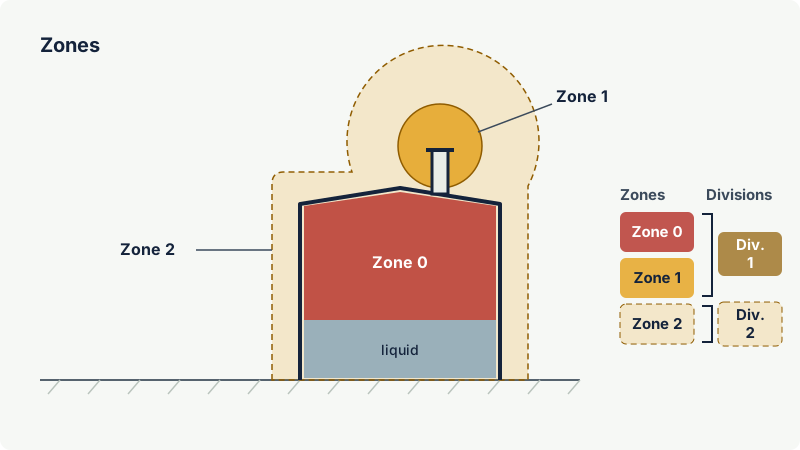
Two details explain most of the differences. First, Division 1 lumps together the continuous hazard inside a tank and the occasional hazard around a vent, so Division 1 equipment must be good enough for both. The zone system separates them and asks for the highest protection level only where the atmosphere is present for long periods. Second, Class III Divisions are defined by activity (where fibres are made, handled or used, or only stored), not by probability, so there is no exact zone equivalent: under Article 506 fibres and flyings are simply classified in Zones 20, 21 or 22 like dust and placed in Group IIIA.
North American codes also define zones partly by adjacency: a location next to Zone 0 from which vapours could spread is Zone 1, and one next to Zone 1 is Zone 2, unless ventilation prevents it, just as Division 2 includes locations next to Division 1. IEC 60079-10-1 reaches similar results through release and ventilation assessment rather than a fixed rule. For the IEC method, see how to carry out a gas hazardous area classification.
Gas groups A to D and IIA, IIB, IIC
Both systems group gases by how easily an explosion passes through a narrow gap (the maximum experimental safe gap, MESG) and by how little electrical energy ignites them (the minimum igniting current ratio, MIC ratio). Background is in MESG and MIC and gas groups IIA, IIB and IIC.
| NEC Article 500 group | MESG (or MIC ratio) | Typical gas | NEC Article 505 group | MESG (or MIC ratio) |
|---|---|---|---|---|
| A | acetylene only | acetylene | IIC | 0.50 mm or less (0.45 or less) |
| B | 0.45 mm or less (0.40 or less) | hydrogen | IIC | 0.50 mm or less (0.45 or less) |
| C | above 0.45 to 0.75 mm (above 0.40 to 0.80) | ethylene | IIB | above 0.50 to 0.90 mm (above 0.45 to 0.80) |
| D | above 0.75 mm (above 0.80) | propane, methane | IIA | above 0.90 mm (above 0.80) |
The NEC states the equivalence as IIC = Groups A and B, IIB = Group C, IIA = Group D, and the Canadian code's table of equivalents adds that equipment marked IIC suits Groups A, B, C and D, IIB suits C and D, and IIA suits D. The Canadian table also lists IIB+H2 as suitable for Groups B, C and D, while noting that this is not a complete equivalence. The IEC limits in ISO/IEC 80079-20-1 are practically the same as those of Article 505, apart from which side of a boundary value counts as the more severe group.
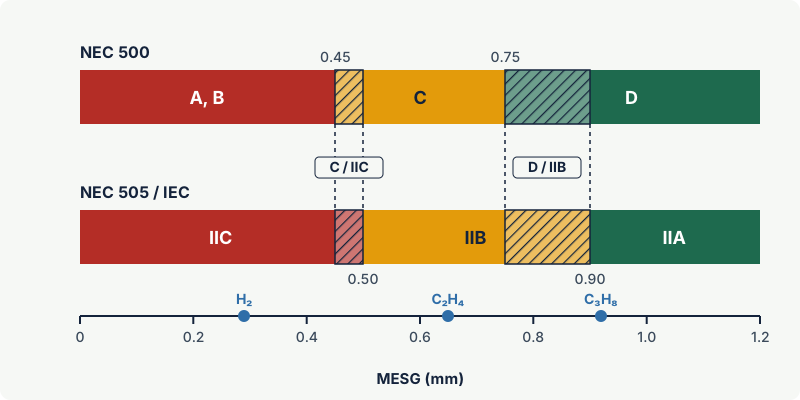
The mismatched strips are where real substances fall into different groups. Ethanol is the classic case: IEC-based data, and the excodex library, put it in IIB, while the NEC lists ethyl alcohol in Group D and in IIA. A plant designed in zones for an ethanol process therefore needs IIB equipment, while the same plant designed in Divisions needs Group D equipment. Neither choice is wrong within its own system; mixing the two is.
Dust groups
| NEC Article 500 group | Material | NEC 506 / IEC group |
|---|---|---|
| E | combustible metal dusts (for example magnesium, aluminium) | IIIC |
| F | combustible carbonaceous dusts (for example coal, carbon black, charcoal) | IIIB |
| G | other combustible dusts (for example flour, grain, wood, plastics, chemicals) | IIIB |
| Class III (no group) | ignitible fibres and flyings | IIIA |
Group E dust is so hazardous that current NEC editions have no Class II, Division 2, Group E location: where metal dust is present in hazardous quantities, the location is Division 1. Note also a definition difference: IEC defines IIIC as conductive dust (by electrical resistivity), while recent NEC editions define IIIC as combustible metal dust, in line with NFPA 499. See dust groups IIIA, IIIB and IIIC.
Temperature codes T1 to T6 and the North American sub-codes
Both systems mark the maximum surface temperature of equipment with a T code, and in both the code must stay below the autoignition temperature of the gas or vapour present. The Division system adds eight intermediate codes so that equipment can be matched more finely to the gas.
| Code | Max. surface temperature | Used in |
|---|---|---|
| T1 | 450 °C | both |
| T2 | 300 °C | both |
| T2A, T2B, T2C, T2D | 280, 260, 230, 215 °C | Division system only |
| T3 | 200 °C | both |
| T3A, T3B, T3C | 180, 165, 160 °C | Division system only |
| T4 | 135 °C | both |
| T4A | 120 °C | Division system only |
| T5 | 100 °C | both |
| T6 | 85 °C | both |
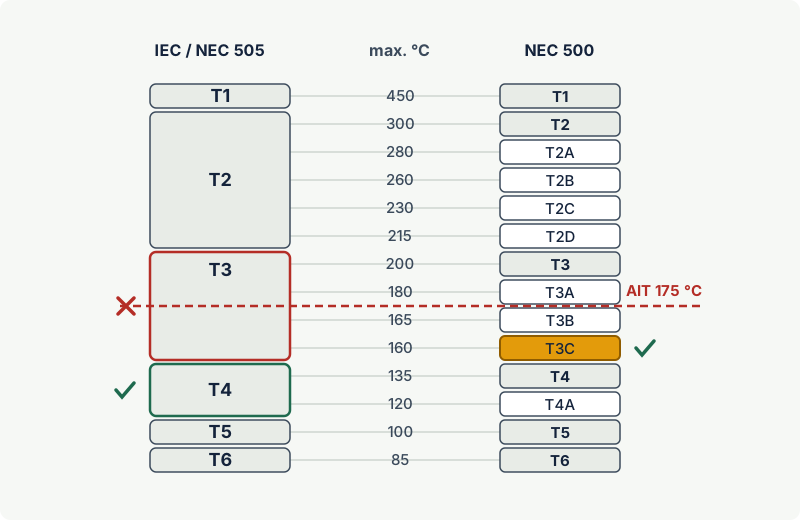
Example: Diethyl ether has an autoignition temperature of 175 °C (excodex library value). In the zone system it needs T4 equipment (135 °C), because T3 allows 200 °C. In the Division system, a device marked T3C (160 °C) is also acceptable, because 160 °C is below 175 °C. Move that T3C device to a zone-classified plant and it is read as T3 unless its certificate states the actual maximum surface temperature, so it no longer qualifies. The sub-codes give the Division system a finer scale, but they do not translate one to one.
Two further points matter. The Division system references T codes to a 40 °C ambient. In the 2017 NEC, Article 500 treats -25 °C to +40 °C as the normal ambient range that needs no marking, while Article 505 uses -20 °C to +40 °C, the same range as the IEC standards; equipment rated for any other range must carry it. IEC 60079-0 edition 8 (2026) now requires the ambient range to be marked on every Ex marking. And in the Division system, non-heat-producing items such as junction boxes and conduit fittings need carry no T code at all, whereas IEC-certified equipment normally carries one. The selection rules are covered in temperature classes T1 to T6.
Using equipment across the two systems
This is where most field errors happen. The NEC allows equipment certified for one system in locations classified under the other, but only in certain directions, and always for the same gas group with a suitable temperature class.
| Equipment listed and marked for | Zone 0 | Zone 1 | Zone 2 | Division 1 | Division 2 |
|---|---|---|---|---|---|
Zone 0 (for example AEx ia) | yes | yes | yes | yes | yes |
Zone 1 (for example AEx db, AEx eb) | no | yes | yes | no | yes |
Zone 2 (for example AEx ec, AEx nA) | no | no | yes | no | yes |
| Class I, Division 1 | no (see note) | yes | yes | yes | yes |
| Class I, Division 2 | no | no | yes | no | yes |
The bold "no" is the classic trap. A Zone 1 flameproof motor is excellent equipment, but Division 1 includes places that the zone system would call Zone 0, and Zone 1 equipment has never been assessed for that. The Canadian code reaches the same conclusion: its table of permitted equipment lists Division 1 equipment for Zone 1, but for a Class I Division 1 location it lists Zone 0 equipment and not Zone 1 equipment.
Note: Zone 0 accepts only equipment specifically listed and marked for Zone 0. Older NEC editions (the 2008 edition, for example) contained an exception to this rule for intrinsically safe apparatus listed for Class I, Division 1 for the same gas and with a suitable temperature class; check whether the edition your AHJ enforces still contains it before relying on it.
What the markings look like
| System | Example marking | What it tells you |
|---|---|---|
| Division (NEC 500) | Class I, Division 1, Groups C and D, T4 | Class, division, groups, temperature code; no type of protection required |
| Division, Division 2 only | Class I, Division 2, Groups A, B, C, D, T4 | Equipment marked with a class but no division suits both divisions; Division 2 only equipment says so |
| Zone, US (NEC 505) | Class I, Zone 1, AEx db IIB T4 Gb | Class, zone, AEx (built to the US versions of the IEC standards), type of protection, group, T class, EPL |
| Zone, dust, US (NEC 506) | Zone 21, AEx tb IIIC T135°C Db | Zone, AEx, type of protection, group, surface temperature in °C, EPL |
| IEC and ATEX | II 2 G Ex db IIB T4 Gb | ATEX category and the IEC marking, with no class or zone |
The equipment protection level (EPL: Ga, Gb, Gc and so on) is the IEC way of linking equipment to zones. In the 2017 NEC, Article 505 permits it in the marking but does not require it, and from the 2020 edition the "Class I" prefix of a zone marking may be omitted; check the marking rules of the edition in force. The Division system does not use the EPL at all. Read more in equipment protection levels and decode IEC strings with the Ex marking check.
Protection methods in each system
The Division system names protection methods differently. In Class I Division 1 the usual methods are explosionproof enclosures, intrinsic safety and purged or pressurised enclosures. Division 2 additionally allows nonincendive circuits and equipment, hermetically sealed devices, oil-immersed contacts and, where it is shown not to be an ignition source in normal operation, general-purpose equipment. The zone system uses the IEC types of protection: d, e, i, m, n, o, p, q and t, each tied to an EPL. An explosionproof enclosure and an Ex d flameproof enclosure work on the same principle, but they are built and tested to different standards and are not interchangeable by default. See Ex protection concepts at a glance.
Mixing Zones and Divisions on one site
US rules allow both systems in one facility, with limits:
- A Zone 2 location may abut a Division 2 location, but the two must not overlap.
- Zone 0 and Zone 1 locations must not abut Division 1 or Division 2 locations.
- A Division location may be reclassified as Zone 0, 1 or 2 only if all the space classified because of a single source of gas or vapour is reclassified, so one release never sits half in each system.
- The NEC requires classification, design, equipment selection, installation and inspection to be done by qualified persons; the OSHA regulation requires zone classification and equipment selection to be supervised by a qualified registered professional engineer.
- Locations must be documented, typically on area classification drawings that show which system was used.
Industry recommended practices exist for both systems. API RP 500 classifies petroleum facilities in Class I Divisions and API RP 505 in Class I Zones; NFPA 497 and NFPA 499 give the corresponding guidance and material data for chemical process areas with gases and dusts. Outside North America, IEC 60079-10-1 and codes such as EI 15 do the same in zones. The European legal side is in the Explosion Protection Document.
Worked example: an IEC-certified motor for a US Division 1 area
A pump skid built in Europe carries a motor marked II 2 G Ex db IIB T4 Gb, with an IECEx certificate. It is shipped to a US terminal where the pump area is classified Class I, Division 1, Group D, for gasoline vapour.
- Is the European marking enough? No. In a US workplace the motor must normally be listed or labelled by a laboratory recognised under the OSHA programme, so it needs a US zone listing (
AEx db IIB T4 Gb) or a Division listing. See North American hazardous location approvals. - Group and temperature. IIB covers Group D. T4 (135 °C) is well below the autoignition temperature of gasoline vapour, so these are not the problem.
- The location. Even with an
AEx dblisting, the motor is Zone 1 equipment, and Zone 1 equipment is not permitted in Division 1. - The options. Either buy a motor listed as explosionproof for Class I, Division 1, Group D, or have the pump area reclassified under Article 505. If a qualified engineer reclassifies all the space around that source and the pump area becomes Zone 1, the
AEx db IIB T4 Gbmotor is acceptable. If the analysis shows the area is in fact Division 2, Zone 1 equipment is also permitted there.
The same table works in the other direction inside the US: in a plant classified in zones, a junction box listed as explosionproof for Class I Division 1 may be used in Zone 1 or Zone 2 for the same gas group. Outside North America this cross-use does not exist. A Division listing means nothing to an EU market surveillance authority, where only ATEX conformity counts.
Common mistakes
- Treating Division 1 as Zone 1. Division 1 also includes the Zone 0 part of a plant. Zone 1 equipment in a Division 1 location breaks the code even when the gas group and temperature code fit.
- Reading "Group A" and "IIA" as similar. They are opposite ends of the scale. Always write "Class I Group D" or "IIA" in full, never just "A" or "D".
- Assuming the group of a substance is the same in both systems. Boundaries differ, so look up the group in the data table for the system you are applying; ethanol is IIB in IEC data but Group D under the NEC.
- Treating T3C as T4. A sub-code belongs to the hotter class above it. In a zone system, T3C equipment is T3 unless the actual temperature is certified.
- Letting a Zone 1 boundary touch a Division area. Only Zone 2 and Division 2 may meet, and even they must not overlap.
- Assuming an ATEX or IECEx certificate makes equipment legal in the US or Canada. Both countries require national certification for onshore installations; IEC-based markings show technical similarity, not legal acceptance. (US Coast Guard rules for vessels are a separate regime that does accept IECEx-certified apparatus.)
Frequently asked questions
Is Class I Division 1 the same as Zone 1?
No. Class I Division 1 covers everything that the zone system would call Zone 0 or Zone 1. Equipment for Division 1 must therefore be safe where gas may be present for long periods, which Zone 1 equipment has not been assessed for.
Can I use Zone 1 equipment in a Class I Division 2 area?
Yes. Under the NEC, equipment listed and marked for Zone 0, Zone 1 or Zone 2 may be installed in a Class I Division 2 location for the same gas and with a suitable temperature class. Only Zone 0 equipment may go into Division 1.
Can Class I Division 1 equipment be used in Zone 1?
Yes. Equipment identified for Class I Division 1 may be used in Zone 1 or Zone 2, and Division 2 equipment in Zone 2, provided the gas group and temperature code are suitable. Neither may be used in Zone 0 unless specifically listed for it.
What is the Zone equivalent of Group D?
Group D corresponds to IIA (propane, methane and similar gases). Group C corresponds to IIB, and Groups A and B together correspond to IIC. Because the MESG boundaries differ, a few substances fall into a different group in each system.
Why does the US have both Divisions and Zones?
The Division system was the original North American method. The NEC added Article 505 in its 1996 edition, giving US facilities the option of the IEC-style zone approach. Both remain valid, and the owner chooses, with the rule that all the space around one release source is classified in one system.
What do T2A, T3C and T4A mean?
They are Division-system temperature codes between the main classes: T2A to T2D cover 280 to 215 °C, T3A to T3C cover 180 to 160 °C, and T4A is 120 °C. The IEC and Article 505 zone systems do not use them.
Related on excodex
- Hazardous area zones explained: Zone 0, Zone 1 and Zone 2
- North American hazardous location approvals: NEC 500/505/506, UL, CSA and FM
- Gas groups IIA, IIB and IIC explained with typical gases
- Temperature classes T1 to T6
- Dust zones 20, 21 and 22 explained with practical examples
- Standards spaces: NEC Articles 500 to 506, API RP 505, IEC 60079-10-1; tools: Ex marking check, gas and solvent library
Standards and further reading
- NFPA 70, National Electrical Code: Article 500 (hazardous classified locations, Classes I, II and III, Divisions 1 and 2), Articles 501 to 503 (installation in Class I, II and III locations), Article 504 (intrinsically safe systems), Article 505 (Class I Zones 0, 1 and 2), Article 506 (Zones 20, 21 and 22)
- CSA C22.1, Canadian Electrical Code Part I, Section 18 (hazardous locations, zone system) and its appendix with the Division rules
- IEC 60079-10-1, classification of areas, explosive gas atmospheres; IEC 60079-10-2, combustible dust atmospheres
- ISO/IEC 80079-20-1, material characteristics for gas and vapour classification
- API RP 500 (petroleum facilities, Class I Divisions) and API RP 505 (petroleum facilities, Class I Zones)
- NFPA 497 and NFPA 499, recommended practices for classifying flammable liquids, gases and vapours, and combustible dusts, in chemical process areas
- OSHA 29 CFR 1910.307, hazardous (classified) locations: osha.gov
- US Coast Guard OCS National Center of Expertise, Drill Down series on hazardous location markings: locations and material groups
- API, note on RP 500 and RP 505: api.org
- IAEI Magazine, changes in the 1998 Canadian Electrical Code Section 18: iaeimagazine.org
This article is general technical information prepared by the excodex editorial team. It does not replace the applicable standards, the equipment certificates and instructions, national regulations or the assessment of a competent person.