Equipment groups I, II and III: mining, gas and dust
Abstract
Ex equipment is grouped by atmosphere: Group I for mines with firedamp, Group II for gases and vapours (IIA, IIB, IIC) and Group III for dusts (IIIA, IIIB, IIIC). Learn the definitions, MESG and dust criteria, why mines are separate and how ATEX groups differ.
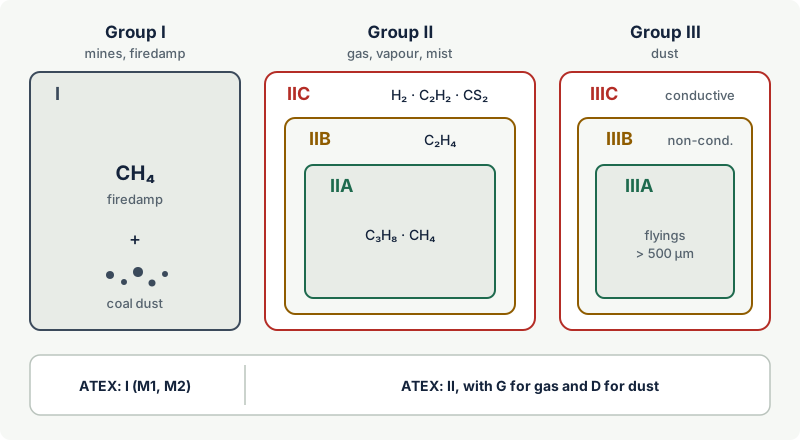
Ex equipment is divided into three equipment groups according to the atmosphere it is built for. Group I is for mines susceptible to firedamp (methane, usually together with coal dust). Group II is for explosive gas atmospheres everywhere else, subdivided into IIA, IIB and IIC according to how easily the gas ignites and how readily its flame passes through narrow gaps, with IIC (for example hydrogen and acetylene) the most demanding. Group III is for explosive dust atmospheres other than mines, subdivided into IIIA (combustible flyings), IIIB (non-conductive dust) and IIIC (conductive dust). Equipment for a more demanding subgroup may always be used for a less demanding one.
This article explains the definitions and test criteria behind each group, why mining equipment has its own group, how the subgroups affect equipment design, and how the IEC groups differ from the ATEX equipment groups.
Key points
- Group I covers mines susceptible to firedamp; Group II covers explosive gas atmospheres other than such mines; Group III covers explosive dust atmospheres other than such mines.
- Gas subgroups are based on the maximum experimental safe gap (MESG) or the minimum igniting current (MIC) ratio: IIA has an MESG of 0.90 mm or more, IIB between 0.50 mm and 0.90 mm, IIC 0.50 mm or less.
- Representative gases are propane for IIA, ethylene for IIB, and hydrogen and acetylene for IIC. Firedamp methane, with an MESG of 1.14 mm, is the reference for Group I.
- Dust subgroups: IIIA combustible flyings (particles larger than 500 µm), IIIB non-conductive dust (resistivity above 10³ Ω·m), IIIC conductive dust (10³ Ω·m or less).
- The hierarchy runs one way: IIC equipment is suitable for IIB and IIA, IIB for IIA; IIIC covers IIIB and IIIA. Group I equipment is not suitable for Group II atmospheres unless it is also certified for them.
- ATEX uses only two equipment groups: I for mines and II for everything else, with the letter G or D to separate gas from dust. The IEC Group III for dust has no ATEX counterpart as a group number.
The three groups at a glance
| Group | Atmosphere | Subgroups | EPLs | Typical locations |
|---|---|---|---|---|
| I | Firedamp (methane) in mines, often with coal dust | None | Ma, Mb | Underground coal mines and endangered surface installations |
| II | Explosive gas, vapour or mist atmospheres, other than mines susceptible to firedamp | IIA, IIB, IIC | Ga, Gb, Gc | Refineries, chemical plants, fuel stations, gas distribution |
| III | Explosive dust atmospheres, other than mines susceptible to firedamp | IIIA, IIIB, IIIC | Da, Db, Dc | Grain handling, food, wood, plastics, metal powders |
The group appears in every IEC marking, for example Ex db IIB T4 Gb (Group II, subgroup IIB) or Ex tb IIIC T85 °C Db (Group III, subgroup IIIC). How to read the rest of the marking is explained in How to read an Ex marking.
Group I: why mines have their own group
Firedamp is the methane released from coal seams. Coal mining was where electrical explosion protection began, and the conditions underground are different enough from surface industry to justify a separate group with its own rules.
- The gas is known. Firedamp is essentially methane, so equipment can be optimised for one gas. Its MESG of 1.14 mm lies well above the 0.90 mm boundary of IIA, which means a flameproof enclosure designed for firedamp may have gaps that would be too wide for propane (0.92 mm) or ethylene (0.65 mm). Methane in surface industry, such as natural gas, is treated as Group IIA.
- Gas and dust occur together. Coal dust settles on equipment and can ignite at lower temperatures than methane. IEC 60079-0 therefore limits Group I surface temperatures to 150 °C where coal dust can form a layer, and 450 °C where dust layers are prevented, for example inside a dust-tight enclosure.
- Mechanical conditions are severe. Falling rock, water, abrasion and frequent moving of equipment demand sturdy construction. The ATEX directive describes category M2 equipment as staying safe under rough handling and changing environmental conditions, and the standards restrict light metals such as aluminium and magnesium in enclosures because a light-alloy part struck against rusty steel can produce incendive sparks.
- The operating philosophy is different. There are no zones as in surface plants. Instead, methane is monitored continuously and most equipment (EPL Mb, ATEX category M2) is switched off when the concentration rises. Only equipment that must keep working, such as monitoring and communication systems, is built to EPL Ma (category M1).
- The legal framework is separate. Mining has its own regulations in most countries, and the ATEX directive defines group I specifically as equipment for underground mines and the endangered surface parts of mines.
Equipment can be certified for both groups and then carries both markings, for example Ex db I Mb and Ex db IIB T4 Gb. More on mining in Coal mine methane: firedamp, monitoring and Group I equipment.
Group II: subgroups IIA, IIB and IIC
Group II gases are subdivided by two laboratory measures of how "difficult" they are to contain:
- MESG (maximum experimental safe gap): the widest gap, in a joint 25 mm wide (the length of the flame path), through which an explosion of the gas-air mixture inside a test vessel fails to ignite the same mixture outside under standard test conditions. A small MESG means the flame passes through very narrow gaps.
- MIC ratio (minimum igniting current ratio): the minimum current that ignites the mixture in a standard spark test apparatus, divided by the same value for laboratory methane. A small ratio means the gas ignites from very little electrical energy.
| Subgroup | MESG | MIC ratio | Representative gas | Other examples (excodex library) |
|---|---|---|---|---|
| IIA | 0.90 mm or more | more than 0.80 | Propane | Methane, butane, acetone, toluene, ammonia |
| IIB | more than 0.50 mm, less than 0.90 mm | 0.45 to 0.80 | Ethylene | Ethylene oxide, diethyl ether, hydrogen sulphide, carbon monoxide |
| IIC | 0.50 mm or less | less than 0.45 | Hydrogen, acetylene | Carbon disulphide |
One measured value is usually enough. Where it lies close to a boundary, ISO/IEC 80079-20-1 (which replaced IEC 60079-20-1) requires both values to be determined and states which one then decides; that standard also tabulates the data for hundreds of substances. Diethyl ether is a good illustration: its MIC ratio (about 0.88) alone would suggest IIA, but it lies in the band where the MESG must also be measured, and its MESG (0.87 mm) places it in IIB. NFPA 70 Article 505 words the boundaries slightly differently (a gas at exactly 0.90 mm falls in IIB there), which matters only for values right on the line.
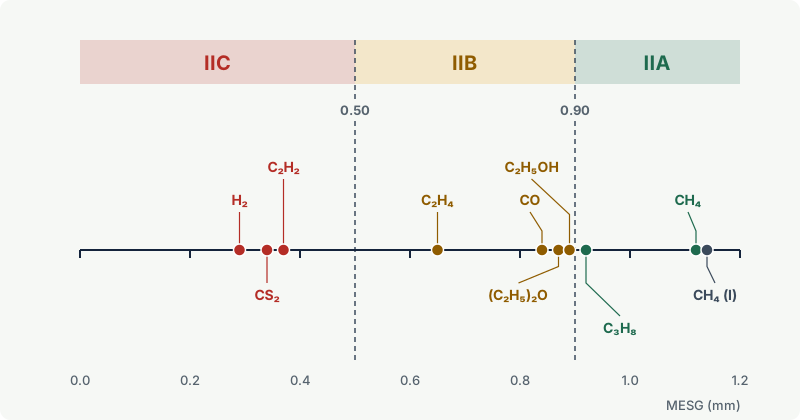
The MESG values in the figure are taken from published IEC-based classification data: hydrogen 0.29 mm, carbon disulphide 0.34 mm, acetylene 0.37 mm, ethylene 0.65 mm, carbon monoxide 0.84 mm, diethyl ether 0.87 mm, ethanol 0.89 mm, propane 0.92 mm, industrial methane 1.12 mm and firedamp 1.14 mm. The test method and its history are covered in MESG and MIC: the two test values behind gas groups, and the gases themselves in Gas groups IIA, IIB and IIC explained with typical gases.
Why the subgroup matters for equipment
For some types of protection the subgroup is fundamental. A flameproof enclosure (d) relies on flamepath gaps that are smaller for IIB and much smaller for IIC. Intrinsic safety (i) limits spark energy according to the ignition curves of each subgroup. For other techniques, such as increased safety (e), the subgroup used to be left out and the marking showed a plain II. Since IEC 60079-0:2007 (adopted in Europe as EN 60079-0:2009), the subgroup is shown in the marking, because many enclosure requirements, such as those on electrostatic charging of non-metallic surfaces, depend on it.
Equipment for a particular gas: IIB + H2
Some equipment is designed and tested for one subgroup plus one specific gas. The best-known case is IIB + H2: IIB equipment that has also been shown to be safe in hydrogen, but not in acetylene or carbon disulphide. It is common for flameproof enclosures where full IIC design would be impractical. See IIB+H2 explained and Acetylene, carbon disulphide and hydrogen: the special cases of gas group IIC.
Group III: subgroups IIIA, IIIB and IIIC
Group III was introduced into the IEC 60079 series when the former dust standards were merged into it; in Europe, the 2009 edition of the general requirements standard defined the dust subgroups. The subgroups are based on particle size and electrical resistivity, not on ignition sensitivity.
| Subgroup | Definition | Typical materials |
|---|---|---|
| IIIA | Combustible flyings: solid particles, including fibres, larger than 500 µm nominal size | Cotton and textile fibres, wood shavings, sisal, jute |
| IIIB | Non-conductive combustible dust: 500 µm or less, resistivity above 10³ Ω·m | Flour, sugar, starch, grain, most plastics and wood dust |
| IIIC | Conductive combustible dust: 500 µm or less, resistivity of 10³ Ω·m or less | Metal powders such as aluminium and magnesium; some carbon-rich dusts |
Conductive dust is the most demanding because, besides igniting, it can enter an enclosure and bridge live parts, causing tracking, short circuits and arcing. Flyings are the least demanding because their large particles do not penetrate small gaps easily. This shows clearly in the dust-tightness required for protection by enclosure (t):
| Subgroup | Level ta (Da) | Level tb (Db) | Level tc (Dc) |
|---|---|---|---|
| IIIA | IP6X | IP5X | IP5X |
| IIIB | IP6X | IP6X | IP5X |
| IIIC | IP6X | IP6X | IP6X |
Whether a particular dust is IIIB or IIIC depends on its measured resistivity, not on its name, so test data or reliable references are needed. Dust explosion properties, which decide temperature limits rather than the subgroup, are explained in Dust explosion parameters explained, and the subgroups in more detail in Dust groups IIIA, IIIB and IIIC.
IEC groups compared with ATEX groups
The word "group" means slightly different things in the two systems, which is a frequent source of confusion.
| Atmosphere | IEC 60079 group | ATEX equipment group and marking | North American Zone system (NEC 505, gas) |
|---|---|---|---|
| Mines with firedamp | I | I, categories M1 or M2 | Not applicable |
| Gas, vapour, mist | II (IIA, IIB, IIC) | II, with letter G | IIA = Class I Group D, IIB = Group C, IIC = Groups A and B |
| Dust | III (IIIA, IIIB, IIIC) | II, with letter D | Separate dust rules (NEC 506) |
So a European dust marking reads II 2 D Ex tb IIIC T85 °C Db: ATEX group II (because it is not a mine), category 2 for dust, and IEC Group III subgroup IIIC in the standards part. Both numbers are correct in their own system. For the North American system see Zones vs Divisions.
Worked example: choosing groups for a mixed plant
A coatings plant handles several substances. The task is to decide the minimum equipment subgroup for each area.
| Area | Substances present | Subgroup of each | Minimum equipment subgroup |
|---|---|---|---|
| Solvent store | toluene, ethyl acetate, acetone | all IIA | IIA (IIB or IIC also acceptable) |
| Mixing room | toluene and ethanol, aluminium pigment powder | IIA, IIB; aluminium powder conductive | IIB for gas and IIIC for dust |
| Battery charging bay | hydrogen from lead-acid charging | IIC | IIC or IIB + H2 |
| Raw material silo | wheat flour | IIIB | IIIB or IIIC |
Three practical lessons come from this table:
- The most demanding substance decides. One IIB solvent in a IIA area raises the whole area to IIB.
- Gas and dust are assessed separately. The mixing room needs equipment marked for both, for example
Ex db IIB T4 Gbtogether withEx tb IIIC T135 °C Db, or two separate items. Where gas and dust are present at the same time, also consider hybrid mixtures (Hybrid mixtures). - Sources can differ. The excodex library and IEC-based data place ethanol in IIB (MESG 0.89 mm, just below the boundary), while the US electrical code lists ethyl alcohol among Class I Group D (IIA) materials. When a value lies close to a boundary, use the more demanding group or follow the code that applies to the installation. For mixtures, see Mixtures of flammable gases and vapours.
Many operators simply standardise on IIC or IIB equipment across the site, which for many electrical items costs little extra and removes the risk of installing the wrong subgroup during maintenance.
Common mistakes
- Thinking IIA is the highest group. The order of severity is the reverse: IIC is the most demanding, so IIC equipment has the widest use and IIA equipment the narrowest.
- Using Group I equipment above ground. Group I equipment is assessed for firedamp. Propane, ethylene and hydrogen have smaller safe gaps than methane, so Group I flameproof equipment is not automatically safe in a refinery.
- Assuming IIB + H2 covers all IIC gases. It covers hydrogen only; acetylene and carbon disulphide still need full IIC equipment.
- Classifying dust by name instead of by data. "Carbon" or "metal" in a product name does not prove conductivity. The subgroup follows the measured resistivity and particle size.
- Mixing up ATEX group II and IEC Group II. A dust marking
II 2 Dis ATEX group II but IEC Group III. Read the D and the IIIA, IIIB or IIIC in the standards part.
Frequently asked questions
What is the difference between Group II and Group III equipment?
Group II equipment is designed for explosive gas, vapour and mist atmospheres; Group III equipment for explosive dust atmospheres. A gas-only device has not been assessed for dust ingress or dust layers, so it is not suitable for dust zones unless it also carries a Group III marking.
Can IIC equipment be used for IIA gases?
Yes. IIC equipment is suitable for IIC, IIB and IIA gases, and IIB equipment is suitable for IIB and IIA gases. The temperature class, EPL and ambient range must still be checked separately.
Why is methane in mines Group I but natural gas IIA?
Group I is defined by the location (mines susceptible to firedamp) and its special conditions, such as coal dust and severe mechanical stress, rather than by the gas alone. In surface industry, methane and natural gas are classified like any other gas and fall into IIA.
What is IIIC dust?
IIIC is conductive combustible dust: particles of 500 µm or less with an electrical resistivity of 10³ Ω·m or less, typically metal powders. It is the most demanding dust subgroup, and equipment for IIIC is also suitable for IIIB and IIIA.
Is ATEX group II the same as IEC Group II?
Not exactly. ATEX group II covers every non-mining location, for both gas (G) and dust (D). IEC Group II covers gas only, and dust equipment belongs to IEC Group III.
Where can I find the gas group of a substance?
ISO/IEC 80079-20-1 tabulates gas groups and temperature classes for many substances, and the excodex gas and solvent library gives the group for each card. The method is explained in How to find the gas group and temperature class of a substance.
Related on excodex
- Gas groups IIA, IIB and IIC explained with typical gases
- MESG and MIC: the two test values behind gas groups IIA, IIB and IIC
- Dust groups IIIA, IIIB and IIIC
- Coal mine methane: firedamp, monitoring and Group I equipment
- ATEX equipment categories 1, 2 and 3 and how they relate to EPLs
- Gas and solvent library: /gas, Ex marking check: /tools/ex, standards spaces: IEC 60079-0, ISO/IEC 80079-20-1
Standards and further reading
- IEC 60079-0, Explosive atmospheres, Part 0: Equipment, general requirements (equipment groups and subgroups, Group I temperature limits)
- ISO/IEC 80079-20-1, material characteristics for gas and vapour classification, test methods and data (MESG, MIC, tabulated groups)
- IEC Electropedia, IEV 426-02-11, definition of maximum experimental safe gap: https://electropedia.org/iev/iev.nsf/17127c61f2426ed8c1257cb5003c9bec/1de51d989a4175bbc12584e7005f3197
- IEC 60079-31, equipment dust ignition protection by enclosure "t" (IP requirements per dust subgroup)
- NFPA 70 (National Electrical Code), Articles 505 and 506, Zone classification in North America
- Directive 2014/34/EU, Annex I, equipment groups and categories: https://eur-lex.europa.eu/legal-content/EN/TXT/HTML/?uri=CELEX:32014L0034
- NSW TestSafe, flammable gas classification, Ex gas and dust grouping (MESG and MIC data): https://www.nsw.gov.au/business-and-economy/testsafe/electrical/explosive-atmosphere/electrical-non-electrical-0
- NSW TestSafe, dust ignition protection by enclosure Ex t (IP requirements by dust group): https://www.nsw.gov.au/testsafe/electrical/explosive-atmosphere/dust-ignition
This article is general technical information prepared by the excodex editorial team. It does not replace the applicable standards, the equipment certificates and instructions, national regulations or the assessment of a competent person.