Acetylene, carbon disulphide and hydrogen: the special cases of gas group IIC
Abstract
Hydrogen, acetylene and carbon disulphide are all gas group IIC, but each adds its own problem: acetylene decomposes and attacks copper, carbon disulphide ignites at 90 °C and needs T6, hydrogen allows IIB+H2. What this means for Ex equipment.
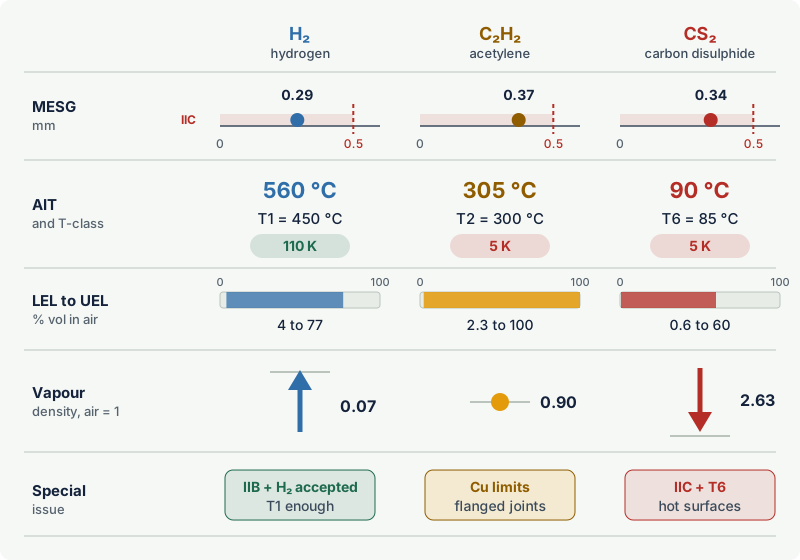
Hydrogen, acetylene and carbon disulphide are the three best-known members of gas group IIC: all three pass a flame through gaps of less than 0.5 mm and ignite with sparks of only one or two hundredths of a millijoule. Beyond that they behave very differently. Acetylene can decompose explosively without air and forms explosive compounds with copper, so the flameproof standards restrict flat flanged joints and copper alloys for acetylene atmospheres. Carbon disulphide ignites on surfaces at only 90 °C, so it needs temperature class T6 as well as IIC. Hydrogen needs only T1 and can be served by IIB+H2 equipment, which is not acceptable for the other two.
This article compares the three gases, explains each special restriction and what it means for flamepaths, materials and temperature classes, and works through an equipment selection for a site that has all three.
Key points
- Hydrogen (MESG about 0.29 mm), carbon disulphide (about 0.34 mm) and acetylene (about 0.37 mm) are all IIC, the group for gases with an MESG of 0.50 mm or less.
- Acetylene can decompose explosively into carbon and hydrogen without any air or oxygen, which is why it is transported dissolved in acetone in cylinders filled with a porous mass, and why its upper explosive limit is given as 100 %.
- Acetylene forms shock-sensitive acetylides with copper and silver. IEC 60079-1 restricts copper and copper alloys on flameproof enclosures for acetylene atmospheres, and IEC 60079-0 contains a clause on copper alloys for the same reason.
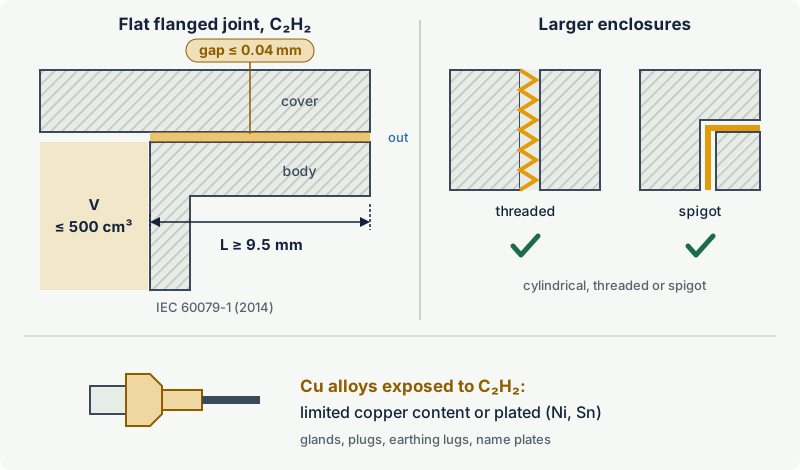
- IEC 60079-1 (2014 edition) permits flat flanged joints in acetylene atmospheres only with a gap of at most 0.04 mm, a width of at least 9.5 mm and an enclosure volume of at most 500 cm³.
- Carbon disulphide has an autoignition temperature of 90 °C, so only T6 equipment (85 °C) is acceptable. A warm steam pipe or a lamp can ignite it.
- Hydrogen is IIC but only T1 (autoignition temperature 560 °C). Equipment marked IIB+H2 is acceptable for hydrogen, but never for acetylene or carbon disulphide.
One group, three different gases
Gas group IIC is defined by flame transmission and spark sensitivity: an MESG (maximum experimental safe gap) of 0.50 mm or less, or an MIC (minimum igniting current) ratio below 0.45, as set out in ISO/IEC 80079-20-1. These two values decide how tight the joints of a flameproof enclosure must be and how little energy an intrinsically safe circuit may release. They say nothing about how hot a surface may become, how a gas behaves at high concentration, or how it reacts with construction materials. On those points the three IIC gases have almost nothing in common.
| Property (excodex library unless stated) | Hydrogen | Acetylene | Carbon disulphide |
|---|---|---|---|
| Formula | H2 | C2H2 | CS2 |
| Typical MESG | 0.29 mm | 0.37 mm | 0.34 mm |
| Explosive limits in air | 4 to 77 % vol | 2.3 to 100 % vol | 0.6 to 60 % vol |
| Autoignition temperature | 560 °C | 305 °C | 90 °C |
| Temperature class needed | T1 | T2 | T6 |
| Vapour density (air = 1) | 0.07 | 0.90 | 2.63 |
| Minimum ignition energy (typical published) | about 0.017 mJ | about 0.017 mJ | about 0.01 mJ |
| The extra problem | wide range, invisible flame | decomposition, copper acetylides | very low ignition temperature |
The MESG values are typical figures from IEC committee test data; individual laboratories report slightly different numbers. Published explosive limits and ignition energies also vary: the International Chemical Safety Card gives 1 to 50 % for carbon disulphide, hydrogen data sheets often quote 4 to 75 %, and one calculated value for carbon disulphide ignition energy is much higher than the measured values most tables carry. The ranking and the conclusions below do not depend on these differences.
Acetylene: decomposition and copper
It can explode without air
Acetylene is thermodynamically unstable. The UK Health and Safety Executive (HSE) explains that it can decompose explosively into its elements, carbon and hydrogen, without any air or oxygen, and that the decomposition can become self-sustaining. A cylinder heated by a fire, a flashback or a torch can therefore explode hours after the initiating event. This is why acetylene cylinders contain a porous mass soaked with acetone in which the gas is dissolved: the porous mass slows down any decomposition.
Two practical consequences follow for explosion protection:
- There is no "too rich to burn". The upper explosive limit is given as 100 % because pure acetylene can still react. Keeping a vessel or pipe full of acetylene is not a basis of safety in the way that operating above the upper limit can be for other gases.
- Pressure is a hazard in itself. Acetylene equipment is designed for low pressure. HSE guidance says the pressure must not exceed 0.62 bar (gauge) unless the equipment is specifically designed for higher pressures, and in Great Britain the Acetylene Safety Regulations 2014 apply specific controls to compressed acetylene at or above that pressure. Flame arrestors stop a decomposition or flashback from travelling back along the line.
Copper, silver and acetylides
Acetylene reacts with copper and silver to form metal acetylides, which can be extremely shock-sensitive and explosive. Dry deposits can go off when they are rubbed, struck or heated, which makes them an ignition source in their own right. Acetylene installation codes therefore ban unalloyed copper in acetylene service. The German technical rules for acetylene, for example, do not allow copper alloys with more than 65 % copper in parts that contact acetylene, and they limit silver brazing alloys.
Ex equipment standards apply the same idea to the outside of the equipment, which the atmosphere can touch. The 2014 edition of IEC 60079-1 introduced a material limitation for copper and copper alloys on flameproof enclosures intended for atmospheres containing acetylene, and IEC 60079-0 has a clause on copper alloys. Published summaries of the 2017 edition of IEC 60079-0 describe the requirement as a limit on the copper content of exposed alloys (65 %) or, alternatively, a coating such as nickel or tin plating. The exact wording and scope should be taken from the edition named on the certificate.
In practice this concerns brass cable glands and stopping plugs, copper earthing studs and bonding lugs, brass name plates and copper-based anti-seize compounds on equipment in acetylene areas. Nickel-plated brass accessories are common for this reason. When an item is certified IIC, the materials assessment is part of the certificate, but accessories added later (glands, adaptors, plugs) must also be suitable.
Flat flanged joints
A flanged joint is a flamepath between two flat faces, the usual construction for rectangular enclosures with a bolted cover. IEC 60079-1 has a specific clause on flanged joints for acetylene atmospheres. In the 2014 edition they are permitted only when the gap is at most 0.04 mm, the flamepath width is at least 9.5 mm and the enclosure volume is at most 500 cm³. Larger IIC enclosures for acetylene therefore use spigot, cylindrical or threaded joints instead. Partial cylindrical joints are not permitted for IIC at all.
This is the main reason why flameproof panels, control stations and large junction boxes are often offered as IIB+H2 rather than IIC: without the acetylene restriction, a flanged design can be certified for hydrogen. IEC 60079-1 was revised again in 2026, so confirm the current rule against the edition listed on the certificate.
Temperature class and margin
With an autoignition temperature (AIT) of 305 °C, acetylene needs T2 (300 °C). The margin is only 5 K, which is why many owners specify T3 for acetylene areas, especially where ambient temperatures are high or equipment sits close to hot process lines.
Where acetylene is found
Acetylene areas are less common than hydrogen areas but appear in welding and cutting gas stores and manifold rooms, acetylene production from calcium carbide, some chemical syntheses, and laboratories where flame spectrometry uses acetylene as fuel gas. Each needs IIC equipment (or equipment certified specifically for acetylene), never IIB+H2.
Carbon disulphide: the low ignition temperature
Why T6 is mandatory
Carbon disulphide has an autoignition temperature of 90 °C in the excodex library, the same value as the International Chemical Safety Card. That is the lowest AIT of any common industrial solvent. It falls in the T6 band (above 85 °C and up to 100 °C), so only T6 equipment, with a maximum surface temperature of 85 °C, is acceptable. The margin is 5 K.
Everyday surfaces exceed 90 °C. The US NOAA chemical datasheet warns that carbon disulphide vapour may be ignited by an ordinary incandescent light bulb and that the liquid or vapour has ignited on contact with steam pipes, particularly rusted ones. Low-pressure steam, hot water above 90 °C, pump casings, bearings, compressor discharge lines and the heat sinks of electronics are all potential ignition sources.
Other properties make the problem worse. The flash point is about -30 °C, so the liquid gives off a flammable vapour at any normal temperature. The vapour is about 2.6 times as heavy as air and flows along floors, into trenches and drains. The lower explosive limit is very low (0.6 % in the excodex library, 1 % on the safety card).
What it means for equipment
- Electrical equipment must be IIC and T6. Few products are available in that combination, and T6 limits the power a device can dissipate. Intrinsically safe instruments are the easiest route for measurement and signalling.
- Motors and heaters are the difficult items. Designers often place motors outside the zone with a shaft through a wall, use pressurised rooms, or choose equipment whose certificate states an actual maximum surface temperature well below 90 °C.
- Non-electrical equipment (pumps, agitators, mechanical seals, gearboxes, fans) must also stay below 85 °C on surfaces the atmosphere can reach. Under ISO 80079-36 and ISO 80079-37 the manufacturer assesses frictional heating, and the result depends heavily on the process temperature.
- Process heat must be designed out. Steam tracing and steam-heated equipment are usually unsuitable where carbon disulphide can be released; tempered water or electric trace heating with a T6 design are used instead.
The North American view
The US National Electrical Code (NFPA 70) has long singled carbon disulphide out. In the 2008 edition, a note to the Class I group definitions in Article 500 stated that some chemical atmospheres need safeguards beyond those of any Class I group, and named carbon disulphide because of its low ignition temperature (90 °C) and the small joint clearance permitted to arrest its flame. Group tables based on NFPA data accordingly leave carbon disulphide without a Division group letter. In IEC and ATEX terms the answer is simpler: IIC for the flamepaths and T6 for surface temperature.
Where carbon disulphide is found
The main users are viscose fibre and cellulose film production, some rubber chemical and agrochemical processes, and laboratories that use it as a solvent. In these plants the temperature class, not the gas group, usually drives the equipment design.
Hydrogen: the most common IIC gas
Hydrogen is by far the most widespread IIC gas: electrolysers, refineries, ammonia and methanol synthesis, generator cooling, battery charging rooms and refuelling stations. Its problems lie in ignition and dispersion rather than temperature:
- Easy ignition. The minimum ignition energy is about 0.017 to 0.02 mJ, less than a tenth of what methane needs, and the explosive range is very wide (4 to 77 % in the excodex library; 4 to 75 % in many data sheets).
- Buoyancy. At about 0.07 times the density of air, hydrogen rises quickly and collects under roofs and in roof voids. Detectors and ventilation openings belong at high level.
- Invisible flames and spontaneous ignition. Hydrogen flames are almost invisible in daylight, and accidental high-pressure releases have sometimes ignited without an obvious source, a phenomenon reviewed in HSE research report RR615.
- High AIT. The AIT is 560 °C in the excodex library (other compilations give roughly 500 to 585 °C), so T1 equipment is acceptable. Hot surfaces are a much smaller concern than with the other two IIC gases.
For flameproof equipment, hydrogen requires the tight IIC flamepath gaps but not the acetylene-specific restrictions. That is what the IIB+H2 marking captures: equipment that meets IIB and has been proven for hydrogen only. It is the usual choice for large flanged enclosures in hydrogen service. For intrinsic safety the situation is simpler still: an IIC intrinsically safe circuit is designed for the whole group and is suitable for all three gases, so no hydrogen-only variant is needed.
Flamepath and construction restrictions compared
The table summarises how the three gases affect flameproof (Ex d) construction and selection. The flamepath values come from IEC 60079-1 (2014 edition); the obstruction distance is an installation rule of IEC 60079-14.
| Requirement | Hydrogen | Acetylene | Carbon disulphide |
|---|---|---|---|
| IIC flamepath tables (smallest gaps) | apply | apply | apply |
| Partial cylindrical joints | not permitted (IIC) | not permitted (IIC) | not permitted (IIC) |
| Flat flanged joints | permitted within the IIC limits | only gap 0.04 mm or less, width 9.5 mm or more, volume 500 cm³ or less | permitted within the IIC limits |
| Copper and copper alloys on the enclosure | acetylene rule does not apply | limited (or plated) | acetylene rule does not apply |
| Clearance from solid obstacles to flanged joints | at least 40 mm unless the certificate states otherwise | at least 40 mm unless the certificate states otherwise | at least 40 mm unless the certificate states otherwise |
| Temperature class needed | T1 or higher | T2 or higher | T6 |
| IIB+H2 equipment acceptable | yes | no | no |
Two practical rules follow. First, equipment marked plain IIC has been designed and tested for all IIC gases, including acetylene, so it can be used for any of the three as far as the gas group is concerned; the temperature class still has to be checked separately. Second, a certificate can always add specific conditions of use (the X suffix), so read it before installing IIC equipment in an acetylene or carbon disulphide area. The flamepath principles are explained in flameproof enclosures.
Worked example: one site, three IIC gases
A chemical site has three areas classified Zone 1:
- Hydrogen compressor house. Hydrogen is the only IIC substance. Gas group: IIC or IIB+H2. Temperature class: T1 is enough; the site standard of T3 is used for spares commonality. A flameproof control station marked
Ex db IIB+H2 T4 Gbis acceptable. The area drawing and equipment register are annotated "IIC (hydrogen only)" so that the IIB+H2 items are not moved elsewhere. - Acetylene cylinder manifold room. Acetylene and the acetone it is dissolved in can be released (acetone is IIA, T1, so it does not change the requirement). Gas group: IIC, not IIB+H2. Temperature class: T2 is the minimum; T3 is chosen for margin. Brass cable glands and plugs are replaced by nickel-plated versions certified for the enclosure, and copper-based anti-seize is not used.
- Carbon disulphide dosing area of a viscose line. Gas group: IIC. Temperature class: T6. Instruments are intrinsically safe
Ex ia IIC T6 Ga. The dosing pump motor is placed outside the classified area with a shaft seal through the wall. The pump's mechanical seal is assessed by its manufacturer for T6 at the actual process temperature, and the steam tracing originally planned for an adjacent line is replaced by tempered water.
The example shows the pattern: hydrogen is mainly a gas group question, acetylene adds construction and material checks, and carbon disulphide is above all a temperature question.
Common mistakes
- Using IIB+H2 equipment in an acetylene or carbon disulphide area. IIB+H2 covers exactly one IIC gas, hydrogen. Correction: use IIC (or equipment certified for the specific gas).
- Choosing IIC T4 for carbon disulphide. IIC settles the flamepaths but not the surface temperature. Correction: carbon disulphide needs T6, or a certified maximum surface temperature below 90 °C with an adequate margin.
- Adding unplated brass accessories to IIC equipment in acetylene service. Glands, plugs and adaptors are part of the installation. Correction: use accessories whose materials are acceptable for acetylene, typically plated, and check the certificate.
- Treating rich acetylene as safe. Acetylene can decompose without air. Correction: keep pressures within the limits for acetylene equipment and fit flame arrestors as the acetylene codes require.
- Forgetting non-electrical and process heat sources around carbon disulphide. Steam lines, pump casings and bearings can exceed 90 °C. Correction: include them in the ignition hazard assessment and design them out.
- Assuming hydrogen's high AIT makes it a low-risk gas. Hydrogen ignites from very weak sparks and spreads quickly upwards. Correction: control electrical and electrostatic sparks, ventilate at high level and detect at high level.
Frequently asked questions
Why is acetylene in gas group IIC?
Acetylene has an MESG of about 0.37 mm, well below the 0.50 mm limit for IIC, and it ignites with very low spark energy. In the North American Division system it has its own group, Group A. Its tendency to decompose and to form copper acetylides adds construction restrictions on top of the IIC requirements.
Can IIB+H2 equipment be used for acetylene?
No. IIB+H2 equipment has been proven for IIB gases and for hydrogen only. It may not meet the acetylene-specific restrictions on flanged joints and copper alloys and has not been tested with acetylene mixtures. Acetylene requires equipment marked IIC or certified for acetylene.
What temperature class is needed for carbon disulphide?
T6. Carbon disulphide has an autoignition temperature of 90 °C, and only T6 equipment (maximum surface temperature 85 °C) stays below it. The gas group must also be IIC, so the full requirement is IIC T6, which few products offer.
Why must copper be avoided with acetylene?
Acetylene reacts with copper (and silver) to form metal acetylides, which can explode when rubbed, struck or heated. Acetylene codes therefore restrict copper and high-copper alloys in contact with the gas, and Ex standards limit exposed copper alloys on equipment for acetylene atmospheres unless they are plated.
Is hydrogen the most dangerous IIC gas?
Not in every respect. Hydrogen has the smallest MESG and a very low ignition energy, but its high autoignition temperature means hot surfaces are less of a concern. Acetylene adds decomposition and acetylide hazards, and carbon disulphide ignites on surfaces at 90 °C. Each is the most demanding gas in a different way.
Does IIC equipment cover carbon disulphide?
For flame transmission and spark ignition, yes: carbon disulphide is a IIC gas and IIC equipment is designed for the whole group. For surface temperature, no: the equipment must also be T6. Always check both parts of the marking and any specific conditions on the certificate.
Related on excodex
- Gas groups IIA, IIB and IIC explained with typical gases
- IIB+H2 explained: when is it enough for hydrogen?
- MESG and MIC: the two test values behind gas groups IIA, IIB and IIC
- Flameproof enclosures (Ex d): how flamepaths stop an internal explosion
- Temperature classes T1 to T6
- Hydrogen safety basics
- Tools: gas library cards for hydrogen, acetylene and carbon disulphide, Ex marking check, standards spaces IEC 60079-1 and ISO/IEC 80079-20-1
Standards and further reading
- ISO/IEC 80079-20-1, material characteristics for gas and vapour classification (gas groups, MESG and MIC ratio, data tables).
- IEC 60079-0, general requirements for Ex equipment (materials, including copper alloys).
- IEC 60079-1, equipment protection by flameproof enclosures "d" (flamepaths, flanged joints for acetylene atmospheres, material limitation in acetylene atmospheres).
- IEC 60079-14, design, selection and erection of electrical installations (selection by gas group and temperature class, obstruction of flanged joints).
- ISO 80079-36 and ISO 80079-37, non-electrical equipment for explosive atmospheres.
- NFPA 70 (National Electrical Code), Articles 500 and 505.
- HSE, Safe use of acetylene: hse.gov.uk
- HSE leaflet INDG327, Working safely with acetylene: hse.gov.uk
- International Chemical Safety Card 0022, carbon disulfide: inchem.org
- NOAA CAMEO Chemicals datasheet, carbon disulfide: cameochemicals.noaa.gov
- HSE research report RR615, Spontaneous ignition of hydrogen: literature review: hse.gov.uk
- Basic hydrogen properties (Hydrogen Tools, US DOE-supported): h2tools.org
- IEC 60079-1:2014 preview with the list of technical changes: vde-verlag.de
- Hydrogen property table citing a self-ignition temperature of 585 °C (example of the spread of published values), in "Hydrogen cooling options for MgB2-based superconducting systems", PubMed Central: ncbi.nlm.nih.gov
This article is general technical information prepared by the excodex editorial team. It does not replace the applicable standards, the equipment certificates and instructions, national regulations or the assessment of a competent person.