IIB+H2 explained: when is it enough for hydrogen?
Abstract
IIB+H2 marks Ex equipment, usually flameproof, that meets gas group IIB and has also been proven for hydrogen. It is enough wherever hydrogen is the only IIC gas, but never for acetylene or carbon disulphide. Meaning, uses, limits and how it compares with IIC.
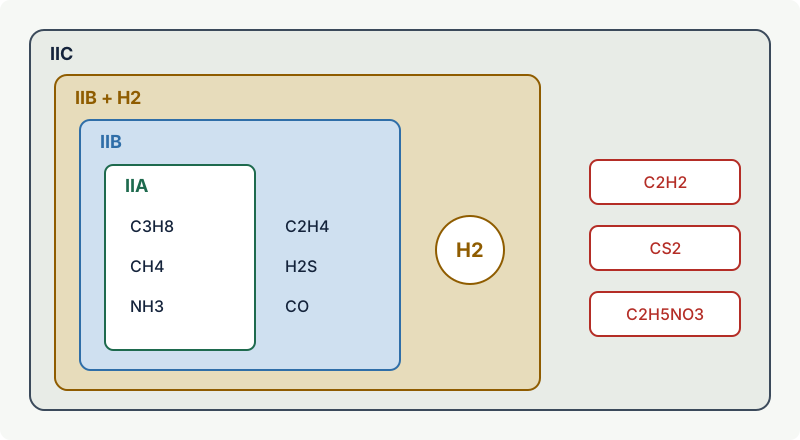
IIB+H2 (often written "IIB + H2") is a gas group marking for Ex equipment that meets all requirements for group IIB and has additionally been tested and certified for hydrogen. Such equipment may be used where the gases present are IIA, IIB or hydrogen. It is therefore enough for hydrogen, but it is not IIC: it must not be used where acetylene, carbon disulphide or any other IIC substance apart from hydrogen can be present. The marking is found mainly on flameproof (Ex d) enclosures and motors, where it allows constructions that full IIC would not.
This article explains what the marking means, where it comes from, where it is used, its limits, and how to decide between IIB+H2 and IIC.
Key points
- IIB+H2 means "group IIB plus hydrogen": the equipment is suitable for all IIA and IIB gases and vapours and for hydrogen, and for nothing else in IIC.
- It does not cover acetylene, carbon disulphide or other IIC substances such as ethyl nitrate. Those need equipment marked IIC (or certified for that specific gas).
- The marking is used mostly for flameproof equipment, because hydrogen and acetylene impose different construction limits on flamepaths and materials. A flameproof enclosure can be proven for hydrogen without meeting the acetylene-specific restrictions.
- Typical uses are hydrogen-cooled generators, refinery hydrotreating and hydrocracking units, chlor-alkali plants, electrolysers, ammonia and methanol synthesis, battery charging rooms and hydrogen fuelling stations.
- The gas group says nothing about temperature: IIB+H2 equipment must still have a temperature class suitable for every substance present.
- In the North American Division system the comparable rating is Class I, Groups B, C and D (Group B being hydrogen, Group A acetylene).
What the marking means
Gas group II is divided into IIA, IIB and IIC according to the maximum experimental safe gap (MESG) and the minimum igniting current (MIC) ratio of the substances (see gas groups IIA, IIB and IIC and MESG and MIC). Equipment for a higher group may be used for a lower one, so IIC equipment is suitable everywhere in group II.
IEC 60079-0 also allows equipment to be certified for a specific gas, identified by its name or chemical formula. When the gas is added to a group, the result is a combined marking. "IIB + H2" is by far the most common example: the equipment meets IIB, and in addition it has been assessed for hydrogen (H2). The US National Electrical Code (NFPA 70) uses the same marking as its example of equipment identified for a specific combination of gases in its Zone article.
A typical marking looks like this:
II 2 G Ex db IIB+H2 T4 Gb
Read it as: ATEX equipment group II, category 2, gas; flameproof enclosure level db; suitable for IIB gases and hydrogen; maximum surface temperature class T4; equipment protection level Gb. The full decoding of a marking is in how to read an Ex marking.
Why IIB+H2 exists: hydrogen and acetylene are different
Group IIC contains only a few substances, but they are not alike. Hydrogen and acetylene are the two reference gases of the group, and carbon disulphide is the third well-known member. For flameproof equipment the differences matter:
- Flamepaths. Hydrogen and acetylene both have very small safe gaps, so IIC flamepaths have tight dimensional limits. Acetylene adds further restrictions. IEC 60079-1 has a requirement specifically for flanged (flat) joints in acetylene atmospheres, which in practice rules out flat-flanged IIC enclosures above a small volume (a published review gives about 0.5 litres). Hydrogen does not carry that restriction.
- Materials. Acetylene can form explosive acetylides with copper. IEC 60079-1 therefore limits copper and copper alloys on the outside of enclosures intended for acetylene atmospheres. This does not apply to hydrogen.
- Type tests. Full IIC certification of a flameproof enclosure involves tests with both hydrogen and acetylene mixtures. An enclosure that passes the hydrogen tests but not the acetylene tests, or that was never designed for acetylene, can still be certified for IIB plus hydrogen.
The result is that rectangular enclosures with bolted flanged covers, which are convenient for panels, switchgear and large junction boxes, can be built and certified as IIB+H2 where an IIC version would need cylindrical or threaded joints or would not be offered at all.
Carbon disulphide is a separate case. It is IIC on MESG grounds, but its autoignition temperature is only 90 °C, so it also needs temperature class T6. An IIB+H2 certificate makes no statement about carbon disulphide, and equipment intended for it has to be assessed for it.
Where IIB+H2 is used
Hydrogen occurs far more often in industry than acetylene or carbon disulphide. Typical IIB+H2 applications are:
| Application | Why hydrogen is present | Other substances that set requirements |
|---|---|---|
| Refinery hydrotreaters and hydrocrackers | hydrogen-rich recycle and make-up gas | hydrocarbons (IIA), hydrogen sulphide (IIB, T3) |
| Hydrogen-cooled turbine generators | hydrogen as coolant inside the generator casing | lubricating oil mist and vapour |
| Chlor-alkali plants | hydrogen produced at the cathode | chlorine (toxic and not flammable in air, but explosive with hydrogen inside the process) |
| Water electrolysers and hydrogen fuelling stations | hydrogen as the product | usually none; check other process chemicals |
| Ammonia and methanol synthesis | hydrogen-rich synthesis gas | ammonia (IIA), carbon monoxide (IIB), methanol (IIA) |
| Battery charging rooms (vented lead-acid) | hydrogen from charging | usually none |
In all of these the only IIC substance is hydrogen, so IIB+H2 is technically sufficient, provided the temperature class and the equipment protection level also fit. Battery rooms are covered in more detail in battery rooms and charging areas, and fuelling stations in hydrogen production and refuelling stations.
Which types of protection carry IIB+H2?
The marking is mostly seen on flameproof equipment (Ex d, Ex db), including combined designs such as Ex db eb IIB+H2. That is where the difference between hydrogen and acetylene changes the construction.
For most other types of protection there is little reason to use it. Increased safety (Ex e), encapsulation (Ex m) and pressurisation (Ex p) do not depend on stopping a flame in a gap, so their products are usually marked IIC anyway. Intrinsically safe apparatus and associated apparatus are widely available for IIC. If a combined product has, for example, an IIC intrinsically safe circuit inside an IIB+H2 flameproof enclosure, the product as a whole is IIB+H2: the lowest gas group of its parts decides.
IIB+H2 or IIC: pros and cons
| Aspect | IIB+H2 | IIC |
|---|---|---|
| Gases covered | IIA, IIB and hydrogen | all group II gases and vapours |
| Flameproof construction | flat flanged joints possible on larger enclosures; acetylene material limits do not apply | most restrictive flamepaths; acetylene-related restrictions apply |
| Availability | wide range of large enclosures, panels and motors | some large flameproof products are not offered, or only in limited sizes |
| Cost and weight | usually lower for flameproof equipment | usually higher for large flameproof equipment |
| Flexibility for future process changes | lost if acetylene or carbon disulphide is ever introduced | none needed |
| Risk of misuse | spares and replacements may end up in acetylene areas | none from the gas group |
The advantages are real for flameproof panels, control stations and motors in hydrogen service. The main disadvantage is that IIB+H2 is a narrower rating and must be managed: the equipment register, spare parts stock and installation drawings must show that the area is "hydrogen only" so that nobody installs a IIB+H2 item where acetylene appears later, for example a welding gas store or an acetylene line added to a laboratory.
Where the choice costs little, many companies standardise on IIC for small items (junction boxes, push buttons, luminaires, sensors) and accept IIB+H2 for large flameproof items where it brings a clear benefit.
Mixtures that contain hydrogen
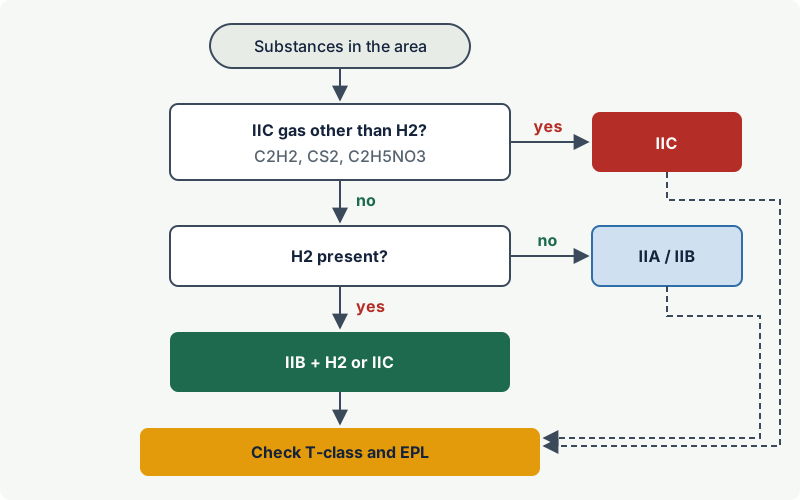
Many process streams are mixtures: refinery off-gas, synthesis gas, coke oven gas, natural gas blended with hydrogen. The gas group of a mixture is determined from its composition (see mixtures of flammable gases and vapours). Depending on the hydrogen content and the other components, the mixture may come out as IIB or IIC.
- If the mixture is classified IIB, IIB equipment is sufficient for the mixture itself. Check whether pure hydrogen can be present elsewhere in the same area, for example at a hydrogen make-up line, vent or analyser.
- If the mixture is classified IIC because of its hydrogen content, and hydrogen is the only IIC component, IIB+H2 equipment is commonly accepted in practice, because each component lies within the certified range. This is engineering judgement rather than a rule written in the equipment standards, so record the reasoning in the area classification document and ask the manufacturer where in doubt.
- If any other IIC component is present, IIC is needed.
Worked example: three areas, three answers
A site has three areas and asks whether its standard IIB+H2 flameproof junction box (Ex db IIB+H2 T4 Gb) can be used in each.
- Hydrotreater compressor shelter. Substances: hydrogen, light hydrocarbons similar to hexane (IIA, autoignition 225 °C, T3) and hydrogen sulphide (IIB, autoignition 260 °C, T3). The only IIC gas is hydrogen, so IIB+H2 is acceptable. The temperature class needed is T3 or better; T4 is fine. Result: acceptable, in Zone 1 or Zone 2 because the EPL is Gb.
- Welding gas store with acetylene cylinders. Acetylene is IIC and outside IIB+H2. Result: not acceptable; use equipment marked IIC (or certified for acetylene), and also check the certificate for any acetylene-specific conditions.
- Viscose process area with carbon disulphide. Carbon disulphide is IIC and its autoignition temperature of 90 °C requires T6. The box fails on both counts. Result: not acceptable; use IIC T6 equipment.
The same box is therefore correct in one area and wrong in two others, even though all three are "IIC areas" in a quick classification summary. This is why the area classification drawings should name the gases, not just the group.
Inspection and maintenance
During initial and periodic inspection to IEC 60079-17, the inspector compares the equipment gas group with the gas group in the area classification. For IIB+H2 equipment that check only works if the documents state which IIC substances are present. A note such as "IIC (hydrogen only)" on the drawing and in the equipment register avoids discussion.
Repairs to flameproof equipment follow IEC 60079-19 and the manufacturer's data. Flamepath gaps and surface finishes on IIB+H2 enclosures are critical in the same way as on IIC enclosures; a joint that would be acceptable for a plain IIB enclosure may not be acceptable when hydrogen is in the certificate. See inspection of Ex installations.
Common mistakes
- Treating IIB+H2 as "almost IIC". It covers exactly one IIC gas. It is wrong for acetylene, carbon disulphide and ethyl nitrate.
- Accepting plain IIB for hydrogen. IIB without "+H2" has not been proven for hydrogen. A IIB enclosure in a hydrogen area is a non-compliance, even if the area also contains IIB gases.
- Forgetting the temperature class. Hydrogen itself needs only T1, but other substances in the area may need T3, T4 or T6.
- Writing only "IIC" on area classification drawings. The installer then cannot tell whether IIB+H2 is acceptable. Name the substances.
- Losing control of spares. A IIB+H2 replacement fitted in an acetylene area looks identical from a distance. Keep the gas group visible in the spare parts system.
Frequently asked questions
What does IIB+H2 mean on an Ex marking?
It means the equipment meets the requirements of gas group IIB and has additionally been certified for hydrogen. It may be used for IIA and IIB gases and for hydrogen, but not for acetylene, carbon disulphide or other IIC substances.
Is IIB+H2 equipment suitable for hydrogen?
Yes. IIB+H2 equipment has been assessed specifically for hydrogen and may be used in hydrogen atmospheres, provided its temperature class, equipment protection level and any specific conditions on the certificate also fit the location.
Can IIB+H2 be used instead of IIC?
Only where hydrogen is the only IIC substance present. Where acetylene, carbon disulphide or another IIC gas or vapour can occur, equipment marked IIC (or certified for that specific gas) is required.
Why is acetylene excluded from IIB+H2?
Acetylene imposes extra restrictions on flameproof enclosures that hydrogen does not, including limits on flat flanged joints and on external copper parts, because acetylene can form explosive copper acetylides. IIB+H2 equipment has not been proven against these acetylene-specific requirements and tests.
Is IIB+H2 the same as Class I Group B?
Not formally, but the idea is similar. In the North American Division system, equipment for Class I Groups B, C and D covers hydrogen (Group B) and the lower groups but not acetylene (Group A). IIB+H2 likewise covers hydrogen and the lower IEC groups, but not acetylene.
Is IIB+H2 used for intrinsically safe equipment?
Rarely. Intrinsically safe apparatus is widely available for IIC, so there is little benefit in a narrower rating. The marking is used mainly for flameproof enclosures, motors and panels.
Related on excodex
- Gas groups IIA, IIB and IIC explained with typical gases
- Acetylene, carbon disulphide and hydrogen: the special cases of gas group IIC
- Hydrogen safety basics: wide flammable range, low ignition energy and invisible flames
- Flameproof enclosures (Ex d): how flamepaths stop an internal explosion
- Mixtures of flammable gases and vapours: choosing gas group and temperature class
- Tools: Ex marking check, hydrogen in the gas library, standards spaces IEC 60079-1, IEC 60079-0 and NEC 500 to 506
Standards and further reading
- IEC 60079-0, Explosive atmospheres: general requirements for equipment (equipment groups, marking for a specific gas).
- IEC 60079-1, Explosive atmospheres: equipment protection by flameproof enclosures "d" (flamepaths, acetylene-specific requirements, type tests).
- ISO/IEC 80079-20-1, material characteristics for gas and vapour classification (MESG, MIC ratio, gas group data).
- IEC 60079-14, design, selection and installation of electrical installations; IEC 60079-17, inspection and maintenance; IEC 60079-19, repair and overhaul.
- NFPA 70 (National Electrical Code), Articles 500 and 505.
- Magyari, Moldovan, Rad, Considerations regarding Ex d IIB + H2 method of protection for flameproof electrical equipment, MATEC Web of Conferences 354, 2022: matec-conferences.org
- US Coast Guard, Hazardous locations drill-down on material groups (IIA, IIB, IIC and Class I Groups A to D): dco.uscg.mil
- IEC 60079-1:2014 (edition 7, since replaced by IEC 60079-1:2026) preview with list of changes (acetylene flanged joints and copper material limits): vde-verlag.de
This article is general technical information prepared by the excodex editorial team. It does not replace the applicable standards, the equipment certificates and instructions, national regulations or the assessment of a competent person.