Battery rooms and charging areas: hydrogen ventilation and hazardous areas
Abstract
Charging lead-acid and NiCd batteries splits water into hydrogen and oxygen. How the IEC/EN 62485-2 ventilation formula works, a worked example, the safety distance around cell vents, when a zone is needed and why lithium-ion rooms are different.
When lead-acid or nickel-cadmium batteries are charged, part of the charging current electrolyses the water in the electrolyte and releases hydrogen and oxygen, most of it near the end of charge and during boost or equalising charge. The safety rule for battery rooms and charging areas is to dilute this hydrogen so that it stays far below its lower explosive limit of 4 % vol: IEC/EN 62485-2 gives a simple formula for the required air flow, and a safety distance around the cell vents inside which no ignition sources are allowed. With that ventilation in place, a battery room is normally not classified as a hazardous area. Lithium-ion batteries do not gas during normal charging, so their hazard is a different one: off-gas from a cell in thermal runaway.
This article explains where the hydrogen comes from, how the ventilation formula is built and used, how to size natural and forced ventilation, when zones are needed, and what changes for lithium-ion.
Key points
- One ampere-hour of overcharge current releases about 0.42 L of hydrogen (at 0 °C and 1 atm, about 0.45 L at 25 °C) and half that volume of oxygen.
- IEC 62485-2 (adopted in Europe as EN IEC 62485-2:2018, which superseded EN 50272-2:2001) sizes stationary battery ventilation with Q = 0.05 x n x Igas x Crt x 10⁻³ in m³/h, where n is the number of cells, Igas the gassing current in mA per Ah and Crt the rated capacity in Ah.
- The constant 0.05 combines a dilution factor of 24 (to stay at 4 % hydrogen from 100 % gas), 0.42 L of hydrogen per Ah and a general safety factor of 5.
- For natural ventilation, the inlet and the outlet each need a free area of at least A = 28 x Q in cm², which corresponds to an air velocity of 0.1 m/s.
- Close to the vent openings, dilution is not assured. The standard therefore defines a safety distance d, growing with the cube root of Igas x Crt, within which sparks, arcs, glowing parts and hot surfaces are not allowed.
- A battery room ventilated to the standard is normally treated as non-hazardous; forced ventilation must be interlocked with charging or alarmed. US model fire and mechanical codes take a similar line and limit hydrogen in battery rooms to 1 % of the room volume (25 % of the LFL).
- Lithium-ion batteries produce no hydrogen in normal charging. Their gas hazard comes from thermal runaway, which is handled by detection, explosion prevention ventilation and venting, not by the 62485-2 formula.
Where the hydrogen comes from
A lead-acid cell stores energy by converting lead sulphate on its plates. As the cell approaches full charge, the plates can no longer absorb all of the current, and the surplus electrolyses water: hydrogen forms at the negative plate and oxygen at the positive plate. Gassing increases steeply with cell voltage, which is why boost and equalising charges, at a higher cell voltage, produce much more gas than float charge. Higher temperature also increases the float current and therefore the gas.
The amount follows from Faraday's law: 1 Ah of current through the electrolysis reaction gives 0.0187 mol of hydrogen, which is 0.42 L at 0 °C or 0.45 L at 25 °C. Every cell in a series string carries the same current, so a battery of n cells releases n times that volume.
The battery types behave differently:
| Battery type | Gas behaviour during charging |
|---|---|
| Vented (flooded) lead-acid | releases all gas produced; water must be topped up |
| Valve-regulated lead-acid (VRLA) | most oxygen recombines inside the cell; the gas released is much smaller but not zero, and rises sharply with overcharge or high temperature |
| Vented nickel-cadmium | releases gas like vented lead-acid, with higher boost charging currents |
| Lithium-ion | no electrolysis of water in normal operation; gas only in abuse or thermal runaway |
Hydrogen is the gas to design for: its explosive range is 4 to 77 % vol, its minimum ignition energy is very low (around 0.02 mJ), and it is in gas group IIC. Its density is only about 7 % of that of air, so it rises quickly and collects under ceilings and in roof pockets. See hydrogen safety basics.
The ventilation formula in IEC 62485-2
IEC 62485-2 covers stationary batteries up to 1500 V DC (UPS, telecom, substations, emergency lighting). Its aim is to keep the hydrogen concentration below the LEL of 4 % vol with a large margin. The required air flow is the product of six terms; in paraphrase:
Q = v x q x s x n x Igas x Crt x 10⁻³ (m³/h)
| Symbol | Meaning | Value |
|---|---|---|
| v | dilution factor: (100 % - 4 %) / 4 % | 24 |
| q | hydrogen generated per Ah | 0.42 x 10⁻³ m³/Ah |
| s | general safety factor | 5 |
| n | number of cells | from the battery |
| Igas | current producing gas, in mA per Ah of rated capacity | from the tables of the standard or the manufacturer |
| Crt | rated capacity (lead-acid C10, NiCd C5) | Ah |
Because v x q x s = 24 x 0.42 x 10⁻³ x 5 = 0.0504, the formula is usually written Q = 0.05 x n x Igas x Crt x 10⁻³. The 0.42 L refers to 0 °C; some national calculation forms (the Swiss one, for example) use 0.055 instead, based on 0.45 L of hydrogen per Ah at 25 °C, which gives about 10 % more air.
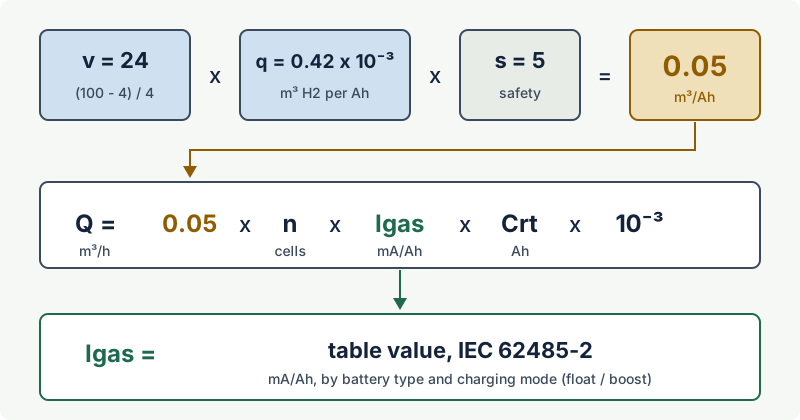
The gassing current Igas
Igas is not the charger current. It is the part of the charging current that produces gas, expressed per Ah of capacity. IEC 62485-2 gives Igas in a table for charging with IU or U charging profiles, depending on the battery type and on whether the battery is on float or boost charge; typical charge voltages are given in an informative annex. VRLA cells release less gas than vented cells, because most of the oxygen recombines inside the cell, but not none.
Note: Take the values from the tables of IEC 62485-2 (EN IEC 62485-2) for the battery type and the charging mode, or from the battery manufacturer. Values copied from secondary sources are not always reproduced correctly, so check them against the current text of the standard before using them in a design.
Use the boost value if the charger can boost or equalise, even occasionally, and the manufacturer's data where the battery or charging regime differs (for example antimony-rich plates, high temperature, or chargers without voltage limitation). Some guidance documents allow the air flow to be reduced where catalytic recombination vent plugs are fitted; Swiss guidance, for example, accepts halving it.
Traction batteries and forklift charging areas
Charging areas for traction batteries (forklifts, floor cleaners, tow tractors) are covered by IEC 62485-3. The principle is the same, but the gassing current is taken directly from the charger characteristic, in amperes. Industry guidance on Part 3 writes the formula as Q = 0.055 x n x Igas, with Igas in A, and recommends using at least 40 % of the charger's maximum rated current when the real value is not known. Forklift chargers often run unattended overnight at high current, so a charging area with many trucks can need several hundred cubic metres per hour.
Natural and forced ventilation
Natural ventilation is preferred where it can deliver Q, because it needs no power and cannot be switched off by mistake. The standard sizes the openings on an assumed air velocity of 0.1 m/s through them:
A = 28 x Q (A in cm², Q in m³/h), for the inlet and for the outlet separately.
Good practice in the standard and in national guidance:
- Inlet low (near the floor), outlet as high as possible, ideally on opposite walls so the air sweeps over the batteries. If both are on the same wall, keep them at least 2 m apart.
- Openings must not be closable and must lead directly outdoors, not into another room.
- Doors and windows count only if they are reliably open while charging.
- Avoid ceiling pockets, beams and false ceilings that can trap hydrogen above the outlet level.
Forced ventilation is needed when the openings cannot be made large enough, for example in basement rooms or large charging areas. The extraction fan must deliver at least Q, discharge outdoors, and keep running for a period after charging stops, because cells continue to release gas (Swiss guidance asks for at least one hour). Charging must depend on the ventilation: either the charger is interlocked with the fan (no air flow, no charging) or a failure alarm is raised. The fan and its motor are in the extract air path, so it is good practice to select them for the hydrogen that could be present if the dilution failed.
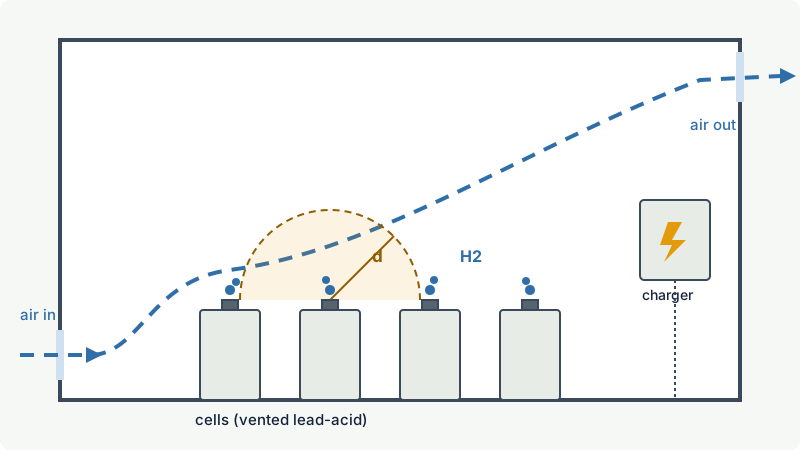
The safety distance around cell vents
The room formula assumes the hydrogen is mixed into the whole air flow. Right at a vent opening the concentration is higher, so the standard adds a safety distance d between the vent openings of cells (or the outlet of a central degassing system) and any ignition source. It is calculated from the gas release of a single cell and grows with the cube root of Igas x Crt:
d = 28.8 x ∛Igas x ∛Crt (d in mm, Igas in mA/Ah, Crt in Ah)
Typical values are a few hundred millimetres; Swiss guidance, as a simple rule, keeps ignition sources about 1 m away from the battery. Inside this distance there must be no devices that can create sparks or arcs (switches, fuses, relays, contactors, chargers, non-Ex lights), no glowing parts and no hot surfaces; guidance on traction batteries quotes a maximum surface temperature of 300 °C and a fixed minimum distance of 0.5 m from vent plugs. The distance can be reduced by a partition between the cells and the ignition source, or by venting each cell through a sealed degassing tube to a safe outlet, in which case the distance applies at the end of the tube.
The distance matters inside battery cabinets, UPS enclosures and racks where the charger, the battery breaker and the cells share one housing. It also matters for people: many battery explosions are not room explosions but small ignitions in or just above a cell, often caused by sparks when leads are connected or disconnected while current flows.
Worked example: a 110 V DC substation battery
A substation has a vented lead-acid battery of 55 cells, rated 400 Ah (C10). The charger float charges and can boost charge after a discharge, so the design case is the boost value of Igas for vented lead-acid cells, taken from the table of IEC 62485-2.
- Air flow: Q = 0.05 x 55 x Igas x 400 x 10⁻³ = 1.1 x Igas m³/h, with Igas in mA/Ah. Every 1 mA/Ah of gassing current needs 1.1 m³/h of air for this battery, so the boost value, not the float value, sets the design.
- Natural ventilation openings: A = 28 x Q = 30.8 x Igas cm² for the inlet and the same for the outlet. This is the free area after deducting louvre blades and mesh, not the size of the wall opening.
- Safety distance: d = 28.8 x ∛Igas x ∛400 = 28.8 x 7.37 x ∛Igas, which is about 212 x ∛Igas mm. Because of the cube root, a fourfold increase in Igas only increases d by about 60 %.
- Check against the room: in a room of 30 m³, each mA/Ah of Igas corresponds to less than 0.04 air changes per hour. Spread through the room, the hydrogen flow is small; the risk is local accumulation near the vents and under the ceiling, not the average concentration.
If the same battery were VRLA, the lower Igas of valve-regulated cells reduces Q in proportion and d with the cube root, but it does not remove the need for ventilation or for the safety distance.
Note: Use the cell count, capacity and charging regime of the actual installation, the Igas values of IEC 62485-2 (EN IEC 62485-2), and the manufacturer's gassing data where the battery or charger differs from the conditions behind the standard's table.
When is a hazardous area needed?
The battery standards approach the problem as explosion prevention by dilution, not as area classification. That leads to three typical outcomes.
The room is ventilated to the standard. The room is regarded as not explosion-hazardous; Swiss accident insurance guidance states this directly for charging rooms that meet the ventilation requirement. Ordinary electrical equipment can be used in the room, outside the safety distance.
The space within the safety distance d. This is a small volume where a flammable mixture can exist for short periods during normal charging. The standard handles it by excluding ignition sources rather than by naming a zone. Many operators record it in their explosion protection document as a small hazardous zone around the vents; where equipment must be installed inside it, use equipment suitable for hydrogen (gas group IIC, temperature class T1 is sufficient for hydrogen's autoignition temperature of 560 °C in the excodex library; other compilations give roughly 500 to 585 °C, all above the T1 limit of 450 °C).
The ventilation cannot be relied on. If the required air flow cannot be achieved, or forced ventilation can fail without stopping the charge, the dilution argument no longer holds. The area then has to be assessed with IEC 60079-10-1 like any other release: the cells become secondary or primary sources of release, and the result is typically a zone in the upper part of the room where hydrogen accumulates. In practice it is almost always better to fix the ventilation and interlock the charger than to install Ex equipment throughout a battery room.
Some situations need extra care in any case: battery cabinets with little free volume, rooms with ceiling voids, charging of many traction batteries in a small room, and emergency situations such as a charger fault that keeps a battery on high current (thermal runaway in VRLA batteries can lead to strong gassing and heat).
Hydrogen detection
Detection is not a substitute for ventilation, but it is useful where forced ventilation is used or where the room geometry may trap gas. US model fire and mechanical codes (the International Fire Code and the International Mechanical Code) require the ventilation of rooms with flooded lead-acid, flooded NiCd and VRLA batteries to limit hydrogen to 1 % of the room volume, a quarter of the LFL. For a gas lighter than air such as hydrogen, detectors normally go near the ceiling, above the racks and in any pocket where gas can collect; no standard sets one fixed height, and the right position follows the likely release, the gas behaviour and the airflow (IEC 60079-29-2). Infrared gas detectors cannot see hydrogen; use catalytic, thermal conductivity or electrochemical hydrogen sensors, see catalytic vs infrared detectors.
Lithium-ion: a different hazard
Lithium-ion cells have an organic electrolyte and no water to electrolyse. In normal charging they release no gas, so the 62485-2 formula does not apply and a Li-ion battery room does not need dilution ventilation for hydrogen. IEC 62485-5:2020 covers the safe operation of stationary lithium-ion batteries.
The gas hazard appears only when a cell fails. In thermal runaway a cell releases, within seconds to minutes, a large volume of flammable and toxic gas, typically hydrogen, carbon monoxide, carbon dioxide, hydrocarbons and electrolyte vapour. This is an abnormal, high-consequence event rather than a normal release, so it is handled by early detection, battery management, explosion prevention ventilation and deflagration venting, as described in lithium-ion battery energy storage safety.
| Aspect | Lead-acid and NiCd | Lithium-ion |
|---|---|---|
| Gas in normal charging | yes, hydrogen and oxygen, continuously | none |
| Gas in failure | more hydrogen (overcharge, VRLA thermal runaway) | large, sudden off-gas: H2, CO, CO2, hydrocarbons, electrolyte vapour |
| Design basis | dilution formula of IEC 62485-2 or -3 | cell test data (for example UL 9540A), detection, NFPA 855 in North America |
| Typical ventilation | continuous or charge-linked, a few to a few hundred m³/h | emergency exhaust started by detection, sized for the off-gas volume |
| Area classification | non-hazardous room if ventilated; safety distance at vents | usually not classified; failure treated as an abnormal event |
| Fire behaviour | limited | thermal runaway can propagate and reignite |
Mixed charging areas are common in warehouses that are converting forklift fleets. Keep the lead-acid ventilation and safety distances for as long as any lead-acid batteries are charged there, and add Li-ion measures (separation, fire detection, thermal runaway response) for the new batteries.
Common mistakes
- Sizing on the float current only. If the charger can boost or equalise, size Q on the boost value of Igas from the standard's table, which is much higher than the float value.
- Treating VRLA batteries as gas-free. VRLA cells release less gas, not none, and can gas heavily when overcharged or hot. They still need ventilation and the safety distance.
- Placing the charger or breaker directly above the cells. Switching devices inside the safety distance are ignition sources. Mount them outside d or behind a partition.
- Natural ventilation openings in the wrong place. Two openings at mid-height on the same wall, or an outlet below a ceiling pocket, leave hydrogen trapped. Put the inlet low, the outlet at the highest point.
- Forced ventilation not interlocked. A fan that can be switched off while charging continues makes the whole calculation void. Interlock the charger or alarm the loss of air flow.
- Disconnecting a battery while current flows. Switch the charger off before removing leads; the spark at the terminal is next to the vent where the gas is most concentrated.
Frequently asked questions
How do you calculate battery room ventilation?
Use Q = 0.05 x n x Igas x Crt x 10⁻³ from IEC/EN 62485-2, giving Q in m³/h, where n is the number of cells, Crt the rated capacity in Ah and Igas the gassing current in mA per Ah, taken from the tables of IEC 62485-2 (EN IEC 62485-2) for the battery type and charging mode (use the boost value if the charger can boost). For natural ventilation, each opening needs at least 28 x Q cm² of free area.
Is a battery room a hazardous area (Zone 1 or Zone 2)?
Normally not, if it is ventilated according to IEC 62485-2 and forced ventilation is interlocked with charging. Ignition sources must still be kept out of the safety distance around the cell vents, which some operators record as a small zone. If adequate ventilation cannot be ensured, the room must be classified according to IEC 60079-10-1.
What is the safety distance around battery vents?
It is the distance from a cell vent within which there must be no sparks, arcs, glowing parts or hot surfaces, because the hydrogen is not yet diluted there. IEC 62485-2 calculates it as d = 28.8 x ∛Igas x ∛Crt in millimetres; typical results are a few hundred millimetres, and traction battery guidance uses 0.5 m.
Do lithium-ion battery rooms need hydrogen ventilation?
Not for normal charging, because lithium-ion cells do not electrolyse water and release no gas when they work properly. They do need a strategy for thermal runaway, which can release a large volume of flammable gas suddenly: detection, emergency exhaust ventilation and, for large systems, explosion control under NFPA 855 or equivalent rules.
How much hydrogen does a lead-acid battery produce?
About 0.42 L per cell for every ampere-hour of gassing current (0.45 L at 25 °C). A 55-cell, 400 Ah battery therefore releases about 9.2 L of hydrogen per hour for each mA/Ah of gassing current (0.42 L x 55 x 400 x 10⁻³). The gassing current to use for design is the value tabulated in IEC 62485-2 for the battery type and charging mode, not a measured float current.
Where should a hydrogen detector be mounted in a battery room?
Hydrogen is much lighter than air, so detectors normally go near the ceiling, above the battery racks, in any ceiling pocket where hydrogen could collect and close to the extract opening for forced ventilation. No standard sets one fixed height: the right position follows the likely release, the gas behaviour and the airflow (IEC 60079-29-2). Use a sensor that responds to hydrogen; infrared flammable gas detectors do not.
Related on excodex
- Hydrogen safety basics: wide flammable range, low ignition energy and invisible flames
- Ventilation in area classification: degree of dilution and availability
- Lithium-ion battery energy storage (BESS) safety
- Hazardous area zones explained: Zone 0, Zone 1 and Zone 2
- IIB+H2 explained: when is it enough for hydrogen?
- Tools: hydrogen in the gas library, standards spaces IEC 60079-10-1 and NFPA 855, Ex marking check, forum
Standards and further reading
- IEC 62485-2:2010, Safety requirements for secondary batteries and battery installations, Part 2: Stationary batteries (adopted as EN IEC 62485-2:2018, which superseded EN 50272-2:2001).
- IEC 62485-3, Part 3: Traction batteries; IEC 62485-5:2020, Part 5: Safe operation of stationary lithium-ion batteries: webstore.iec.ch
- IEC 60079-10-1, Explosive atmospheres, classification of areas, explosive gas atmospheres.
- IEEE 1635 / ASHRAE Guideline 21, Guide for the ventilation and thermal management of batteries for stationary applications.
- ZVEI information leaflet 14, Ventilation of battery charging rooms for lead traction batteries (2020): zvei.org
- Suva (Swiss accident insurance), ventilation measures when charging lead-acid batteries (French): suva.ch
- Brzezińska, Ventilation system influence on hydrogen explosion hazards in industrial lead-acid battery rooms, Energies 11(8) 2086, 2018: mdpi.com
- International Fire Code and International Mechanical Code (International Code Council), ventilation of stationary storage battery rooms, hydrogen limited to 1.0 % of the room volume; the text is reproduced in the ICC code change documents: iccsafe.org
This article is general technical information prepared by the excodex editorial team. It does not replace the applicable standards, the equipment certificates and instructions, national regulations or the assessment of a competent person.