Lithium-ion battery energy storage (BESS) safety: thermal runaway, off-gas detection and explosion prevention
Abstract
A lithium-ion cell in thermal runaway releases a flammable, toxic gas rich in hydrogen and carbon monoxide. How runaway develops, what the gas contains, how to detect it early, and how NFPA 855, UL 9540A, venting and ventilation prevent a BESS explosion.
When a lithium-ion cell goes into thermal runaway it heats itself uncontrollably and vents a large volume of gas that is both flammable and toxic, typically dominated by hydrogen, carbon dioxide and carbon monoxide with hydrocarbons and electrolyte vapour. In a closed battery container this gas can build up to an explosive atmosphere within minutes, long before or even without any visible fire. BESS explosion protection therefore rests on three things: stopping one failing cell from spreading to others, detecting the off-gas early, and keeping the gas below its flammable limit by exhaust ventilation (explosion prevention, NFPA 69), with vent panels that relieve an ignition safely (deflagration venting, NFPA 68) as the traditional alternative or backstop.
This article walks through the stages of thermal runaway, the composition of the vent gas, a detection strategy, the role of NFPA 855 and UL 9540A, and the choice between venting and prevention ventilation.
Key points
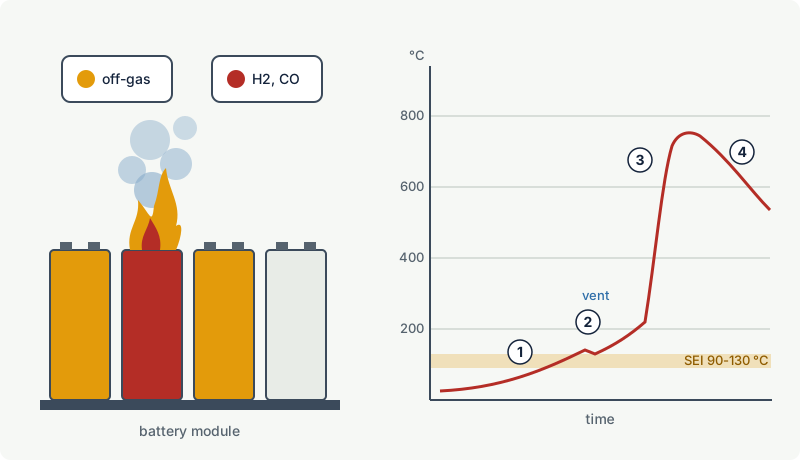
- Thermal runaway starts when heat generation inside a cell exceeds heat removal. The solid electrolyte interphase (SEI) begins to decompose at roughly 90 to 130 °C, the separator softens and melts above about 130 °C, and cathode decomposition and electrolyte reactions then drive cell temperatures to several hundred degrees Celsius.
- Before full runaway most cells vent: the safety vent opens and releases electrolyte vapour and gas. Detecting this first venting is the basis of off-gas detection.
- Vent gas composition depends on chemistry and state of charge. In one 2025 comparison, LFP cells gave about 44 % hydrogen and NMC cells about 14 to 17 % hydrogen but around 30 to 35 % carbon monoxide.
- Gas volume rises with state of charge: laboratory tests on small (2.5 Ah) NMC pouch cells measured about 1.2 L per Ah at 30 to 50 % charge and about 2.4 to 2.6 L per Ah at 80 to 100 %.
- NFPA 855 requires explosion control for lithium-ion energy storage. Its 2023 edition allowed deflagration venting (NFPA 68) or explosion prevention by ventilation (NFPA 69); published summaries of the 2026 edition agree that NFPA 69 prevention is now required and that venting alone is no longer accepted.
- UL 9540A is the test method that supplies the data for this design: cell, module, unit and installation level tests that measure gas volume and composition and whether runaway propagates.
- A 2019 explosion at a battery container in Surprise, Arizona, seriously injured four firefighters when they opened the door about three hours after the first alarm. It shaped today's requirements for gas detection, explosion prevention and remote monitoring.
How thermal runaway develops
Thermal runaway is a self-accelerating chain of exothermic reactions. It can be triggered by an internal defect (for example lithium plating and dendrite growth leading to an internal short circuit), by overcharge, by external heating, or by mechanical damage. The stages below are typical; the temperatures are approximate and depend on chemistry, cell design and state of charge.
| Stage | What happens | Approximate temperature |
|---|---|---|
| 1. Abuse and self-heating | internal short, overcharge or external heat; the cell starts to heat itself | from ambient upwards |
| 2. SEI decomposition | the protective layer on the anode breaks down; anode reacts with electrolyte | about 90 to 130 °C |
| 3. Separator failure and venting | separator softens and melts, gas pressure opens the cell vent; electrolyte vapour and gas escape | above about 130 °C |
| 4. Thermal runaway | cathode decomposes (in NMC, with release of oxygen), electrolyte reacts and burns; temperature rises within seconds | rapid runaway at roughly 200 to 230 °C for NMC-type cells in one study |
| 5. Propagation | heat, hot gas and ejecta from the failed cell drive neighbouring cells into runaway | depends on module design |
Peak temperatures measured on small cells in laboratory tests were about 400 °C for LFP and about 680 to 850 °C for metal-oxide (NMC and LCO/NMC) cells. LFP (lithium iron phosphate) cells generally react later and less violently than NMC (nickel manganese cobalt) cells, but they still vent large amounts of flammable gas.
The time between first venting and full runaway is the window for early warning. It is not reliable everywhere: a 2025 study found that for LFP cells the intense reaction came well after the vent opened, while for NMC cells vent opening and violent reaction happened almost together.
What the vent gas contains
The gas from a cell in thermal runaway is a mixture of:
- Hydrogen, often the largest flammable component and the one that makes the mixture easy to ignite (see hydrogen safety basics).
- Carbon monoxide, flammable and highly toxic.
- Carbon dioxide, not flammable, but it dilutes the mixture.
- Hydrocarbons such as methane, ethylene and ethane.
- Electrolyte solvent vapours, for example dimethyl carbonate and diethyl carbonate, which dominate the first venting.
- Toxic traces such as hydrogen fluoride from the conducting salt and hydrogen cyanide.
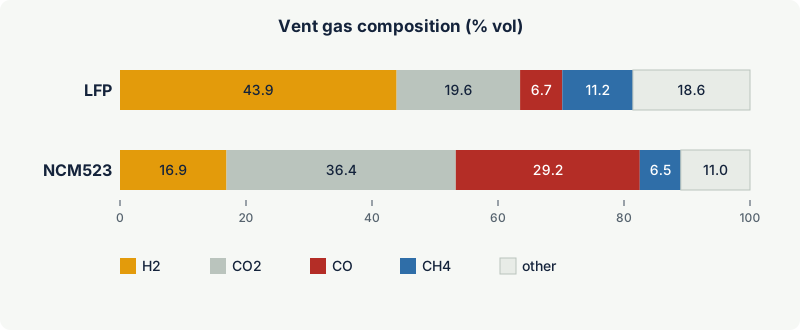
Composition varies with chemistry, state of charge and test conditions. In the comparison shown, LFP gas was about 44 % hydrogen, while NMC gas carried more carbon monoxide and carbon dioxide. Older work on small consumer cells also found hydrogen and carbon dioxide to be the main components, with the CO share lowest for LFP (about 4 %) and much higher for metal-oxide cells (13 to 28 %).
The flammable limits of the mixture follow from its composition. For NMC pouch cell gas, one laboratory calculated a lower flammable limit of about 7 % vol and an upper limit of about 31 % vol, but its infrared analyser could not measure hydrogen, so hydrogen was left out of that calculation and the limit of the real gas is likely lower. A Le Chatelier estimate for the hydrogen-rich LFP gas in the figure above, using the library limits of its main components, gives a lower flammable limit of roughly 5 % vol. Because hydrogen is often present in large proportion, the mixture is easy to ignite and burns fast.
Gas volume grows with state of charge. Small (2.5 Ah) NMC pouch cells tested at 30 and 50 % state of charge released about 1.2 L per Ah of capacity; at 80 and 100 % they released about 2.4 to 2.6 L per Ah. Only the fully charged cells exploded; at 80 % the cells ruptured, and at 50 % or less they only swelled. Larger cells of the same study, all fully charged, released between about 1.7 and 4.2 L per Ah. For design, take the volume and composition from UL 9540A test data for the actual cell, not from literature.
Detection strategy
A BESS needs several layers of detection, because each catches a different stage:
| Layer | What it detects | Stage | Typical action |
|---|---|---|---|
| Battery management system (BMS) | cell voltage, temperature, current anomalies | before or at stage 1 | derate, stop charging, disconnect |
| Off-gas detection | electrolyte vapour at first venting | stage 2 | alarm, stop charging and isolate the affected string, start ventilation |
| Flammable gas detection (H2 and others) | build-up of flammable gas, in % of LFL | stages 2 to 5 | start or increase exhaust ventilation, keep people out |
| Carbon monoxide detection | toxic and flammable product of runaway | stages 3 to 5 | alarm, entry control for responders |
| Smoke and heat detection | fire | stages 3 to 5 | fire alarm, suppression where provided |
Practical points for the gas detection part:
- Choose sensors for the actual gas. Catalytic sensors respond to hydrogen, CO and hydrocarbons and give a combined flammable reading; they need oxygen and can be poisoned. Electrochemical hydrogen sensors may be cross-sensitive to CO, which is present in large amounts. Infrared flammable gas sensors see hydrocarbons only: they are blind to hydrogen and do not measure CO. Many designs combine a hydrogen sensor with a CO sensor. See catalytic vs infrared detectors and electrochemical sensors.
- Calibrate and set alarms for the mixture. The LFL of vent gas differs from that of pure hydrogen. Set points are expressed in % of the LFL of the gas used for calibration, and the design must account for the sensor's response to the real mixture. The general method is in setting gas detector alarm levels.
- Placement. Hot vent gas rises, and hydrogen is light, but electrolyte vapours and CO2 are heavier than air and cool gas can stratify. Place detectors according to the test data and the enclosure's air flow: typically at ceiling level and at the exhaust intake, and for off-gas sensors close to the racks.
- Make readings available outside. One recommendation after the Arizona incident was remotely accessible gas monitoring. Gas readings should be visible at a safe location before anyone opens a door.
NFPA 855 and UL 9540A
NFPA 855 (Standard for the Installation of Stationary Energy Storage Systems) is the main installation standard in North America and is used as a reference elsewhere. Its 2023 edition required explosion control for lithium-ion systems and allowed two options: deflagration venting to NFPA 68, or explosion prevention by exhaust ventilation to NFPA 69. The 2026 edition was released in September 2025 and treats the topic as explosion control and prevention. Published summaries agree that an NFPA 69 system (combustible concentration reduction, keeping the average flammable gas concentration at or below 25 % of the LFL) is now required and that deflagration venting is no longer accepted as the stand-alone method. They differ on whether NFPA 68 venting has been removed altogether or remains as an additional measure, for example where an analysis shows local gas pockets above 25 % of the LFL. Summaries also report large-scale fire testing alongside UL 9540A, including a unit-level test with intentional ignition of the vent gas, and emergency or standby power for critical safety systems. The text of the standard decides, and which edition applies depends on what the authority having jurisdiction has adopted, so check both before designing.
UL 9540 is the safety standard for energy storage systems and equipment. UL 9540A is the test method for evaluating thermal runaway fire propagation; its fifth edition was published in March 2025. It works at four levels:
| UL 9540A level | Main question |
|---|---|
| Cell | Can the cell be driven into thermal runaway, at what temperature does it vent, how much gas does it release and what is the composition (including hydrogen and total hydrocarbons)? |
| Module | Does runaway propagate from one cell to others in the module; is the vent gas flammable? |
| Unit | Does runaway propagate between modules or to adjacent units; what heat and gas are released? |
| Installation | How does the system behave in its real installation, including fire protection? |
The cell-level gas data (volume, composition, flammability) is exactly what an explosion prevention or venting design needs. Outside North America, IEC 62933-5-2 (safety requirements for grid-integrated electrochemical energy storage systems, edition 2 published in December 2025) covers BESS safety at system level.
Explosion venting vs prevention ventilation
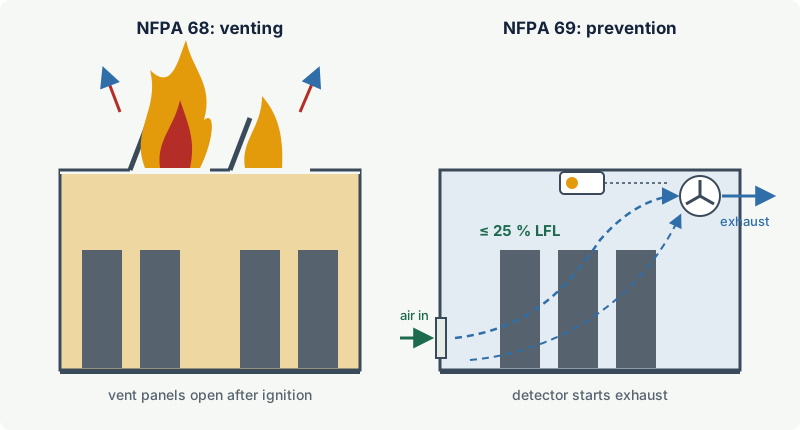
The two approaches answer different questions. Venting accepts that a flammable atmosphere may form and ignite, and limits the damage. Prevention ventilation stops the atmosphere from reaching a flammable concentration. This is the same hierarchy as in explosion protection strategy: avoid the atmosphere first, limit the effects only where that is not possible.
| Aspect | Deflagration venting (NFPA 68) | Explosion prevention ventilation (NFPA 69) |
|---|---|---|
| Principle | panels open at a low pressure and release the explosion to a safe direction | detection starts exhaust ventilation that dilutes the gas below a fraction of the LFL |
| Design input | gas burning velocity, maximum pressure, enclosure strength, partial volume deflagration | gas release rate and volume from UL 9540A, enclosure volume, air flow pattern |
| Depends on | panel opening reliably; clear zone outside the vent | detection, power supply and fans working during the event |
| Effect on people | flame and pressure jet outside the vent; area must be kept clear | no deflagration if it works; gas is exhausted to a safe place |
| Weak points | flame and debris projection; pockets that burn before the vent opens | loss of power; fan or damper failure; very fast releases |
In practice designs often combine both: ventilation to prevent a flammable atmosphere in foreseeable events, and venting as a backstop. The ventilation system is a safety system: it needs reliable power (summaries of the 2026 edition of NFPA 855 report emergency or standby power requirements for critical safety systems), commissioning and periodic testing, and its fans and dampers must keep working while flammable gas passes through them.
Is a BESS enclosure a hazardous area?
IEC 60079-10-1 excludes catastrophic failures, those beyond the abnormal conditions considered in area classification, such as the rupture of a vessel. A cell in thermal runaway is commonly treated as such an event, so the inside of a lithium-ion BESS enclosure is often not classified as a zone. Practice is not uniform, and some owners and authorities classify the enclosure or the extract path, so the decision belongs in the documented risk assessment. The explosion risk is handled by the explosion control design and, in Europe, by the risk assessment required for workplaces. Equipment that has to operate in the gas during the event, such as gas detectors, exhaust fans and dampers in the extract path, is nevertheless frequently specified as Ex equipment. Because the gas can be rich in hydrogen, gas group IIC (or IIB + H2 where the gas group of the mixture allows) is a common choice.
Vented lead-acid and nickel-based batteries are a different case: they release hydrogen during normal charging and are classified with ventilation rules, see battery rooms and charging areas.
Worked example: how much gas from one cell?
An outdoor container has a free gas volume of about 25 m³ (an assumption for this example). It contains large prismatic LFP cells of 280 Ah. For the example, assume a vent gas release of 1.5 L per Ah and a lower flammable limit of the gas of 5 % vol (the rough estimate for hydrogen-rich LFP gas above); real values must come from UL 9540A data for the cell.
- Gas from one cell: 280 Ah x 1.5 L/Ah = 420 L = 0.42 m³.
- Average concentration if retained: 0.42 / 25 = 1.7 % vol, which is about a third of the assumed LFL of 5 %. One cell alone takes the container above the 25 % LFL design limit.
- Propagation to eight cells: 8 x 0.42 = 3.4 m³, or about 13 % vol averaged over the container, well inside the flammable range. Local concentrations near the racks and under the roof will be higher still.
- Ventilation needed for one cell: if the cell vents its 0.42 m³ over about 2 minutes (0.0035 m³/s), keeping a fully mixed concentration at 25 % LFL (1.25 % vol) needs an exhaust of about 0.0035 / 0.0125 = 0.28 m³/s, or about 1,000 m³/h, roughly 40 air changes per hour for this container. Real air flow is never perfectly mixed, so a design adds margin and checks local concentrations.
The example shows why a single failing cell matters, why propagation has to be stopped at module level, and why exhaust ventilation must start on early detection rather than after a fire alarm.
The 2019 Arizona incident
On 19 April 2019 a lithium-ion battery container of about 2 MWh at a utility site in Surprise, Arizona, went into cascading thermal runaway. The smoke detection alarmed and a clean agent extinguishing system discharged, but the agent did not stop the runaway, and the container had no means to exhaust the gas. A hazardous materials team found high readings of carbon monoxide and hydrogen cyanide during entries; about three hours after the alarm, with those readings below their thresholds, the team opened the container door. A deflagration followed within minutes and seriously injured four firefighters.
The public firefighter-safety investigation recommended, among other measures, explosion prevention protection, remotely accessible gas monitoring and specific training. The incident is one reason why NFPA 855 now emphasises explosion prevention and why toxic gas readings must never be taken as proof that a battery enclosure is safe to open.
Common mistakes and misconceptions
- "The fire suppression system will handle it." Gaseous agents can knock down flames but do not stop thermal runaway or the release of flammable gas. Without exhaust, suppression can even allow gas to accumulate.
- Using only infrared gas detectors. Infrared flammable gas detectors respond to hydrocarbons only. They do not detect hydrogen and do not measure CO, the two main flammable components of vent gas in many chemistries.
- Assuming LFP batteries do not produce explosive gas. LFP cells react less violently, but their vent gas is particularly rich in hydrogen.
- Designing ventilation from literature values. Gas volume and composition depend on the cell and its state of charge; use UL 9540A data for the cell actually installed.
- Treating toxic gas readings as a flammability check. Low CO or HCN readings say nothing about hydrogen or the overall % LFL.
- Forgetting that the ventilation is a safety function. It needs secure power, monitoring and testing, and its components must work while flammable gas passes through them.
Frequently asked questions
What gases are released during lithium-ion battery thermal runaway?
Mainly hydrogen, carbon dioxide and carbon monoxide, with methane, ethylene and other hydrocarbons, electrolyte solvent vapours and small amounts of toxic gases such as hydrogen fluoride and hydrogen cyanide. LFP cells tend to give hydrogen-rich gas, NMC cells more carbon monoxide.
What is off-gas detection in a BESS?
Off-gas detection uses sensitive sensors to detect the electrolyte vapour released when a cell's safety vent first opens. Because this can happen before full thermal runaway, it allows charging to be stopped, the affected string to be isolated and ventilation to be started early. How much warning it gives depends on the cell chemistry.
Does NFPA 855 require gas detection?
NFPA 855 requires explosion control for lithium-ion systems. Where explosion prevention by exhaust ventilation to NFPA 69 is used, gas detection is normally what starts the ventilation, so it becomes part of the required system. Check the edition adopted in your jurisdiction, because the 2026 edition changed the explosion control requirements.
What does UL 9540A test?
UL 9540A is a test method for thermal runaway fire propagation in battery energy storage systems. It drives cells into thermal runaway and measures, at cell, module, unit and installation level, the gas released, its composition and flammability, and whether runaway and fire spread. The results are the design basis for detection, ventilation and venting.
Is explosion venting or exhaust ventilation better for a BESS?
Exhaust ventilation prevents the explosive atmosphere and is the preferred approach; according to published summaries, the 2026 edition of NFPA 855 requires it and no longer accepts venting on its own. Deflagration venting limits damage after ignition but releases flame and pressure outside the enclosure. Many designs use ventilation as the primary measure and venting as a backstop.
Is the inside of a battery container a Zone 1 or Zone 2?
Often neither. Area classification standards exclude catastrophic failures, and cell thermal runaway is commonly treated as one, so the explosion risk is addressed by detection, ventilation and venting instead. Equipment that must operate in the gas during an event is often still specified as Ex equipment.
Related on excodex
- Hydrogen safety basics: wide flammable range, low ignition energy and invisible flames
- Battery rooms and charging areas: hydrogen ventilation and hazardous areas
- Fixed gas detection systems: design principles and when they are required
- Deflagration, detonation and overpressure: what happens in a gas or dust explosion
- LEL and UEL explained
- Tools: hydrogen and carbon monoxide in the gas library, standards spaces NFPA 855 and IEC 60079-29-0, forum
Standards and further reading
- NFPA 855, Standard for the Installation of Stationary Energy Storage Systems (2023 edition; 2026 edition released September 2025).
- NFPA 68, Standard on Explosion Protection by Deflagration Venting; NFPA 69, Standard on Explosion Prevention Systems.
- UL 9540, Energy Storage Systems and Equipment; UL 9540A, Test Method for Evaluating Thermal Runaway Fire Propagation in Battery Energy Storage Systems (5th edition, March 2025).
- IEC 62933-5-2, Electrical energy storage systems, safety requirements for grid-integrated electrochemical-based systems: webstore.iec.ch
- IEC 60079-10-1 (area classification) and IEC 60079-29-0 / IEC 60079-29-2 (gas detector performance and selection).
- Qi et al., Research on the thermal runaway behavior and flammability limits of sodium-ion and lithium-ion batteries, Batteries 11(1) 24, 2025: mdpi.com
- Amano et al., Composition and explosibility of gas emissions from lithium-ion batteries undergoing thermal runaway, Batteries 9(6) 300, 2023: mdpi.com
- Golubkov et al., Thermal-runaway experiments on consumer Li-ion batteries with metal-oxide and olivin-type cathodes, RSC Advances 4, 2014: scispace.com
- Fire Safety Research Institute, Four firefighters injured in lithium-ion battery energy storage system explosion, Arizona (2020): fsri.org
- Summary of UL 9540A 2025 changes published by Santa Fe County: santafecountynm.gov
This article is general technical information prepared by the excodex editorial team. It does not replace the applicable standards, the equipment certificates and instructions, national regulations or the assessment of a competent person.