Deflagration, detonation and overpressure: what happens in a gas or dust explosion
Abstract
Most gas and dust explosions are deflagrations: flames slower than sound whose pressure depends on confinement and congestion. A detonation is a shock-driven flame at about 1,800 to 2,000 m/s. Flame speed, overpressure effects, vapour cloud and dust explosions, and BLEVEs.
Almost every gas, vapour or dust explosion in industry is a deflagration: a flame that travels through the fuel-air mixture slower than the speed of sound, pushing the expanding hot gases ahead of it. How much pressure it produces depends less on the fuel than on its surroundings: in the open a deflagration may be a flash fire with little pressure, inside a closed vessel it reaches roughly 7 to 9 bar, and in congested plant it can accelerate to hundreds of metres per second. A detonation is different: a shock wave and flame travelling together at about 1,800 to 2,000 m/s, with pressures around 15 to 20 bar before any reflection.
This article explains burning velocity and flame speed, deflagration and detonation, how confinement and congestion turn a fire into an explosion, what overpressure does to buildings and people, why dust explosions so often come in pairs, and why a BLEVE is a separate phenomenon.
Key points
- A deflagration propagates by heat and mass transfer into the unburned mixture at less than the speed of sound; a detonation propagates as a shock-supported reaction front at more than the speed of sound.
- The laminar burning velocity of methane and propane in air is below about 0.5 m/s, and about 3 m/s for hydrogen; turbulence created by obstacles can raise flame speeds a hundredfold.
- A stoichiometric methane-air deflagration in a closed vessel reaches a maximum explosion pressure of roughly 7 to 9 bar when it starts at atmospheric pressure.
- A stoichiometric methane-air detonation travels at about 1,800 m/s with a pressure of about 17 bar; hydrogen-air detonates at close to 2,000 m/s.
- Overpressure of about 7 kPa (1 psi) partly demolishes houses and shatters windows; about 14 kPa (2 psi) causes partial collapse of walls and roofs.
- Secondary dust explosions, fed by settled dust lifted by a first, smaller explosion, are usually the most destructive part of a dust explosion.
- A BLEVE is the sudden boiling of a pressurised liquid when its container fails; it is a physical explosion that does not need an explosive atmosphere, though a flammable contents adds a fireball.
From flame to explosion: burning velocity, flame speed and expansion
When a premixed fuel-air mixture is ignited, a thin flame front forms and moves into the unburned gas. Its speed relative to the unburned gas just ahead of it is the burning velocity, a property of the mixture. Under laminar conditions the maximum values in air are about 0.45 m/s for methane, 0.46 m/s for propane and 2.8 m/s for hydrogen (data compiled by the US Department of Energy hydrogen safety programme).
Behind the flame, the burned gas is several times hotter and expands roughly seven to eight times in volume. In an open space this expansion pushes the flame forward, so an observer sees a flame speed equal to the burning velocity multiplied by the expansion: a few metres per second for a hydrocarbon in still air. The expanding gas also pushes the surrounding air away, creating a pressure wave.
Whether that pressure wave is harmful depends on one balance: how fast hot gas is produced compared with how fast it can escape. A slow flame in the open produces almost no pressure. A fast flame, or any flame in a closed box, produces a lot.
| Event | Typical front speed | Typical pressure | Main hazard |
|---|---|---|---|
| Flash fire (open, uncongested) | a few m/s | negligible | Thermal radiation, burns inside the cloud |
| Deflagration in a closed vessel | slow, but no venting | roughly 7 to 9 bar for hydrocarbons | Vessel rupture, fragments |
| Deflagration in congested plant (vapour cloud explosion) | tens to hundreds of m/s | from a few kPa to above 100 kPa locally | Blast damage, structural collapse |
| Detonation | about 1,800 to 2,000 m/s | about 15 to 20 bar, more when reflected | Severe blast, no time for relief devices |
Deflagration in a closed vessel
In a closed vessel, the burned gas has nowhere to go and the pressure rises until all the fuel has burned. For a stoichiometric methane-air mixture starting at atmospheric pressure, published test results lie between roughly 7 and 9 bar, depending on the test vessel and on whether the value is quoted as overpressure or as absolute pressure. Most hydrocarbon-air mixtures and many dusts fall in a similar range. This is the maximum explosion pressure, pmax.
The second parameter is the maximum rate of pressure rise, (dp/dt)max. In geometrically similar vessels it falls with size according to the cube-root law: (dp/dt)max × V^(1/3) is constant. That constant is the KG value for gases and the Kst value for dusts, the explosion severity figure used to design venting and suppression (see dust explosion parameters).
Example: Why ordinary equipment cannot contain an internal explosion. At 8 bar overpressure, a 600 mm manway cover (area 0.28 m²) carries 800 kPa × 0.28 m² = 226 kN, the weight of about 23 tonnes. A thin-walled filter housing or a sheet-metal duct designed for a few millibar of fan pressure will burst long before that. This is why internal explosions are either prevented, vented, suppressed, or contained by vessels specifically designed as explosion-pressure-resistant.
Two effects make closed-vessel explosions worse in real plants. Pressure piling occurs when an explosion in one vessel pushes unburned mixture into a connected vessel and pre-compresses it; when the flame arrives, the second explosion starts from a higher pressure and can exceed the normal pmax. Turbulent jet ignition, a flame jet emerging from a pipe into the second vessel, makes the second explosion much faster. Both are reasons for explosion isolation between connected equipment, covered in explosion protection strategy.
Confinement and congestion: when an open cloud explodes
A flammable cloud released outdoors is not confined, yet large outdoor explosions happen. The reason is congestion: pipework, vessels, structures, cable trays and even trees and hedges in the path of the flame.
As the flame passes each obstacle, the flow of unburned gas pushed ahead of it becomes turbulent. Turbulence wrinkles and stretches the flame, increasing its surface area and burning rate. A faster flame pushes the gas ahead faster, which creates more turbulence at the next obstacle. This feedback loop can accelerate a flame from a few metres per second to hundreds of metres per second within a few metres of congestion. When the flame leaves the congested region into open space, it slows down again.
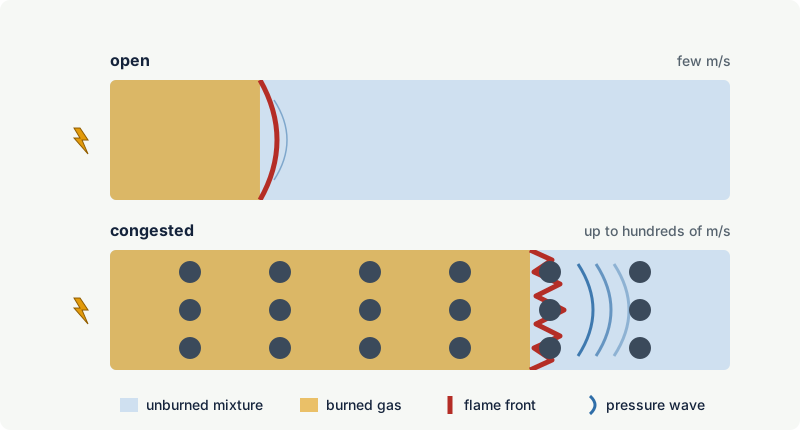
Confinement adds to the effect. A flame that can expand in only one direction, along a pipe or a tunnel, accelerates most; one confined between two surfaces, such as the decks of an offshore module or a floor and a roof, accelerates less; a flame free to expand in three dimensions accelerates least. Engineering methods for predicting vapour cloud explosion overpressures, such as the multi-energy and Baker-Strehlow-Tang methods, use exactly these parameters: degree of congestion, degree of confinement, fuel reactivity and the size of the congested region.
Two well-documented UK cases show the range:
- Flixborough, 1 June 1974. A 20-inch bypass pipe at a chemical plant ruptured and released a large quantity of cyclohexane, which formed a vapour cloud and exploded among the plant structures. Twenty-eight workers died, eighteen of them in the control room.
- Buncefield, 11 December 2005. Overfilling of a petrol tank produced a vapour cloud over a large area of the depot that exploded in still conditions. The advisory group that studied the explosion mechanism found evidence of overpressures around 1 bar and more along a line of trees and undergrowth at the site boundary, where the flame may have reached around 400 m/s. It considered deflagration, detonation or a combination, and could not identify a single scenario that explained all observations.
Buncefield changed industry thinking: vegetation and other "non-process" congestion around a site can drive severe flame acceleration.
Detonation and deflagration-to-detonation transition
In a detonation, a strong shock wave compresses and heats the mixture so much that it reacts almost immediately behind the shock, and the energy released keeps the shock going. The front advances at supersonic speed relative to the unburned mixture. There is no pressure wave running ahead to warn or to open relief devices: the pressure jump arrives with the flame.
Measured values from large-scale tests at the NIOSH Lake Lynn Laboratory show methane-air detonations travelling at about 1,500 to 1,860 m/s, close to the calculated Chapman-Jouguet values, with a calculated maximum pressure of about 1.77 MPa (17.7 bar) near 10 % methane. A large-scale test with 30 % hydrogen in air measured about 1,980 m/s. When a detonation hits a wall, the reflected pressure is considerably higher still.
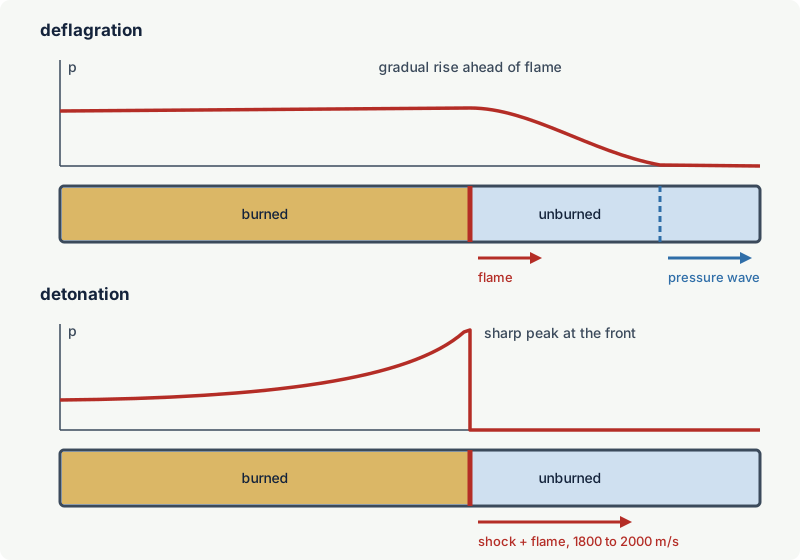
Detonations can start in two ways. Direct initiation needs a very strong source, such as a high explosive charge. In industry the usual route is deflagration-to-detonation transition (DDT): a deflagration accelerates in a long pipe, a tunnel or a highly congested region until local explosions in the compressed, turbulent mixture ahead of the flame turn into a self-sustaining detonation. Mixtures that are more reactive, such as those of hydrogen, acetylene and ethylene, are much more prone to DDT than methane. The NIOSH work found that natural gas-air mixtures can sustain detonation between about 5.3 % and 15.5 % by volume, close to the flammability limits, once a detonation has formed in a large enough channel.
DDT has practical consequences. Flame arresters on long vent and vapour recovery lines must be suitable for the flame regime that can occur at their position: ISO 16852 distinguishes deflagration arresters from those tested against stable and unstable detonations. A device that stops a slow deflagration can be destroyed by a detonation.
Overpressure and what it does
The blast wave from an explosion is described by its peak side-on overpressure (the pressure above atmospheric felt by a surface parallel to the wave), its duration and its impulse. A surface facing the wave sees the higher reflected pressure. Damage depends on both peak pressure and duration, so the same peak from a large vapour cloud does more damage than from a small charge.
The US National Oceanic and Atmospheric Administration (NOAA) uses the following damage levels, based on a classic compilation; kPa values are rounded conversions.
| Side-on overpressure | Typical effect |
|---|---|
| about 1 kPa (0.15 psi) | Typical pressure for glass failure |
| 3.5 to 7 kPa (0.5 to 1 psi) | Most windows shatter, some frame damage |
| about 7 kPa (1 psi) | Houses partly demolished and made uninhabitable |
| about 14 kPa (2 psi) | Partial collapse of house walls and roofs |
| 14 to 21 kPa (2 to 3 psi) | Unreinforced concrete or cinder block walls shatter |
| about 21 kPa (3 psi) | Steel frame buildings distorted and pulled from foundations |
| 35 to 48 kPa (5 to 7 psi) | Nearly complete destruction of houses |
| 17 to 84 kPa (2.4 to 12.2 psi) | 1 % to 90 % eardrum rupture among exposed people |
| 100 to 200 kPa (14.5 to 29 psi) | 1 % to 99 % fatalities from direct blast effects |
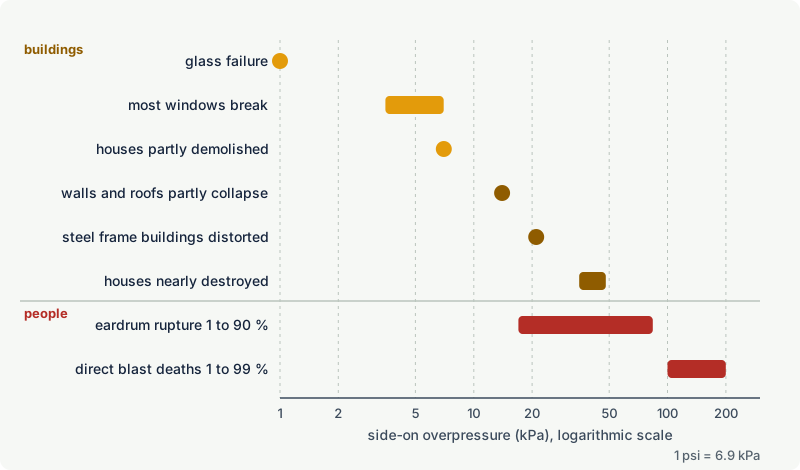
The table shows the key fact for plant layout: people are far more likely to be killed by what the blast does to buildings, windows and equipment than by the pressure itself. A control room or office that collapses at 14 to 21 kPa is lethal to its occupants at a pressure their bodies would survive in the open. Flixborough, where most of the dead were in the control room, is the classic example.
Example: A 5 m by 3 m wall (15 m²) facing a side-on overpressure of 7 kPa carries 7,000 Pa × 15 m² = 105 kN, roughly the weight of 10 tonnes, applied within milliseconds. Ordinary masonry and lightweight cladding are not built for this, which is why occupied buildings near process areas are assessed for blast and either sited at a safe distance or designed for it.
Dust explosions and secondary explosions
Dust clouds deflagrate in the same way as gas mixtures, with comparable maximum pressures in closed vessels, but with two important differences. A dust cloud only exists while it is stirred up, and settled dust can be raised by the explosion itself.
The typical sequence starts with a primary explosion inside equipment: a mill, a filter, a bucket elevator or a conveyor. Its pressure wave and flame escape through the equipment and shake loose dust lying on beams, ducts, ledges and floors. The raised dust forms a large cloud in the building, and the flame following the pressure wave ignites it. This secondary explosion involves far more fuel than the first and often spreads from room to room.
At the sugar refinery in Port Wentworth, Georgia, on 7 February 2008, the US Chemical Safety Board found that the first dust explosion started in an enclosed steel belt conveyor below the sugar silos. It lofted sugar dust that had accumulated on floors and elevated surfaces and propagated more explosions through the buildings. Fourteen workers were killed and 38 injured. The lesson is that housekeeping is an explosion protection measure, not a cosmetic one. See dust layers and housekeeping and dust explosion protection.
BLEVE: a different kind of explosion
A boiling liquid expanding vapour explosion (BLEVE) happens when a container holding a liquid above its atmospheric boiling point fails suddenly. The pressure drops at once and a large part of the liquid flashes to vapour almost instantly, releasing energy as a blast wave and throwing vessel fragments, sometimes over long distances. The usual cause is a fire heating a pressurised tank of liquefied gas: the vapour space wall loses strength while the pressure relief valve holds the pressure up, until the shell tears.
A BLEVE is a physical explosion: it needs no fuel-air mixture and can occur with non-flammable liquids such as water in a boiler. When the contents are flammable, such as propane or LPG, the released vapour and droplets ignite into a fireball whose radiant heat adds to the blast and fragment hazards. The protection is therefore different from ATEX measures: fire prevention around pressurised storage, water spray cooling, fireproofing, emergency depressurisation and correctly sized relief valves.
Common mistakes and misconceptions
- "Outdoors, a gas cloud can only burn." In the open and uncongested it may only be a flash fire, but pipe racks, equipment and vegetation can accelerate the flame into a damaging vapour cloud explosion.
- "Every explosion is a detonation." Most industrial explosions are deflagrations. The distinction matters because venting and many flame arresters work against deflagrations but not detonations.
- "A strong building protects people." If the building is not designed for blast, its collapse and flying glass are the main cause of injury.
- "A dust explosion is over when the first one is." Secondary explosions fed by settled dust are often far larger than the primary event.
- "BLEVE is just a big gas explosion." It is a container failure with sudden boiling; it needs no explosive atmosphere, and its prevention focuses on fire protection and pressure relief.
Frequently asked questions
What is the difference between a deflagration and a detonation?
A deflagration is a combustion front moving through the mixture by heat and mass transfer, slower than the speed of sound in the unburned gas. A detonation is a reaction front coupled to a shock wave that moves faster than sound, about 1,800 to 2,000 m/s in fuel-air mixtures. Detonations produce much higher and more sudden pressures.
How much pressure does a gas explosion produce?
It depends on confinement. In a closed vessel, a stoichiometric hydrocarbon-air mixture reaches roughly 7 to 9 bar from atmospheric pressure. In open, uncongested space the overpressure may be negligible, while in congested plant it can range from a few kPa to more than 100 kPa locally.
What is a vapour cloud explosion?
A vapour cloud explosion (VCE) is the explosion of a flammable gas or vapour cloud released into the open or into a partly open plant area. Its strength comes mainly from flame acceleration through congestion such as pipe racks, equipment or vegetation.
What overpressure breaks windows and damages buildings?
According to the damage levels used by NOAA, glass typically fails at about 1 kPa (0.15 psi), houses are partly demolished at about 7 kPa (1 psi), and walls and roofs partly collapse at about 14 kPa (2 psi).
Can a dust cloud detonate?
Dust explosions in industrial equipment and buildings are normally deflagrations, and protection methods such as venting and suppression are designed for that. The decisive hazard in dust handling is not detonation but the chain of primary and secondary deflagrations through a building.
Is a BLEVE a vapour cloud explosion?
No. A BLEVE is the sudden failure of a container holding a liquid above its boiling point, producing a blast from flashing liquid and fragments. If the contents are flammable, a fireball follows, and a vapour cloud explosion can occur only if a cloud forms and ignites later.
Related on excodex
- What is an explosive atmosphere? Fire triangle, explosion pentagon and why ATEX exists
- Explosion protection strategy: avoid the atmosphere, avoid ignition, limit the effects
- Dust explosion parameters explained: Kst, Pmax, St classes, MIE
- Dust explosion protection: venting, suppression, isolation and containment
- Flameproof enclosures (Ex d): how flamepaths stop an internal explosion
- Gas cards: methane, propane, hydrogen; standards space EN 1127-1
Standards and further reading
- EN 1127-1, explosion prevention and protection, basic concepts and methodology
- EN 15967, determination of maximum explosion pressure and maximum rate of pressure rise of gases and vapours; EN 14034 series for dust explosion characteristics
- EN 14994 and EN 14491, gas and dust explosion venting protective systems; ISO 16852, flame arresters (deflagration and detonation)
- CCPS process safety glossary, definitions of deflagration, detonation and BLEVE: aiche.org
- NOAA, ALOHA overpressure levels of concern and damage table: response.restoration.noaa.gov
- NIOSH, methane-air detonation experiments at Lake Lynn Laboratory: stacks.cdc.gov
- Hydrogen tools portal, properties of hydrogen compared with other fuels: h2tools.org
- HSE research report RR718, Buncefield explosion mechanism phase 1: hse.gov.uk; Buncefield explosion mechanism advisory group report: icheme.org
- HSE case study, Flixborough 1974: hse.gov.uk
- US Chemical Safety Board, sugar dust explosion and fire, Port Wentworth 2008: csb.gov
This article is general technical information prepared by the excodex editorial team. It does not replace the applicable standards, the equipment certificates and instructions, national regulations or the assessment of a competent person.