LEL and UEL explained: explosive limits, %LEL and how gas detectors use them
Abstract
The LEL and UEL are the lowest and highest gas concentrations in air that can burn. Learn typical values, how the %LEL scale of gas detectors works, why IEC and NIOSH figures differ, and how temperature, pressure and oxygen shift the limits.
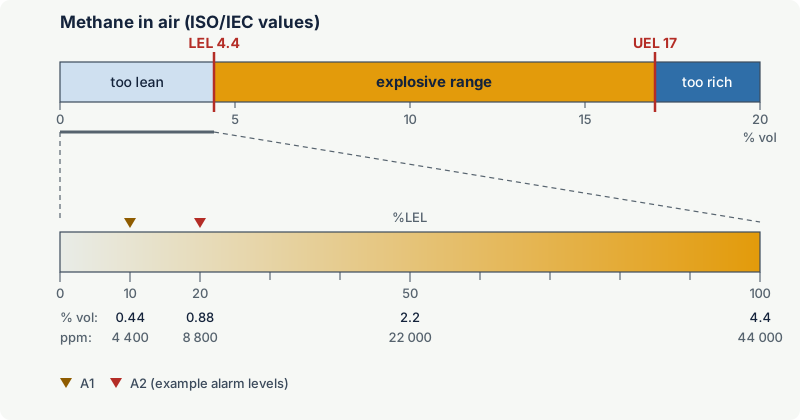
The lower explosive limit (LEL) is the lowest concentration of a flammable gas or vapour in air that can propagate a flame; the upper explosive limit (UEL) is the highest. Between the two, the mixture is an explosive atmosphere; below the LEL it is too lean to burn, and above the UEL it is too rich, but it becomes explosive again as soon as air dilutes it. Gas detectors express flammable gas as a percentage of the LEL (%LEL), so 100 %LEL is the point where an explosive atmosphere begins: for methane on the ISO/IEC basis, 100 %LEL is 4.4 % by volume and 10 %LEL is 0.44 % by volume.
This article explains the definitions, gives typical values from the excodex gas library, shows how the %LEL scale works, why IEC and NIOSH values differ, how temperature, pressure and oxygen move the limits, and what all of this means when you set up a gas detector.
Key points
- The LEL (also called lower flammable limit, LFL) and UEL (upper flammable limit, UFL) are measured in % by volume of gas in air at atmospheric conditions, usually near room temperature.
- A mixture between the LEL and the UEL can be ignited; a mixture above the UEL is not safe, because dilution with air brings it back through the explosive range.
- A flammable gas detector reading of 100 %LEL means the gas concentration equals the LEL; 10 %LEL of methane is 0.44 % vol (4,400 ppm) on the ISO/IEC value of 4.4 % vol.
- Published limits depend on the test method: the European and ISO/IEC methods give methane 4.4 to 17 % vol, while US Bureau of Mines data, now published by NIOSH, give 5 to 15 % vol.
- Higher temperature, higher pressure and more oxygen widen the flammable range; less oxygen narrows it until no flame can propagate.
- The detector, its calibration gas and the alarm settings must all use the same LEL basis, otherwise the alarm points shift by 10 % or more.
- Catalytic (pellistor) sensors need oxygen and can read falsely low above the LEL, so over-range readings must latch.
What LEL and UEL mean
A flame only travels through a gas mixture if there is enough fuel and enough oxygen. Below the LEL, burning the little fuel present does not release enough heat to ignite the next layer of mixture, so the flame dies. Above the UEL, there is too little oxygen. Between the two limits, a single ignition source can start a flame that runs through the whole cloud.
LEL and LFL mean the same thing in practice, as do UEL and UFL. The international material data standard, ISO/IEC 80079-20-1 (which replaced IEC 60079-20-1 in 2017), says "lower flammable limit"; detectors and site procedures say "LEL". This series uses LEL and UEL.
The limits are expressed in % by volume (% vol, the same as mole fraction for ideal gases) and refer to a mixture with air at or near atmospheric pressure and ambient temperature. The range between them is the flammable range or explosive range. An atmosphere inside that range, at atmospheric conditions, is what the ATEX directives and IEC 60079 standards call an explosive gas atmosphere.
For liquids, the limits apply to the vapour. A liquid can only form a mixture above its LEL if it is warm enough to produce that much vapour, which is what the flash point describes (see flash point, autoignition temperature and minimum ignition energy).
Typical LEL and UEL values
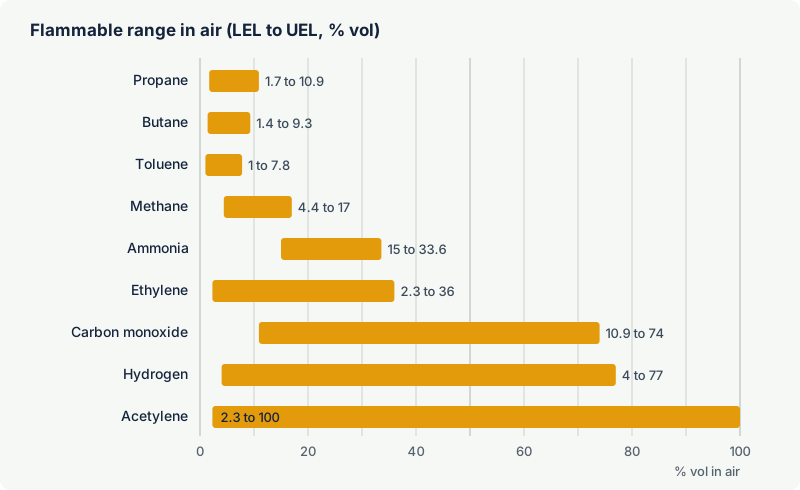
The table uses the values of the excodex gas library, which follow the ISO/IEC data tables where available. Other sources may differ slightly (see the section on IEC versus NIOSH values below).
| Substance | LEL (% vol) | UEL (% vol) | Relative density (air = 1) | Gas group |
|---|---|---|---|---|
| Methane | 4.4 | 17 | 0.554 | IIA |
| Ethane | 2.4 | 15.5 | 1.04 | IIA |
| Propane | 1.7 | 10.9 | 1.52 | IIA |
| Butane | 1.4 | 9.3 | 2.01 | IIA |
| n-Pentane | 1.1 | 8.7 | 2.49 | IIA |
| Hexane | 1 | 8.9 | 2.98 | IIA |
| Toluene | 1 | 7.8 | 3.18 | IIA |
| Acetone | 2.5 | 14.3 | 2.01 | IIA |
| Methanol | 6 | 36 | 1.11 | IIA |
| Ethanol | 3.1 | 19 | 1.59 | IIB |
| Ethylene | 2.3 | 36 | 0.968 | IIB |
| Hydrogen sulfide | 4 | 45.5 | 1.18 | IIB |
| Carbon monoxide | 10.9 | 74 | 0.967 | IIB |
| Ammonia | 15 | 33.6 | 0.588 | IIA |
| Hydrogen | 4 | 77 | 0.0696 | IIC |
| Acetylene | 2.3 | 100 | 0.899 | IIC |
A few patterns are worth remembering:
- Heavier hydrocarbons have lower LELs. Most solvent and fuel vapours have an LEL around 1 % vol, so a small quantity of liquid can make a large explosive cloud.
- Hydrogen and acetylene have very wide ranges. Hydrogen burns from 4 % to 77 % vol. Acetylene has a UEL of 100 % because it can decompose explosively without any air at all.
- Ammonia and carbon monoxide have high LELs. They are harder to bring into the explosive range, but both are highly toxic long before they reach it, so toxic detection usually governs.
- A low LEL alone does not make a gas "more dangerous". Ignition energy, density, toxicity, release conditions and reactivity matter as much.
The %LEL scale: how detectors express concentration
A flammable gas detector for safety monitoring does not normally display % vol. It displays the concentration as a fraction of the LEL of the gas it is calibrated for:
%LEL = (concentration in % vol / LEL in % vol) x 100
The advantage is that alarm levels mean the same thing for every gas. An alarm at 20 %LEL always means "one fifth of the way to an explosive mixture", whether the gas is methane with an LEL of 4.4 % vol or toluene vapour with an LEL of 1 % vol. The scale also matches the hazard: the reading reaches 100 at exactly the point where the mixture becomes ignitable.
| %LEL | Methane (% vol) | Methane (ppm) | Propane (% vol) | Hydrogen (% vol) |
|---|---|---|---|---|
| 5 | 0.22 | 2,200 | 0.085 | 0.2 |
| 10 | 0.44 | 4,400 | 0.17 | 0.4 |
| 20 | 0.88 | 8,800 | 0.34 | 0.8 |
| 50 | 2.2 | 22,000 | 0.85 | 2 |
| 100 | 4.4 | 44,000 | 1.7 | 4 |
Values use the excodex library LELs (methane 4.4, propane 1.7, hydrogen 4 % vol). 1 % vol = 10,000 ppm.
Alarm levels in brief
Fixed systems typically have two or three alarm levels well below 100 %LEL, so there is time to act before an explosive atmosphere forms. Values of 10 to 25 %LEL for the first alarm and 20 to 50 %LEL for the second are common industry practice, not universal requirements; the right values depend on the speed of the release, the detector response time and the action triggered. The details are in setting gas detector alarm levels.
Some regulations use the LEL directly. The US OSHA permit-required confined space rule (29 CFR 1910.146), for example, treats an atmosphere with flammable gas, vapour or mist above 10 % of its LFL as a hazardous atmosphere.
Example: A detector calibrated for methane on the ISO/IEC basis shows 15 %LEL in a valve pit. The methane concentration is 0.15 x 4.4 = 0.66 % vol, or 6,600 ppm. The atmosphere is not explosive, but a leak is present and the source must be found before anyone works there.
Above 100 %LEL
Most safety detectors measure only up to 100 %LEL. Higher concentrations need a % vol range (for example 0 to 100 % vol methane for purging work), which infrared and thermal conductivity sensors can provide. A catalytic (pellistor) sensor is the opposite: above the LEL there is not enough oxygen to burn all the gas on the bead, and the signal can fall back to a value that looks safe. IEC guidance on detector selection expects instruments that meet the IEC performance standard to give a latching over-range indication for this reason, but stand-alone transmitters and older instruments may not have one. More in catalytic (pellistor) vs infrared flammable gas detectors.
IEC values versus NIOSH values: why the numbers differ
If you compare a European safety data sheet with a US one, the LEL of the same substance often differs. Neither is wrong. The limits are not natural constants but the results of a standardised test, and the main test methods differ:
- EN 1839 (European method, also used for ISO/IEC data) offers a tube method, where an explosion counts if the flame detaches and travels a set distance up a vertical glass tube, and a bomb method, where it counts if the pressure rises by a set amount in a closed vessel. The standard itself notes that the tube method generally gives a wider range and that the two methods can differ by up to about 10 % relative.
- ASTM E681 (US method) uses a glass flask, a spark and visual observation of upward and outward flame propagation. ASTM states that its method aims at the best representation of the flammability limit, whereas the European methods aim for a conservative result.
- Much older US data, still reproduced in many references, come from US Bureau of Mines work summarised by Zabetakis in Bulletin 627 (1970), now hosted by NIOSH. That bulletin gives methane as 5 to 15 % vol.
The NIOSH Pocket Guide to Chemical Hazards lists LEL and UEL values for substances that have occupational exposure limits, so it includes common solvents and fuel gases such as propane and butane:
| Substance | excodex / ISO-IEC LEL to UEL (% vol) | US value LEL to UEL (% vol) | US source |
|---|---|---|---|
| Methane | 4.4 to 17 | 5 to 15 | Bureau of Mines Bulletin 627 |
| Propane | 1.7 to 10.9 | 2.1 to 9.5 | NIOSH Pocket Guide |
| Butane | 1.4 to 9.3 | 1.6 to 8.4 | NIOSH Pocket Guide (n-butane) |
| n-Pentane | 1.1 to 8.7 | 1.5 to 7.8 | NIOSH Pocket Guide |
| Hexane | 1 to 8.9 | 1.1 to 7.5 | NIOSH Pocket Guide (n-hexane) |
| Toluene | 1 to 7.8 | 1.1 to 7.1 | NIOSH Pocket Guide |
| Acetone | 2.5 to 14.3 | 2.5 to 12.8 | NIOSH Pocket Guide |
The pattern is clear: the ISO/IEC values usually give a lower LEL and a higher UEL, so a wider and more conservative flammable range.
Why this matters for a gas detector
The %LEL reading is only meaningful if you know which LEL the instrument uses. The same gas gives different readings on the two bases:
Example: A room contains 2.2 % vol methane. A detector set up on the ISO/IEC value (100 %LEL = 4.4 % vol) shows 50 %LEL. A detector set up on 5.0 % vol shows 44 %LEL. For n-pentane at 0.55 % vol, the readings would be 50 %LEL (LEL 1.1 % vol) and about 37 %LEL (LEL 1.5 % vol). An alarm set at 40 %LEL would trip on one instrument and not on the other.
Practical rules:
- Use the LEL basis required where the plant is located. In regions that apply IEC and EN standards, that is normally the ISO/IEC 80079-20-1 data.
- Order calibration gas as % vol of the actual gas, not as "%LEL", or state the LEL basis explicitly. "50 %LEL methane" means 2.2 % vol on one basis and 2.5 % vol on the other.
- Check that the detector firmware, the control system scaling and the calibration gas certificate all use the same value. Mixing bases is a common commissioning error on international projects.
- When in doubt, the lower LEL value is the conservative choice, because the detector then reads higher for the same gas concentration.
How temperature, pressure and oxygen change the limits
Published limits apply to the test conditions, normally atmospheric pressure and a temperature close to ambient. Process conditions can be quite different.
Temperature
Raising the temperature widens the flammable range: the LEL falls and the UEL rises. A hot mixture needs less fuel to sustain a flame, because the unburnt gas is already partly preheated. For hot process gases, dryer exhausts and heated vessels, the ambient LEL is therefore not conservative. EN 1839 covers measurements up to 200 °C, and specialist test data should be used when the process is significantly above ambient.
Pressure
Increasing the pressure above atmospheric also generally widens the range. For hydrocarbons such as natural gas, the effect is mostly on the upper limit, which rises markedly, while the lower limit changes much less. Below atmospheric pressure the range narrows. Flammability data measured at 1 atm should not be used for high-pressure vessels, compressors or pipelines without checking pressure-specific data.
Oxygen
Oxygen is the third side of the fire triangle, so its concentration has a strong effect:
- Oxygen enrichment barely changes the LEL but raises the UEL substantially, and it lowers the ignition energy. Oxygen-enriched atmospheres are therefore more dangerous than air even at the same fuel concentration.
- Oxygen depletion by an inert gas such as nitrogen or carbon dioxide narrows the range until the LEL and UEL meet. Below that oxygen level, the limiting oxygen concentration (LOC), no mixture can burn. For methane diluted with nitrogen, Bureau of Mines data give about 12 % vol oxygen at room temperature and atmospheric pressure. Inerting design is covered in oxygen concentration, enrichment and inerting.
Oxygen also affects the detector. A catalytic sensor burns the gas on its bead and needs oxygen to do so; IEC guidance states that it needs roughly 10 % vol oxygen as a minimum, and a US OSHA hazard bulletin reached the same figure after a fatal explosion in a nitrogen-purged tank. Infrared sensors do not need oxygen.
Mixtures of flammable gases
Real releases are often mixtures: natural gas, refinery off-gas, solvent blends. For mixtures of similar fuels, Le Chatelier's mixing rule gives a useful estimate of the mixture LEL:
LEL(mix) = 1 / (y1/LEL1 + y2/LEL2 + ...)
where y1, y2 are the volume fractions of each flammable component in the fuel (excluding air and inert gases, and summing to 1).
Example: A fuel gas is 70 % methane and 30 % propane by volume. LEL(mix) = 1 / (0.7/4.4 + 0.3/1.7) = 1 / (0.159 + 0.176) = about 3.0 % vol. The same rule applied to the UELs (17 and 10.9 % vol) gives about 14.6 % vol.
The rule works well for mixtures of hydrocarbons and less well for mixtures containing hydrogen or large amounts of inert gas, where measured data are preferable. The detector will not see the mixture LEL directly in any case: it responds to each component according to its own sensitivity, which is why calibration for mixtures uses response factors (see gas detector calibration and bump testing).
How gas detectors use the LEL in practice
A flammable gas channel relies on the LEL four times: for the measuring range (0 to 100 %LEL for early warning, % vol ranges for purging and inerting work), for calibration (a known % vol of test gas set to read the matching %LEL, with the manufacturer's relative response data when the target gas differs), for alarm set points in %LEL, and for over-range and fault handling, where readings at or above 100 %LEL, negative readings and low oxygen need a defined response in the control logic.
Warning: A rich atmosphere is not a safe atmosphere. A tank or pipe full of gas above the UEL cannot be ignited inside, but every leak, vent or ventilation step passes through the explosive range. When a gas-filled space is opened or ventilated with air, the mixture will pass from above the UEL, through the flammable range, to below the LEL. Purging procedures use inert gas first for this reason.
Common mistakes
- Treating "below the LEL" as safe. Alarm levels sit well below 100 %LEL because concentrations vary in space and time, detectors measure at one point, and the reading lags the release.
- Mixing LEL bases. A detector configured for methane at 5.0 % vol, calibrated with gas labelled on a 4.4 % vol basis, shifts every alarm point by 12 to 14 %. Specify calibration gas in % vol and state the basis.
- Trusting a falling catalytic reading during a large release. Above the LEL a pellistor can read low or even zero. Over-range must latch and be treated as a high alarm.
- Using ambient limits for hot or pressurised processes. Elevated temperature and pressure widen the range; use condition-specific data.
- Measuring flammable gas in an inerted vessel with a catalytic sensor. Without about 10 % vol oxygen the reading is meaningless. Use an infrared or thermal conductivity instrument and measure oxygen as well.
- Assuming a rich mixture is harmless. Mixtures above the UEL become explosive on dilution.
Frequently asked questions
What is the LEL of methane: 4.4 % or 5 %?
Both figures are in use. ISO/IEC 80079-20-1, used for European and international gas detection and area classification, gives 4.4 % vol (UEL 17 % vol). Older US Bureau of Mines data give 5 % vol (UEL 15 % vol). Use the value required in your jurisdiction and make sure the detector, calibration gas and alarm settings all use the same one.
Is 100 %LEL an explosion?
100 %LEL means the gas concentration has reached the lower explosive limit, so the mixture can now be ignited. Nothing happens without an ignition source, but at that point any spark, hot surface or flame can start an explosion. Alarm levels are set far below 100 %LEL so that action is taken long before this point.
What is the difference between LEL and LFL?
There is no practical difference. LFL (lower flammable limit) is the term used in ISO/IEC material data standards and in NFPA documents; LEL (lower explosive limit) is the term used on gas detectors and in most site procedures. Both describe the minimum concentration of fuel in air that can propagate a flame.
Can a gas concentration above the UEL be safe?
Only while nothing changes, and that is rarely guaranteed. A mixture above the UEL becomes explosive as soon as air mixes in, for example at a leak, a vent or when a vessel is opened. It also means the space contains a large amount of fuel. Rich atmospheres are handled by inerting and controlled purging, not by relying on the UEL.
How do I convert %LEL to ppm?
Multiply the %LEL reading by the LEL in % vol, divide by 100 to get % vol, then multiply by 10,000 to get ppm. For methane at 10 %LEL on the 4.4 % vol basis: 10 x 4.4 / 100 = 0.44 % vol = 4,400 ppm. For toxic gases, ppm exposure limits are far lower than flammable alarm levels, so separate toxic sensors are needed.
Related on excodex
- Flash point, autoignition temperature and minimum ignition energy
- Vapour density: which gases rise and which sink
- Catalytic (pellistor) vs infrared flammable gas detectors
- Setting gas detector alarm levels
- Oxygen concentration, enrichment and inerting
- Gas and solvent library with LEL, UEL and other data: /gas; standards spaces IEC 60079-20-1 and IEC 60079-29-0; questions in the forum
Standards and further reading
- ISO/IEC 80079-20-1, Explosive atmospheres: material characteristics for gas and vapour classification, test methods and data (replaced IEC 60079-20-1 in 2017).
- EN 1839, Determination of the explosion limits and the limiting oxygen concentration (LOC) for flammable gases and vapours.
- ASTM E681, Standard test method for concentration limits of flammability of chemicals (vapours and gases).
- IEC 60079-29-0 (2025), gas detection equipment: general requirements and test methods for flammable gas, oxygen and toxic gas detectors; it replaces IEC 60079-29-1 (formerly the flammable gas detector performance standard) and IEC 60079-29-4.
- IEC 60079-29-2, gas detectors: selection, installation, use and maintenance of detectors for flammable gases and oxygen.
- US OSHA 29 CFR 1910.146, permit-required confined spaces: https://www.osha.gov/laws-regs/regulations/standardnumber/1910/1910.146
- NIOSH Pocket Guide to Chemical Hazards, propane entry (example of US LEL and UEL data): https://www.cdc.gov/niosh/npg/npgd0524.html
- M. G. Zabetakis, Flammability characteristics of combustible gases and vapors, US Bureau of Mines Bulletin 627 (1970), NIOSH library: https://stacks.cdc.gov/view/cdc/235822
- IEC webstore record showing that IEC 60079-20-1 was replaced by ISO/IEC 80079-20-1: https://webstore.iec.ch/en/publication/635
- IEC 60079-29-0 webstore record: https://webstore.iec.ch/en/publication/77173
This article is general technical information prepared by the excodex editorial team. It does not replace the applicable standards, the equipment certificates and instructions, national regulations or the assessment of a competent person.