Oxygen concentration, enrichment and inerting: how oxygen changes the explosion risk
Abstract
Below the limiting oxygen concentration no flame can spread, which is the basis of inerting; above 21 % oxygen the flammable range widens and ignition becomes far easier. LOC values, inerting methods, safety margins, oxygen monitoring and enrichment hazards.
Oxygen is the side of the fire triangle that process engineers can control most precisely. If the oxygen concentration is kept below the limiting oxygen concentration (LOC), no flame can spread through the mixture whatever the amount of fuel; for most hydrocarbon gases and vapours diluted with nitrogen the LOC lies around 10 to 12 % by volume, and for hydrogen it is about 5 %. Replacing air with nitrogen or carbon dioxide to stay below that level is called inerting. The opposite, oxygen enrichment above the 21 % of normal air, widens the flammable range, makes ignition up to a hundred times easier and takes Ex equipment outside the conditions it was certified for.
This article explains the LOC, the main inerting methods with a worked purge calculation, the safety margins used in practice, how oxygen is monitored in inerted plant, and why enriched atmospheres need their own assessment.
Key points
- The limiting oxygen concentration is the highest oxygen concentration at which a flame can no longer propagate through a fuel, air and inert gas mixture, whatever the fuel concentration.
- US Bureau of Mines data give an LOC with nitrogen of 12 % for methane, 11.5 % for propane, 10 % for ethylene and 5 % for hydrogen; with carbon dioxide the values are higher (14.5 %, 14.5 %, 11.5 % and 5.2 %).
- LOC values depend on the test method and fall at higher temperature and pressure, so inerted systems run with a safety margin below the LOC.
- NFPA 69 requires a margin of at least 2 percentage points below the LOC where oxygen is monitored continuously with interlocks (no more than 60 % of the LOC if the LOC is below 5 %), and a larger margin without continuous monitoring.
- Oxygen monitoring is the safety function that makes inerting work: sensors must be placed where air can enter, respond fast enough, fail safe and be calibrated.
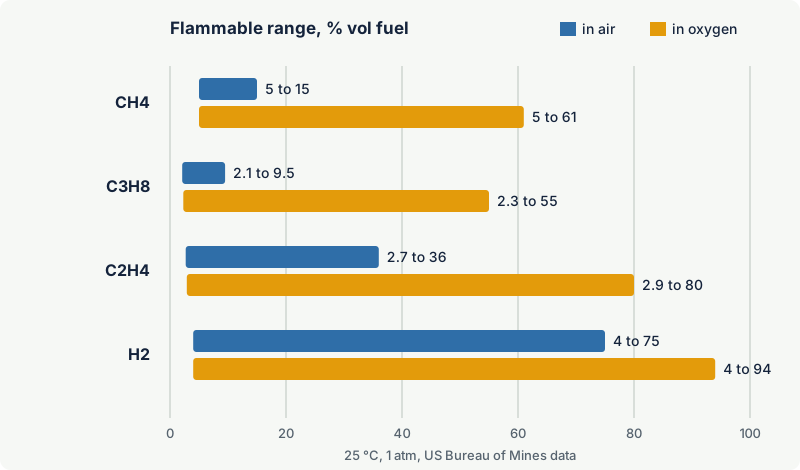
- In pure oxygen the minimum ignition energy of methane falls from about 0.3 mJ to about 0.003 mJ, and its upper flammable limit rises from 15 to 61 % (US Bureau of Mines data).
- Ex equipment is designed and tested for air with a normal oxygen content of about 21 %. Its certification does not cover oxygen-enriched atmospheres.
How oxygen controls whether a mixture can burn
A flame front survives only if the heat released by burning one layer of mixture is enough to ignite the next layer. Inert gas such as nitrogen or carbon dioxide does not take part in the reaction but has to be heated along with the products, so it absorbs heat and lowers the flame temperature. As inert gas replaces air, the lower and upper flammable limits move towards each other until they meet. The oxygen concentration at that meeting point is the LOC. Below it, no mixture of that fuel can carry a flame.
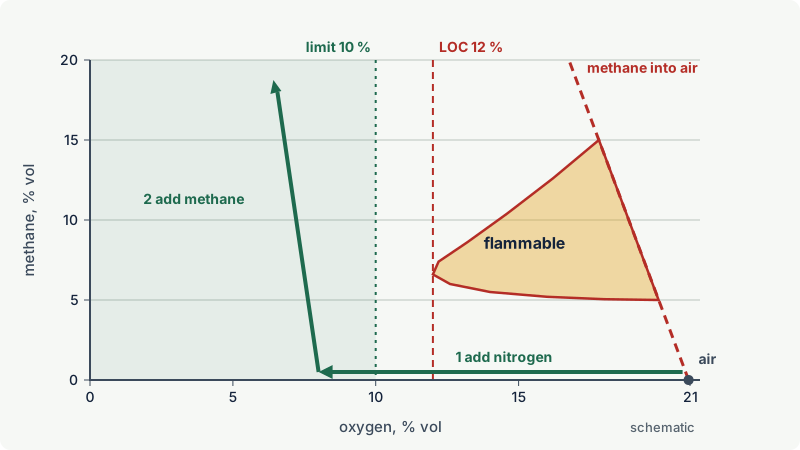
The same diagram explains the rule for taking equipment in and out of service. A vessel full of air must be inerted before fuel is admitted, and a vessel full of fuel must be purged with inert gas before air is let in. Going straight from air to fuel, or from fuel to air, passes through the flammable region every time.
Typical LOC values
| Substance | LOC with nitrogen (% vol O2) | LOC with carbon dioxide (% vol O2) |
|---|---|---|
| Methane | 12 | 14.5 |
| Propane | 11.5 | 14.5 |
| n-Hexane | 12 | 14.5 |
| Ethylene | 10 | 11.5 |
| Ethanol | 10.5 | 13 |
| Acetone | 11.5 | 14 |
| Carbon disulfide | 5 | 7.5 |
| Hydrogen | 5 | 5.2 |
Values at about 25 °C and atmospheric pressure from US Bureau of Mines data, as compiled by Kuchta (Bulletin 680, 1985). For hydrogen with carbon dioxide, the lowest oxygen content at which a flame still propagates is found at the upper flammable limit in plain air, which is why the two values are so close.
Three cautions apply to any LOC table:
- Method dependence. These classic values come largely from flammability tubes. Later NIOSH tests in 12 litre and 120 litre chambers found lower LOCs than the traditional tube data, and the European values, measured with different apparatus and ignition criteria, are more conservative still. Use values from one consistent source and know which method they come from.
- Temperature and pressure. The LOC falls as temperature and pressure rise. The Bureau of Mines compilation gives 10 % for kerosene vapour with nitrogen at 150 °C, for example. A reactor or dryer must be assessed at its real conditions.
- The inert gas matters. Carbon dioxide is roughly one and a half times as effective as nitrogen per unit volume for most hydrocarbons, because it absorbs more heat. For hydrogen the difference almost disappears, and for some metal dusts carbon dioxide is less effective or even reactive.
Combustible dusts also have an LOC, measured in dust explosion vessels. Examples tabulated in an annex of NFPA 69 for nitrogen range from 9 to 11 % for cellulose samples of different fineness to 14 % for a bituminous coal dust, and values depend strongly on particle size. See dust explosion parameters.
Inerting: methods and safety margins
Inerting is a primary explosion protection measure: it removes the explosive atmosphere instead of controlling ignition sources or the effects of an explosion (see explosion protection strategy). Typical applications are reactor and tank headspaces, centrifuges, mills, dryers, silos, solvent recovery systems and the purging of pipelines before and after maintenance. European guidance is given in CEN/TR 15281:2022, which replaced the 2006 edition; in North America NFPA 69 sets requirements for oxidant concentration reduction.
Inert gases
- Nitrogen is the most common, from bulk liquid supply, cylinders or on-site generators. Generated nitrogen still contains some oxygen, and its purity varies with flow, so it must be specified and checked against the inerting target.
- Carbon dioxide is more effective per volume for many organic fuels, but it is heavier than air, can react with some metals, and can generate static charge (charged dry ice particles) when released from liquid storage.
- Steam inerts while hot but condenses on cooling and can then draw air into the system.
- Argon and helium are used where nitrogen reacts with the product, for example with some metals.
Purging methods
| Method | How it works | Oxygen after n cycles (pure inert gas) | Typical use |
|---|---|---|---|
| Pressure swing | Pressurise with inert gas, then vent back to the starting pressure | y_n = y_0 × (P_low / P_high)^n | Pressure-rated vessels and pipework |
| Vacuum swing | Evacuate, then refill with inert gas | y_n = y_0 × (P_low / P_high)^n | Vessels rated for vacuum |
| Sweep (flow-through) | Inert gas flows in at one point and out at another | y = y_0 × e^(-V_inert / V), for perfect mixing | Large or low-pressure vessels, pipelines |
| Continuous blanketing (padding) | A small positive inert gas pressure is held in the headspace | Maintains the inerted state | Storage tanks, reactors in operation |
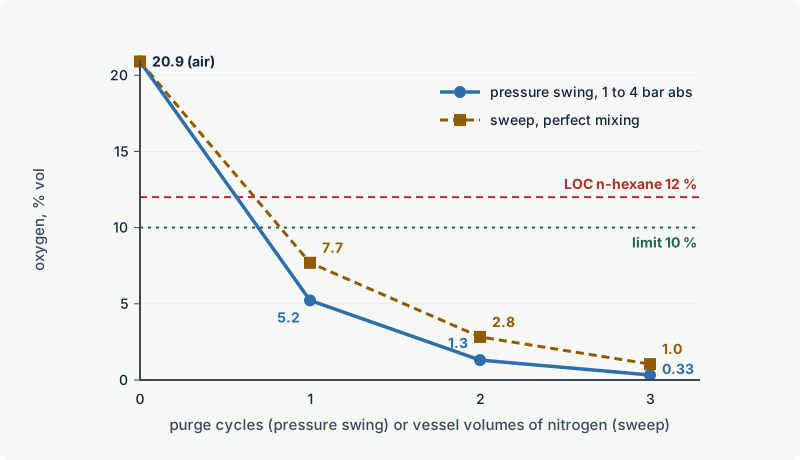
The formulas assume complete mixing and pure inert gas. If the inert gas contains oxygen, the vessel approaches that oxygen content instead of zero. Real vessels with dead legs, internals or poor gas distribution need more inert gas than the ideal value, and the result must be confirmed by measurement.
Safety margin below the LOC
An inerted system is never run at the LOC itself. The margin has to cover measurement uncertainty, the delay between air entering and the alarm acting, local pockets with higher oxygen and the uncertainty of the LOC value. Recent editions of NFPA 69 set the following:
| Oxygen monitoring | LOC of the mixture | Maximum operating oxygen concentration |
|---|---|---|
| Continuous, with safety interlocks | 5 % or more | At least 2 percentage points below the worst credible LOC |
| Continuous, with safety interlocks | Below 5 % | No more than 60 % of the LOC |
| Not continuous with interlocks | 7.5 % or more | At least 4.5 percentage points below the worst credible LOC |
| Not continuous with interlocks | Below 7.5 % | No more than 40 % of the LOC |
Without continuous monitoring, NFPA 69 also requires the oxygen concentration to be checked on a regular schedule. For continuously monitored systems with interlocks, it allows the margin to be set by a documented risk assessment acceptable to the authority having jurisdiction. CEN/TR 15281, the European guidance, likewise stresses that the oxygen level required depends on the inert gas, the fuel and the process.
Worked example: inerting a solvent vessel
A 10 m³ stainless steel vessel will receive n-hexane, and the headspace must be inerted with nitrogen before charging.
- LOC. For n-hexane with nitrogen, the Bureau of Mines value is 12 %.
- Operating limit. With continuous oxygen monitoring and an interlock that stops charging, the NFPA 69 margin gives at most 12 - 2 = 10 %. The design team sets an alarm at 7 % and a trip at 8 %, so that analyser error and response time cannot let the real value exceed 10 %. Without continuous monitoring the limit would be 12 - 4.5 = 7.5 %.
- Purge by pressure swing. The vessel is rated for 6 barg. Pressurising with nitrogen from 1 to 4 bar absolute and venting back to 1 bar reduces the oxygen by a factor of 4 per cycle: 20.9 % becomes 5.2 % after one cycle and 1.3 % after two. Two cycles are chosen, giving a wide margin below the 7 % alarm.
- Nitrogen use. Each cycle adds about 30 m³ of nitrogen measured at atmospheric pressure (3 bar of extra pressure in 10 m³), so about 60 m³ in total.
- Comparison. Sweep purging the same vessel to 1.3 % with perfect mixing would need 10 × ln(20.9 / 1.3), about 28 m³, but only if the gas mixes completely; a poorly mixed vessel may need two or three times more.
- Verify and maintain. The oxygen level is measured at the vent before charging starts, and the vessel is then held under a nitrogen blanket with continuous monitoring during operation.
For a hydrogen system the same logic gives a much tighter limit: with an LOC of 5 %, a continuously monitored system may operate at no more than 3 % oxygen, and one without continuous monitoring at no more than 2 %.
Monitoring oxygen in inerted systems
Inerting fails silently. A nitrogen supply runs out, a manway seal leaks, a vacuum draws air through a gland, a cooling vessel sucks in air through its vent, or powder fed from an open bag carries air into the vessel. Oxygen monitoring is the measure that detects these failures in time.
What a good monitoring system covers
- Sample points where oxygen is most likely to be highest: near solids feed points, manways, vacuum connections, the far end of a sweep path and dead zones. One analyser at the inert gas inlet proves nothing about the vessel.
- Response time, including the transport delay in sample lines. The time from air ingress to a trip must be short compared with the time the process needs to reach the LOC.
- Fail-safe behaviour. Loss of sample flow, analyser fault, power failure and out-of-range readings must lead to an alarm or a trip, not to a reading of "0 %".
- Calibration with nitrogen for zero and a known span gas or clean air (20.9 %), at intervals set by the manufacturer and the experience of the site.
- Pressure effects. Many oxygen sensors respond to the oxygen partial pressure rather than the volume fraction, so readings taken at a pressure different from the calibration pressure must be corrected or the sample reduced to atmospheric pressure.
- Functional safety. Where the trip is a safety instrumented function, its design follows IEC 61511; see gas detection and functional safety.
Oxygen sensor types
| Sensor | Principle | Strengths | Limitations |
|---|---|---|---|
| Electrochemical (galvanic) | Oxygen reacts at an electrode and produces a current | Simple, low power, common in fixed and portable detectors | Limited life, drift, affected by some gases and by pressure |
| Paramagnetic | Oxygen is attracted by a magnetic field, unlike most other gases | Accurate, stable, used in process analysers | Needs a clean, dry sample system; sensitive to vibration |
| Zirconia | Oxygen ions conduct through a heated ceramic cell | Fast, durable, used in combustion control | The cell is hot; combustible gases react at the cell and lower the reading, and the cell itself can be an ignition source |
| Tunable diode laser | Absorption of laser light by oxygen across a duct or vessel | In situ, fast, no sample line | Needs a clear optical path; higher cost |
Performance requirements for oxygen detectors are now part of IEC 60079-29-0, alongside flammable gas detectors. When the flammable gas concentration in an inerted vessel also needs to be measured, avoid catalytic (pellistor) sensors: they need roughly 10 % oxygen to work and read falsely low in an inert atmosphere. Infrared or thermal conductivity sensors do not need oxygen; see LEL and UEL explained.
Warning: An inerted vessel is an asphyxiation hazard. Nitrogen escaping from openings can create an oxygen-deficient atmosphere outside the vessel as well. In 2005 two contract workers died at a refinery in Delaware City, USA, after being overcome by nitrogen near a reactor opening, one of them while trying to rescue the other (US Chemical Safety Board). Entry and work near inerted equipment need confined space procedures and personal oxygen monitors; see oxygen deficiency.
Oxygen enrichment: when there is too much oxygen
The US OSHA confined space rule treats an atmosphere with more than 23.5 % oxygen as oxygen-enriched, and the UK HSE warns that even a rise to 24 % creates a dangerous situation in which fires start more easily, burn hotter and can be almost impossible to put out. Oxygen has no smell, so people do not notice the enrichment.
Where enrichment occurs
- Leaking oxygen hoses and valves in welding, flame cutting and brazing, especially in confined spaces.
- Oxygen used to "freshen" the air or to blow down clothing and benches, which HSE explicitly warns against.
- Medical and laboratory oxygen supplies, and oxygen-enriched combustion in furnaces and burners.
- Electrolysers, where oxygen is produced alongside hydrogen and must be vented separately.
- Cryogenic equipment: surfaces cooled with liquid nitrogen can condense air, and because nitrogen evaporates first the condensate becomes enriched in oxygen.
What enrichment does to a flammable mixture
| Substance | Minimum ignition energy in air (mJ) | Minimum ignition energy in oxygen (mJ) | Quenching distance in air / oxygen (mm) |
|---|---|---|---|
| Methane | 0.30 | 0.003 | 2.03 / 0.30 |
| Propane | 0.26 | 0.002 | 1.75 / not given |
| Ethylene | 0.07 | 0.001 | 1.22 / 0.23 |
| Hydrogen | 0.017 | 0.0012 | 0.64 / 0.25 |
US Bureau of Mines data (Kuchta, 1985), stoichiometric or near-optimum mixtures at 25 °C and 1 atm. The flammable ranges in air in the figure are the Bureau of Mines values, kept for a like-for-like comparison with oxygen; IEC-based data used in the excodex gas library give somewhat wider ranges in air, for example 4.4 to 17 % for methane, 1.7 to 10.9 % for propane and 4.0 to 77 % for hydrogen (North American sources often give 75 %). The difference comes from the test method: the European method uses a small vessel and a flame detachment criterion, while the classic US values come from flame propagation over a long distance in large vessels.
The consequences for explosion protection are direct:
- Ignition is far easier. Minimum ignition energies fall by one to two orders of magnitude, so weak sparks, static discharges and friction become effective.
- More fuel-rich mixtures burn. The upper limit rises sharply, so a vapour space that would be too rich in air may be flammable in enriched air.
- Autoignition temperatures fall. The same compilation gives, for example, 370 °C in air and 285 °C in oxygen for n-butane, and 440 °C and 315 °C for an aviation gasoline. A temperature class chosen for air may not be sufficient.
- Flame paths are not validated. Quenching distances in oxygen are only a few tenths of a millimetre. Flameproof joints and flame arresters are designed and tested with mixtures in air, not in oxygen.
- Materials that do not burn in air burn in oxygen. Clothing, seals, lubricants and even metals can ignite, and oil or grease can react violently with high-pressure oxygen.
Ex equipment and oxygen enrichment
The scope of IEC 60079-0 defines the standard atmospheric conditions, which describe the explosive atmosphere itself, as a pressure of 80 to 110 kPa, a temperature of -20 to +60 °C and air with a normal oxygen content, typically 21 % by volume, and states that equipment for use outside the standard pressure range and oxygen content needs additional consideration and testing. (These are not the equipment's ambient temperature range, which is normally -20 °C to +40 °C; edition 8 requires the rated ambient range to be marked on every Ex marking.) The ATEX directives likewise define an explosive atmosphere as a mixture with air under atmospheric conditions. An oxygen-enriched process atmosphere is therefore outside the scope of normal Ex certification: the hazard has to be removed or controlled by process design (oxygen-compatible materials, cleanliness, limiting enrichment, ventilation and oxygen monitoring), and any equipment exposed to it needs a specific assessment.
Common mistakes
- Setting the oxygen trip at the LOC. The LOC is the edge of the flammable region; the operating limit must be below it with a documented margin.
- Using an LOC from the wrong conditions. Values at 25 °C and atmospheric pressure do not apply to a hot dryer or a pressurised reactor, and nitrogen values do not apply to carbon dioxide or steam.
- Measuring oxygen at the inert gas inlet. The inlet always looks good. Sample where air can enter and where gas mixing is poorest.
- Assuming generated nitrogen is pure. On-site generators deliver nitrogen with some residual oxygen that varies with demand.
- Using a catalytic LEL detector inside an inerted vessel. It needs oxygen to work and will read falsely low.
- Treating enrichment as a minor change. A few percent extra oxygen changes ignition energy, autoignition temperature and the validity of Ex certification.
Frequently asked questions
What is the limiting oxygen concentration?
It is the highest oxygen concentration at which a flame cannot propagate through a mixture of fuel, air and inert gas, whatever the fuel concentration. For most hydrocarbons diluted with nitrogen it is about 10 to 12 % by volume; for hydrogen it is about 5 %. Values depend on the inert gas, temperature, pressure and the test method.
What oxygen level is safe in an inerted vessel?
It depends on the LOC of the substances present and on how the oxygen is monitored. NFPA 69 requires at least 2 percentage points below the LOC with continuous monitoring and interlocks, or no more than 60 % of the LOC if the LOC is below 5 %, and larger margins without continuous monitoring. Many operators set alarms and trips lower still to cover analyser error and response time.
Is nitrogen or carbon dioxide better for inerting?
Carbon dioxide is roughly one and a half times as effective per volume for most hydrocarbon vapours, so less of it is needed. Nitrogen is cheaper, widely available, does not react with most products and is the usual choice. Carbon dioxide is unsuitable for some metal dusts and can generate static electricity when released from liquid storage.
Is oxygen itself flammable or explosive?
No. Oxygen does not burn, but it makes other materials burn much more easily and more intensely. An oxygen-enriched atmosphere lowers ignition energies, raises the upper flammable limit and can make materials burn that would not burn in air.
Can ATEX or IECEx equipment be used in oxygen-enriched atmospheres?
Not on the basis of its normal certificate. Ex equipment is designed and tested for explosive atmospheres in air with a normal oxygen content of about 21 %. Use in enriched atmospheres requires a specific assessment and usually additional testing, and the better solution is to prevent the enrichment.
Related on excodex
- LEL and UEL explained: explosive limits and how gas detectors use them
- Explosion protection strategy: avoid the atmosphere, avoid ignition, limit the effects
- Oxygen deficiency: nitrogen, argon and other inert gas hazards
- Dust explosion parameters explained: Kst, Pmax, St classes, MIE
- Gas detection and functional safety: SIL for gas detection
- Gas library: oxygen, nitrogen, carbon dioxide; standards spaces IEC 60079-29-0 and EN 1127-1
Standards and further reading
- CEN/TR 15281:2022, guidance on inerting for the prevention of explosions (replaces the 2006 edition): SFS catalogue entry
- NFPA 69, standard on explosion prevention systems, including oxidant concentration reduction; first draft report showing the current requirements: nfpa.org (PDF)
- EN 1839, determination of the explosion limits and the limiting oxygen concentration for flammable gases and vapours
- EN 1127-1, explosive atmospheres, explosion prevention and protection, basic concepts and methodology
- IEC 60079-0 (edition 8, 2026), explosive atmospheres, equipment general requirements (standard atmospheric conditions in the scope): catalogue entry of the edition 8 committee draft
- IEC 60079-29-0, gas detectors, performance requirements for flammable gas, toxic gas and oxygen detectors
- IEC 61511, functional safety, safety instrumented systems for the process industry
- J. M. Kuchta, Investigation of fire and explosion accidents in the chemical, mining and fuel-related industries, US Bureau of Mines Bulletin 680, 1985 (LOC, limits in oxygen, MIE, AIT): stacks.cdc.gov (PDF)
- M. G. Zabetakis, Flammability characteristics of combustible gases and vapors, US Bureau of Mines Bulletin 627, 1965: digital.library.unt.edu (PDF)
- I. A. Zlochower, The limiting oxygen concentration and flammability limits of gases and gas mixtures, NIOSH, 2009 (abstract): onemine.org
- HSE INDG459, Oxygen use in the workplace: fire and explosion hazards: hse.gov.uk (PDF)
- OSHA 29 CFR 1910.146, permit-required confined spaces (definitions of oxygen-deficient and oxygen-enriched atmospheres): osha.gov
- US Chemical Safety Board, Valero Delaware City refinery asphyxiation incident (2005): csb.gov
This article is general technical information prepared by the excodex editorial team. It does not replace the applicable standards, the equipment certificates and instructions, national regulations or the assessment of a competent person.