Hydrogen safety basics: wide flammable range, low ignition energy and invisible flames
Abstract
Hydrogen burns between about 4 and 77 % vol in air, ignites with roughly a fifteenth of the energy methane needs and burns with an almost invisible flame. What these properties mean for area classification, IIC equipment, gas detection and flame detection.
Hydrogen forms a flammable mixture with air from 4 % by volume up to about 75 to 77 %, needs only about 0.02 mJ to ignite (roughly a fifteenth of what methane needs) and burns with a flame that is almost invisible in daylight. It is also the lightest gas, so it rises and disperses quickly outdoors but collects under roofs indoors. In practice this means: hydrogen is gas group IIC, temperature class T1, it must be detected with sensors that do not rely on infrared absorption, and its fires must be found with UV or suitably tuned IR flame detectors or thermal imaging, not by eye.
This article explains the properties that make hydrogen different, what they mean for area classification, Ex equipment, gas detection and flame detection, and which mistakes are made most often when a plant handles hydrogen for the first time.
Key points
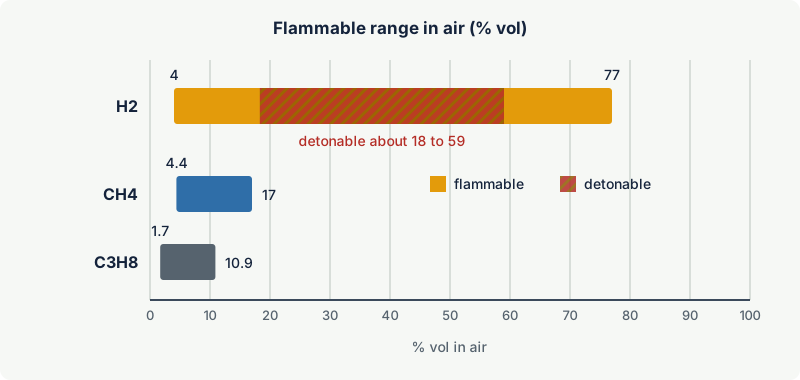
- Hydrogen's lower explosive limit (LEL) is 4 % vol, close to methane's 4.4 %, but its upper limit is 77 % vol in IEC data (75 % in many North American sources), so almost any leak into an enclosed space passes through the flammable range.
- The minimum ignition energy of hydrogen in air is about 0.017 to 0.02 mJ, compared with about 0.28 mJ for methane and 0.25 mJ for propane. Weak sparks and small electrostatic discharges that would not ignite hydrocarbons can ignite hydrogen.
- Hydrogen is about 14 times lighter than air (vapour density 0.07). Low-pressure leaks rise and accumulate under ceilings; high-pressure leaks form jets whose direction is set by the leak, not by buoyancy.
- For Ex equipment hydrogen is gas group IIC (or the special marking IIB + H2) and temperature class T1 (autoignition temperature 560 °C in the excodex library).
- Infrared gas detectors cannot see hydrogen. Catalytic, thermal conductivity, electrochemical and semiconductor sensors are used instead.
- A hydrogen flame contains no carbon, so it produces almost no visible light, no soot and no CO2 emission band. Flame detectors must use the ultraviolet or the infrared water-vapour bands.
- Hydrogen embrittles many steels, especially high-strength and cold-worked ferritic steels, so material selection is part of the explosion protection.
Hydrogen properties that matter for explosion protection
The table compares hydrogen with the two most familiar flammable gases. Flammable limits, autoignition temperatures, gas groups and temperature classes are the excodex library values; the other values are typical literature values (sources at the end).
| Property | Hydrogen | Methane | Propane |
|---|---|---|---|
| LEL / UEL in air | 4 / 77 % vol | 4.4 / 17 % vol | 1.7 / 10.9 % vol |
| Minimum ignition energy | about 0.017 to 0.02 mJ | about 0.28 to 0.29 mJ | about 0.25 mJ |
| Autoignition temperature | 560 °C | about 600 °C | 450 °C |
| Vapour density (air = 1) | 0.07 | 0.55 | 1.52 |
| Gas group | IIC | IIA (I in mines) | IIA |
| Temperature class | T1 | T1 | T2 |
| Typical MESG | 0.29 mm | 1.12 mm | 0.92 mm |
Wide flammable range
The LEL of hydrogen is not unusually low: at 4 % vol it is almost the same as methane. What is unusual is the upper limit. Published values range from 75 % (the figure most often quoted in North American data) to 77 % (the value in IEC classification data and the excodex library). Between those limits lies the detonable range, roughly 18 to 59 % vol according to the classic data compiled for space programme safety standards, although the limits depend strongly on the size and confinement of the cloud.
The practical consequence is that the "too rich to burn" argument almost never applies. A hydrocarbon leak into a closed cabinet may become too rich to ignite; a hydrogen leak would have to displace about three quarters of the air before that happens. See LEL and UEL explained for the general principle.
Very low ignition energy
The minimum ignition energy (MIE) is the smallest spark energy that ignites the most easily ignited mixture. For hydrogen in air it is about 0.017 mJ, with some sources quoting 0.019 or 0.02 mJ, compared with about 0.28 to 0.29 mJ for methane. For hydrogen that mixture lies in the region of the stoichiometric concentration (about 29.5 % vol). Near the flammable limits much more energy is needed, but still little by everyday standards.
The low MIE matters for:
- Electrostatic discharges. Brush discharges from charged plastic surfaces can ignite most flammable gases and vapours, and for hydrogen even weak ones are enough; small sparks from ungrounded conductors that would not ignite propane can ignite hydrogen. Earthing, bonding and antistatic materials become more important (see static electricity).
- Intrinsically safe circuits. IIC limits for voltage, current, capacitance and inductance are the tightest of all gas groups.
- Unexplained ignitions. High-pressure hydrogen releases have sometimes ignited with no obvious ignition source. A literature review for the UK Health and Safety Executive (HSE) found that many proposed mechanisms do not stand up to scrutiny, but some have been reproduced in the laboratory. The safe assumption for a high-pressure release is that it may ignite.
The difference between flash point, autoignition temperature and MIE is explained in a separate article.
Buoyancy and diffusion
At normal temperature and pressure hydrogen has a density of about 0.084 kg/m³, against about 1.2 kg/m³ for air. A low-momentum leak therefore rises fast, and hydrogen also diffuses quickly (diffusion coefficient in air about 0.61 cm²/s, several times that of methane). Outdoors this is an advantage: the cloud lifts away from people and ignition sources and dilutes quickly. Indoors it is a disadvantage: hydrogen collects under the ceiling, in roof apexes, in light fittings and cable trays mounted high, and in any pocket that has no high-level opening. See vapour density.
Two exceptions are easy to forget. A release from a high-pressure system leaves as a jet, and the jet carries the gas horizontally or downwards for a considerable distance before buoyancy takes over. Cold hydrogen vapour from liquid hydrogen is denser than air at first and can flow along the ground until it warms up.
Embrittlement and leaks
Hydrogen atoms can enter many metals and reduce their ductility and toughness. The classic hydrogen safety literature describes susceptible materials such as high-strength and cold-worked ferritic steels and nickel, and generally satisfactory materials such as austenitic stainless steels, aluminium and copper. Embrittlement is not an ignition source, but it can turn a fitting into a release source, so it belongs in the same safety case. Pipework for hydrogen service is designed to dedicated codes (for example ASME B31.12) rather than to general process piping practice.
Hydrogen also leaks more easily than other gases through threads, seals and porous materials because of its small molecule and high diffusivity. Joints that are gas-tight for natural gas may weep hydrogen. Hydrogen has no smell, and hydrogen for fuel cells is normally not odorised because sulphur-based odorants would poison the fuel cell, so people cannot rely on their nose.
Consequences for hazardous area classification
Hydrogen is classified with the same method as other gases, in Europe and internationally with IEC 60079-10-1. The properties above change the inputs, not the method:
- Release rates by volume are large. One kilogram of hydrogen is about 11.9 m³ of gas at normal conditions, against about 1.5 m³ for methane. A given mass leak rate therefore produces a much larger volumetric release, and the hypothetical volume of flammable mixture is correspondingly larger.
- Pressure is often high. Industrial gas cylinders are typically filled to 20 MPa (200 bar) or more, and vehicle refuelling works at up to 87.5 MPa. Even small holes then give choked, high-velocity jets with a considerable extent along the jet axis.
- Buoyancy decides where an enclosed release accumulates. Ventilation openings, extract points and detectors belong at the highest point of a room or enclosure. Ceiling shapes that trap gas (beams, voids, suspended ceilings) need their own assessment.
- Outdoor low-pressure releases usually give small zones because buoyancy and diffusion dilute the gas quickly, provided nothing above the release traps it (canopies, roofs, cable trays).
- Catastrophic failures such as vessel rupture remain outside the scope of zoning, as for any gas; they are handled by the wider risk assessment.
For typical installations see battery rooms and charging areas and hydrogen production and refuelling stations. The general method is in how to carry out a gas hazardous area classification.
Worked example: how little hydrogen it takes
A storeroom measures 5 m by 4 m by 3 m, a volume of 60 m³. A small hydrogen leak continues unnoticed.
- Fully mixed room: to reach the LEL of 4 % vol in the whole room, 0.04 x 60 m³ = 2.4 m³ of hydrogen is needed. At 0.084 kg/m³ that is about 0.2 kg.
- Layer under the ceiling: in reality the hydrogen collects at the top. A 0.3 m deep layer under the 20 m² ceiling is 6 m³. To bring that layer to 4 % vol needs only 0.24 m³ of hydrogen, about 20 g.
- Compared with methane by mass: 20 g of methane is about 0.03 m³ of gas, enough for only about 0.7 m³ of mixture at its LEL. The same 20 g of hydrogen gives 6 m³ of mixture at the LEL.
A ceiling-level layer that will burn can therefore form from a leak that would be harmless with most other gases. This is why hydrogen rooms need high-level ventilation openings and detectors at the ceiling, close to and above the likely leak points.
Ex equipment for hydrogen: IIC and IIB + H2
Hydrogen has a maximum experimental safe gap (MESG) of about 0.29 mm, the smallest of the common gases, and a very low minimum igniting current. It is therefore one of the defining gases of group IIC, together with acetylene. Electrical and non-electrical Ex equipment in a hydrogen area must be marked:
- IIC, which covers all gases and vapours, or
- IIB + H2, a marking mainly found on flameproof (Ex d) equipment, meaning IIB plus hydrogen but not acetylene or carbon disulphide. See IIB+H2 explained.
With an autoignition temperature of 560 °C (sources range from about 500 to 585 °C depending on the test method) hydrogen only needs temperature class T1. In practice equipment in hydrogen areas is often T3 or T4 because other substances are present or because that is what the product range offers. Always take the strictest requirement of all substances present: a hydrogen plant that also handles solvents may need T3 or better. The equipment protection level (EPL) follows the zone as usual (see EPL).
In the North American Division system hydrogen is the typical gas of Class I, Group B.
Detecting hydrogen leaks
Hydrogen does not absorb infrared radiation at the wavelengths used by gas sensors, so the infrared point and open-path detectors that work well for hydrocarbons cannot detect it. The usable sensor principles are:
| Principle | Typical range | Strengths | Limitations |
|---|---|---|---|
| Catalytic (pellistor) | 0 to 100 % LEL | proven, responds to all flammable gases, linear in the LEL range | needs oxygen; can be poisoned (silicones, sulphur compounds); not selective |
| Thermal conductivity | % vol up to 100 % vol | hydrogen conducts heat about seven times better than air; no oxygen needed; suits inerted or purge measurements | not selective; affected by temperature, pressure and humidity; poor at low % LEL |
| Electrochemical | ppm to low % vol | sensitive, low power, good for leak search and early warning | limited life; cross-sensitivity (for example to CO); temperature limits |
| Semiconductor (metal oxide) | ppm range | sensitive, rugged, inexpensive | non-linear; humidity and poison sensitive; drifts; needs oxygen |
| Ultrasonic (acoustic) | detects the noise of a pressurised leak | reacts to the leak itself, independent of where the wind takes the gas | no concentration measurement; only pressurised releases; background noise |
Stationary hydrogen detectors are covered by the performance standard ISO 26142, and the flammable gas detection standards apply as well: IEC 60079-29-0 (formerly IEC 60079-29-1) for performance and IEC 60079-29-2 for selection, installation and maintenance. Calibrate hydrogen detectors with hydrogen; a sensor calibrated with methane or pentane can give a significantly different reading for hydrogen.
Where to put detectors follows from the physics: above and close to the likely leak points, at the highest point of rooms and enclosures, in ventilation extract ducts, and in canopies or roofs over outdoor equipment where hydrogen can collect. Typical alarm levels are around 10 % and 20 to 25 % of the LEL (0.4 % and 0.8 to 1 % vol), but the actual settings come from the safety concept of the plant (see setting alarm levels and where to install gas detectors).
Invisible flames: detecting hydrogen fires
Hydrogen burns to water vapour only. With no carbon in the fuel there is no soot, and soot is what makes ordinary flames yellow and bright. In daylight a pure hydrogen flame is nearly invisible and may be heard rather than seen, so a person can walk into a jet flame without noticing it, a risk that hydrogen safety guidance warns about specifically. Dust or other materials drawn into the flame can make it partly visible, which is not something to rely on.
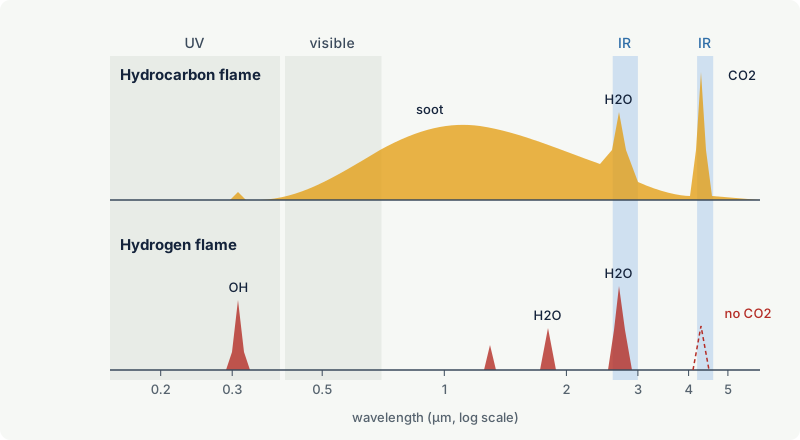
The emission of a hydrogen flame is concentrated in two regions:
- Ultraviolet: the OH radical formed in the flame emits strongly around 306 to 310 nm, and hydrogen flames also emit at shorter UV wavelengths. UV flame detectors, UV/IR combinations and UV cameras are widely used for hydrogen fires. Point UV flame detectors usually work in the "solar-blind" band below about 260 nm, so arc welding, lightning and other UV sources are their typical interferences rather than sunlight; UV cameras that image the OH band near 310 nm are affected by strong sunlight.
- Infrared water bands: hot water vapour emits strongly between about 1.2 and 3 µm, with a main band around 2.7 µm. Multi-spectrum IR detectors designed or configured for hydrogen look in these bands.
What hydrogen flames lack is the carbon dioxide emission at about 4.3 µm. Many single and triple IR flame detectors made for hydrocarbon fires depend on that band and may respond poorly or not at all to a hydrogen fire. Check the detector's approval data for hydrogen: response distance and time for a hydrogen test fire are stated separately from those for hydrocarbon fuels. Thermal imaging cameras show the heat of a hydrogen flame and are used both for fixed monitoring and by responders. In a 2026 comparison by the German national metrology institute, small burning leaks that were practically invisible to the eye were detected at 40 m in sunlight by both a UV camera and a thermal infrared camera, each with its own interferences. More detail is in detecting hydrogen fires and other invisible flames and how flame detectors work.
Common mistakes and misconceptions
- "Hydrogen is lighter than air, so it cannot form a hazard." Outdoors at low pressure it usually disperses, but indoors it accumulates under the ceiling, and high-pressure jets go wherever the leak points. Classify and ventilate on the basis of the actual geometry.
- Using IR gas detectors for hydrogen. They do not respond to it at all. Use catalytic, thermal conductivity, electrochemical or semiconductor sensors, and consider ultrasonic leak detection for high-pressure outdoor plant.
- Using IIB equipment because "the LEL is like methane". The gas group depends on MESG and minimum igniting current, not on the LEL. Hydrogen needs IIC or IIB + H2.
- Choosing a hydrocarbon IR flame detector for a hydrogen plant. Without a 4.3 µm CO2 signal it may not see the fire. Choose detectors with documented hydrogen performance, or UV, UV/IR or thermal imaging.
- Calibrating hydrogen detectors with methane. Relative sensitivity varies between sensors; use hydrogen calibration gas.
- Treating embrittlement as a purely mechanical topic. A cracked fitting is a release source; material selection and inspection belong to the explosion protection concept.
Frequently asked questions
What is the LEL of hydrogen?
The lower explosive limit of hydrogen in air is 4 % by volume (40,000 ppm). Its upper limit is about 75 to 77 % by volume, depending on the source. A gas detector reading of 10 % LEL for hydrogen therefore means about 0.4 % vol.
Why is hydrogen gas group IIC?
Gas groups are based on the maximum experimental safe gap (MESG) and the minimum igniting current. Hydrogen's MESG is about 0.29 mm and it ignites with very low spark energy, both well inside the IIC limits. Equipment for hydrogen must be marked IIC or IIB + H2.
Can an infrared gas detector detect hydrogen?
No. Hydrogen has no usable absorption at the infrared wavelengths used by gas detectors, so IR point and open-path detectors are blind to it. Catalytic, thermal conductivity, electrochemical and semiconductor sensors detect hydrogen; ultrasonic detectors can detect the noise of a pressurised leak.
Why can't you see a hydrogen flame?
Hydrogen burns to water vapour without forming soot, and soot is what makes most flames bright. The hydrogen flame radiates mainly in the ultraviolet and in the infrared water-vapour bands, which the eye cannot see. Hydrogen fires are detected with UV, UV/IR or hydrogen-capable multi-spectrum IR flame detectors, or with thermal imaging.
Where should hydrogen detectors be installed?
Close to and above the likely leak points, at the highest point of rooms and enclosures where hydrogen can accumulate, and in ventilation extract paths. For high-pressure equipment outdoors, consider that jets may carry gas away from point detectors and add ultrasonic or more closely spaced detection.
What temperature class does hydrogen need?
Hydrogen's autoignition temperature is about 560 °C (excodex library value; sources range from about 500 to 585 °C), so temperature class T1 is sufficient for hydrogen alone. If other flammable substances are present, the lowest autoignition temperature of all of them decides.
Related on excodex
- IIB+H2 explained: when is it enough for hydrogen?
- Acetylene, carbon disulphide and hydrogen: the special cases of gas group IIC
- Battery rooms and charging areas: hydrogen ventilation and hazardous areas
- Hydrogen production and refuelling stations: hazardous areas, detection and equipment
- Detecting hydrogen fires and other invisible flames
- Catalytic (pellistor) vs infrared flammable gas detectors
- Tools: hydrogen in the gas library, Ex marking check, standards spaces IEC 60079-10-1 and IEC 60079-29-0
Standards and further reading
- IEC 60079-10-1, Explosive atmospheres: classification of areas, explosive gas atmospheres.
- ISO/IEC 80079-20-1, material characteristics for gas and vapour classification (gas groups, MESG, autoignition data).
- IEC 60079-14, design, selection and installation of electrical installations in explosive atmospheres.
- IEC 60079-29-0 (performance of gas detectors, formerly IEC 60079-29-1) and IEC 60079-29-2 (selection, installation, use and maintenance of gas detectors).
- ISO 26142, hydrogen detection apparatus for stationary applications: iso.org
- ISO/TR 15916, basic considerations for the safety of hydrogen systems.
- Hydrogen Tools (Pacific Northwest National Laboratory, US DOE), basic hydrogen properties: h2tools.org
- Hydrogen Tools, comparative properties of hydrogen and other fuels: h2tools.org
- Safety chapter based on the NASA hydrogen safety standard (properties, embrittlement, detection): nat.vu.nl
- US Department of Energy, safe use of hydrogen: energy.gov
- Buttner, Post, Burgess, Rivkin (NREL), An overview of hydrogen safety sensors and requirements: h2tools.org
- Brunzendorf (German national metrology institute), Small burning hydrogen leaks in industrial plants: a comparison of UV and IR remote imaging detection, Hydrogen Safety, 2026: reference-global.com
- Weiser et al., Measuring and modelling unsteady radiation of hydrogen combustion: h2tools.org
- HSE research report RR615, Spontaneous ignition of hydrogen, literature review: hse.gov.uk
This article is general technical information prepared by the excodex editorial team. It does not replace the applicable standards, the equipment certificates and instructions, national regulations or the assessment of a competent person.