How flame detectors work: UV, IR, UV/IR and multi-spectrum IR
Abstract
Flame detectors look for the radiation a fire emits: solar-blind ultraviolet, the hot CO2 band near 4.4 µm, and the 1 to 20 Hz flicker of flames. How UV, IR, UV/IR and multi-spectrum IR detectors work, what they miss and how to choose.
A flame detector is an optical sensor that recognises a fire from the radiation it emits. UV detectors look for ultraviolet light between about 185 and 260 nm, a band that sunlight never reaches at ground level. IR detectors look for the strong emission of hot carbon dioxide near 4.4 µm and check that it flickers like a flame. UV/IR detectors alarm only when both channels see a fire, and multi-spectrum IR detectors compare the CO2 band with reference bands on either side to tell a real flame from the sun or a hot surface.
This article explains what a flame emits, how each detector type turns that into an alarm decision, and the strengths and blind spots of each type, with a comparison table and a selection example.
Key points
- Flame detectors respond to radiation, not to heat or smoke reaching the device, so they can detect a fire at tens of metres within seconds, provided they have a clear line of sight.
- Sunlight below about 280 to 290 nm is absorbed by ozone in the upper atmosphere. UV flame detectors work in the 185 to 260 nm range, where the sun is effectively dark at ground level ("solar blind").
- Hot CO2 from any carbon-containing fuel emits strongly around 4.2 to 4.8 µm. Cold CO2 in the air absorbs the centre of this band, so the flame peak seen at a distance lies near 4.4 µm, and sunlight is almost absent there.
- Flames flicker. Pool fires pulse at roughly 1.5/√D Hz (D in metres), about 2 to 5 Hz for small fires, and most detectors look for flicker in a band of about 1 to 20 Hz.
- UV detectors see every flame, including hydrogen, but smoke and oil films blind them, and welding arcs, lightning and ionising radiation can trigger them.
- IR detectors that rely on the CO2 band cannot see fires of fuels without carbon, such as hydrogen, ammonia or silane.
- No technology is best everywhere. The choice depends on the fuel, the expected fire, the background radiation sources and the environment.
What a flame emits
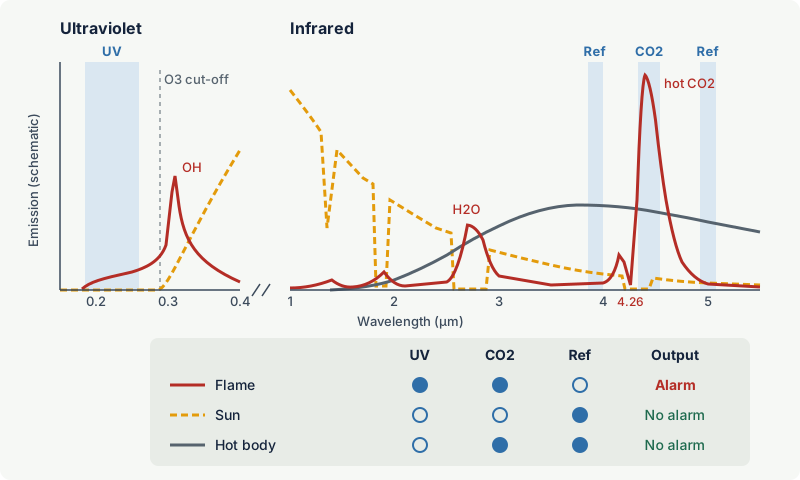
A fire radiates across a wide spectrum, and each part comes from a different process. Detector designers pick narrow bands where flames emit strongly and the background, mainly the sun, does not.
Ultraviolet: excited radicals and a dark sky
Flames in air emit ultraviolet light from excited radicals formed in the reaction zone, mainly the hydroxyl radical OH, whose strongest bands lie around 306 to 312 nm, and from other species that emit at shorter wavelengths. Research on UV sensors describes almost all flames in air as emitting in the 185 to 300 nm region, regardless of fuel.
The useful property of this band is the sky. Ozone in the stratosphere absorbs practically all solar radiation below about 280 nm, and very little reaches the ground below about 290 to 300 nm, so at ground level there is no usable sunlight in the 185 to 260 nm band that UV flame detectors use. Air near the ground is transparent enough at these wavelengths for short paths: oxygen absorbs the shortest wavelengths, close to 185 nm, within a few tens of metres, while wavelengths above about 240 nm travel much further.
Infrared: hot water vapour and hot CO2
Burning produces hot water vapour (from hydrogen in the fuel) and hot carbon dioxide (from carbon in the fuel). Both radiate in molecular bands:
- Water vapour has emission bands near 1.4, 1.9 and 2.7 µm; the 2.7 µm band is by far the strongest. These bands matter for hydrogen fires (see detecting hydrogen fires).
- Carbon dioxide emits strongly in a band from roughly 4.2 to 4.8 µm. Classic measurements of flame spectra show the CO2 band near 4.4 µm as the dominant feature of a hydrocarbon flame in the mid infrared.
Why 4.4 µm and not 4.3 µm? The CO2 molecule absorbs most strongly at about 4.26 µm. The cold CO2 in the air between the fire and the detector (about 420 ppm today) absorbs the centre of the band, while the hot CO2 in the flame emits over a broader range. What arrives at the detector is a peak on the long-wavelength side, around 4.4 µm. The same atmospheric CO2 blocks sunlight across this band, which is why the CO2 band is also nearly "solar blind".
Luminous, sooty flames also emit a continuous spectrum from glowing soot particles, which makes them visible. Clean flames such as hydrogen or methanol produce little or no soot, which is why they are hard to see in daylight.
Flicker: the time signature of a flame
A diffusion flame is unsteady. Buoyant vortices make it pulse, and for pool fires the pulsation frequency follows a well-known correlation of about 1.5 divided by the square root of the pool diameter in metres. A 0.3 m pan pulses at roughly 2.7 Hz, a 1 m pool fire at about 1.5 Hz. Turbulence adds faster fluctuations.
Most flame detectors therefore analyse the signal in a band of about 1 to 20 Hz. A hot pipe or a sunlit wall gives a steady signal; electric lamps flicker at twice the mains frequency (100 or 120 Hz), far above the flame band. The flicker check is one of the main defences against false alarms, though not a complete one (see false alarms in flame detectors).
UV flame detectors
The classic UV sensor is a gas-filled tube with a metal cathode, working like a Geiger-Müller counter. A UV photon striking the cathode releases an electron, the high voltage across the gas turns it into an avalanche, and the tube produces a pulse. The detector counts pulses: a fire produces a high count rate, the solar-blind background almost none. The cathode material and the tube window set the band, typically about 185 to 260 nm. Solid-state UV sensors also exist, but those whose response extends into the solar UV range are not suitable outdoors.
Strengths:
- Very fast: the sensor itself responds within milliseconds. A time delay of a few seconds is often added to reject short events.
- Responds to practically every flame in air, whatever the fuel, including hydrogen.
- Unaffected by hot surfaces, which emit no UV unless they are at arc temperatures.
Weaknesses:
- Smoke scatters and absorbs UV strongly. In a smoky liquid fire the UV signal can drop sharply once smoke builds up.
- Oil films, condensed vapours and dirt on the window absorb UV and can blind the detector without an obvious sign.
- Electric arcs (welding, switching, lightning), corona discharge from high-voltage equipment, germicidal lamps (whose main line is at 253.7 nm) and ionising radiation (X-ray and gamma radiography) can all produce counts.
IR flame detectors
An IR flame detector uses a sensor such as a pyroelectric or lead selenide element behind a narrow optical filter centred on the hot-CO2 band. The simplest single-band IR detector alarms when the signal in this band is high enough and flickers in the flame frequency range.
A dual-band IR detector adds a second channel at a nearby wavelength where flames emit little, the reference band. A flame raises the CO2 channel much more than the reference; a hot body, whose emission is smooth over wavelength, raises both. Comparing the two removes most hot-body alarms.
Strengths:
- Infrared passes through smoke much better than UV, so IR detectors keep seeing smoky fires.
- Not triggered by welding UV, lightning UV or radiation sources (although a welding arc and hot metal also emit IR).
Weaknesses:
- Only fuels that contain carbon produce CO2. Fires of hydrogen, ammonia, silane or hydrazine give no CO2 peak, and a CO2-band detector will not see them.
- Water absorbs strongly in the infrared. Water films, ice or snow on the window, heavy rain and dense fog can reduce the signal without the detector noticing unless it has an optical self-test.
- Hot CO2 is not unique to fires: engine and turbine exhausts and flares emit in the same band. Modulated hot sources can also mimic flicker.
UV/IR detectors
A UV/IR detector combines a UV tube and an IR channel and alarms only when both see a fire. Many designs also check the ratio between UV and IR signals, because the mix is characteristic of flames. The logic removes the classic single-channel nuisances: welding produces UV, but its IR signature differs from a flame; a hot body produces IR but no UV.
The combination inherits the UV channel's sensitivity to smoke and window contamination: if smoke blinds the UV channel, the detector may respond late or not at all to a smoky fire. For hydrogen, the IR channel must be tuned to a water band instead of the CO2 band; a standard hydrocarbon UV/IR detector may not see a hydrogen fire because its IR channel stays silent.
Multi-spectrum IR detectors
A multi-spectrum IR detector, often called IR3 or triple IR, measures the CO2 band and at least two reference bands, one on each side. Some designs use more bands, and some add a UV channel or a visible-light camera.
The decision combines several tests: the CO2 channel must rise strongly, the ratios to the reference bands must match a flame and not a hot body or the sun, the signals must flicker in the flame range and the channels must be correlated in time. Because the discrimination comes from the shape of the spectrum rather than from absolute level, these detectors can work at higher sensitivity, which gives the longest detection ranges of the common point detectors. They see through smoke like other IR detectors.
Their limits are those of the CO2 band: no response to carbon-free fuels unless a specific hydrogen version uses water bands instead, attenuation by water and ice, and, in some installations, interference from flares or exhaust plumes that genuinely contain hot CO2.
The alarm algorithm
Whatever the sensors, the detector's processor runs a decision chain like the one below. Details are proprietary and differ between designs, but the steps are similar.
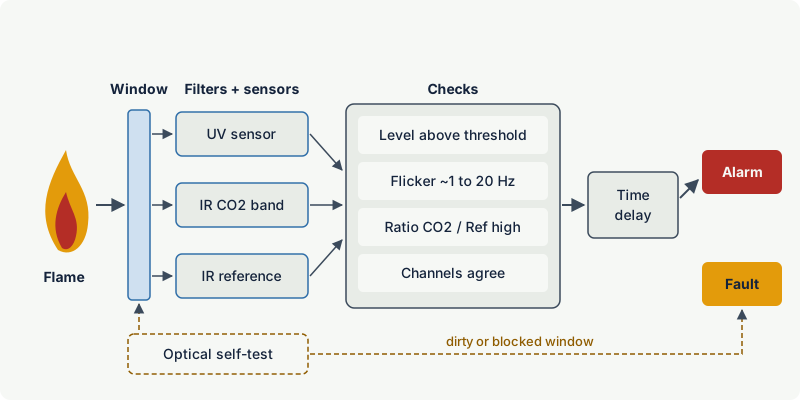
- Threshold. Each channel's signal must exceed a level set by the chosen sensitivity.
- Flicker. The signal must contain energy in the flame frequency band. Steady sources and mains-frequency lamps fail this test.
- Spectral ratio. The ratio of the CO2 band to the reference bands (or UV to IR) must lie in the range typical of flames.
- Correlation. The channels must fluctuate together; independent fluctuations point to separate sources.
- Persistence. All conditions must last for the set time delay, typically a few seconds and adjustable on many detectors. Longer delays reduce nuisance alarms but slow the response.
- Self-test. Many detectors shine an internal source through the window at intervals and report a fault if the optics are dirty, wet or blocked.
The sensitivity setting and time delay change both the detection range and the false-alarm behaviour. They must match the assumptions in the detector layout; reducing sensitivity after a nuisance alarm shrinks the area the detector protects (see flame detector placement).
Comparison of detector types
| Type | Senses | Strengths | Weaknesses | Typical use |
|---|---|---|---|---|
| UV | UV 185 to 260 nm | Fastest; sees all flames including hydrogen; ignores hot bodies and the sun | Blinded by smoke, oil films and dirt; alarms on welding, lightning, X-rays, gamma, corona | Clean gas and hydrogen fires indoors; fast-developing fires |
| Single-band IR | Hot CO2 near 4.4 µm plus flicker | Sees through smoke; ignores UV sources | Carbon fuels only; modulated hot bodies, sunlight glints; water and ice on the window | Enclosed spaces with few hot or moving sources |
| Dual-band IR | CO2 band plus one reference band | Better rejection of hot bodies than single IR | Carbon fuels only; reduced range compared with multi-spectrum | Indoor and sheltered process areas |
| UV/IR | UV and IR together | Good false-alarm immunity; fast | UV channel blinded by smoke and oil; hydrocarbon version misses hydrogen | General industry, turbine and compressor enclosures |
| Multi-spectrum IR | CO2 band plus two or more reference bands | Longest range; best immunity to sun and hot bodies; sees through smoke | Carbon fuels only (hydrogen versions use water bands); water, ice and fog attenuate; flares and hot exhausts | Outdoor process plant, offshore, tank farms, loading |
| Hydrogen IR | Hot water vapour bands | Sees hydrogen and other carbon-free flames | Shorter range; atmospheric water absorbs the same bands | Electrolysers, hydrogen compressors and dispensers |
Video flame detection and thermal imaging work differently, using cameras and image analysis; they are covered in video and thermal imaging for flame and smoke detection.
Practical case: choosing detectors for three areas
A site has three areas that need flame detection. The choice follows from the fuel, the fire and the background.
1. Outdoor natural gas compressor skid, flare stack 150 m away. The fuel is mainly methane and a release would most likely burn as a jet fire. A multi-spectrum IR detector suits the long distances outdoors and rejects sunlight and hot casings. Because the flare is a real CO2 flame, the detectors are aimed so that the flare and its reflections are not in the field of view.
2. Hydrogen electrolyser hall. A hydrogen fire produces no CO2 and almost no visible light. Suitable options are UV, UV/IR with a water-band IR channel, or a multi-spectrum IR detector designed for hydrogen. CO2-band IR detectors are excluded.
3. Indoor drum store for solvents, next to a maintenance workshop. A solvent pool fire such as n-heptane soon becomes smoky. Arc welding happens regularly near the open doorway. An IR or multi-spectrum IR detector is preferred: it sees through smoke and does not respond to welding UV. A UV detector here would need inhibiting every time welding takes place, with a fire watch as compensating measure.
Note: A flame detector installed in a hazardous area must have Ex certification for the zone, gas group and temperature class, like any other electrical equipment. Most industrial models use a flameproof (Ex d) housing with a window transparent to the detection bands. Ex certification says nothing about fire detection performance; that is proven separately, for example against FM 3260 or EN 54-10 (see flame detector performance standards).
Common mistakes
- Using CO2-band IR detectors for hydrogen. They cannot see a pure hydrogen flame. Use UV, hydrogen-specific IR or UV/IR with a water-band channel.
- Choosing UV for smoky fires. Liquid hydrocarbon fires can produce enough smoke to blind a UV detector. IR-based detectors are usually better for pool fires of heavy fuels.
- Assuming "solar blind" means immune to all light. A CO2-band detector can still respond to modulated reflections of hot sources, and sunlight reduces the sensitivity of some IR channels. UV detectors are solar blind but not blind to arcs and radiation.
- Treating the Ex marking as proof of detection performance. Ex certification addresses ignition risk only. Check the performance approval and the manufacturer's data for the fuels and fire sizes on site.
- Changing sensitivity or time delay to cure nuisance alarms without reviewing coverage. Lower sensitivity reduces the detection distance and can leave gaps in the fire detection layout.
Frequently asked questions
What is the difference between UV and IR flame detectors?
A UV detector senses ultraviolet radiation from the flame's reaction zone in a band where sunlight is absent, responds within milliseconds and sees every type of flame, but smoke and dirt blind it and arcs can trigger it. An IR detector senses the hot CO2 emission near 4.4 µm and its flicker, sees through smoke, but only detects fuels that contain carbon.
Why do flame detectors use 4.4 µm and not 4.3 µm?
Hot CO2 in a flame emits over roughly 4.2 to 4.8 µm, but cold CO2 in the air absorbs the centre of the band near 4.26 µm. After a few metres of air, the strongest flame signal remaining is near 4.4 µm. The same atmospheric absorption removes sunlight from the band.
What does "multi-spectrum IR" or IR3 mean?
It is an infrared flame detector that measures the CO2 emission band and at least two reference bands. By comparing the bands, it recognises the spectral shape of a flame and rejects smooth sources such as the sun, lamps and hot surfaces, which allows long detection ranges with good false-alarm immunity.
Can a flame detector see a hydrogen fire?
UV detectors and detectors with infrared channels tuned to hot water vapour bands can. Detectors that rely only on the CO2 band cannot, because hydrogen produces no carbon dioxide. Always check the manufacturer's data for hydrogen performance.
How fast does a flame detector respond?
The sensors respond within milliseconds (UV) or a fraction of a second (IR), but the processing usually adds a confirmation time of a few seconds. Performance standards set maximum response times for their test fires; FM 3260, for example, requires an alarm within 30 seconds of flame exposure at the rated distance.
Do flame detectors detect smoke or heat?
No. They detect radiation only. A smouldering fire without flames, or a fire hidden behind an obstruction, will not trigger them. Smoke and heat detection, or gas detection, are separate measures in a fire and gas system.
Related on excodex
- Flame detector placement and cone of vision
- False alarms in flame detectors: common sources and how to avoid them
- Detecting hydrogen fires and other invisible flames
- Flame detector performance standards: EN 54-10, FM 3260 and response time
- Video and thermal imaging for flame and smoke detection
- Gas library: /gas; Ex marking check: /tools/ex; questions in the forum
Standards and further reading
- FM 3260, examination (approval) standard for radiant energy-sensing fire detectors for automatic fire alarm signalling (October 2021 edition): https://www.fmapprovals.com/-/media/Feature/Approval-Standards/3260-pdf.pdf
- ANSI/FM 3260-2023, the American National Standard version, approved on 24 August 2023: https://www.fmapprovals.com/-/media/Feature/Approval-Standards/3260ansi-pdf.pdf
- EN 54-10:2002 with amendment A1:2005, fire detection and fire alarm systems, flame detectors (point detectors) for fire detection systems in buildings; still the current edition, because a revision circulated as an enquiry draft in 2012 was later abandoned.
- NFPA 72, National Fire Alarm and Signaling Code, sections on radiant energy-sensing fire detectors.
- IEC 60079-0 and IEC 60079-1, general requirements and flameproof enclosures, for the Ex design of the detector housing.
- NASA SP-5092, Hydrogen leak and fire detection: a survey (1970), with flame emission bands and detector principles: https://ntrs.nasa.gov/api/citations/19700031601/downloads/19700031601.pdf
- E. K. Plyler and C. J. Humphreys, Infrared emission spectra of flames, Journal of Research of the National Bureau of Standards, 1948: https://nvlpubs.nist.gov/nistpubs/jres/40/jresv40n6p449_A1b.pdf
- L. Periale and co-authors, The development of sealed UV sensitive gaseous detectors and their applications (solar-blind flame detection): https://arxiv.org/pdf/physics/0605207
- X. Xia and P. Zhang, Flickering of buoyant diffusion flames: a vortex dynamics revisit (2018), which compares pool fire data with the 1.5/√D correlation: https://arxiv.org/pdf/1803.10400
This article is general technical information prepared by the excodex editorial team. It does not replace the applicable standards, the equipment certificates and instructions, national regulations or the assessment of a competent person.