False alarms in flame detectors: common sources and how to avoid them
Abstract
Sunlight and its reflections, welding arcs, hot and moving machinery, flares, lightning and ionising radiation cause most flame detector false alarms. Why each source fools UV or IR detectors and how technology, aiming, settings and work permits prevent them.
Most flame detector false alarms come from a small group of sources that emit or modulate radiation in the same bands as a fire: sunlight and its reflections, arc welding and other electric arcs, hot bodies, especially when something makes their radiation flicker, real flames that are not fires such as flares, and, for UV detectors, lightning, corona and ionising radiation from radiography. They are avoided by choosing a detector technology that is immune to the sources present, aiming detectors so those sources are out of view, setting time delays and voting sensibly, and controlling hot work and radiography with permits.
This article explains why each source fools a detector, which detector types are affected, and the practical measures that remove false alarms without leaving the plant unprotected.
Key points
- A false alarm is an alarm without a fire. Every measure against false alarms (lower sensitivity, longer delay, inhibits) can also delay or prevent the detection of a real fire, so each must be checked against the detection requirements.
- UV detectors are blind to sunlight but respond to arc welding, lightning, corona discharge, germicidal UV lamps and the X-rays and gamma rays used in radiography.
- IR detectors ignore UV sources but can respond to modulated hot bodies, hot exhaust gas containing CO2, flares and sunlight reflected and chopped by moving water or machinery.
- Flicker analysis rejects steady sources. Sources that are steady but are chopped or vibrated, such as hot surfaces behind a fan or sun glint on waves, are the hardest cases.
- Combining channels (UV/IR, multi-spectrum IR) and requiring two detectors to agree before automatic action are the most effective technical defences.
- During welding or radiography, UV detectors are usually inhibited under a permit, with a fire watch or other compensating measure and a defined time limit.
Why false alarms matter
An unwanted alarm is not harmless. It can release deluge or gaseous extinguishing systems, shut down a process, call out the fire service and expose people to an unnecessary emergency response. Repeated false alarms also train operators to distrust the system, and the most dangerous response, inhibiting a detector permanently or turning down its sensitivity without a review, leaves the area unprotected.
The goal is therefore not "no alarms at any price", but detectors that alarm reliably on the fires they are meant to detect and stay quiet otherwise. That requires understanding how a detector separates a fire from everything else.
How a detector tells a flame from other sources
A flame detector checks several features of the radiation it receives (see how flame detectors work):
- Spectral band: ultraviolet in the solar-blind band, or the hot-CO2 band near 4.4 µm, or both.
- Spectral shape: in multi-band detectors, the ratio between the fire band and reference bands. Flames emit a peak; hot surfaces and the sun give a smooth spectrum.
- Flicker: flames fluctuate irregularly, mainly between about 1 and 20 Hz.
- Persistence: the conditions must last for a set time delay, typically a few seconds.
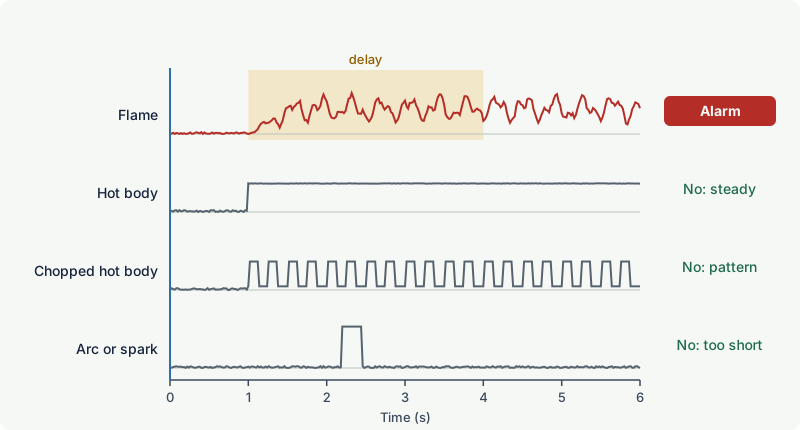
A false alarm happens when a source passes all the checks the detector applies. A single-band detector applies few checks and is easy to fool; a multi-band detector applies more and is harder to fool, but not impossible.
Common sources of false alarms
Sunlight, direct and reflected
At ground level the sun is dark in the 185 to 260 nm band used by UV tube detectors, because ozone absorbs solar UV below about 280 nm. Tube-type UV detectors therefore do not respond to sunlight. Solid-state UV sensors whose response extends into the solar UV range are not suitable outdoors.
In the infrared, cold CO2 in the atmosphere absorbs sunlight across the CO2 band, so the main channel of an IR detector is nearly solar blind. Sunlight still matters:
- It can reduce the sensitivity of IR channels, and it reaches the reference bands of multi-band detectors.
- Reflections from water, wet roofs, windscreens and polished metal can be modulated. Sunlight reflected from a rippled water surface flickers as waves pass, and the modulation can fall within the flame flicker band. Low sun at sunrise and sunset, which changes direction through the year, is the typical pattern.
- Sunlight chopped by rotating fan blades, moving vegetation or passing vehicles produces flicker from a steady source.
FM 3260 tests detectors against modulated and unmodulated, direct and reflected sunlight, which shows how seriously approval bodies take this source.
Arc welding, cutting and other electric arcs
An electric arc is a very hot plasma that emits intensely in the ultraviolet. UV detectors respond to it readily, including through reflections from walls and steelwork, and well beyond the immediate work area. Welding arcs and glowing metal also emit infrared, so single-band IR detectors and UV/IR detectors can respond when the arc is close or large. FM 3260 includes an arc welding test with a defined electrode and current (180 to 200 A) to show that an approved detector does not alarm under its stated conditions.
Other electric arcs behave the same way, for example switching arcs in open electrical equipment or arcing at damaged cables and sparking contacts.
Hot bodies
Every hot surface emits infrared radiation according to its temperature. A furnace wall, a steam line, an engine casing, a heater or a sunlit dark roof gives a smooth, broad spectrum that rises steeply with temperature. On its own it gives a steady signal, so flicker analysis and spectral ratio checks reject it.
Hot bodies become false alarm sources when something makes them look like a flame:
- Modulation. A fan rotating in front of a hot surface, a vibrating hot pipe, a person or vehicle passing in front of a heater, or a detector mounted on a vibrating structure turns a steady signal into a flickering one.
- Hot CO2. Engine and gas turbine exhaust, heater stacks and burner flues contain hot CO2, which emits in exactly the band IR flame detectors use. A hot exhaust plume that flickers can look like a flame to a CO2-band detector.
- Very high temperatures. Only extremely hot sources, such as arc plasma, emit enough UV to affect UV detectors; ordinary hot surfaces do not.
Flares and other real flames
A flare, a burner viewing port, a pilot light or a hot work flame is a real flame. Every flame detector that sees it is working correctly when it alarms. The solution is not a better algorithm but keeping these flames out of the field of view, or out of the detector's range, by position, aim and shielding. Reflections of a large flare from nearby surfaces can also reach detectors that do not see the flare directly.
Lightning, corona and ionising radiation
UV tube detectors work by counting photoelectric discharges, and anything that ionises the gas in the tube or emits short-wave UV produces counts:
- Lightning emits intense UV. A nearby strike can produce a short burst of counts; time delays usually reject it.
- Corona discharge from high-voltage equipment emits weakly in the solar-blind UV band. UV detectors looking at substations, transformers or high-voltage lines can respond to it.
- Germicidal UV lamps (low-pressure mercury lamps) emit mainly at 253.7 nm, inside the UV detector band.
- X-rays and gamma rays from industrial radiography of welds, and from other radioactive sources, can trigger UV detectors directly by ionisation inside the sensor.
- Artificial lighting is a test item too: FM 3260 checks that detectors do not alarm on incandescent, fluorescent and halogen lamps. Halogen lamps have quartz envelopes, which let more ultraviolet through than ordinary glass.
Electrical interference
Radio transmitters used close to a detector, and electrical transients from motors, drills or arcing contacts, can disturb the electronics. The October 2021 edition of FM 3260 tests detectors against radio transmissions equivalent to a 5 W transmitter at 0.6 m in several frequency bands (the ANSI/FM 3260-2023 version states the test as a field strength of 20 V/m), and against electrical interference from an open spark gap, an electric drill, a soldering gun and an unsuppressed bell. Follow the manufacturer's guidance on minimum distance for radios and on cable screening and earthing.
Which detectors are affected
The table summarises the usual susceptibility of each technology. Actual behaviour depends on the design and settings, so the manufacturer's immunity data for the specific detector is the reference.
| Source | UV | Single or dual IR | UV/IR | Multi-spectrum IR |
|---|---|---|---|---|
| Direct sunlight | Not affected (tube type) | Low, reduced sensitivity possible | Not affected | Not affected |
| Modulated sun reflections | Not affected | Susceptible | Low | Low, possible in strong glint |
| Arc welding and electric arcs | Highly susceptible | Possible at close range | Possible at close range | Low |
| Steady hot bodies | Not affected | Low | Not affected | Not affected |
| Modulated hot bodies | Not affected | Susceptible | Low | Low |
| Hot CO2 exhaust plumes | Not affected | Susceptible | Low | Possible |
| Flares and other real flames | Responds (real flame) | Responds | Responds | Responds |
| Lightning and corona | Susceptible | Not affected | Low | Not affected |
| X-rays and gamma rays | Susceptible | Not affected | Low | Not affected |
| Germicidal UV lamps | Susceptible | Not affected | Low | Not affected |
How to avoid false alarms
Choose the technology for the background
Start from the radiation sources present in and around the area. Where welding, radiography or high-voltage equipment is common, IR-based detectors avoid the UV problem. Where hot moving machinery, exhausts or water reflections dominate, UV/IR or multi-spectrum IR detectors with several independent checks perform better than single-band IR. The fire to be detected sets the limits of this choice: hydrogen fires, for example, need UV or hydrogen-specific IR (see detecting hydrogen fires).
Position and aim the detectors
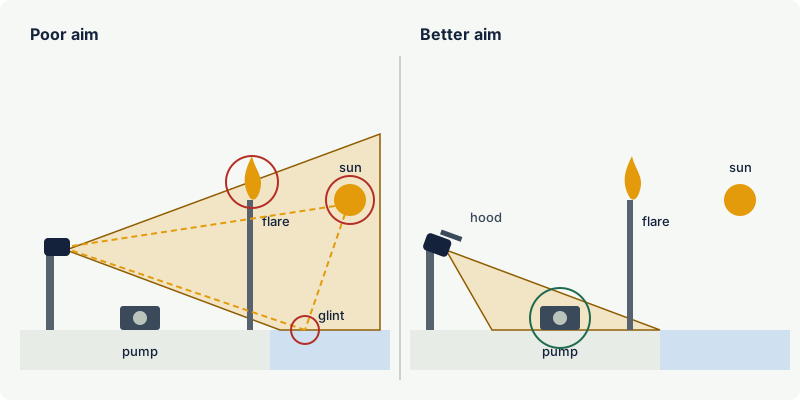
- Tilt detectors down onto the hazard so the horizon, the sky and the low sun are outside the field of view. Check the sun's path at sunrise and sunset in summer and winter for outdoor detectors facing east or west.
- Keep flares, exhausts, heater stacks, welding bays and high-voltage equipment out of the field of view, and look for reflections of them from walls, tanks and water.
- Use hoods, shields or field of view restrictors supplied for the detector where a source cannot be avoided by aiming. Any restriction changes coverage and must be reflected in the coverage assessment.
- Mount detectors rigidly, away from vibrating structures.
These measures must be balanced with coverage; see flame detector placement and cone of vision.
Configure settings and voting
- Time delay. A confirmation delay of a few seconds rejects lightning, sparks and short reflections. Longer delays reject more but slow the response to real fires; keep within the response time assumed in the fire and gas design.
- Sensitivity. Lower sensitivity reduces range. Change it only with a recalculation of coverage, never as a quick fix.
- Voting. Requiring two detectors to confirm a fire (two-out-of-N) before automatic executive action, such as deluge release or shutdown, greatly reduces spurious trips, because one false source rarely fools two detectors looking from different directions. A single detector alarm still alerts operators. Voting only works if the area is covered by at least two detectors.
Control hot work and radiography
Welding, cutting and grinding near UV detectors, and industrial radiography anywhere nearby, should be planned under the permit system (see hot work permits in hazardous areas):
- Identify the detectors that can see the work or be reached by the radiation.
- Inhibit only those detectors, only for the duration of the work, with the inhibit logged and visible in the control room.
- Put compensating measures in place: a fire watch with extinguishers, portable gas monitoring, and where needed temporary detection.
- Restore the detectors and confirm they are healthy when the work ends.
Maintain and investigate
- Keep windows clean and check the aim after any maintenance on or near the detector. Dirty windows rarely cause false alarms but they do cause missed fires; most detectors with an optical self-test will report them as a fault.
- Treat every false alarm as an incident to investigate. Record time, weather, sun position, work in progress and equipment running. Many detectors store event data that shows which channels responded.
- Fix the cause (aim, shielding, technology, procedure) rather than the symptom (sensitivity, delay, permanent inhibit).
Practical case: morning alarms at a jetty
A multi-spectrum IR detector protecting a loading arm on a jetty (northern hemisphere) gives several single-detector alarms in the first hour after sunrise on clear winter mornings, never in summer and never on cloudy days. No deluge is released because the system votes two-out-of-three, but each event requires a response.
The pattern points to the sun. The detector faces east-south-east across the water. In winter the sun rises further south and stays low for longer, and its reflection from the rippled water surface enters the lower part of the detector's field of view. The ripples modulate the reflection in the flame flicker range.
The fix is to increase the downward tilt so that the water surface beyond the loading area is outside the field of view, and to fit the manufacturer's hood. Because the change alters the coverage, the coverage map is rerun to confirm that the loading arm and manifold are still seen by at least two detectors. The alarms stop. Lowering the sensitivity, the first suggestion on site, would also have stopped them, but would have cut the detector's range for a fire at the manifold.
Common mistakes
- Turning down sensitivity or lengthening delays without a coverage review. It hides the symptom and shrinks protection.
- Leaving inhibits in place after welding or radiography. Inhibits must be time-limited, logged and removed when the work stops.
- Using UV detectors in areas with frequent welding or radiography. IR-based detectors avoid the problem altogether if they suit the fire to be detected.
- Aiming detectors horizontally outdoors. It brings the horizon, the low sun, reflections from water and distant flares into view.
- Forgetting reflections. A detector that cannot see a flare or welding bay directly can still see its reflection on a tank shell or a wet surface.
- Assuming a multi-spectrum detector cannot false alarm. It is much harder to fool, but real flames, hot CO2 exhausts and strong modulated reflections can still trigger it.
Frequently asked questions
Can sunlight set off a flame detector?
Direct sunlight does not trigger tube-type UV detectors or the CO2 channel of IR detectors, because the atmosphere removes sunlight from those bands. Sunlight reflected from water or shiny surfaces and chopped by waves or moving objects can still trigger IR detectors, especially single-band types, when the sun is low.
Why does welding cause flame detector alarms?
An electric welding arc emits strong ultraviolet radiation, which UV detectors cannot distinguish from a flame's UV, even at a distance and via reflections. Arcs and hot metal also emit infrared, which can affect simple IR and UV/IR detectors at close range. UV detectors near welding should be inhibited under a hot work permit with a fire watch.
Can X-rays or gamma rays trigger a UV flame detector?
Yes. UV tube detectors count discharges in a gas-filled tube, and ionising radiation from industrial radiography or other radioactive sources can produce such discharges directly. Detectors that may be exposed should be identified and inhibited during radiography under the permit system.
How do I stop false alarms without reducing protection?
Find the source first, then remove it from the detector's view by aiming, tilting or shielding, or choose a technology that is immune to it. Use a short confirmation delay and two-detector voting for executive actions. Any change to sensitivity, delay or field of view must be checked against the coverage the detectors are supposed to provide.
Do hot surfaces cause false alarms in IR flame detectors?
A steady hot surface usually does not, because it does not flicker and its spectrum does not match a flame's. It becomes a problem when its radiation is modulated, for example by a fan, vibration or people passing in front of it, or when it is a hot gas containing CO2, such as an engine exhaust.
Is a flare alarm a false alarm?
Technically no: the detector has seen a real flame. It is an unwanted alarm caused by poor positioning, and the cure is to keep flares and their reflections out of the field of view or out of range.
Related on excodex
- How flame detectors work: UV, IR, UV/IR and multi-spectrum IR
- Flame detector placement and cone of vision
- Flame detector performance standards: EN 54-10, FM 3260 and response time
- Hot work permits in hazardous areas
- Video and thermal imaging for flame and smoke detection
- Questions and field experience in the forum
Standards and further reading
- FM 3260, examination (approval) standard for radiant energy-sensing fire detectors (October 2021 edition), including false stimulus tests with sunlight, arc welding, heated bodies and lamps, and radio frequency and electrical transient tests: https://www.fmapprovals.com/-/media/Feature/Approval-Standards/3260-pdf.pdf
- ANSI/FM 3260-2023, the American National Standard version of FM 3260, approved 24 August 2023: https://www.fmapprovals.com/-/media/Feature/Approval-Standards/3260ansi-pdf.pdf
- EN 54-10:2002 with amendment A1:2005, point-type flame detectors for fire detection and fire alarm systems installed in buildings (a 2012 revision draft was abandoned, so this edition remains current).
- NFPA 72, National Fire Alarm and Signaling Code, requirements for radiant energy-sensing detectors.
- NASA SP-5092, Hydrogen leak and fire detection: a survey (1970), which also discusses UV detector interference from welding, arc lamps and lightning: https://ntrs.nasa.gov/api/citations/19700031601/downloads/19700031601.pdf
- L. Periale and co-authors, The development of sealed UV sensitive gaseous detectors and their applications (solar-blind UV detection): https://arxiv.org/pdf/physics/0605207
This article is general technical information prepared by the excodex editorial team. It does not replace the applicable standards, the equipment certificates and instructions, national regulations or the assessment of a competent person.