Detecting hydrogen fires and other invisible flames
Abstract
Hydrogen burns with a nearly invisible, smokeless flame that emits UV and hot water vapour bands but no CO2, so standard IR flame detectors miss it. How UV, water-band IR and thermal cameras detect hydrogen and methanol fires, and what to watch out for.
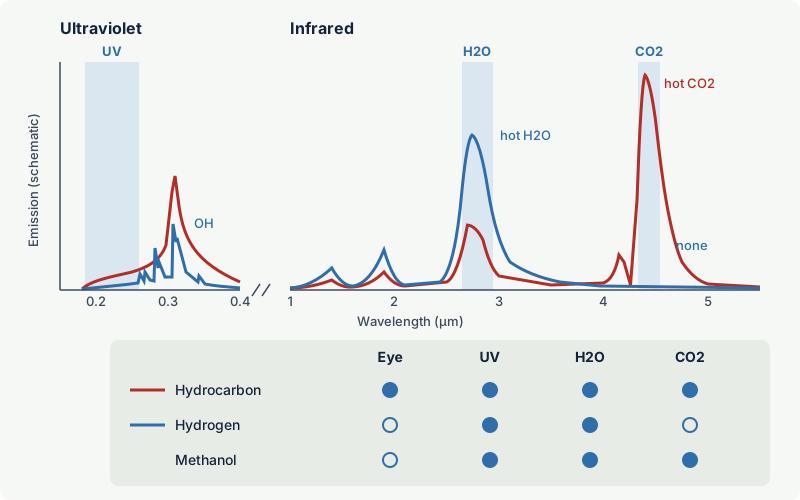
A hydrogen flame is pale blue, nearly invisible in daylight, produces no smoke and radiates little heat, so people can walk into it without seeing or feeling it. It emits ultraviolet light from OH radicals and infrared from hot water vapour, strongest near 2.7 µm, but no carbon dioxide, so flame detectors that rely on the CO2 band near 4.4 µm cannot see it. Hydrogen fires are detected with UV detectors, IR detectors tuned to water vapour bands (alone or combined with UV), and thermal imaging cameras; methanol flames, also nearly invisible in daylight, are seen by most technologies because they do produce CO2.
This article explains why these flames are hard to see, what they emit, which detection technologies work, and how to combine them with gas detection and safe working practices.
Key points
- Hydrogen flames emit almost entirely from OH radicals (ultraviolet) and hot water vapour (infrared). Neither emits appreciable visible light, and a pure hydrogen flame burns without smoke.
- Any visible colour in a hydrogen flame comes from impurities such as dust or sodium from sea spray, not from the hydrogen itself.
- Hydrogen contains no carbon, so its flame has no 4.4 µm CO2 peak. Standard IR and multi-spectrum IR flame detectors designed for hydrocarbons can miss hydrogen fires completely.
- UV flame detectors respond to hydrogen flames. IR detectors for hydrogen look at hot water vapour emission, mainly in the band around 2.7 µm, where the lower atmosphere also removes most sunlight.
- Thermal cameras show hydrogen flames as hot plumes. A 2026 study detected flames only a few centimetres long at 40 m in direct sunlight with both UV and long-wave infrared imaging.
- Methanol burns with a flame that is invisible in daylight, but it contains carbon, so its fire does emit in the CO2 band; detection distances are usually given separately from n-heptane.
- Other carbon-free fuels, such as ammonia, silane and hydrazine, also produce no CO2, so the same rule applies: check that the detector responds to the actual fuel.
Why some flames are invisible
The bright yellow of an ordinary fire comes from soot: tiny carbon particles heated in the flame glow like a lamp filament and emit a continuous spectrum across the visible range. Without soot, a flame emits only in narrow molecular bands, most of which lie outside the range of the human eye.
A pure hydrogen flame has no carbon and therefore no soot. A NASA survey of hydrogen leak and fire detection describes pure hydrogen fires as invisible in all conditions except near darkness; in normal light they show at most as a heat shimmer. The same survey estimated the total radiation from hydrogen flames as roughly ten times lower than from many organic flames, which is why people near a hydrogen fire may not feel its heat until they are very close.
Methanol is the other well-known case. It contains carbon but burns almost without soot, and laboratory safety literature describes its flame as invisible in daylight.
Warning: Never approach a suspected hydrogen leak by sight or feel. Use a hydrogen gas detector, listen for escaping gas, and check for flame with a thermal imaging camera, or, as a last resort, with a combustible probe such as a dry broom held ahead of the body.
What a hydrogen flame emits
Ultraviolet
The excited OH radical emits a series of UV bands. The NASA survey lists band heads from about 261 to 343 nm, with the strongest near 306 and 281 nm. UV tube detectors, whose sensitivity typically runs from about 185 nm up to 260 to 280 nm depending on the tube, respond to the short-wave end of this emission, in a range where there is practically no sunlight at ground level. The same survey notes that OH radiation from hydrogen flames is weaker than from the reaction zones of hydrocarbon flames, so UV detection distances for hydrogen are not automatically the same as for hydrocarbons.
Infrared
Hot water vapour emits in bands near 1.4, 1.9 and 2.7 µm, and further out near 6.3 µm. The 2.7 µm band is by far the strongest. Two atmospheric effects matter here:
- The lower atmosphere absorbs almost all sunlight between about 2.55 and 2.9 µm (and between about 1.81 and 1.88 µm), because of the water vapour and CO2 in the air. A detector working in this region sees little direct sunlight.
- The same atmospheric water vapour also absorbs part of the flame's emission. Some radiation still gets through because the hot flame emits over a wider band than the cooler air absorbs. Humid air and long distances reduce the signal.
No CO2 peak appears near 4.3 to 4.4 µm, the band used by standard IR flame detectors. That single fact explains most missed hydrogen fires.
Choosing detectors for hydrogen fires
UV detectors
UV detectors respond quickly to hydrogen flames and work outdoors because they are solar blind. A weakness that limits UV detectors elsewhere, smoke, does not apply to a pure hydrogen fire, which produces none, although burning insulation or other materials nearby can produce smoke later.
Their usual false alarm sources remain: arc welding, lightning, corona from high-voltage equipment and X-ray or gamma radiography (see false alarms in flame detectors). Hydrogen plants often contain large electrical equipment, such as electrolyser rectifiers and transformers, so arcs and corona sources must be kept out of the field of view.
Water-band IR and UV/IR detectors
IR flame detectors for hydrogen replace or supplement the CO2 channel with one or more channels in the hot water vapour bands, usually in the region around 2.7 to 3 µm, and use reference bands and flicker analysis as other IR detectors do. Variants include:
- Multi-band IR detectors designed for hydrogen, which do not respond to arcs, lightning or radiation sources.
- UV/IR detectors with a water-band IR channel, which combine the UV response to hydrogen with an IR confirmation.
- Detectors covering both fuels, which watch the water band and the CO2 band so that both hydrogen and hydrocarbon fires are seen. These matter where hydrogen is blended into natural gas or where both fuels are present.
Water and ice on the window attenuate these bands strongly, as they do for any IR detector.
Performance data for hydrogen
Detection distances in data sheets are normally stated for a 0.1 m² n-heptane pan fire. That figure says nothing about hydrogen. FM 3260's test fires are n-heptane and alcohol pan fires, a small propane flame and, for wet bench applications, polypropylene pellets, and the ANSI/FM 3260-2023 version adds a JP4 or Jet B pan fire; neither version defines a hydrogen test fire. Manufacturers therefore state hydrogen performance against their own hydrogen test flame, typically a jet flame of a given length or flow. When comparing detectors, ask for:
- the hydrogen flame used (flow, pressure, flame length or size),
- the distance, angle and response time achieved,
- the sensitivity setting during the test, and whether it is the one you intend to use.
Hydrogen detection distances are generally shorter than hydrocarbon distances, so layouts for hydrogen usually need detectors closer to the potential leak points than a hydrocarbon layout would (see flame detector placement).
Thermal cameras and imaging
A thermal camera sees heat. In the mid-wave (about 3 to 5 µm) or long-wave (about 7.5 to 14 µm) infrared, a hydrogen flame appears as a bright plume of hot gas, and the pipework and surfaces it heats also stand out.
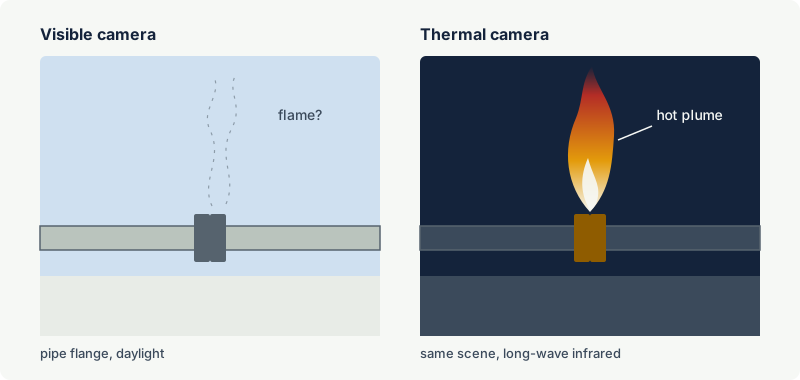
A study by the German national metrology institute PTB, published in 2026, compared UV imaging of OH emission at 310 nm with long-wave infrared imaging at 7.5 to 14 µm for small burning hydrogen leaks between industrial pipes. Flames between 1.7 and 26.5 cm long, from flows of 2 to 100 litres per minute, were detected unambiguously by both methods outdoors in direct sunlight at a distance of 40 m. Each method had its own interference: sunlight degraded the UV images, while hot surfaces and incandescent lamps interfered with the infrared images.
Thermal imaging is used in three ways:
- Portable thermal imagers for operators and emergency responders checking for flames before approaching a leak. Hydrogen safety guidance recommends them where available.
- Fixed thermal cameras with analysis software that raise an alarm when a hot region with flame-like behaviour appears (see video and thermal imaging for flame and smoke detection).
- Verification, where an operator views the camera image after a flame detector alarm to confirm the fire and judge its size.
Ordinary colour CCTV cannot show a pure hydrogen flame and must not be used to confirm or dismiss a hydrogen fire alarm.
Methanol and other hard-to-see flames
A methanol fire is the opposite case to hydrogen in one respect: it is nearly invisible to the eye but not to most detectors. Methanol contains carbon, so its flame emits in the CO2 band, and it emits UV like other flames. UV, IR, UV/IR and multi-spectrum IR detectors can all respond. Because the flame is soot-free and radiates less than a sooty hydrocarbon fire, detection distances for an alcohol pan fire can be noticeably shorter than for n-heptane. FM 3260 includes an alcohol pan fire among its test fires, and manufacturers' data usually lists methanol or ethanol separately; use those figures for alcohol storage, methanol-fuelled ships and similar applications.
For other carbon-free fuels, the reasoning used for hydrogen applies: ammonia, silane and hydrazine produce water vapour and other products but no CO2 when they burn, so CO2-band IR detectors are not a suitable choice. Their flame emission differs from hydrogen's, so the manufacturer must confirm the response for the specific fuel.
A layered approach for hydrogen facilities
Flame detection is one layer. For hydrogen, it works best combined with others:
- Gas detection to find leaks before they ignite. Infrared gas detectors cannot detect hydrogen; catalytic, thermal conductivity, electrochemical or other hydrogen-specific sensors are needed, mounted close to and above likely leak points because hydrogen rises (see catalytic vs infrared gas detectors).
- Flame detection with UV, water-band IR or UV/IR detectors chosen and placed for hydrogen jet fires.
- Process monitoring, such as pressure decay or flow imbalance, which can reveal a leak that neither gas nor flame detectors see.
- Automatic response: isolation of the hydrogen supply, depressurisation where designed, alarm and, where relevant, increased ventilation.
- Safe working practices: portable hydrogen detectors and thermal imagers for anyone approaching a suspected leak, and training that a hydrogen fire may be invisible.
Practical case: hydrogen compressor enclosure
A containerised hydrogen compressor has flanged connections and valves at about 1 to 2 m height. The original design, copied from a natural gas compressor, used two multi-spectrum IR flame detectors with the standard hydrocarbon filter set.
A review finds three problems. First, the detectors' CO2-band design will not respond to a hydrogen fire. Second, their stated range applies to an n-heptane pan, not a hydrogen jet flame. Third, the electrical cabinet of the motor drive is in view of the positions considered for UV detectors, and switching arcs with the cabinet doors open during maintenance could cause nuisance alarms.
The revised design uses multi-band IR detectors specified for hydrogen, located so that every flange and valve is seen by two detectors at a distance within the manufacturer's hydrogen performance data, and aimed away from the drive cabinet and the door opening. Hydrogen gas detectors are placed at the roof above the compressor, and a portable thermal imager is kept at the entrance for anyone responding to an alarm.
Common mistakes
- Using hydrocarbon IR or multi-spectrum IR detectors for hydrogen. Without a water-band channel they will not see a hydrogen fire. Check the manufacturer's statement for hydrogen explicitly.
- Relying on the n-heptane range for hydrogen. Hydrogen performance must be shown with a hydrogen flame; distances are usually shorter.
- Confirming alarms with colour CCTV. A clear camera image does not mean there is no hydrogen fire. Use thermal imaging or treat the alarm as real.
- Approaching a hydrogen leak on foot to look for flames. The flame cannot be seen and radiates little heat. Use detectors, a thermal imager, or a combustible probe.
- Assuming methanol is "invisible" to detectors. Methanol flames are hard to see, but most detectors do respond; the issue is the shorter detection distance, which must be taken from the alcohol fire data.
- Using IR gas detectors for hydrogen leak detection. Hydrogen does not absorb infrared, so IR gas sensors cannot measure it.
Frequently asked questions
Why is a hydrogen flame invisible?
A pure hydrogen flame contains no carbon, so it forms no soot, and soot is what makes ordinary flames glow yellow. The flame emits mainly ultraviolet from OH radicals and infrared from hot water vapour, both outside the range of the eye. Any colour seen usually comes from dust or sodium impurities.
Can a UV flame detector detect a hydrogen fire?
Yes. Hydrogen flames emit ultraviolet from OH radicals, and UV detectors respond to it quickly, also outdoors because they work in a band free of sunlight. They remain sensitive to welding arcs, lightning, corona and radiography, which must be considered when choosing locations.
Can an IR flame detector detect a hydrogen fire?
Only if it is designed for it. Standard IR and multi-spectrum IR detectors look for the hot CO2 peak near 4.4 µm, which a hydrogen flame does not produce. Detectors with channels in the hot water vapour bands, around 2.7 to 3 µm, can detect hydrogen fires.
How can you see a hydrogen flame?
Use a thermal imaging camera, which shows the hot gas plume and heated surfaces. Without one, watch for heat shimmer, listen for escaping gas and use a dry combustible probe such as a broom held ahead of you. Throwing dry powder or dust into the suspected area can also make the flame visible.
Is a methanol flame invisible?
Methanol burns with almost no soot, and its flame is very hard to see in daylight. Unlike hydrogen, it contains carbon, so flame detectors that use the CO2 band, as well as UV detectors, do respond to it, although usually at shorter distances than for n-heptane fires.
Do hydrogen flames give off heat?
Yes, they are very hot, but they radiate much less heat than sooty hydrocarbon flames. A person can be close to a hydrogen flame without feeling strong radiant heat, which is one reason hydrogen fires are dangerous.
Related on excodex
- Hydrogen safety basics: wide flammable range, low ignition energy and invisible flames
- How flame detectors work: UV, IR, UV/IR and multi-spectrum IR
- Hydrogen production and refuelling stations: hazardous areas, detection and equipment
- Video and thermal imaging for flame and smoke detection
- Catalytic (pellistor) vs infrared flammable gas detectors
- Substance cards: hydrogen, methanol; gas detection standard space IEC 60079-29-0
Standards and further reading
- FM 3260, examination (approval) standard for radiant energy-sensing fire detectors (October 2021 edition), listing its test fires: https://www.fmapprovals.com/-/media/Feature/Approval-Standards/3260-pdf.pdf
- ANSI/FM 3260-2023, the American National Standard version of FM 3260 (approved 24 August 2023), which adds a JP4 or Jet B pan fire but no hydrogen test fire: https://www.fmapprovals.com/-/media/Feature/Approval-Standards/3260ansi-pdf.pdf
- EN 54-10:2002 with amendment A1:2005, point-type flame detectors for fire detection and fire alarm systems installed in buildings (a 2012 revision draft was abandoned).
- IEC 60079-29-0, gas detection equipment for flammable gases, oxygen and toxic gases (formerly IEC 60079-29-1), for the hydrogen gas detection layer.
- NASA SP-5092, Hydrogen leak and fire detection: a survey (1970), with hydrogen flame emission bands, visibility and detection methods: https://ntrs.nasa.gov/api/citations/19700031601/downloads/19700031601.pdf
- J. Brunzendorf (PTB), Small burning hydrogen leaks in industrial plants: a comparison of UV and IR remote imaging detection, Hydrogen Safety, 2026: https://reference-global.com/article/10.58895/hysafe.39
- Hydrogen Tools portal (developed by Pacific Northwest National Laboratory with US Department of Energy support), hydrogen safety best practices on flame detection, including portable thermal imagers and combustible probes: https://h2tools.org/node/1121
- National Research Council, laboratory chemical safety summary for methanol (flame invisible in daylight), hosted by Stanford University: https://web.stanford.edu/dept/EHS/cgi-bin/lcst/lcss/lcss58.html
This article is general technical information prepared by the excodex editorial team. It does not replace the applicable standards, the equipment certificates and instructions, national regulations or the assessment of a competent person.