Video and thermal imaging for flame and smoke detection
Abstract
Video fire detection analyses camera images for the colour, motion and flicker of flames or the spread of smoke; thermal imaging measures surface temperature to find hot spots before they burn. How both work, where they fit, their limits and the standards that test them.
Video and thermal imaging detect fire with cameras instead of point sensors. Video fire detection runs image analysis on visible-light camera pictures and raises an alarm when it finds regions with the colour, motion and flicker of flames, or the spreading, contrast-reducing pattern of smoke. Thermal imaging uses an infrared camera that measures the apparent surface temperature of every pixel, so it can find a hot spot in a waste pile or on a conveyor before anything burns, and see flames and hot gases through smoke. Both cover large areas from one position and give the operator a picture of what is happening, but both depend on a clear line of sight, careful configuration and site-specific testing.
This article explains how each technique works, where it is used, how it compares with optical flame detectors and smoke detectors, its limitations, and the standards that test it.
Key points
- Video flame detection looks for fire-coloured regions that move and flicker. Typical algorithms check the flame boundary for irregular flicker, several oscillations per second, which a passing fire-coloured object does not show.
- Video smoke detection needs light: most systems do not work in darkness unless the scene is lit with infrared illuminators. Video flame detection works in dark and lit spaces, because the flame provides its own light.
- Thermal imaging measures surface temperature, not the temperature inside a pile or behind a wall. UK guidance for waste sites notes that surface monitoring is unlikely to give the core temperature of a pile.
- A thermal camera can only measure a hot spot that covers enough pixels. The footprint of one pixel grows with distance, so a small hot spot far away is averaged with its cooler surroundings and reads too low.
- FM 3232 is the US approval standard for video image fire detectors; ANSI/CAN/UL 2684 (2025) covers video and thermal image detectors for fire alarm systems. A camera offered as a flame detector can also be submitted against a flame detector standard such as FM 3260; check the listing for the exact model.
- Camera-based detection supplements, and normally does not replace, the detection that codes require. FM 3232 states that video image fire detectors are not a direct replacement for standard open area protection.
Why use cameras for fire detection
Point smoke and heat detectors work only when smoke or heat reaches them. Under a high roof, in a tunnel, an atrium, a hangar or an open storage yard, that may happen late or not at all. Optical flame detectors see at a distance, but only flames, and they report "fire" without showing where or how large it is (see how flame detectors work).
Cameras add three things:
- Detection at the source. A camera sees smoke rising from a fire at floor level long before the plume reaches the ceiling.
- Location and verification. The alarm comes with an image, so an operator can confirm the fire, judge its size and direct the response.
- Early warning. A thermal camera sees heating that has not yet become a fire: self-heating waste, a hot bearing, a hot electrical joint.
Typical applications include power generation, warehouses and logistics halls, aircraft hangars, tunnels, heritage buildings where spot detectors would spoil the interior, large production halls, waste and recycling plants, biomass and coal storage, and outdoor storage yards. Waste regulators in the UK list CCTV flame detection among the automated detection options a site may use in its fire prevention plan.
Video fire detection
How video flame detection works
A video flame detector takes the stream from an ordinary colour or monochrome camera and processes it frame by frame. Published methods and commercial systems differ, but most combine the same clues:
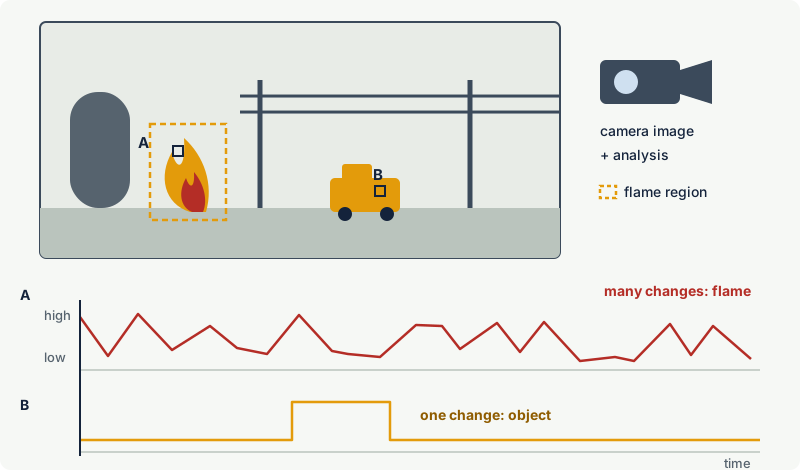
- Moving regions. The background is learned over time; pixels that change are candidates.
- Fire colour and brightness. Flames in a visible image occupy a typical range of red, orange, yellow and near-white colours. One well-known research method models this range from sample images and keeps only moving pixels whose colour falls inside it.
- Flicker. The edge of a flame oscillates irregularly. A pixel on the boundary alternates between flame colour and background several times per second. A fire-coloured object that passes through the pixel, such as an orange jacket or a forklift, produces one change and no oscillation.
- Shape and growth. The region's outline is irregular and changes constantly, and a developing fire grows.
- Persistence. All clues must hold for a set time before the alarm.
Flame flicker is broadband. Research on turbulent flames often quotes oscillations around 10 Hz, while pool fires pulse more slowly: about 3 Hz for a 0.25 m pan and 1.5 Hz for a 1 m pool. The camera frame rate limits what can be seen: to resolve an oscillation, the camera must take at least two frames per cycle, so a 10 frames per second stream shows flicker only up to 5 Hz, and faster flicker appears at false, lower frequencies. Practical algorithms therefore analyse a band of a few hertz and count oscillations over a few seconds rather than look for one frequency.
Many recent systems add machine-learning classifiers trained on fire and non-fire images, sometimes combined with the handcrafted clues above. Reviews of the field describe hybrid systems that combine both as the current direction of development.
How video smoke detection works
Smoke changes the image in characteristic ways. It is semi-transparent and grey, so it lowers the contrast and sharpness of the background behind it; it moves slowly, upward and outward; and its edges are soft and changing. Video smoke detection algorithms track brightness, contrast, edge content, motion and its pattern over time, and alarm when a region shows the signature of a growing plume.
Because these clues depend on seeing the background, smoke detection needs light. Most systems do not work in the dark; some use cameras sensitive to near infrared together with infrared illuminators. Smoke against a sky, or against a grey, featureless wall, gives little contrast to work with.
System architecture and supervision
Two architectures are common: cameras connected to a central processing unit, or cameras with the analysis built in and an alarm output at the camera. In both cases the result goes to a fire alarm panel as an alarm or fault signal, and the image can go to a video recorder and the control room.
A camera used for detection must be supervised like any fire detector. FM 3232 requires a fault (trouble) signal for loss of camera power, loss of the video path, loss of image contrast or clarity, and movement of a manual switch from its normal position. Systems typically also report images that are too dark, too bright or obscured. The camera must stay fixed: a pan-tilt-zoom camera that moves away from its preset view no longer sees the configured detection zones.
Thermal imaging
What a thermal camera measures
A thermal camera forms an image from the infrared radiation that objects emit because of their temperature. Most fixed fire detection cameras are uncooled microbolometer cameras working in the long-wave infrared, about 7 to 14 µm; cooled detectors for the 3 to 5 µm mid-wave band exist but are more expensive and need a cool-down time. A radiometric camera is calibrated so that each pixel can be converted into an apparent surface temperature. That is the basis of hot-spot detection: an alarm when any region exceeds a temperature threshold, rises faster than a set rate, or exceeds a threshold over a minimum area.
Two consequences follow from the physics:
- Emissivity and reflection. The camera receives emitted and reflected radiation. A shiny metal surface with low emissivity reads far below its real temperature, and it may show the reflection of a hot object nearby. Painted surfaces, wood, paper, plastics and most waste materials have high emissivity and read well.
- Glass blocks the view. Ordinary window glass is practically opaque in the long-wave infrared. A thermal camera cannot look through a normal window; enclosures for thermal cameras use windows of infrared-transparent material such as germanium.
Fire detection with thermal cameras
Thermal cameras are used in three ways:
- Hot-spot and pre-fire detection in waste bunkers, recycling halls, biomass and coal storage, and on conveyors. Material that heats itself, or a smouldering ember buried just below the surface, shows as a warm patch before flames appear. Alarms can be staged, for example a warning at a moderate temperature and a fire alarm at a higher one, with the values set for the material and the environment.
- Flame detection. Flames and hot combustion gases are much hotter than the background and change shape constantly, so analysis of temperature, area and fluctuation can identify a fire. A camera sold as a flame detector should hold an approval that covers flame detection, under UL 2684 or a flame detector standard such as FM 3260, for the model and software version supplied.
- Verification. Thermal images let operators and emergency responders see through smoke and see heat from flames that are invisible to the eye, such as burning hydrogen (see detecting hydrogen fires and other invisible flames).
Resolution and distance
Each pixel of a camera views a small cone. The size of the area one pixel covers, its footprint, is the distance multiplied by the pixel's angular size. A hot spot smaller than a pixel is averaged with its cooler surroundings, and the camera reports a lower temperature than the real one. A common thermography rule of thumb is that a target should cover at least about 3 × 3 pixels for a reliable temperature reading.
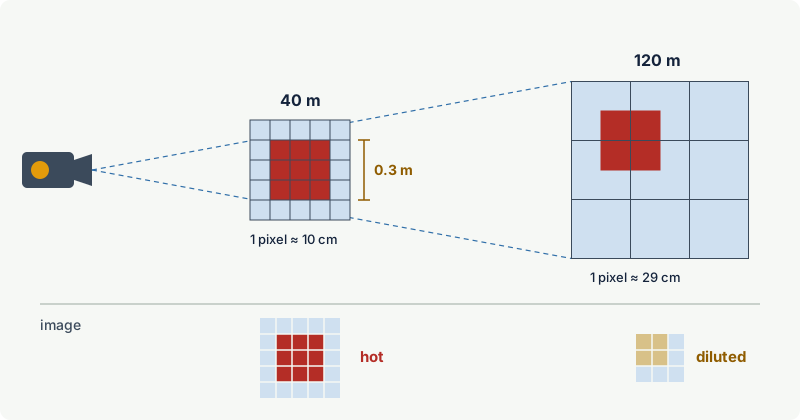
Example: A radiometric camera with 320 pixels across a 45° horizontal field of view has an angular pixel size of 45° / 320 = 0.14°, about 2.45 mrad. At 40 m one pixel covers 40 m × 0.00245 = 0.098 m, about 10 cm, so a 0.3 m hot spot spans about 3 pixels in each direction and is measured reliably. At 120 m one pixel covers about 0.29 m; the same hot spot fills at most one pixel, and if it straddles pixel boundaries, several pixels each see only part of it. To watch a 60 m long storage bay for 0.3 m hot spots, the camera must therefore be no more than about 40 m from the far end, or a camera with a narrower lens or more pixels is needed.
Frame rate also matters for flame analysis. Many thermal cameras sold internationally run at 9 frames per second or less, because higher frame rates at higher resolutions are subject to export controls. At 9 frames per second, flicker can be resolved only up to about 4.5 Hz.
Comparison with point and optical detectors
| Technique | Senses | Strengths | Main limitations |
|---|---|---|---|
| Point smoke detector | Smoke reaching the detector | Simple, prescriptive rules | Slow under high ceilings and in open or ventilated spaces |
| Optical flame detector | UV and IR radiation of flames | Fast, long range, approved to EN 54-10 and FM 3260 | Flames only; no image; line of sight |
| Video flame detection | Visible flame colour, motion, flicker | Image of the fire; large areas; works in the dark | Needs visible flame; nuisance from lights and reflections; line of sight |
| Video smoke detection | Smoke plume in the image | Sees smoke at the source, before it reaches the roof | Needs light and contrast; steam, dust and fog |
| Thermal imaging | Surface temperature | Warning before flames; sees through smoke; measures temperature | Surface only; emissivity; resolution falls with distance; glass is opaque |
Limitations
Camera systems are powerful, but every one of the following has caused missed fires or false alarms in practice and must be addressed in the design.
- Line of sight. Like optical flame detectors, cameras see only what is in direct view. Racks, stacked goods, machinery and the pile itself hide fires. A fire inside a pile, a duct or a closed cabinet is invisible until it breaks through.
- Fires the camera cannot see. Clean flames such as methanol or hydrogen emit little visible light. A research project on methanol fire detection noted that some approved detectors, for example visual detectors, are not suitable for methanol fires. Video smoke detection cannot see a fire that makes no smoke.
- Lighting and contrast. Changing daylight, headlights, rotating beacons, welding, flashing displays, reflections on water or polished floors and sunlight through roof lights all move and change brightness. Smoke detection fails in darkness or against featureless backgrounds.
- Obscurants. Steam, dust, fog, heavy rain and spray reduce visibility, and steam or dust can look like smoke.
- Optics and housing. Dirt, condensation, insects and spider webs on the window degrade the image. Outdoor housings may need heating and sun shields, and thermal cameras need infrared-transparent windows.
- Thermal effects. Sun-heated surfaces, hot exhausts, engines, freshly delivered hot loads and low-emissivity metal produce false or misleading temperatures. Thresholds must be set for the site and season.
- Configuration, software and network. Detection zones, masks, sensitivity and persistence times are set on site. FM 3232 requires that software releases are identified, that firmware cannot be changed by unauthorised persons and that a software failure, like a lost video path, produces a fault. Every later configuration change should be tested.
Standards and approvals
At the time of writing, the European EN 54 series has no part dedicated to video or thermal image fire detectors. The main approval standards are North American:
- FM 3232, examination standard for video image fire detectors for automatic fire alarm signalling (January 2023 edition), treats the detector as a combined video image smoke and flame detector; flame-only video detectors may not fit its test protocol. Its fire tests include the paper, wood, flammable liquid and smouldering smoke tests of the US smoke detector standard ANSI/UL 268, 0.3 m × 0.3 m n-heptane and alcohol pans, a 1 m methane flame and burning cardboard boxes with paper. The response must not exceed 30 s, and false stimulus tests include sunlight (outdoor detectors), arc welding, a heater and lamps. At the edges of the declared field of view the sensitivity may not fall by more than 10 % compared with the on-axis result. The standard notes that these detectors are not a direct replacement for standard open area protection.
- ANSI/CAN/UL 2684, video and thermal image detectors for fire alarm systems (2025), covers imaging detectors that sense smoke, flame or heat, video detectors for indoor use and thermal detectors for indoor and outdoor use, for open area protection. Wildfire detectors and single-pixel flame detectors are outside its scope.
- FM 3260 and EN 54-10, the flame detector standards, are the reference where a thermal or combined camera is offered as a flame detector (see flame detector performance standards).
- NFPA 72 recognises video image smoke and flame detection, treats video flame detection like other radiant energy detection, and requires these systems to be inspected, tested and maintained according to the manufacturer's published instructions. Siting follows a performance-based design rather than fixed spacing rules.
Note: In a hazardous area a camera is electrical equipment like any other. It needs Ex certification for the zone, gas or dust group and temperature class, usually as a flameproof housing with a suitable window, or an intrinsically safe or other suitable design. The Ex certificate says nothing about detection performance, and the fire approval says nothing about ignition protection.
Practical case: a waste bunker
A waste-to-energy plant stores shredded municipal waste in a 40 m long, 20 m wide bunker, up to 15 m deep. Fires start from batteries, hot ash and self-heating material, often just below the surface. The plant combines:
- Two radiometric thermal cameras at opposite ends of the bunker, high on the walls, each covering the whole surface at a distance where a 0.3 m hot spot still spans several pixels. Alarm levels are staged: a pre-alarm to the crane operator to dig out and quench the material, and a fire alarm that starts the water cannons.
- Video flame detection on the same views for open flames, giving the control room an image.
- Point or aspirating smoke detection under the roof as code-required detection, independent of the cameras.
The limits are managed: the cameras see only the surface, so the crane turns the waste regularly; steam from quenching can look like smoke, so video smoke detection does not start automatic actions here; and the camera windows are cleaned on a fixed schedule.
Common mistakes
- Using a security camera as a fire detector. Fire detection needs an approved detector or system, supervision of the video path and a link to the fire panel. A recorded image is not an alarm.
- Assuming a thermal camera sees inside a pile. It sees the surface. Probes, turning and inspection remain necessary for deep-seated self-heating.
- Ignoring pixel footprint. A camera that covers a 200 m yard may not resolve a small hot spot at the far end. Check distance against resolution.
- Relying on video smoke detection at night. Most video smoke systems need light. Plan illumination or use other detection.
- Choosing video flame detection for clean-burning fuels. Hydrogen and methanol flames give little visible light; use suitable optical flame detectors or thermal imaging.
- Changing zones or sensitivity without retesting. Every configuration change can create a blind area.
Frequently asked questions
What is video flame detection?
Video flame detection is software that analyses images from a camera and raises an alarm when it finds regions with the colour, brightness, motion and flicker of flames. It covers large areas and gives an image of the fire, but it needs a direct view of a visible flame.
Can a thermal camera detect a fire before it starts?
A radiometric thermal camera can detect abnormal heating, such as self-heating waste, a hot bearing or a smouldering ember near the surface, before open flames appear. It measures only surface temperature, so heating deep inside a pile may not show until it nears the surface.
Can video smoke detection work in the dark?
Most video smoke detection systems need a minimum light level, because they detect smoke by the way it changes the visible background. Some systems use near-infrared cameras with infrared illuminators to work in darkness. Video flame detection works in the dark because the flame lights itself.
Is video fire detection approved by FM or UL?
Yes, for listed products. FM Approvals tests video image fire detectors against FM 3232, and ANSI/CAN/UL 2684 covers video and thermal image detectors for fire alarm systems. Check the approval listing for the exact model, software version and conditions of use.
Can thermal cameras see through smoke?
Long-wave infrared passes through smoke much better than visible light, which is why firefighters use thermal imagers to find people and the seat of a fire in smoke-filled rooms. Dense smoke, steam and water spray still reduce what the camera sees, and ordinary glass blocks it completely.
Related on excodex
- How flame detectors work: UV, IR, UV/IR and multi-spectrum IR
- Flame detector performance standards: EN 54-10, FM 3260 and response time
- Flame detector placement and cone of vision
- False alarms in flame detectors: common sources and how to avoid them
- Detecting hydrogen fires and other invisible flames
- Ex protection concepts at a glance
Standards and further reading
- FM 3232, examination standard for video image fire detectors for automatic fire alarm signalling (January 2023): https://www.fmapprovals.com/-/media/Feature/Approval-Standards/3232-pdf.pdf
- ANSI/CAN/UL 2684, video and thermal image detectors for fire alarm systems (2025), scope summary: https://scc-ccn.ca/standardsdb/standards/4032361
- FM 3260, approval standard for radiant energy-sensing fire detectors (FM examination standard, October 2021 edition; also published as ANSI/FM 3260-2023), and EN 54-10:2002 with amendment A1:2005, point flame detectors for fire detection systems installed in buildings.
- NFPA 72, National Fire Alarm and Signaling Code, provisions for video image smoke and flame detection.
- D. T. Gottuk, Flame and smoke video image detection, SFPE FPE Extra issue 21: https://sfpe.connectedcommunity.org/publications/fpeextra/etarchives/fpeetissue21
- B. U. Töreyin et al., computer vision based method for real-time fire and flame detection (colour, motion and wavelet flicker analysis): https://homepages.inf.ed.ac.uk/rbf/CVonline/LOCAL_COPIES/TOREYIN2/index.html
- A. Gaur et al., Video flame and smoke based fire detection algorithms: a literature review, Fire Technology 56 (2020): https://link.springer.com/doi/10.1007/s10694-020-00986-y
- UK Environment Agency, fire prevention plans for environmental permits (detection options and pile temperature monitoring): https://www.gov.uk/government/publications/fire-prevention-plans-environmental-permits/fire-prevention-plans-environmental-permits
- Thermographic cameras, wavelength bands, detector types and export rules: https://en.wikipedia.org/wiki/Thermographic_camera
This article is general technical information prepared by the excodex editorial team. It does not replace the applicable standards, the equipment certificates and instructions, national regulations or the assessment of a competent person.