Flame detector performance standards: EN 54-10, FM 3260 and response time
Abstract
EN 54-10 sorts flame detectors into Class 1, 2 or 3 by the distance at which they detect two reference fires within 30 s; FM 3260 verifies the distance, field of view and response time the maker declares. How to read the numbers on a datasheet.
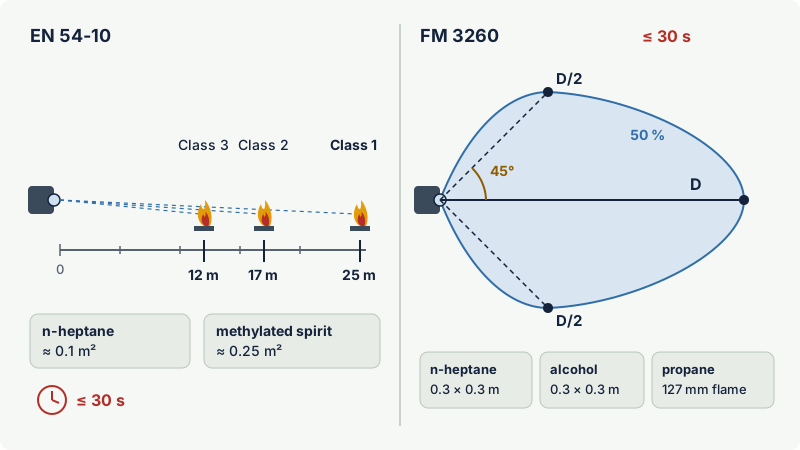
Flame detector performance is proven against two main standards. EN 54-10 is the European product standard for point flame detectors in fire alarm systems: it sorts detectors into Class 1, 2 or 3 according to the distance at which they detect two reference fires, n-heptane and methylated spirit, within 30 seconds (the class distances usually quoted are 25 m, 17 m and 12 m). FM 3260 is the US approval standard: instead of fixed classes, it verifies the detection distance, field of view and response time that the manufacturer declares for defined test fires, and it requires an alarm no later than 30 seconds after flame exposure.
This article explains what each standard tests, what "class", "sensitivity" and "response time" really mean, how the two compare, and how to read the performance section of a flame detector datasheet without being misled.
Key points
- EN 54-10 classes are defined by the distance at which the detector responds within 30 s to an n-heptane fire and a methylated spirit fire. Class 1 is the most sensitive; the distances usually quoted are 25 m for Class 1, 17 m for Class 2 and 12 m for Class 3.
- FM 3260 has no classes. The manufacturer declares the distance at which the detector reliably alarms for each test fire, and FM Approvals verifies it with full-scale fire tests.
- FM 3260 test fires include a 0.3 m × 0.3 m (12 in × 12 in) n-heptane pan, a pan of the same size burning alcohol and a 127 mm (5 in) propane flame; the 2023 ANSI edition adds a JP4/Jet B pan.
- FM 3260 defines the field of view as the angle within which the detection distance is at least 50 % of the on-axis value, checked left, right, up and down.
- A datasheet distance is meaningless without the fuel, fire size, sensitivity setting and response time it refers to. Response gets slower as the fire approaches the maximum rated distance.
- Performance approval and Ex certification are separate. An ATEX or IECEx certificate says nothing about how well a detector sees a fire, and EN 54-10 or FM 3260 says nothing about ignition protection.
What a performance standard proves
A flame detector has three separate jobs, and each is proven by a different kind of document:
| Question | Proven by | Example |
|---|---|---|
| Does it see the fires I care about, far enough and fast enough, without false alarms? | Performance standard | EN 54-10, FM 3260, ISO 7240-10 |
| Is it safe to install in a hazardous area? | Ex certification | ATEX, IECEx, Ex db IIC T4 Gb |
| Can it be credited in a safety instrumented function? | Functional safety assessment | IEC 61508 SIL capability |
The performance standard is the subject here. It answers questions such as: at what distance does the detector respond to a standard fire, within what time, over what angle, with what spread between samples, and does it stay silent when exposed to sunlight, welding or hot bodies? None of this follows from the Ex marking, which deals only with preventing the detector from igniting the atmosphere around it (see how to read an Ex marking).
EN 54-10: flame detectors in fire alarm systems
EN 54-10 is part of the EN 54 series for fire detection and fire alarm systems. It covers point-type, resettable flame detectors that respond to radiation from flames, for fire detection systems installed in buildings. The current edition is EN 54-10:2002 with amendment A1:2005. A revision was circulated as an enquiry draft in 2012, but the project was later abandoned, so the 2002 edition remains the reference. The standard is harmonised under the EU Construction Products Regulation, which is why EN 54-10 detectors sold in the EU carry CE marking.
The international counterpart is ISO 7240-10:2012, point-type flame detectors, which ISO confirmed as current in 2025.
Classes
The heart of EN 54-10 is classification by distance:
| Class | Distance usually quoted | Meaning |
|---|---|---|
| Class 1 | 25 m | Highest sensitivity |
| Class 2 | 17 m | Intermediate |
| Class 3 | 12 m | Lowest sensitivity the standard accepts |
To earn a class, the detector must respond within 30 s to two test fires placed at the class distance: an n-heptane fire, which is sooty and radiates strongly, and a methylated spirit fire, which burns with a clean, pale flame and little soot. Manufacturers' documentation describes them as about 0.1 m² of n-heptane and 0.25 m² of methylated spirit.
Note: The full text of EN 54-10:2002 is not publicly available. The class distances in the table are the values given in manufacturers' documentation for the 2002 edition and in the class table of the 2012 draft revision, which also proposed a "Class X" for distances beyond 25 m. Class X never became part of the standard. For a specific product, the test report or certificate is the reference.
Many detectors have selectable sensitivity and therefore reach different classes at different settings. The class is a property of a setting, not of the product: a detector sold as "Class 1" may be Class 3 at its low setting. EN 54-10 requires that settings made on site can be changed only with a code, a special tool or by removing the detector, and that any setting which does not meet the standard is identified as such.
What else EN 54-10 tests
Fire tests are only part of the standard. Most of the testing happens on an optical bench with a calibrated, modulated radiation source, which allows sensitivity to be measured precisely and repeatedly:
- Response point. The greatest distance at which the detector reliably alarms within 30 s of exposure to the source. It is the basic measurement repeated before and after every environmental test.
- Reproducibility. Eight specimens are tested. The largest response point may not exceed the mean by more than a factor of 1.15, and the mean may not exceed the smallest by more than a factor of 1.22.
- Repeatability and directional dependence. Repeated exposures, and exposures at angles to the optical axis.
- Dazzling. Operation with artificial light sources shining on the detector.
- Environmental and durability tests. Dry heat, cold, damp heat (cyclic and steady state), sulphur dioxide corrosion, shock, impact, vibration, supply variations and electromagnetic compatibility.
The detector must have a red alarm indicator, and the manufacturer must supply technical, installation and maintenance data. For detectors controlled by software, the standard also requires documentation and version control of the software.
FM 3260: radiant energy-sensing fire detectors
FM 3260 is the approval standard of FM Approvals for radiant energy-sensing fire detectors used for automatic fire alarm signalling. It is published both as an FM examination standard (October 2021 edition) and as an American National Standard, ANSI/FM 3260-2023, approved in August 2023 as the revision of the 2014 ANSI edition. It covers two kinds of device: flame detectors for normally lit areas and spark/ember detectors for ducts, chutes and conveyors with little light.
Declared performance instead of classes
FM 3260 does not sort detectors into classes. The manufacturer declares performance, and the approval verifies it:
- Sensitivity is the maximum distance from the centre of the fire at which the detector consistently alarms within a specified time, which may not exceed 30 s. The manufacturer states the fuel, fire size, distance and response time for each declared fire, and describes sensitivity as distance against average response time across the field of view.
- Test fires are a 0.3 m × 0.3 m (12 in × 12 in) n-heptane pan, an alcohol pan of the same size, and a 127 mm (5 in) propane flame from a 0.53 mm orifice. Pans of polypropylene pellets are used for wet bench applications in semiconductor plants, and the 2023 ANSI edition adds a JP4/Jet B pan.
- Field of view is the angle within which the detection distance is at least 50 % of the on-axis distance, measured in at least four directions: left, right, up and down.
- Response time: the alarm must be initiated no later than 30 s after the initial flame exposure.
FM Approvals stresses that these are full-scale fire tests at the declared distances, not bench measurements extrapolated to distance. At least four detectors are tested, with at least three tests of each fuel at each distance.
False stimuli and environmental tests
A detector that sees everything is useless if it also alarms on the sun. FM 3260 checks that the detector neither alarms nor signals a fault when exposed to modulated and unmodulated, direct and reflected sunlight, arc welding, heated bodies such as electric heaters, and incandescent, fluorescent and halogen lamps, and that it still detects a test fire while these sources are present. Other tests cover hand-held radio transmitters at short distance, electrical transients, voltage variation, vibration, humidity, dielectric strength, durability and surges. Outdoor detectors are tested at -40 °C and +60 °C, and a stability test runs the detector for at least 30 days in clean air at maximum sensitivity. After each conditioning test, the detection distance may not have fallen by more than 10 % compared with the baseline measurement.
FM Approvals evaluates video image fire detectors under a separate standard, FM 3232 (see video and thermal imaging for flame and smoke detection).
EN 54-10 and FM 3260 compared
| Aspect | EN 54-10 | FM 3260 |
|---|---|---|
| Type | European harmonised product standard | US approval standard (also ANSI/FM 3260) |
| Result | Class 1, 2 or 3 at a given setting | Declared distances per fuel, verified |
| Reference fires | n-heptane (about 0.1 m²), methylated spirit (about 0.25 m²) | n-heptane and alcohol pans 0.3 × 0.3 m, propane flame 127 mm, more for special uses |
| Distance | Fixed per class (usually quoted as 25, 17 or 12 m) | As declared by the manufacturer |
| Response limit | Within 30 s at the class distance | No later than 30 s |
| Field of view | Directional dependence test | Angle at 50 % of on-axis distance, four directions |
| Sensitivity measurement | Mainly optical bench, plus fire tests | Full-scale fire tests |
| False alarm tests | Dazzling with artificial light | Sunlight, welding, hot bodies, lamps, with fire present |
Neither is "better". EN 54-10 makes detectors easy to compare because the classes are fixed; FM 3260 gives more information because the manufacturer's full performance claims are verified. Industrial detectors often hold both.
Response time: what it is and what it is not
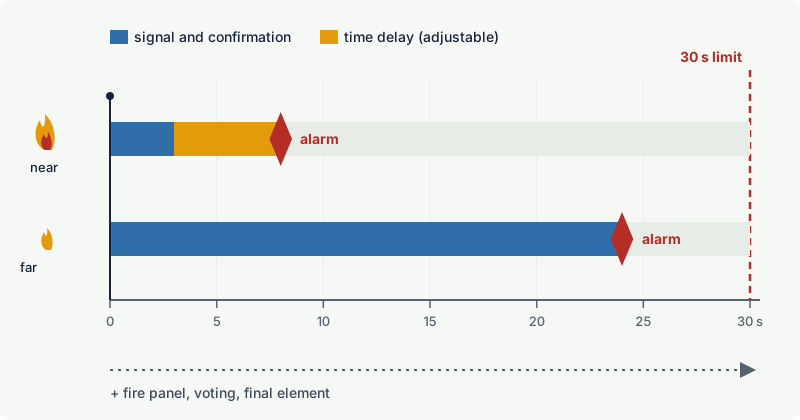
"Response time" on a datasheet is the time from the moment the flame is exposed to the detector until the detector's alarm output changes state, for a stated fire at a stated distance and sensitivity. It is built from several parts:
- Sensor response. UV tubes react within milliseconds, IR sensors within a fraction of a second.
- Signal processing. The algorithm must see flicker, the right spectral ratio and agreement between channels for a minimum time. This typically takes one to a few seconds.
- Adjustable time delay. Many detectors let the user add a delay to reject short events such as lightning or reflections.
- Output. Relay or current loop change, then the fire panel's own processing, and any voting logic with other detectors.
The 30 s limit in both standards applies to the detector, and the datasheet response time covers steps 1 and 2, sometimes 3. The time from ignition to an executive action, such as closing an emergency shutdown valve or releasing an extinguishing agent, also includes the panel, any voting delay and the final element. That total is what the fire and gas design must check.
Response time depends on distance
A detector does not have one response time. Close to the detector, the fire produces a strong signal and the processing confirms it quickly. Near the maximum rated distance, the signal barely exceeds the thresholds, and the detector needs longer to be sure. FM 3260 recognises this by asking for sensitivity as distance against average response time. A datasheet might therefore show a response of a few seconds at half the rated distance and a response approaching the 30 s limit at the full distance. A single headline figure such as "response under 5 s" usually refers to a short distance, a large fire or both.
Sensitivity: settings, classes and distance
Sensitivity is the property that converts into distance. As a rule of thumb, the radiant power reaching the detector from a small fire falls roughly with the square of the distance, so the detection distance for a different fire size scales with the square root of the fire area: four times the area gives about twice the distance, a quarter of the area about half. The relation is explained, with its limits, in flame detector placement and cone of vision.
Most industrial detectors offer several sensitivity settings, each with its own distance table. The setting used on site must be the one the coverage study assumed. Reducing sensitivity to cure nuisance alarms is a common and dangerous shortcut, because every distance in the layout shrinks with it (see false alarms in flame detectors).
Note: 12 in × 12 in is 0.093 m², which datasheets usually round to "1 ft² (0.1 m²)". EN 54-10's n-heptane fire is described as about 0.1 m². The difference in fire area changes the expected distance by only about 4 %, but the two figures still come from different test methods and should not be treated as interchangeable without reading the basis.
How to read a flame detector datasheet
The performance section of a datasheet is compact and easy to misread. Read every number with its conditions:
| Datasheet item | Questions to ask |
|---|---|
| "EN 54-10 Class 1" | At which sensitivity setting? Which class do the other settings reach? Is the certificate current? |
| "FM 3260 approved" | Which fuels and distances are in the approval, at which settings? Does the approval cover the version and options you are buying? |
| Detection distance, e.g. "60 m" | For which fuel, fire size, sensitivity setting and response time? On axis only? |
| Response time, e.g. "< 3 s" | At what distance and fire size? With or without the adjustable time delay? |
| Field of view, e.g. "90° horizontal" | Defined at 50 % of the on-axis distance (FM 3260 practice), or the full optical angle? Is there a separate vertical value and a polar diagram? |
| Fuel table | Is your fuel listed, at your sensitivity setting? Clean-burning fuels such as methanol usually give shorter distances than n-heptane, and carbon-free fuels such as hydrogen need specific data. |
| False alarm immunity | Which sources were tested, at what distance, and was the detector shown to still detect a fire in their presence? |
| Environment | Operating temperature range, ingress protection, window heating, optical self-test. |
| Ex marking and SIL | Separate certificates; check that they cover the same model and options. |
The approval listing or certificate, not the brochure, is the reference. Datasheets often quote the most favourable combination of fire, setting and distance; the approval documents state what was actually verified.
Practical case: does this detector cover the pump?
A designer must cover a pump in an outdoor process area. The fire hazard analysis sets a design fire of a 0.1 m² hydrocarbon pool fire anywhere around the pump, which is 30 m from the only practical mounting position and 40° off the detector's axis. Two candidate detectors:
- Detector A is listed as EN 54-10 Class 1 at its high setting. That shows it detects the standard n-heptane fire (about 0.1 m²) at the Class 1 distance, usually quoted as 25 m, within 30 s on axis. The class says nothing about 40° off axis, and 30 m exceeds 25 m.
- Detector B has an FM 3260 approval and a datasheet showing a 0.093 m² n-heptane pan at 50 m on axis at high sensitivity, average response 10 s, with a 90° field of view defined at the 50 % points.
For Detector B, the distance at the 45° edge of the field of view is at least 25 m, which is all the field-of-view definition guarantees. At 40° the manufacturer's polar diagram may show a value between 25 and 50 m; without it, the designer must assume 25 m. With 25 m against a required 30 m, the pump is not covered from that position. Moving the detector 10 m closer, aiming it more directly at the pump, or adding a second detector solves the problem. Detector A cannot be accepted on the class alone; it needs the manufacturer's directional data and a closer position.
The same design must also check the response time at the working distance against the time allowed for executive action, and confirm that the chosen sensitivity setting is the one the approval and the layout assume.
Common mistakes
- Comparing distances without the fire. "60 m" for a 0.1 m² n-heptane fire and "30 m" for a 0.25 m² alcohol fire describe different tests. Compare only like with like.
- Reading the class as a product property. The class belongs to a sensitivity setting. Check which setting is commissioned on site.
- Assuming the full range across the field of view. At the edge of an FM-style field of view the distance is half the on-axis value.
- Quoting the best response time for every distance. Response slows as the fire nears the maximum distance; at the limit it may approach 30 s.
- Treating Ex certification as performance proof, or the reverse. ATEX and IECEx address ignition risk only. EN 54-10 and FM 3260 address detection only.
- Lowering sensitivity after nuisance alarms without redoing the coverage. The detector still works, but it protects a much smaller area.
Frequently asked questions
What does Class 1 mean for a flame detector?
Under EN 54-10, Class 1 is the most sensitive class: at the setting tested, the detector responds within 30 s to the standard n-heptane and methylated spirit fires at the Class 1 distance, usually quoted as 25 m (17 m for Class 2, 12 m for Class 3). The class does not describe performance off axis or for other fuels.
What is the response time requirement of FM 3260?
FM 3260 requires the detector to initiate an alarm no later than 30 s after the initial exposure to the test fire at the declared distance. Manufacturers declare sensitivity as distance against average response time, so actual response at shorter distances is usually much faster.
Is FM 3260 the same as ANSI/FM 3260?
They are versions of the same standard. FM Approvals publishes its examination standard (October 2021 edition) and an American National Standard version, ANSI/FM 3260-2023, which lists the same type of test fires plus a JP4/Jet B pan fire.
Does EN 54-10 apply to industrial and offshore flame detectors?
EN 54-10 was written for fire detection systems in buildings, and it is the harmonised standard for CE marking flame detectors as construction products in the EU. Industrial and offshore projects often specify it together with FM 3260, the manufacturer's fuel-specific data and the project's own fire and gas mapping criteria.
Why does my flame detector datasheet give a 90° field of view but the coverage map shows less?
Under FM 3260 practice, the field of view is the angle at which the detection distance has fallen to 50 % of the on-axis value. A 90° field of view therefore means half the rated distance at 45° either side, and the coverage map correctly shows a lobe, not a full-range sector.
Related on excodex
- How flame detectors work: UV, IR, UV/IR and multi-spectrum IR
- Flame detector placement and cone of vision
- False alarms in flame detectors: common sources and how to avoid them
- Detecting hydrogen fires and other invisible flames
- Video and thermal imaging for flame and smoke detection
- Gas detection and functional safety: SIL for gas detection
- Ex marking check: /tools/ex, discussion in the forum
Standards and further reading
- EN 54-10:2002 + A1:2005, fire detection and fire alarm systems, point-type flame detectors: requirements, test methods and performance classes. Public sample of the 2002 text: https://cdn.standards.iteh.ai/samples/1815/1ac7cb6bfe1e4d2c8f159a899671a86a/SIST-EN-54-10-2002.pdf
- prEN 54-10 (2012 enquiry draft, later abandoned), showing the class table including the draft Class X: https://cdn.standards.iteh.ai/samples/37035/1c457b2e3d274d949f4ecda32143b01d/oSIST-prEN-54-10-2012.pdf
- ISO 7240-10:2012, fire detection and alarm systems, point-type flame detectors: https://www.iso.org/standard/57473.html
- FM 3260, examination standard for radiant energy-sensing fire detectors for automatic fire alarm signalling (October 2021): https://www.fmapprovals.com/-/media/Feature/Approval-Standards/3260-pdf.pdf
- ANSI/FM 3260-2023, American National Standard for radiant energy-sensing fire detectors: https://www.fmapprovals.com/-/media/Feature/Approval-Standards/3260ansi-pdf.pdf
- FM Approvals, how flame detectors are approved: https://fmapprovals.com/products-we-certify/understanding-the-benefits/fm-approved-flame-detection
- EN 54 series overview, harmonised status under the Construction Products Regulation: https://en.wikipedia.org/wiki/EN_54
- IEC 61508, functional safety of electrical/electronic/programmable electronic safety-related systems (for SIL claims on detectors).
This article is general technical information prepared by the excodex editorial team. It does not replace the applicable standards, the equipment certificates and instructions, national regulations or the assessment of a competent person.