Static electricity as an ignition source: charging, discharges and bonding
Abstract
Static electricity ignites solvents, gases and dusts when charge from flowing liquids, powders or people discharges as a spark, brush, propagating brush or cone discharge. How charge builds up, which discharges ignite what, and how bonding and flow control prevent it.
Static electricity becomes an ignition source when charge separated by flowing liquids, moving powders, belts or people builds up on something that cannot drain it to earth, and then discharges into an explosive atmosphere. A spark from an unearthed metal drum or a person can carry several to tens of millijoules, up to a hundred times more than most solvent vapours need. Prevention rests on three ideas: earth and bond every conductor, avoid or limit insulating materials, and slow down charge generation so that charge can relax before it accumulates.
This article explains how charge is generated, why conductivity and relaxation time decide whether it accumulates, which of the six discharge types can ignite gases, vapours and dusts, and the practical controls, following the guidance of IEC TS 60079-32-1.
Key points
- Static charge comes from separation of surfaces: liquid flowing along pipes and through filters, powder sliding through chutes and conveying lines, belts on pulleys and people walking on insulating floors.
- Liquids are grouped by conductivity: low (up to 50 pS/m), medium (50 to 10,000 pS/m) and high (above 10,000 pS/m). Low-conductivity liquids such as toluene, xylene, petrol and diesel accumulate charge; alcohols and ketones normally do not.
- The relaxation time τ = εr·ε0/κ sets how fast a liquid loses charge: about 18 s for a hydrocarbon of 1 pS/m, a few milliseconds or less for alcohols.
- Spark, brush, propagating brush and cone discharges can ignite flammable gases and vapours; brush discharges are not considered able to ignite dust clouds, while sparks, propagating brush and cone discharges can.
- Earthing and bonding remove charge from conductors: a resistance to earth of up to 10⁶ Ω is generally enough, but bonding cannot drain charge from an insulating liquid, powder or plastic.
- In Zones 0, 1 and 20, people must be earthed through conductive footwear and floors, with a person-to-earth resistance of no more than 10⁸ Ω in German guidance (TRGS 727).
The guidance documents
IEC TS 60079-32-1 (electrostatic hazards, guidance) is the international reference: a technical specification from 2013, amended in 2017, with a revision in preparation. Test methods are in IEC 60079-32-2, and NFPA 77 is the US counterpart. Because the IEC text is not freely available, the numbers in this article come from the German technical rule TRGS 727 (2016), which is published openly and uses the same physical approach. Directive 1999/92/EC requires electrostatic discharges to be considered explicitly in the workplace risk assessment.
How static charge is generated
When two materials touch and separate, charge moves from one to the other. If at least one is a poor conductor, the charges stay separated. This contact charging happens at every solid-liquid and solid-solid interface; pure gases are not charged, but the droplets and particles they carry are.
Liquids charge as they flow along pipe walls, pass pumps and valves, are stirred, sprayed or splashed. Turbulent flow charges much more than laminar flow, and the charge grows with velocity. Fine filters are the strongest generators: TRGS 727 gives typical charge densities of about 10 µC/m³ in pipe flow, about 100 µC/m³ after dirty screens and 5,000 µC/m³ or more after a microfilter. A second phase, such as water droplets or solids in a hydrocarbon, increases charging greatly. Spraying and jetting can charge even conductive liquids such as water, which is why steam and high-pressure water cleaning of tanks needs its own limits.
Powders charge as they are sieved, poured, ground and conveyed. The more energetic the process, the more charge per kilogram:
| Process | Typical specific charge (µC/kg) |
|---|---|
| Sieving | 10⁻⁵ to 10⁻³ |
| Pouring | 10⁻³ to 1 |
| Screw conveying | 10⁻² to 1 |
| Grinding | 10⁻¹ to 1 |
| Micronising | 10⁻¹ to 10² |
| Pneumatic conveying | 10⁻¹ to 10³ |
Values from TRGS 727, Annex A.
People charge by walking, standing up from a seat and taking off clothing, especially on insulating floors or in insulating footwear. Belts and plastics charge by friction: conveyor and drive belts, plastic sheets and liners, packaging films being unrolled.
Why some materials hold charge: conductivity and relaxation time
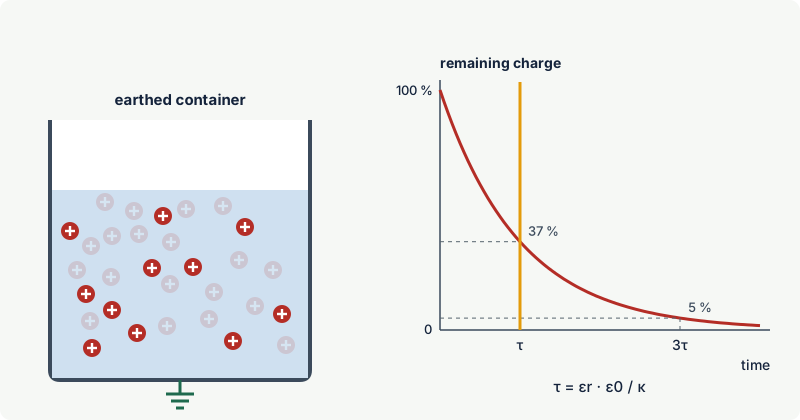
Charge is only dangerous if it accumulates: in an earthed conductor it flows away almost instantly, in an insulator it stays. For a liquid in an earthed metal tank, the charge decays exponentially with the relaxation time
τ = εr · ε0 / κ
where εr is the relative permittivity of the liquid (about 2 for hydrocarbons), ε0 = 8.85 × 10⁻¹² F/m, and κ the conductivity in S/m. After one τ about 37 % of the charge remains, after three τ about 5 %.
| Conductivity class | Range (pS/m) | Examples (TRGS 727, Annex F) | Typical relaxation time |
|---|---|---|---|
| Low | up to 50 (100 for non-hydrocarbons) | Cleaned aromatics such as toluene and xylene; petrol; diesel; kerosene | about 0.4 s to several minutes |
| Medium | 50 to 10,000 | Some esters; hydrocarbons with antistatic additive | a few milliseconds to about 0.4 s |
| High | above 10,000 | Ethanol, methanol, acetone, water | a few milliseconds or less |
Published conductivities depend strongly on purity, so they are indicative only; a liquid used in very pure form must be expected to have a lower conductivity. TRGS 727 advises treating pure hydrocarbons as insulating. A low-conductivity liquid can hold enough charge to produce an incendive discharge inside a tank even when the tank, pipes and pump are perfectly earthed, because the charge sits in the liquid itself, not on the metal.
Powders behave the same way, with volume resistivity taking the place of conductivity. Highly insulating plastic granules and many organic powders hold charge for a long time, particularly in a dust cloud, where the charge cannot reach a wall at all.
The six types of electrostatic discharge
The type of discharge depends on what holds the charge and how it is released. That decides which atmospheres it can ignite.
| Discharge | Where it occurs | Gases and vapours | Dust clouds |
|---|---|---|---|
| Spark | Between two conductors, one of them charged and not earthed (drum, flange, tool, person) | Yes | Yes |
| Corona | At sharp points and edges of earthed conductors in a strong field | Generally no: its energy density is far lower than that of a spark | No |
| Brush | Between a charged insulating surface, or charged liquid surface, and an earthed conductor brought close | Yes, most gases and vapours | Not under normal conditions |
| Propagating brush | Across a thin insulating layer charged on both sides, backed by a conductor (lined pipes, coated walls, FIBC fabric) | Yes | Yes, energy can reach 1 J or more |
| Cone (bulking brush) | On the surface of a charged powder heap in a silo or large container during filling | Yes | Yes |
| Lightning-like | In very large charged dust clouds | Yes | Yes; not observed in vessels below 100 m³ or 3 m diameter |
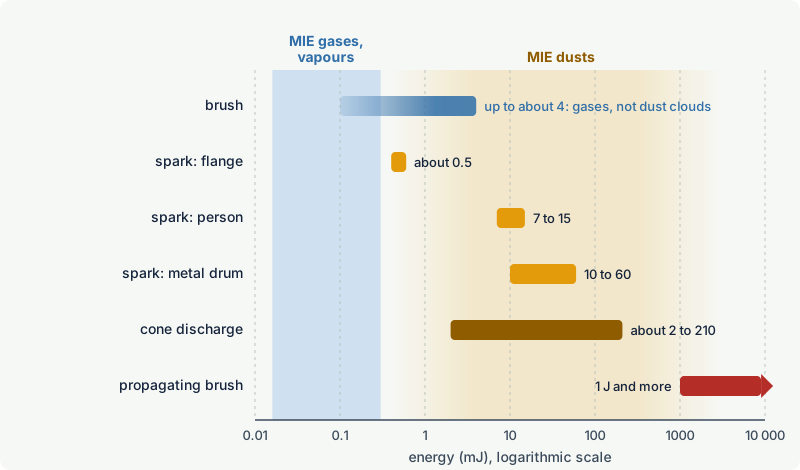
Spark discharges release the energy stored on an isolated conductor, E = ½·C·U². TRGS 727 gives typical values: a flange 10 pF at 10 kV, about 0.5 mJ; a metal drum of 200 to 500 litres 50 to 300 pF at 20 kV, 10 to 60 mJ; a person 100 to 200 pF at 12 kV, 7 to 15 mJ. These are example calculations with the stated capacitance and voltage; for a person the result is of the order of 10 mJ or more. Every one of these is above the minimum ignition energy of typical solvent vapours (about 0.2 to 0.3 mJ, see flash point, autoignition temperature and minimum ignition energy).
Brush discharges are judged by the charge they transfer rather than by energy. Ignition tests with propane mixtures put their equivalent energy at about 1 to 4 mJ: enough to ignite most flammable gases and vapours, yet in practice they do not ignite dust clouds. TRGS 727 sets maximum transferred charges for Zones 1 and 2 of 60 nC for IIA, 25 nC for IIB and 10 nC for IIC; in Zone 0 the limits are 25 nC for IIA and 10 nC for IIB, and for IIC no detectable discharge is allowed. They are the reason for limits on insulating surfaces in gas zones.
Propagating brush discharges need a thin insulating layer (less than about 9 mm) with a breakdown voltage above about 4 kV, charged to a high surface charge density, typically by pneumatic conveying or fast-moving belts. They are bright, loud and energetic. Keeping the breakdown voltage of linings and coatings at 4 kV or below (6 kV for fabrics) prevents them.
Cone discharges grow with the vessel diameter and the particle size. TRGS 727 gives an empirical estimate for metal silos of 0.5 to 3 m diameter, W ≈ 5.22 · d^3.36 · g^1.46 mJ (d in m, median grain size g in mm). For a 3 m silo filled with 1 mm granules this gives about 210 mJ. They are especially dangerous when coarse insulating granules carry the charge and fine dust or solvent vapour provides the sensitive atmosphere.
Controlling static: what works
Earthing and bonding of conductors
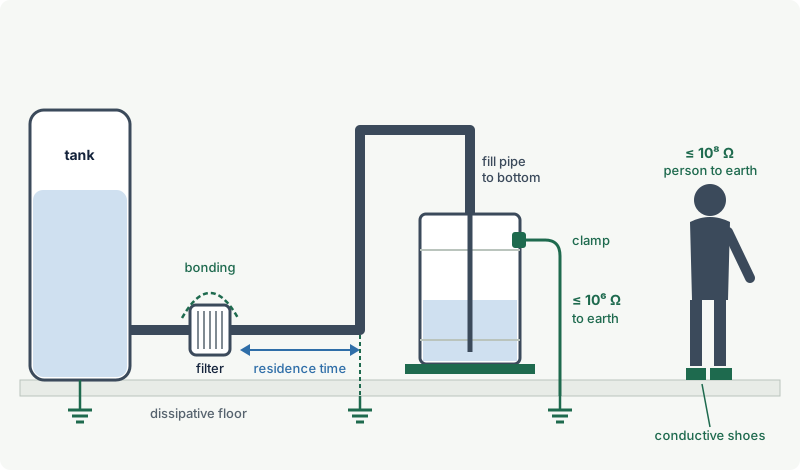
Bonding connects conductive parts to each other; earthing connects them to earth. Together they keep every conductor at earth potential, so no spark can jump. TRGS 727 states that a resistance to earth of up to 10⁶ Ω is generally sufficient, and up to 10⁸ Ω where the charging current is below 10⁻⁶ A and the capacitance below 100 pF. In practice, a far lower value, often 10 Ω, is used as the test limit for all-metal bonding paths, because a higher reading in metal indicates a loose or corroded connection.
Rules that matter in practice:
- Earth every conductive object with a capacitance above about 10 pF that can be charged, including mobile items such as drums, funnels, hose nozzles, sample cans and loose pipe spools.
- Connect earthing clamps before transfer starts and remove them only after charge has relaxed. Clamps must bite through paint, rust and coatings, and should be visible and easy to check.
- Use earth monitoring with interlocks for road tankers, rail cars and IBC filling, so that pumping cannot start without a verified connection.
- Bridge insulating flanges, gaskets, sight glasses and plastic sections, or earth each metal part individually. See earthing, bonding and equipotential bonding in hazardous areas.
Liquids
Earthing alone does not protect against charge in a low-conductivity liquid. The controls act on generation and relaxation:
- Velocity. Fill large tanks at no more than 1 m/s until the fill pipe outlet is covered by about twice its diameter; for clean single-phase liquids in fixed-roof tanks, up to 7 m/s afterwards. Liquids with a second phase (water, solids) stay at 1 m/s. For road tankers and smaller tanks, TRGS 727 uses a velocity-times-diameter limit instead.
- Relaxation after filters. Allow residence time between a filter and the receiving tank: at least three relaxation times if the conductivity is known, otherwise at least 30 s after coarse filters and 100 s after fine filters (pore size below 10 µm).
- No splash filling. Fill pipes should reach the bottom of the container; top filling with a free-falling jet generates charge and mist.
- Conductivity additives. Antistatic additives in the ppm range can lift hydrocarbons above 50 pS/m, as is done for aviation fuels.
- Waiting times. Do not dip, sample or gauge a tank of low-conductivity liquid during filling or just after it. TRGS 727 asks for at least 30 minutes with two-phase liquids. Metal parts that float or hang in the liquid, such as level floats, must be bonded to the tank.
- Inerting. Where none of the above is practicable, remove the explosive atmosphere instead (see explosion protection strategy).
Powders and bulk solids
- Use conductive, earthed equipment for conveying, and choose pneumatic conveying hoses with defined resistivity and earthed helix wires.
- Choose flexible intermediate bulk containers (FIBCs) by type: type A has no static protection and is generally unsuitable in hazardous areas; type B has fabric with low breakdown voltage to prevent propagating brush discharges; type C is conductive and must be earthed during filling and emptying; type D is dissipative and works without an earth connection, provided people and conductive objects nearby are earthed. TRGS 727 allows only types C or D for dusts with an MIE of 3 mJ or less.
- Never pour powder from insulating plastic bags into a vessel containing flammable solvent. Charge on the bag and on the falling powder can ignite the vapour by brush or spark discharge. Use closed charging under nitrogen, or conductive or dissipative packaging, earthed chutes and operators, and a limited pouring rate (TRGS 727 states less than 1 kg/s).
- Silo filling with coarse insulating granules needs an assessment for cone discharges; inerting or limiting the vessel size are common answers.
Insulating materials in gas zones
Insulating surfaces cannot be earthed, so their size is limited instead. TRGS 727 gives maximum projected areas for objects in Zone 0 of 50, 25 and 4 cm² for IIA, IIB and IIC, and in Zone 1 of 100, 100 and 20 cm². Insulating coatings on earthed metal must stay below 2 mm thick for IIA and IIB substances and 0.2 mm for IIC. In Zone 2 measures are needed where experience shows incendive discharges occur. These limits do not hold near strong charge generation such as fast liquid flow or pneumatic conveying.
People
In Zones 0, 1 and 20 (and in Zone 21 for dusts with MIE of 10 mJ or less), TRGS 727 requires conductive footwear with a person-to-earth resistance of no more than 10⁸ Ω, on a floor that is itself dissipative (below 10⁸ Ω). Safety shoes typically range from 10⁵ to 10⁹ Ω, and those between 10⁸ and 10⁹ Ω are not suitable, so the type must be specified and checked. Gloves must not be insulating. Clothing should not be put on or taken off in Zones 0 and 1, and in Zone 0 or with IIC gases only conductive clothing should be worn.
Humidity and ionisers
High relative humidity makes many surfaces slightly conductive, and ionisers can neutralise charge on films and webs. Both only support other measures: they fail with strongly charging processes, warm products, large powder volumes and low-conductivity liquids. TRGS 727 does not accept humidity as the only measure in Zone 0, does not allow active ionisers in Zone 0 or with IIC gases, and requires ionisers to be checked regularly.
Worked example: filling a drum with toluene
A 200 litre metal drum is filled with toluene (flash point 4 °C, so explosive vapour is present at room temperature) through a 1 µm cartridge filter. The drum stands on a plastic pallet.
The spark hazard. Isolated on the pallet, the drum has a capacitance of the order of 50 to 300 pF. Charged to 10 kV, a drum of 200 pF stores E = ½ × 200 × 10⁻¹² × (10⁴)² = 0.01 J, or 10 mJ, about 40 times the MIE of toluene vapour (about 0.24 mJ). A spark to the filling nozzle or to an operator's hand would very likely ignite the vapour at the opening. Earthing the drum removes this hazard.
The liquid hazard. Toluene is a low-conductivity liquid. With κ = 1 pS/m and εr ≈ 2, τ = 2 × 8.85 × 10⁻¹² / 10⁻¹² ≈ 18 s. The microfilter loads the liquid with charge that an earthed drum cannot remove quickly. A residence time of 100 s between filter and drum leaves about e^(-100/18), roughly 0.4 %, of the charge. Without it, a brush discharge from the charged liquid surface to the fill nozzle or a dip tube is possible even in an earthed drum.
The controls. Earthed metal drum on an earthed plate with a clamp connected before filling; bonded filling line and nozzle; fill pipe to the bottom of the drum; filling at low velocity until the pipe outlet is covered; enough pipe volume or a relaxation vessel downstream of the filter; operator in conductive footwear on a dissipative floor; no sampling or dipping until the charge has relaxed.
What the Barton Solvents explosion showed
On 17 July 2007, a 15,000 gallon storage tank exploded during filling with VM&P naphtha, a non-conductive solvent, at a chemical distribution facility in Valley Center, Kansas. About 6,000 residents were evacuated and the facility was destroyed. The US Chemical Safety Board concluded that stop-and-start filling introduced air and turbulence, that a metal level float accumulated charge, and that a spark likely jumped across a loose linkage between the float and its tape into the flammable vapour-air mixture in the tank. The transfer equipment was likely properly bonded and earthed. The lesson: for low-conductivity liquids, bonding and earthing are necessary but not sufficient; filling practice, internal fittings and the vapour space must be controlled too.
Common mistakes
- "The system is earthed, so static is controlled." Earthing drains conductors, not insulating liquids, powders or plastics.
- Plastic containers and funnels in Zone 1. Insulating items charge by handling and pouring and cannot be earthed; use conductive or dissipative ones.
- Sampling or dipping straight after filling. The liquid surface can still be charged; wait for relaxation.
- Removing the earthing clamp too early, or fitting it late. A clamp attached to an already charged drum can itself cause the spark.
- Pouring powder from a plastic bag into a solvent vessel. One of the most frequent static ignition scenarios in chemical and pharmaceutical plants.
- Relying on humidity. It helps with some surfaces but does nothing for low-conductivity liquids and strongly charging processes.
Frequently asked questions
What is the difference between bonding and earthing?
Bonding connects conductive objects to each other so no spark can pass between them; earthing (grounding) connects them to earth so the charge drains away. Static control normally needs both.
What resistance is acceptable for static earthing?
German guidance (TRGS 727) states that up to 10⁶ Ω to earth is generally enough to drain static charge, and up to 10⁸ Ω under favourable conditions. For all-metal bonding paths a much lower value, often 10 Ω, is used as a test limit because it shows the metal connections are intact.
Which liquids are static accumulators?
Liquids with a conductivity of up to about 50 pS/m: most purified hydrocarbons such as toluene, xylene, hexane, heptane, petrol, diesel and kerosene. Alcohols, ketones and water are conductive enough to lose charge almost instantly when in earthed containers, but they can still be charged when sprayed.
Can a brush discharge ignite a dust cloud?
Under normal atmospheric conditions, brush discharges are not considered able to ignite dust-air mixtures. They can ignite most flammable gases and vapours, which is why solvent-wet powders and hybrid mixtures need the stricter controls of gas zones.
Why is filling velocity limited at the start of tank filling?
Until the fill pipe outlet is submerged, the incoming liquid splashes and stirs up any water or sediment, which generates much more charge. Limiting the velocity to about 1 m/s during this phase keeps charging low while the vapour space is most likely to be flammable.
Related on excodex
- Ignition sources in hazardous areas: the 13 ignition sources
- Flash point, autoignition temperature and minimum ignition energy
- Earthing, bonding and equipotential bonding in hazardous areas
- Hybrid mixtures: when flammable gas and combustible dust are present together
- Pharmaceutical and chemical plants: solvent handling, powders and Ex equipment
- Tools and spaces: gas and solvent library, EN 1127-1, ATEX 1999/92/EC, forum
Standards and further reading
- IEC TS 60079-32-1:2013 with Amendment 1:2017, explosive atmospheres, electrostatic hazards, guidance (consolidated edition available): webstore.iec.ch
- IEC 60079-32-2, electrostatic hazards, test methods
- IEC 61340-4-4, electrostatic classification of flexible intermediate bulk containers (FIBC)
- NFPA 77, recommended practice on static electricity
- EN 1127-1, explosion prevention and protection, basic concepts (static electricity as an ignition source)
- German technical rule TRGS 727 (2016), avoidance of ignition hazards due to electrostatic charges: discharge types, Annex A, liquids, section 4, bulk materials, section 6, earthing, section 8
- Directive 1999/92/EC, Article 4 and Annex II (electrostatic discharges in the risk assessment): legislation.gov.uk
- M. Glor and K. Schwenzfeuer, Direct ignition tests with brush discharges, Journal of Electrostatics 63 (2005) 463 to 468 (equivalent energy of brush discharges, non-incendivity for dust clouds): sciencedirect.com
- US Chemical Safety Board, Barton Solvents explosions and fire, Valley Center, Kansas (2007): csb.gov
This article is general technical information prepared by the excodex editorial team. It does not replace the applicable standards, the equipment certificates and instructions, national regulations or the assessment of a competent person.