Pressurisation (Ex p): px, py and pz, purging and protective gas
Abstract
Pressurisation (Ex p) keeps gas or dust out of an enclosure with air or inert gas at overpressure. Levels pxb, pyb and pzc, purging before power-on, 50 Pa and 25 Pa minimums, leakage compensation vs continuous flow, and when pressure loss must trip the power.
Pressurisation, type of protection "p", keeps an explosive atmosphere out of an enclosure by filling it with clean air or inert gas held slightly above the outside pressure: at least 50 Pa for levels pxb and pyb and 25 Pa for pzc. Before the power is switched on, the enclosure is purged with a measured quantity of protective gas to flush out any gas that entered while it was off, and a safety device then watches the overpressure. Level pxb lets ordinary equipment work in Zone 1, pyb lets Zone 2 equipment work in Zone 1, and pzc lets ordinary equipment work in Zone 2.
This article explains the principle, the three levels, how the purge is set, the protective gas, leakage compensation versus continuous flow, and what must happen when pressure is lost.
Key points
- Ex p works by segregation: protective gas at an overpressure of at least 50 Pa (pxb, pyb) or 25 Pa (pzc), at every point where leakage can occur, stops the outside atmosphere getting in.
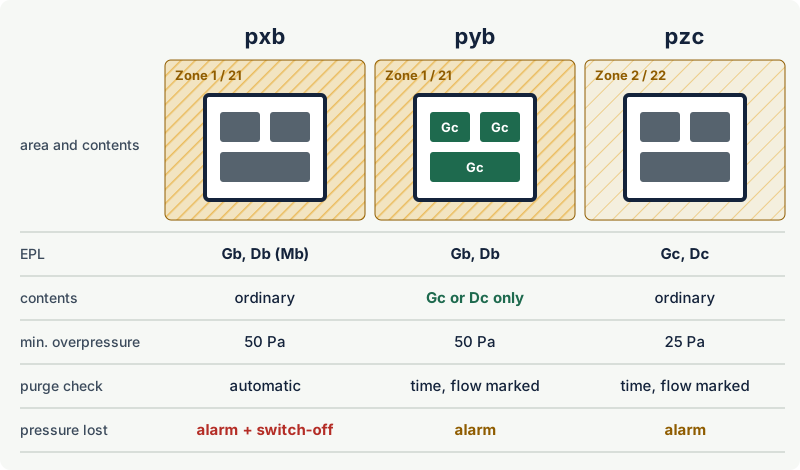
- Level pxb (EPL Gb or Db, and Mb for mines) allows ordinary, non-Ex equipment inside; pyb (EPL Gb or Db) allows only equipment that is already EPL Gc or Dc; pzc (EPL Gc or Dc) allows ordinary equipment in Zone 2 or 22.
- A gas enclosure must be purged before power is applied; where the manufacturer has not set the purge by test, the usual basis is five enclosure volumes of protective gas, plus external ducts.
- Level pxb needs an automatic purge sequence: power is released only after outlet flow and overpressure have been proven for the full purge time.
- After purging, pressure is held by leakage compensation (gas replaces leaks only) or by continuous flow, which is needed for cooling or to dilute an internal release such as an analyser.
- If pressure is lost in a Zone 1 location and the enclosure holds ordinary equipment, the minimum action is alarm and automatic switch-off; with ordinary equipment in Zone 2, or with contents already EPL Gc in Zone 1, an alarm followed by immediate action is the minimum.
- Purging cannot remove dust: Group III pressurised enclosures must be cleaned inside before power is restored after opening.
How pressurisation works
As long as the internal pressure is higher than the outside pressure, any leakage at doors, glands and seals flows outwards, so gas or dust from the surroundings cannot reach the equipment inside. That is why pressurisation lets equipment with no Ex protection of its own (control panels, computers, analysers, large motors) work in a hazardous area.
The overpressure is small: 50 Pa is 0.5 mbar, about 5 mm of water column. What makes the concept work is the discipline around it: the enclosure is flushed before use, the pressure is monitored all the time, and a defined action follows if it is lost.
The equipment standard is IEC 60079-2, currently the sixth edition (2014, with a 2015 corrigendum); a seventh edition reached the committee draft for vote stage in 2026. Rooms and analyser houses that people enter are covered by IEC 60079-13, see pressurised rooms and analyser houses.
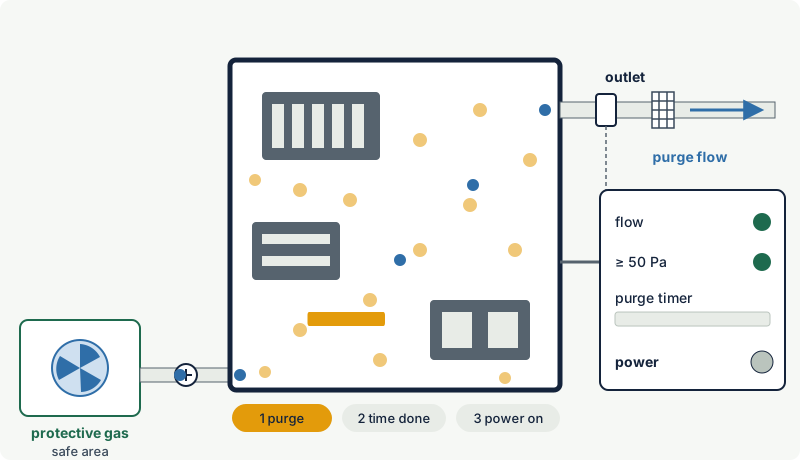
Every pressurised system runs through three phases:
- Purge. Protective gas flows through the enclosure and out of an outlet until any flammable gas inside is diluted to a safe level. Power stays off.
- Pressurise. The outlet flow is reduced or closed, the overpressure is held, and the equipment may be switched on.
- Monitor. A pressure sensor, and where needed a flow sensor, watches the protective gas and acts if it falls below the set minimum.
The temperature class needs care. For pxb and pyb it is based on the hotter of the outside surface and the hottest internal component, because if pressurisation fails, gas reaches hot parts before they cool. A pxb enclosure may contain hotter parts only if they qualify as small components or if the design meets the cool-down rules: a marked delay before opening and measures that keep gas away from the hot part while it cools. For pzc the external surface sets the temperature class.
Levels of protection: pxb, pyb and pzc
The choice of level depends on the EPL the location requires, on whether the equipment inside can ignite gas in normal operation, and on whether there is an internal source of release.
| pxb | pyb | pzc | |
|---|---|---|---|
| EPL provided | Gb or Db (Mb in mines) | Gb or Db | Gc or Dc |
| Typical location | Zone 1 or 21 | Zone 1 or 21 | Zone 2 or 22 |
| Equipment allowed inside | Any, including sparking and hot equipment | Only EPL Gc or Dc or better; no hot ignition-capable parts | Any |
| Minimum overpressure | 50 Pa | 50 Pa | 25 Pa |
| Purge verification (gas) | Automatic: timer, outlet flow sensor, pressure sensor | Purge time and flow marked | Purge time and flow marked |
| Pressure loss detected by | Automatic safety device | Automatic safety device | Automatic safety device, or an indicator plus an alarm on the gas supply |
| Doors opened without a tool | Interlocked to cut power | Warning label | Warning label |
| Minimum enclosure IP | IP4X | IP4X | IP4X (IP3X with an alarm) |
The safety devices (pressure switches, flow sensors, control unit) must be Ex protected or mounted outside the hazardous area. For pxb and pyb their control logic must stay safe with a single fault; for pzc, normal operation is the design basis.
Older names. Before 2014 the levels were px, py and pz, and dust pressurisation was a separate type "pD" (IEC 61241-4). Typical markings today are Ex pxb IIC T4 Gb or, for Zone 22, Ex pzc IIIC T135 °C Dc. See how to read an Ex marking.
pyb reduces the inside of a Zone 1 enclosure to Zone 2 conditions, so the contents must be suitable for Zone 2 on their own, for example Ex ec, Ex nR or Ex ic items. Because they still do not ignite gas in normal operation if pressure is lost, pyb needs no automatic purge control and no door interlock.
Purging: removing the gas before power is applied
While the power is off, the enclosure breathes as it cools and warms, and gas in the area gets in; the same happens when a door is opened. For pxb, IEC 60079-2 requires an automatic sequence:
- Outlet flow and overpressure are monitored from the start.
- The purge timer starts only when the minimum purge flow is reached and the pressure is within limits.
- When the timer expires, the equipment may be energised.
- Any failure during the sequence resets it to the beginning.
For pyb and pzc the purge may be manual; a label then states that power must not be restored after opening until the enclosure has been purged for a given time at a given flow. Purge flow is proven at the outlet. For pxb the actual flow is measured; for pyb and pzc it may be deduced, for example from the enclosure pressure and a calibrated outlet orifice.
How much purge is enough
The manufacturer specifies the minimum purge flow and time, by one of two routes:
- By test. The enclosure is filled with test gas to at least 70 % and purged at the minimum flow while samples are taken where gas is most likely to linger. To cover all gases, helium (light) must fall to 1 % or less and argon or carbon dioxide (heavy) to 0.25 % or less, roughly 25 % of the lower flammable limit (LFL) of light and heavy gases. With inert protective gas, the criterion is 2 % oxygen or less.
- By five volumes. For pxb and pyb the purge may be based on five enclosure volumes without a test where that is judged adequate; for pzc five volumes is the default and can be reduced only by test. This does not apply to rotating machines or complex internal geometries, where pockets can trap gas.
"Enclosure volume" means the empty enclosure (for a rotating machine, free volume plus rotor), so the rule errs on the safe side. Ducts that are not part of the certified equipment are the user's responsibility: extend the purge to pass at least five times their free volume at the minimum flow.
For dust (Group III), purging does not work: blowing air does not remove settled dust and may raise a cloud. Instead, the enclosure carries a warning that dust inside must be removed before power is restored after opening.
Worked example: purge time for a cabinet and its duct
A pxb cabinet measures 1.0 m × 0.8 m × 0.5 m inside. Its certificate allows a five-volume purge at the manufacturer's minimum purge flow of 100 L/min. Air comes from a fan in the safe area through 12 m of 100 mm duct that is not part of the certified equipment.
- Enclosure: 1.0 × 0.8 × 0.5 = 0.40 m³ = 400 L. Five volumes = 2,000 L. At 100 L/min: 20 min.
- Duct: π × (0.05 m)² × 12 m ≈ 0.094 m³ = 94 L. Five volumes ≈ 470 L: about 5 min more.
- Purge timer: at least 25 min at a proven outlet flow of at least 100 L/min.
If the certificate gives a tested purge time instead, use that time and add the duct allowance.
Protective gas: air or inert gas
The protective gas must be non-flammable: in practice instrument-quality air or nitrogen. For the standard, inert gas means nitrogen, carbon dioxide, argon or a similar gas that does not make the flammability of a mixture more onerous. Oxygen-enriched gas is outside the scope of IEC 60079-2.
- Intake. Except for gas from cylinders, the intake should be in a non-hazardous area. Intake ducting should not pass through a hazardous area; if it does and runs below atmospheric pressure (suction side of a fan), it must be leak-free, or it will draw gas in.
- Temperature. Normally no more than 40 °C at the enclosure inlet; any other value is marked.
- Supply. The blower or compressor should be fed from a separate source or from the supply side of the enclosure isolator, so isolating the enclosure does not stop its purge. A backup supply is optional; each source must be able to hold the pressure alone.
- Inert gas hazard. A nitrogen-filled enclosure is an asphyxiation hazard. A warning is required, and the enclosure should be flushed with air before doors are opened.
Leakage compensation, continuous flow and static pressurisation
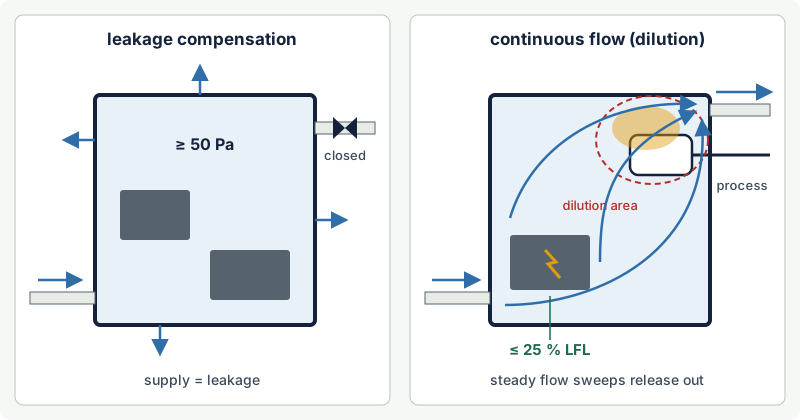
After purging, the overpressure can be held in three ways.
Leakage compensation. The outlet closes and the supply provides only enough gas to replace leaks from the enclosure and its ducts. It uses little gas and suits most control cabinets. The manufacturer states the maximum leakage rate; check it against the supply capacity on site.
Continuous flow. Gas flows through the enclosure all the time. It is needed for:
- Cooling. If the contents would exceed the temperature class without a minimum flow, that flow is part of the protection, and an automatic safety device must act when outlet flow falls below the minimum.
- Dilution. Analysers and sampling systems bring flammable gas into the enclosure through a containment system. Any release must be diluted so that, outside a small dilution area around the release point, the concentration stays at or below 25 % of the LFL with air as protective gas, or the oxygen content at or below 2 % with inert gas.
Static pressurisation. The enclosure is filled with inert gas in a non-hazardous area and used without any further supply. It is allowed only with inert gas and no internal release; pxb and pyb versions need two automatic pressure safety devices, and an enclosure that loses pressure goes back to a safe area to be refilled.
The rules for internal releases depend on the substance:
- A liquid release always needs inert protective gas, and no release in normal operation is allowed.
- A substance with an upper flammable limit above 80 %, such as acetylene (UEL 100 % in the excodex library), can burn with very little oxygen. Inert gas cannot protect it: it must be diluted with air to 25 % of the LFL, and leakage compensation is not acceptable.
- Leakage compensation with an internal release needs inert gas, no normal release, an upper flammable limit of 80 % or less and no more than 2 % oxygen in the flammable substance.
- Equipment inside the dilution area must carry its own EPL: Ga or Gb where the release is abnormal, Ga where it occurs in normal operation (Gc is also accepted for an abnormal release in a pzc enclosure).
Worked example: dilution flow for a gas analyser
An analyser receives methane through a flow restrictor that limits the worst-case release into the enclosure to 2 L/min. Methane's LFL is 4.4 % by volume, so 25 % of the LFL is 1.1 %. With perfect mixing, 2 / (2 + Q) ≤ 0.011, so the protective air flow Q must be at least about 180 L/min.
Real enclosures do not mix perfectly, so certification relies on a dilution test. On site, the manufacturer's minimum continuous flow, monitored at the outlet, is what counts; the estimate shows whether the air supply can deliver it.
Alarm or disconnection: what happens when pressure is lost
IEC 60079-2 requires the safety devices but leaves the use of their signal to the user. IEC 60079-14 sets the minimum action from the EPL required at the location and from whether the contents are safe without pressurisation. For enclosures without an internal release, the logic is:
| Location requires | Contents not suitable for EPL Gc without pressurisation (ordinary equipment) | Contents meet EPL Gc without pressurisation |
|---|---|---|
| EPL Gb (Zone 1) | Alarm and automatic switch-off | Alarm |
| EPL Gc (Zone 2) | Alarm | No action required |
In Zone 1 gas is expected at some time, so exposed ordinary equipment must be switched off at once. In Zone 2, or with Zone 2 equipment inside, ignition needs a further independent failure, so an alarm is enough. Check the edition that applies to your project, and note:
- An alarm must lead to immediate action: restore the protective gas or switch off. An alarm nobody acts on is not protection.
- If switch-off would create a greater danger, for example by stopping a critical control system, other measures are needed, such as a duplicated gas supply.
- Equipment that stays energised when pressure is lost (anti-condensation heaters, clocks) must itself suit the location: at least EPL Gb for pxb and pyb and at least Gc for pzc (Db and Dc for dust).
- Override or maintenance switches may be used only while the area is assessed as gas-free, in practice confirmed with gas detection; if gas is detected, switch off and repurge.
- A running fan is not proof of pressure. A slipping belt or a fan turning backwards leaves the motor running without pressure, so the sensor must take its signal directly from the enclosure, with no valve in between.
Installation and inspection points
- Certify the whole assembly. A certified purge controller fitted to an uncertified cabinet does not make the cabinet or its contents certified.
- Read the X conditions. If the manufacturer does not supply the safety devices, or the flow limiter for an analyser, the certificate carries an "X" listing what the user must provide. See the X and U suffixes.
- Outlets. Discharge to a non-hazardous area where possible. An outlet that discharges into a location requiring EPL Gb (Zone 1) needs a spark and particle barrier; into a location requiring EPL Gc (Zone 2) it needs one when the contents can produce ignition-capable sparks or particles in normal operation.
- Keep the layout. New equipment, heat sources or partitions inside can create pockets the purge no longer clears; treat them as modifications.
- Test the functions at commissioning and at the intervals set under IEC 60079-17: set points, purge timing, door interlocks, alarms, switch-off, seals, filters and sensing lines.
Common mistakes
- Shortening the purge because "the door was only open briefly". The purge time is part of the certification.
- Forgetting the ducts. The certified purge covers the enclosure only; external ducts must be added.
- Leaving the bypass key in. A permanent override turns a pxb enclosure into an unprotected cabinet.
- Putting ordinary equipment in a pyb enclosure. pyb is valid only if every item inside is at least EPL Gc or Dc.
- Trying to purge dust. In Zone 21 or 22, dust inside the enclosure must be cleaned out before power is restored.
- Opening a nitrogen-filled enclosure straight away. The inside is not breathable; flush it with air first.
Frequently asked questions
What is the minimum overpressure for Ex p?
IEC 60079-2 requires at least 50 Pa (0.5 mbar) for pxb and pyb and at least 25 Pa for pzc, relative to the outside, at every point of the enclosure and its ducts where leakage can occur. The manufacturer also states a maximum overpressure, which the enclosure is tested against.
What is the difference between px, py and pz?
They are the older names of pxb, pyb and pzc. px makes the inside of a Zone 1 enclosure non-hazardous so ordinary equipment can be used; py reduces it to Zone 2 conditions, so only Zone 2 equipment may be inside; pz makes the inside of a Zone 2 enclosure non-hazardous. The letters b and c, added in 2014, show the EPL.
How long does a pressurised enclosure need to be purged?
As long as the manufacturer specifies at the minimum purge flow, plus an allowance for external ducts. Without a test, the usual basis is five enclosure volumes: 20 minutes for a 400 L enclosure at 100 L/min. The purge restarts from zero if flow or pressure fails during it.
Can a pressurised enclosure be used in Zone 0?
No. Pressurisation gives at most EPL Gb, suitable for Zone 1 and Zone 2. IEC 60079-2 has no level for EPL Ga, so Zone 0 needs another concept such as intrinsic safety ia.
Is Ex p the same as Type X, Y and Z purging?
The idea is the same. In North America, NFPA 496 uses Type X (Division 1 to non-hazardous), Type Y (Division 1 to Division 2) and Type Z (Division 2 to non-hazardous), which correspond broadly to pxb, pyb and pzc. Requirements and approvals differ, so certification under one system is not automatically accepted under the other. See zones vs divisions.
Does a pressurised enclosure need a gas detector?
Not for normal operation: purge and pressure monitoring are the protection. Gas detection matters when an override is used and for pressurised rooms and analyser houses under IEC 60079-13. The draft seventh edition of IEC 60079-2 states that using gas detection to skip purging is outside its scope.
Related on excodex
- Ex protection concepts at a glance
- Pressurised rooms and analyser houses
- Equipment Protection Levels (EPL)
- Temperature classes T1 to T6
- Ex installation basics under IEC 60079-14
- Tools: Ex marking check, gas library, forum, standards spaces IEC 60079-2, IEC 60079-13 and IEC 60079-14
Standards and further reading
- IEC 60079-2, equipment protection by pressurised enclosure "p" (edition 6, 2014; a seventh edition is in draft).
- IEC 60079-13, equipment protection by pressurised room "p" and artificially ventilated room "v".
- IEC 60079-0, general requirements for Ex equipment.
- IEC 60079-14, design, selection and installation, including the action on failure of pressurisation.
- IEC 60079-17, inspection and maintenance of electrical installations.
- NFPA 496, purged and pressurised enclosures for electrical equipment (North America).
- IEC 60079-2:2014 text, incorporated by reference in US federal regulations: law.resource.org; IEC webstore (current edition, IEC 60079-2:2014): webstore.iec.ch
- IEC 60079-13:2017 text: law.resource.org; IEC webstore (current edition, IEC 60079-13:2017): webstore.iec.ch
- Draft seventh edition prEN IEC 60079-2:2026, summary of changes: standards.iteh.ai
- SafeWork NSW TestSafe, pressurisation Ex p: nsw.gov.au
This article is general technical information prepared by the excodex editorial team. It does not replace the applicable standards, the equipment certificates and instructions, national regulations or the assessment of a competent person.