Portable electronics in hazardous areas: phones, tablets, cameras and tools
Abstract
When phones, tablets, cameras, radios and battery tools may enter a hazardous area: Ex certified devices and their markings, permits for non-Ex devices, battery rules, wireless and RF ignition thresholds, and the guidance of IEC 60079-14 and IEC TS 60079-48.
An ordinary phone, tablet, camera or battery tool is not designed to avoid ignition: its battery, circuits, switches and connectors can produce sparks and hot spots in normal use or when it is dropped. In a hazardous area the safe choice is a device certified for the location (zone or EPL, gas or dust group, temperature class and ambient range), used exactly as its certificate allows. A non-Ex device may enter only where the site's risk assessment allows it, normally under a permit with a gas test and continuous gas monitoring, and never where EPL Ga or Da is required.
This article covers what certified portable devices are and how to check them, how permits for non-Ex devices work, why batteries deserve special attention, and what is and is not known about radio transmissions as an ignition source.
Key points
- IEC 60079-14:2024 applies to fixed, transportable, portable and personal Ex equipment, and gives guidance on portable and personal equipment in an informative annex.
- IEC TS 60079-48:2023 guides owners on using portable or personal electronic devices without an Ex certificate, but only in areas requiring EPL Gb, Gc, Db or Dc and only where certified equipment is not commercially available; it excludes battery-powered tools, medical devices and Zone 0 and 20.
- A certified device is safe only with the battery types, accessories and conditions listed in its certificate; changing or charging batteries in the hazardous area is usually forbidden by those conditions.
- IEC 60079-0 (values as given in the 2007 and 2011 editions) limits the radio frequency threshold power of Ex equipment to 6 W for Group IIA, 3.5 W for IIB and 2 W for IIC, and does not allow power settings that users can change to be used to meet these limits.
- The main RF ignition risk on plants comes from powerful fixed transmitters inducing currents in large metal structures, which can spark at loose joints; this is assessed with CENELEC report CLC/TR 50427.
- Offshore regulators have warned about the same problems: non-certified phones and other devices used in classified areas without a permit, and the risk of Zone 2 devices being carried into Zone 1.
Why an ordinary device is an ignition source
A smartphone or tablet contains several ignition mechanisms:
- The battery. A lithium-ion cell stores a large amount of energy in a small volume. An internal short circuit, crushing or a drop can cause heating, venting and fire. External short circuits across contacts can produce sparks.
- Electronic circuits. Capacitors and inductors can release stored energy as a spark when a connector is unplugged or a circuit board cracks. Charging ports, buttons and vibration motors make and break contacts.
- Hot surfaces. Processors and charging circuits can run hot.
- Optical radiation. Camera flashes and torch LEDs concentrate light; focused optical energy can ignite some mixtures, which is why IEC 60079-28 sets limits for optical sources in Ex equipment.
- Electrostatic charge. Plastic housings and cases can charge when rubbed.
- Radio transmission. Discussed below; for handheld devices this is rarely the dominant risk.
A certified device addresses all of these by design. Most certified phones and tablets use intrinsic safety, often combined with encapsulation of the battery and other parts, so that the energy available anywhere in the device is too low to ignite the gas group it is rated for, even with specified faults.
Ex certified devices: what to check
The label and certificate of a portable device are read like any other Ex marking. Typical markings look like this:
| Marking example | Meaning | Where it may be used |
|---|---|---|
II 2 G Ex ib IIC T4 Gb | ATEX category 2 for gas, intrinsic safety level ib, all gas groups, maximum surface temperature 135 °C, EPL Gb | Zone 1 and Zone 2, gases with autoignition temperature above 135 °C |
II 3 G Ex ic IIC T4 Gc | Category 3, intrinsic safety level ic, EPL Gc | Zone 2 only |
Ex ib IIIC T135 °C Db (in addition) | Dust protection, EPL Db, maximum surface temperature 135 °C | Zone 21 and 22, subject to the dust's ignition temperatures |
Before a device is issued for a particular area, check:
- EPL or zone. A Gc device must not be taken into Zone 1. The Norwegian offshore regulator HAVTIL (then the Petroleum Safety Authority) warned in a 2020 letter to operators that, because portable devices move with people, Zone 2 equipment risks being used unintentionally in Zone 1.
- Gas or dust group against the substances handled.
- Temperature class against the lowest autoignition temperature. For example, hexane has an autoignition temperature of 225 °C in the excodex library, so T3 (200 °C) or better is needed.
- Ambient temperature range marked on the device, which may be narrower than the site's climate.
- Specific conditions of use (the "X" on the certificate): typical ones restrict battery changes and charging to non-hazardous areas, list approved batteries and accessories, require cleaning with a damp cloth to avoid static charge, or forbid the use of certain interfaces in the hazardous area.
Accessories are part of the certification. Headsets, external microphones, protective cases, styluses, chargers and Bluetooth earpieces are covered only if the certificate or instructions list them. A non-listed accessory plugged into an intrinsically safe phone can add energy or capacitance that the safety assessment never included.
Damage ends the protection. A cracked screen, a swollen battery, a missing port cover or a damaged housing means the device must be withdrawn and returned for repair by a competent facility, never patched on site.
Permits for non-Ex devices
Sometimes no certified device can do the job: a specialist camera, a vibration analyser, a laptop running commissioning software, or a phone for a video call with a remote expert. The site then has three options, in this order: do the task from outside the hazardous area, make the area non-hazardous for the duration, or control the risk under a permit.
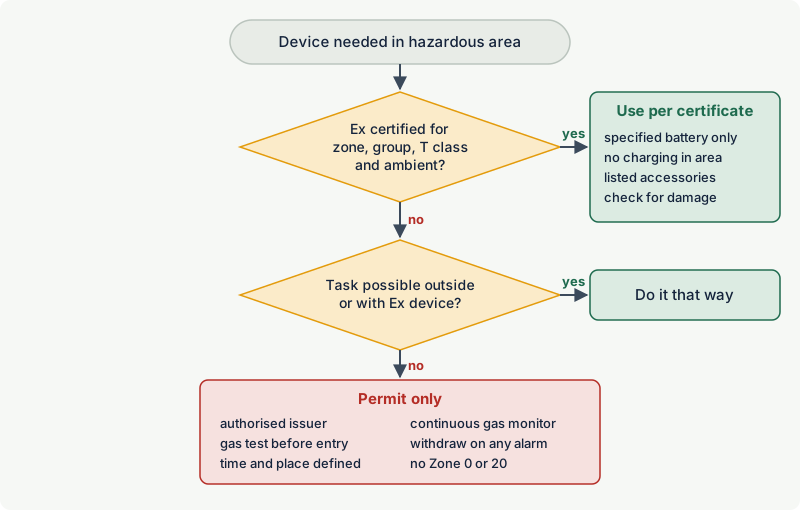
The permit treats the device as a potential ignition source, just like a grinder or a welding set. Many permit systems put it in the same category as hot work with spark potential. A typical permit for a non-Ex electronic device sets out:
- the device, the task, the exact location and a time limit;
- a gas test immediately before the device enters the area, by an authorised gas tester with a calibrated detector, with an acceptance criterion of no flammable gas detected;
- continuous gas monitoring at the point of use for the whole time the device is there, with the device switched off and removed at the first alarm;
- conditions such as no battery changes, no charging, no connecting or disconnecting cables in the area, and protection against dropping;
- process conditions: no sampling, draining or line breaking nearby while the permit is active.
In the USA, the Department of the Interior is merging its offshore safety regulator, the Bureau of Safety and Environmental Enforcement (BSEE), with the Bureau of Ocean Energy Management into a new Marine Minerals Administration (MMA), established by a Secretary's Order of 10 July 2026 and becoming operational in phases. Safety Alert 521, dated 12 August 2026 and issued under the MMA name, describes inspections that found a wireline operator using a mobile phone on a mobile offshore drilling unit during active wireline operations, and devices not rated for the location in a Class I, Division 2 area with no hot work permit. It recommends prohibiting portable electronic devices in hazardous areas unless they are certified for the location, requiring hot work permits when their use cannot be avoided, and checking company policies against API RP 14F and the US offshore regulations.
IEC TS 60079-48:2023 offers a structured alternative for some uncertified personal and portable devices. It applies only where EPL Gb, Gc, Db or Dc is required and where certified equipment is not commercially available. It groups devices into categories linked to the EPL and sets technical and organisational conditions, based on a documented risk assessment. It does not cover battery-powered tools, medical devices or transportable equipment, and it does not apply to Zone 0 or Zone 20. A 2024 review of the specification in Chemical Engineering Transactions stresses that it does not open the door to casual use: certified devices remain the first choice.
Fuel forecourts are a special public case. The Energy Institute's 2018 guidance on mobile phones and other portable devices on petrol filling stations moved away from a blanket ban across the whole forecourt, which it considered excessive, towards a site risk assessment that identifies where and when devices must not be used, such as where a flammable atmosphere may be present during deliveries.
Batteries: the energy source in your pocket
Batteries are the hardest part of a portable device to make safe, and the part users most often compromise.
- Use only the specified battery type. The intrinsic safety assessment of a certified device assumes a specific cell chemistry, capacity, internal resistance and current limitation. A similar-looking battery from another source invalidates the certificate.
- Do not change or charge batteries in the hazardous area unless the certificate explicitly permits it. Battery contacts are exposed during a change, and chargers are rarely certified for hazardous areas.
- Withdraw damaged or swollen batteries immediately. Swelling indicates gas generation inside the cell.
- Spare batteries in pockets can be short-circuited by keys or coins; carry them covered or not at all.
- Charging areas need the same discipline outside the hazardous area. BSEE Safety Alert 337 (August 2018) describes three fires in offshore living quarters linked to charging phones and tablets, including a charger cable that failed while a phone charged on a mattress.
Lithium-ion thermal runaway is also a hazard in its own right: a failing cell releases flammable and toxic gases and can ignite them.
Wireless, RF energy and ignition
Radio waves carry energy, and in principle that energy can ignite a gas in two ways: by heating or sparking inside a device, and by being picked up by metal structures that act as unintended receiving antennas.
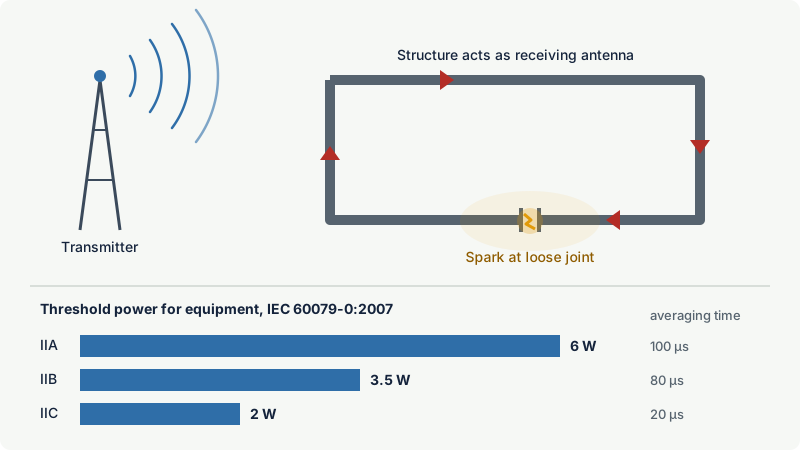
Equipment limits. IEC 60079-0 sets the threshold power that radiating Ex equipment may emit, defined as the effective output power of the transmitter multiplied by the antenna gain, for continuous transmission between 9 kHz and 60 GHz:
| Equipment group | Threshold power | Thermal initiation time (averaging period) | Threshold energy for short pulses |
|---|---|---|---|
| Group I | 6 W | 200 µs | 1500 µJ |
| Group IIA | 6 W | 100 µs | 950 µJ |
| Group IIB | 3.5 W | 80 µs | 250 µJ |
| Group IIC | 2 W | 20 µs | 50 µJ |
| Group III | 6 W | 200 µs | 1500 µJ |
Values as given in IEC 60079-0:2007 (checked in a published national adoption of that edition); the 2011 edition carried the same values. IEC 60079-14:2024 also has radio frequency power and energy threshold tables for installations. Check the current edition of IEC 60079-0 (edition 8, 2026) for any change before using these values in a design. The standard does not allow power settings that users can change to be used to meet these limits, so a wireless access point or radio with a high-gain antenna must be assessed with its maximum possible output.
Fixed wireless installations. Wi-Fi access points, private radio base stations, wireless sensor gateways and RFID readers installed in hazardous areas are Ex equipment like any other, and their antennas and cables are part of the assessment. IEC 60079-14:2024 adds that the manufacturer of an RFID tag used in a hazardous area must demonstrate and document that the tag presents no explosion hazard.
External transmitters. High-power broadcast, radar and communication transmitters near a plant can induce currents in cranes, pipe racks, storage tank structures and other large metal loops. At a break in such a loop, for example a loose flange or a crane hook touching a load, the induced current can produce a spark. The CENELEC technical report CLC/TR 50427 gives the method for assessing this risk, using the structure's geometry, the transmitter's power and frequency, and the distance.
Handheld phones. A GSM handset in the 900 MHz band transmits at up to 2 W nominal peak power, and in the 1800 MHz band up to 1 W, according to the 3GPP specification; newer networks generally use less. A phone's radio is not regarded as a realistic way to make plant structures spark; RF assessments focus on much more powerful fixed transmitters. The reason a non-Ex phone is excluded from hazardous areas is the device as a whole, mainly its battery and electronics, not its antenna.
Cameras and tools
Cameras. Ex certified cameras and thermal imagers exist for Zone 1 and Zone 2. An ordinary camera falls under the permit approach above; its flash is an additional optical and electrical source.
Battery-powered tools. Drills, impact drivers and saws combine a large battery, a brushed or electronic motor and switch contacts, and their work itself produces heat and sparks. IEC TS 60079-48 excludes them, and IEC 60079-14:2024 notes that even a tool with an Ex certificate can create an ignition source that the certificate does not cover, for example a drill bit heating the workpiece. Drilling, cutting and grinding in a hazardous area are hot work and need a hot work permit.
Hand tools. Steel hand tools can produce mechanical sparks, especially in impacts with rusty steel or light alloys. So-called non-sparking tools of copper alloys reduce this risk but do not remove the need for gas testing and permits in areas where an explosive atmosphere may be present.
Personal items. Smartwatches, fitness trackers, electronic car keys, e-cigarettes and lighters are common in workforce pockets. Site rules should state which are banned at the hazardous area boundary and which are accepted after assessment.
Worked example: photographs for an inspection report
An inspector must photograph equipment in two areas of a gas plant: a compressor house classified Zone 1 for methane (gas group IIA, autoignition temperature about 600 °C, T1) and a tank farm classified Zone 2 for hexane (IIA, 225 °C, T3).
The site's Ex camera-phone is marked II 2 G Ex ib IIC T4 Gb with an ambient range of -20 °C to +50 °C. Checks:
- EPL Gb covers Zone 1 and Zone 2.
- Group IIC covers IIA gases.
- T4 (135 °C) is below both autoignition temperatures.
- The forecast is 32 °C, inside the ambient range.
- The certificate conditions say: approved battery only, no charging or battery change in the hazardous area, clean with a damp cloth. The inspector checks that the battery is the listed type, the port cover is closed and the screen is intact.
The device can be used in both areas without a permit beyond normal access. Later, a remote specialist asks for a live video call from the Zone 2 tank farm on the inspector's own smartphone. That phone is not certified. The certified device cannot run the video application, so the call is held under a permit: gas test with no flammable gas detected, a personal gas detector clipped next to the phone, a 20-minute limit, no tank movements during the call, and the phone switched off and removed at any alarm. For Zone 1, the same request would be refused and the call made from outside the area.
Common mistakes
- Assuming "rugged" or "IP68" means Ex. Water and dust resistance say nothing about ignition protection. Look for the Ex marking and certificate.
- Using a Zone 2 device in Zone 1. Portable devices move with people; check the EPL against the area every time, and colour-code or label devices by permitted zone.
- Fitting a third-party battery or charging in the field. Only the specified battery keeps the certificate valid, and charging is usually allowed only outside the hazardous area.
- Adding uncertified accessories. A Bluetooth headset or plug-in microphone can introduce an ignition source of its own or alter the intrinsic safety parameters.
- Blaming radio waves and forgetting the battery. For handheld devices, the battery and circuits are the main concern; for fixed transmitters, the structures around them.
- Treating a permit as a formality. Without continuous gas monitoring at the point of use, a permit for a non-Ex device offers little protection when conditions change.
Frequently asked questions
Can I use my mobile phone in a Zone 2 area?
Only if your site's risk assessment and permit system allow it. A normal phone is not Ex certified, so most sites either ban it or allow it only under a permit with a gas test and continuous gas monitoring. IEC TS 60079-48 describes how an owner can assess uncertified personal devices for EPL Gc areas when no certified alternative is available.
What does an intrinsically safe phone have that a normal phone does not?
Its circuits and battery are designed and certified so that sparks and hot surfaces cannot ignite the specified gas group, even with defined faults. This usually involves energy-limiting circuits, encapsulated batteries, controlled surface temperatures and restrictions on battery changes and accessories. The certificate defines the zone, gas group, temperature class and ambient range.
Is it dangerous to use a mobile phone at a petrol station?
The risk is limited to places and times where a flammable atmosphere may be present, such as during fuel deliveries or a spill. The Energy Institute's 2018 guidance replaced a blanket ban across forecourts with a site risk assessment that defines where devices must not be used, and site instructions should be followed.
Can an Ex certified phone be charged in the hazardous area?
Normally not. Most certificates for portable devices require batteries to be charged and changed only outside the hazardous area, because the charger and the exposed contacts are not protected. Read the specific conditions of use in the certificate and instructions.
Can radio waves from a phone ignite gas?
A phone's transmit power is low, at most about 2 W during transmission bursts, and is not regarded as a realistic way to make plant structures spark. The ignition risks of a non-Ex phone come mainly from its battery and electronics. Radio frequency ignition is a concern for high-power fixed transmitters near large metal structures and is assessed with CLC/TR 50427.
Related on excodex
- Hot work permits in hazardous areas
- How to read an Ex marking: decoding II 2 G Ex db IIC T4 Gb step by step
- Intrinsic safety (Ex i): ia, ib and ic and the energy limitation principle
- Ignition sources in hazardous areas: the 13 ignition sources and how to control them
- Portable gas detectors and confined space entry and BESS safety and thermal runaway
- Tools: Ex marking check; standards spaces: IEC 60079-14, IEC 60079-11, IEC 60079-28
Standards and further reading
- IEC 60079-14:2024, electrical installations design, selection and installation, including transportable, portable and personal equipment (informative annex) and RFID tags
- IEC TS 60079-48:2023, portable or personal electronic equipment without a certificate in hazardous areas: IEC webstore
- IEC 60079-0, general requirements, including radio frequency threshold power and energy (values quoted here from the 2007 edition); IEC 60079-11, intrinsic safety; IEC 60079-28, optical radiation
- CLC/TR 50427, assessment of inadvertent ignition of flammable atmospheres by radio frequency radiation
- M. S. Scotton and G. Suter, "Balancing safety and innovation: a critical examination of IEC TS 60079-48", Chemical Engineering Transactions 111 (2024): paper PDF
- HAVTIL (Norwegian Ocean Industry Authority, then PSA), letter on portable electronic communication equipment in hazardous areas, 12 May 2020: letter PDF
- Marine Minerals Administration (MMA), Safety Alert 521, control portable electronic device use to prevent ignition hazards offshore, 12 August 2026, published on the BSEE website: alert PDF
- US Department of the Interior, Secretary's Order 3451, establishment of the Marine Minerals Administration (10 July 2026): order PDF
- BSEE Safety Alert 337, fires caused by electronic device chargers, 2018: alert PDF
- Energy Institute, guidance on the use of mobile phones and other portable electrical devices on petrol filling stations (2018): publication page
This article is general technical information prepared by the excodex editorial team. It does not replace the applicable standards, the equipment certificates and instructions, national regulations or the assessment of a competent person.