Occupational safety International framework and country guides
Occupational safety and health in Qatar: law, authorities and employer duties
Abstract
Qatar regulates workplace safety through Labour Law No. 14 of 2004 (Articles 99 to 115) and ministerial decisions, enforced by Ministry of Labour inspectors. A worker's death or injury must be reported immediately to the police and the Ministry; summer heat rules are in Decision No. 17 of 2021.
Qatar has no stand-alone occupational safety and health (OSH) act. The core rules sit in Labour Law No. 14 of 2004, chapter ten (safety, occupational health and social care) and chapter eleven (work accidents and compensation), and in ministerial decisions made under it. The Ministry of Labour enforces them through its occupational safety and health department and its labour inspectors, who can enter workplaces without notice; the Minister can close all or part of a site where workers face serious danger.
This guide covers the framework, authorities, duties, heat-stress rules, reporting, committees, penalties, chemicals, Ex equipment and major hazards, with a comparison with the EU and Türkiye. Points we could not confirm in an official text are flagged for checking with the Ministry.
Key points
- The main OSH provisions are Articles 99 to 115 of Labour Law No. 14 of 2004 (القانون رقم 14 لسنة 2004 بإصدار قانون العمل), supported by ministerial decisions of 2005 on medical care, work injury reporting and periodic medical examinations, and Ministerial Decision No. 17 of 2021 on heat stress.
- The Ministry of Labour (وزارة العمل) enforces the law; its inspectors may enter workplaces day or night without prior notice, take samples, inspect machinery and question workers (Article 138).
- A death or injury at work must be reported immediately to the police and the Ministry (Article 108); a diagnosed occupational disease within three days (Article 105); a fire, collapse or explosion that stops work for a working day or more within 24 hours (Decision No. 18 of 2005).
- The Labour Law sets medical staffing by headcount: a first-aid box and trained first-aider per group of 5 to 25 workers, a nurse above 100 workers, and a clinic with at least one physician and one nurse above 500 workers (Article 104).
- Outdoor work in the sun is banned from 10:00 to 15:30 between 1 June and 15 September, and work must stop when the wet bulb globe temperature (WBGT) exceeds 32.1 °C (Decision No. 17 of 2021).
- The Labour Law excludes several groups, including government staff, domestic workers (who have their own Law No. 15 of 2017) and the workers of companies in which QatarEnergy (formerly Qatar Petroleum) has a stake (Article 3); in the oil and gas sector, company and contract rules carry much of the OSH load.
- Qatar has no national Ex equipment certification scheme that we could identify and is not listed as an IECEx member country, so hazardous-area equipment is accepted on the plant owner's specification, usually IECEx or ATEX certificates.
Legal framework: the Labour Law and its decisions
The Labour Law applies to employers in the private sector. Chapter ten places the general duties on the employer: inform each worker of the risks of the work and the preventive measures on starting work (Article 99), take all precautions against occupational injury, disease, accident, fire and equipment breakdown (Article 100), and secure hygiene, ventilation, lighting, drinking water and drainage (Article 103). Article 102 empowers the Minister to issue decisions on OSH appliances, preventive measures and occupational diseases, and most of the detail is in those decisions.
| Instrument | Subject | Status we could confirm |
|---|---|---|
| Labour Law No. 14 of 2004, Arts. 99 to 115 | General OSH duties, first aid and medical staff, medical examinations, accident reporting, compensation | Text as published on Al Meezan; amended several times since 2004 |
| Decision No. 16 of 2005 | Medical care for workers in establishments (check-ups, medical file, first aid, nurse, clinic) | In force when last summarised; Arabic text on Al Meezan |
| Decision No. 18 of 2005 | Work injury and occupational disease statistics, forms and reporting | As above |
| Decision No. 19 of 2005 | Periodic medical examinations for workers exposed to occupational disease | As above |
| Decision No. 17 of 2021 | Heat stress: summer working hours, WBGT limit, risk assessment, training, health checks | In force; replaced Decision No. 16 of 2007 |
| Law No. 9 of 2026 | Amends the Labour Law (joint committees, enforcement powers, vocational certificates, strikes and more) | Published in the Official Gazette in June 2026; several parts wait for implementing decisions |
The 2005 decisions were issued by the then Minister of Civil Service Affairs and Housing, and the 2021 decision by the Minister of Administrative Development, Labour and Social Affairs; responsibility has since passed to the Ministry of Labour. Qatar adopted a National Policy on Occupational Safety and Health in 2020, and in 2025 the Cabinet approved a draft decision to reorganise the National Committee for Occupational Safety and Health so that it can develop that policy.
Who is covered and who is not
Article 3 (as amended in 2009) excludes from the Labour Law: government employees, the armed forces and police, casual workers, domestic workers, family members of the employer, most farming and grazing workers, and the workers of companies that Qatar Petroleum (now QatarEnergy) establishes, participates in or holds shares in, together with petroleum and petrochemical joint ventures, and anyone whose employment is governed by a special law. Domestic workers are covered by Law No. 15 of 2017 on domestic workers instead. The Council of Ministers may extend some or all provisions of the Labour Law to casual, domestic, family and farm workers. The heat-stress decision also states that it does not apply to companies working on oil and gas projects. In those sectors, employment contracts and the operator's HSE (health, safety and environment) rules fill much of the gap, so always check which regime covers your workforce.
Note: No official consolidated English text of the Labour Law could be opened during our research. We worked from the English text of the Al Meezan legal portal, which is marked "not official". Arabic is the authoritative language, and later amendments, including Law No. 9 of 2026, must be checked on Al Meezan.
Who enforces OSH in Qatar
The Ministry of Labour is the competent authority. ILO reports from 2023 describe an Occupational Safety and Health Department (also called a unit) and a Labour Inspection Department within the Ministry. The Labour Law creates a Work Inspection Authority whose inspectors take an oath, carry identity cards and, when authorised by the Attorney General, act as judicial officers (Articles 135 to 137).
Other bodies have a role:
- Ministry of Public Health (وزارة الصحة العامة): the health authority acts as the "competent medical authority" of the Labour Law, whose decision on treatment, fitness to return and disability disputes is final (Article 112), and inspects workplace clinics with the labour administration (Decision No. 16 of 2005, which names the then national health authority). A November 2021 memorandum between the Ministry of Labour and the Ministry of Public Health aims at a national registry of occupational accidents; by 2023 a common set of data forms had been drafted for hospitals, the Ministry, employers and insurers.
- Police: receive accident reports and investigate the link between the accident and the work (Article 108).
- General Directorate of Civil Defence (Ministry of Interior): fire and life safety requirements for buildings and structures, published as the Civil Defence Technical Requirements Guide (2022), and the related approvals.
- QatarEnergy industrial cities: Ras Laffan and Mesaieed are developed and operated by QatarEnergy with its own HSE requirements for operators and contractors.
Employer and worker duties in practice
The employer must not charge workers or deduct wages for safety precautions (Article 100). Employers with 50 or more workers must also provide the social services set by ministerial decision (Article 107), and employers with workers at remote sites without normal transport must provide transport or accommodation, drinking water and food (Article 106). Workers must use the protective equipment and clothing provided and obey safety instructions, and must not damage safety appliances (Article 101). A worker who intentionally breaks safety instructions or is grossly negligent can lose the right to injury compensation (Article 111).
Risk assessment
The Labour Law does not contain a general article requiring a written risk assessment in the way the EU Framework Directive does. The duty to know and explain the risks (Article 99) and to take all precautions (Article 100) cannot be met without one, and two instruments are explicit: Decision No. 16 of 2005 asks for a study of working conditions to guide medical examinations, and Decision No. 17 of 2021 requires a heat-stress risk assessment carried out with the workers, updated regularly and kept at the workplace for inspectors. Large clients and the oil and gas operators require written hazard identification and risk assessment in their contracts.
Training
The law requires information on starting work and conspicuous written safety instructions (Article 99), trained first-aiders (Article 104 and Decision No. 16 of 2005), heat-stress training for all workers by the beginning of May each year, and trained paramedics and OSH supervisors on site (Decision No. 17 of 2021). Law No. 9 of 2026 allows the Ministry to list professions whose workers must complete accredited training or pass an examination before they start work; the list comes in later ministerial decisions, so check which trades are covered.
First aid, nurses and physicians
| Workers in the establishment | Minimum required by Article 104 |
|---|---|
| 5 to 25 | One first-aid box with contents set by the competent medical authority, in the care of a trained first-aider |
| More than 25 | One box for each group of 5 to 25 workers |
| More than 100 | The boxes plus a nurse (the English text of the law says full-time) |
| More than 500 | A clinic with at least one physician and one nurse |
There is no general statutory duty, by headcount, to appoint a safety professional such as Türkiye's OSH expert. Decision No. 18 of 2005 assumes that a health and safety manager supervises injury data where one exists, and the heat-stress decision refers to OSH supervisors. In practice the requirement usually comes from the contract: for example, the contractor HSE regulations of the national energy company (QP-REG-S-001, Rev. 3 of 2009, the version we could open) ask every contractor with more than 20 people on a worksite to appoint an HSE officer or supervisor.
Medical examinations
Workers exposed to the risk of an occupational disease must have periodic medical examinations at intervals that match the risk, under rules set by the competent authority (Article 105 and Decision No. 19 of 2005). Results go into the worker's file, and the employer pays for the time spent on the examination. Decision No. 16 of 2005 adds medical check-ups and a medical file for every worker, and the heat-stress decision requires an annual health check, free to the worker, aimed at chronic conditions that raise heat-stress risk.
Heat stress: Qatar's best-known OSH rule
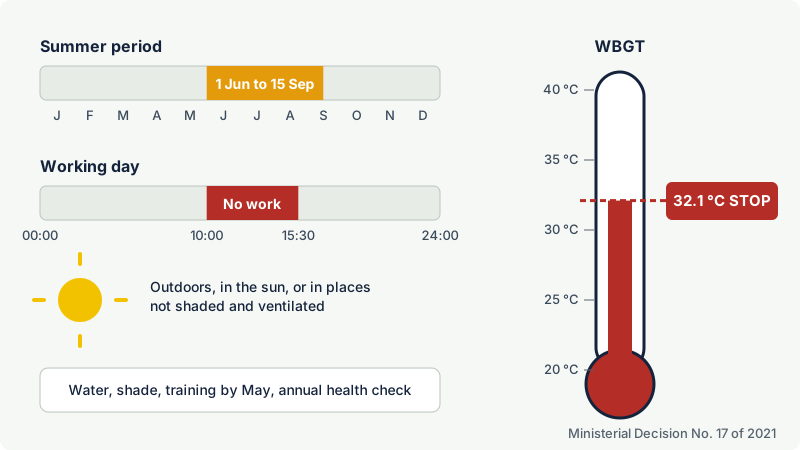
Ministerial Decision No. 17 of 2021 replaced the 2007 summer-hours rule after a field study carried out in 2019 with the ILO. Its main duties are:
- No work in the sun, in outdoor workplaces or in places that are not shaded and ventilated from 10:00 to 15:30, from 1 June to 15 September each year (Article 2), with the daily schedule posted for workers and inspectors (Article 3).
- Measure WBGT, record weather conditions at the workplace and stop work wherever WBGT rises beyond 32.1 °C (Article 4). This limit applies whenever it is reached, not only in the summer window.
- A written heat-stress risk assessment with the workers, free cool drinking water, shaded rest areas, light loose clothing, training by May and an annual health check (Article 4).
- Where several employers work on one site, the main contractor follows up compliance by the others (Article 5).
- Workers may stop work and complain to the Ministry if they reasonably believe heat stress threatens their safety, without dismissal or discrimination (Article 6).
- Breaches can lead to whole or partial closure of the workplace by decision of the Minister (Article 7).
Summer inspections are intensive: the Ministry reported 463 worksites closed in 2022 and the ILO 504 in 2023, almost all in construction. The decision does not apply to companies working on oil and gas projects (Article 8), which follow their operators' heat rules. See heat stress, WBGT and cold stress for how WBGT works.
Reporting accidents and occupational diseases
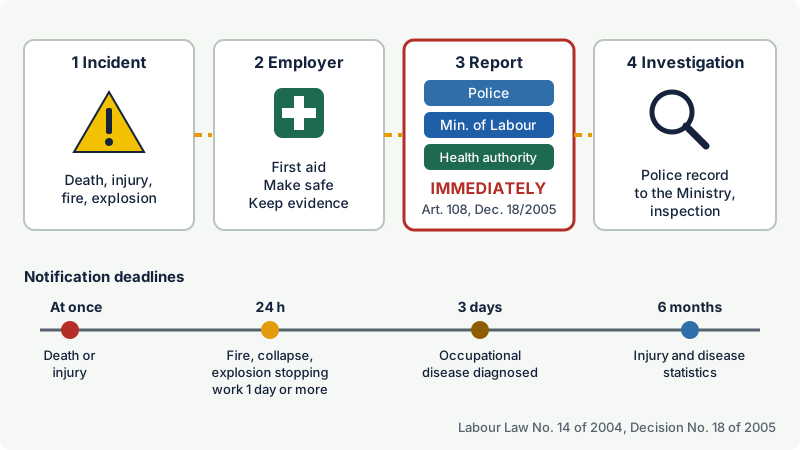
The duties come from Article 108 of the Labour Law and Decision No. 18 of 2005:
| Event | To whom | Deadline |
|---|---|---|
| Death or injury of a worker during or because of work | Police and the labour administration (Ministry of Labour); the decision adds the competent medical authority | Immediately |
| Fire, collapse or explosion that stops the establishment or a production unit for one working day or more | Labour administration | Within 24 hours |
| Occupational disease diagnosed by a doctor | Labour administration | Within 3 days of knowing the result |
| Final conclusions on causes and losses of a fatal incident | Labour administration | As soon as available |
| Injury, fatality and occupational disease statistics on the official forms | Labour administration | Every six months |
The report must give the worker's name, age, occupation, address, nationality, a short description of the accident and the first aid or treatment given (Article 108). Decision No. 18 of 2005 asks for three copies of the form: for the labour administration, for the investigating authority and for the establishment's records. The police investigate, record statements and send copies of the record to the Ministry and to the employer.
Example: A scaffold fitter on a Doha site falls 3 m at 08:40 and is taken to hospital with a fractured wrist. The site manager calls the police and notifies the Ministry of Labour that morning, completes the injury form in three copies, leaves the scaffold and harness untouched for the investigation, and logs the case for the next six-monthly return.
Treatment and compensation after an injury
The employer pays for treatment as decided by the competent medical authority, and the injured worker receives full pay during treatment for up to six months, then half pay until recovery or a finding of permanent disability (Article 109). Compensation for death is calculated under Islamic law (Shariah), total permanent disability counts as death, and partial disability is a percentage set by the schedule to the law (Article 110). The employer pays disability compensation within 15 days of the disability being proved, and deposits death compensation with the court within 15 days (Article 114); the worker's claim lapses one year after the final medical report or the death (Article 113).
The Ministry and the ILO have run campaigns on the legal duty to notify accidents. Near misses are not notifiable under the law, but most client contracts require them to be reported internally.
Joint committees, inspections and penalties
Joint committees
The 2004 text allowed an establishment with 30 or more workers to form a joint committee of employer and worker representatives, with four, six or eight members depending on size, half from each side (Article 124). Means of protection from hazards and better compliance with OSH rules are among its tasks (Article 126). Law No. 9 of 2026 makes joint committees mandatory for establishments with 100 or more workers, with equal representation. Qatari law has no separate statutory "safety representative" role; the joint committee is the forum for consultation. The ILO and the UK Health and Safety Executive have helped develop OSH training for joint committee members.
Inspection
Inspectors may enter, inspect records, take samples, examine machinery, check accommodation and question workers (Article 138). They may advise, issue a written warning with a deadline, or report the violation for action (Article 140). Where the employer does not take precautions or there is imminent danger, the Minister may close the site in whole or in part or stop machines, and the employer must keep paying full wages during the closure (Article 100). According to published summaries of Law No. 9 of 2026, the Minister may also suspend an establishment's transactions with the Ministry and publish the names of repeat violators.
Penalties
| Breach | Articles | Penalty in the 2004 text |
|---|---|---|
| Not informing workers of risks or posting instructions; remote-site services; injury statistics; obstructing inspectors | 99, 106, 115, 139 | Fine of QAR 2,000 to 5,000 |
| Hygiene and welfare; first aid, nurse, clinic; medical examinations and disease notification; accident reporting | 103, 104, 105, 108 | Up to one month's imprisonment and/or a fine of QAR 2,000 to 6,000 |
Under Article 143 the fine is multiplied by the number of workers affected, so a medical-examination breach for 30 exposed workers could reach QAR 60,000 to 180,000 on the 2004 amounts. These are fixed amounts (Qatari riyals) written into the law, not re-valued yearly; we could not confirm whether Law No. 9 of 2026 changed them, so check the consolidated text.
Chemicals, explosive atmospheres, major hazards and PPE
Chemicals. The Labour Law empowers the Minister to regulate preventive measures for occupational diseases, and Decision No. 19 of 2005 links exposure to periodic examinations. We could not confirm from an official source how far Qatar has implemented the UN Globally Harmonized System (GHS) for workplace labels and safety data sheets; in practice, international suppliers provide GHS-format safety data sheets, and the environmental side of chemical storage and discharge is regulated separately by the environment authorities.
Explosive atmospheres and Ex equipment. No Qatari regulation equivalent to the EU ATEX directives was found, and Qatar does not appear on the IECEx list of member countries (checked November 2026). Plant owners set the rules: the energy company's contractor regulations classify hazardous areas into Zones 0, 1 and 2 under the IP Model Code of Safe Practice and, for example, ban light-alloy ladders and scaffolding in Zone 1. Project specifications usually call for equipment with IECEx or ATEX certification suited to high ambient temperatures. See which Ex certification is needed in the Gulf.
Major-hazard sites. We found no Seveso-type law with notification tiers and safety reports. Gas processing, refining and petrochemical plants are concentrated in Ras Laffan and Mesaieed industrial cities, where the operator's HSE management, permit-to-work and emergency requirements apply, alongside Civil Defence approvals, environmental permits and the Labour Law duties above.
PPE. The employer must provide PPE free of charge and workers must use it (Articles 100 and 101). We could not identify a national PPE conformity mark; buyers usually specify European (EN), US (ANSI/ISEA) or equivalent standards. Confirm any import conformity requirement with the national standards authority.
How Qatar compares with the EU and Türkiye
| Topic | Qatar | EU (Directive 89/391/EEC) | Türkiye (Law No. 6331) |
|---|---|---|---|
| Main instrument | Labour Law No. 14 of 2004, Arts. 99 to 115, plus decisions | Framework Directive and national laws | OSH Law No. 6331 of 2012 and regulations |
| Written risk assessment | No general article; mandatory for heat stress | Required (Art. 9) | Required (Art. 10); renewed at least every 2, 4 or 6 years by hazard class (Risk Assessment Regulation, Art. 12) |
| Safety professional | No general duty; often required by contract | Designated workers or services (Art. 7) | OSH expert for every employer, in-house or from an external service (Art. 6) |
| Doctor or nurse | Nurse above 100 workers, clinic with physician above 500 | Health surveillance under national law (Art. 14) | Workplace physician for every employer; other health staff in very hazardous workplaces with 10 or more workers (Art. 6) |
| Accident reporting | Immediately to police and Ministry; 24 h; 3 days for disease | National rules; list of accidents causing more than 3 working days' absence (Art. 9) | To the Social Security Institution within 3 working days of the accident, or of learning of an occupational disease (Art. 14) |
| Committee | Joint committee mandatory at 100 or more workers (2026) | Consultation and worker representatives (Arts. 10, 11) | OSH board at 50 or more workers and work lasting over six months (Art. 22) |
For a wider table see OSH law comparison: appointments and reporting deadlines.
Common mistakes
- Assuming the Labour Law covers everyone. It excludes domestic workers, government staff and many oil and gas company workers; check the regime before writing procedures.
- Reporting only to the police. Article 108 requires the Ministry of Labour to be notified immediately as well, and Decision No. 18 of 2005 adds the medical authority and the six-monthly statistics.
- Treating the summer ban as the whole heat rule. The 32.1 °C WBGT stop, the written heat risk assessment, training by May and annual health checks apply too, and inspectors check them.
- Waiting for a nurse until 500 workers. A nurse is due above 100 workers; the clinic with a physician is the 500-worker step.
- Quoting fines without the multiplier. Fines are multiplied by the number of workers affected (Article 143), which changes the exposure for large sites.
- Assuming CE or ATEX marking is a legal requirement in Qatar. It is a client requirement; read the project specification for the certificates and temperature ratings accepted.
Frequently asked questions
Who is the competent authority for workplace safety in Qatar?
The Ministry of Labour, through its OSH department and labour inspectors. The Ministry of Public Health acts as the competent medical authority, and Civil Defence covers fire safety.
Are near misses reportable in Qatar?
Not under the Labour Law or Decision No. 18 of 2005, which cover deaths, injuries, occupational diseases and fires, collapses or explosions that stop work. Most large clients require near misses to be reported under the contract.
Does the heat-stress decision apply to oil and gas sites?
No. Article 8 of Decision No. 17 of 2021 excludes companies working on oil and gas projects. Those sites follow the operator's heat-stress rules, which should be checked in the contract.
Must a foreign contractor follow Qatari law or its home rules?
Qatari law applies to work in Qatar. Home-country or client standards can add to it but cannot reduce the legal minimum, and Article 4 voids conditions less favourable to the worker.
Related on excodex
- What is the main OSH law in Qatar and who enforces it?
- How and within what time must a workplace accident be reported in Qatar?
- Must an employer in Qatar appoint a safety professional or an occupational physician?
- How are explosive atmospheres and Ex equipment regulated in Qatar?
- Occupational safety and health in the United Arab Emirates
- EU Framework Directive 89/391/EEC explained
Standards and further reading
- Law No. 14 of 2004 promulgating the Labour Law (القانون رقم 14 لسنة 2004 بإصدار قانون العمل), State of Qatar: official Arabic text and later amendments on the Al Meezan legal portal, almeezan.qa (search for Law 14 of 2004); record with Arabic and English texts in the Gulf Labour Markets and Migration database: gulfmigration.grc.net
- Ministerial Decision No. 17 of 2021 specifying measures to protect workers from heat stress (unofficial English translation): gulfmigration.grc.net
- Decision No. 18 of 2005 on work injury and occupational disease statistics and reporting (summary): gulfmigration.grc.net
- Decision No. 16 of 2005 on medical care for workers (summary): gulfmigration.grc.net
- Decision No. 19 of 2005 on periodic medical examinations (summary): gulfmigration.grc.net
- ILO Project Office for Qatar, Progress report on the technical cooperation programme, November 2023: ilo.org
- ILO Project Office for Qatar, 2021 progress report: ilo.org
- Ministry of Labour, Qatar's occupational heat stress legislation and enforcement, May 2023: ilo.org
- IECEx member countries: iecex.com
- QatarEnergy industrial cities and HSE regulations for contractors QP-REG-S-001: qatarenergy.qa, QP-REG-S-001
- Council Directive 89/391/EEC on the introduction of measures to encourage improvements in the safety and health of workers at work; Turkish Occupational Health and Safety Law No. 6331 (6331 sayılı İş Sağlığı ve Güvenliği Kanunu)
This article is general occupational safety and health information prepared by the excodex editorial team. It does not replace the applicable legislation, standards, manufacturers' instructions or the assessment of a competent OSH professional or occupational physician.
Questions on this topic
- What is the main occupational safety and health law in Qatar and who enforces it?
- Must an employer in Qatar appoint a safety professional or an occupational physician?
- Is a written risk assessment mandatory in Qatar, and how often must it be reviewed?
- How and within what time must a workplace accident be reported in Qatar?
- What OSH training must employers provide to workers in Qatar?
- Are pre-employment and periodic medical examinations required for workers in Qatar?
- What are the penalties for breaking occupational safety rules in Qatar?
- Is a safety committee or a worker safety representative required in Qatar?
- How are explosive atmospheres and Ex equipment regulated in Qatar?
- Which rules apply to major-hazard chemical sites in Qatar?