Occupational safety International framework and country guides
Occupational safety and health in Iran: law, authorities and employer duties
Abstract
Iran's core OSH law is Chapter 4 (Articles 85 to 106) of the 1990 Labour Law. The Ministry of Labour sets technical safety rules and inspects; the Ministry of Health covers occupational health. Employers carry criminal and civil liability. Iran ratified ILO C155 in 2023.
Occupational safety and health (OSH) in Iran is governed mainly by Chapter 4, "Technical protection and occupational health" (حفاظت فنی و بهداشت کار), Articles 85 to 106 of the Labour Law of the Islamic Republic of Iran (قانون کار جمهوری اسلامی ایران), finally approved by the Expediency Council in November 1990. The Ministry of Cooperatives, Labour and Social Welfare writes the technical safety rules and runs the labour inspectorate, while the Ministry of Health and Medical Education is responsible for occupational health. The employer is responsible for applying the rules and is criminally and civilly liable when an accident follows a breach.
This guide covers the legal framework, the authorities, employer and worker duties, OSH services and committees, medical surveillance, accident reporting, penalties, chemicals, explosive atmospheres, major-hazard sites and PPE, with a comparison against the EU and Türkiye. Iranian government portals could not be opened while it was prepared, so it relies on the Persian Labour Law text, ILO and FAO records and peer-reviewed studies; unconfirmed points are flagged.
Key points
- The main OSH law is Chapter 4 (Articles 85 to 106) of the 1990 Labour Law; penalties are in Chapter 11 (Articles 171 to 186). Home workplaces are also covered (Article 85, Note).
- Two ministries share the field: the Ministry of Labour (technical safety, labour inspection, the High Council for Technical Protection) and the Ministry of Health (occupational health, health inspectors, exposure limits).
- Article 91 obliges employers to provide the means for safety and health, train workers in their use and supervise compliance; workers must use and look after the protective equipment and follow the instructions.
- Workers exposed to occupational disease risks must have a medical file and be examined at least once a year (Article 92).
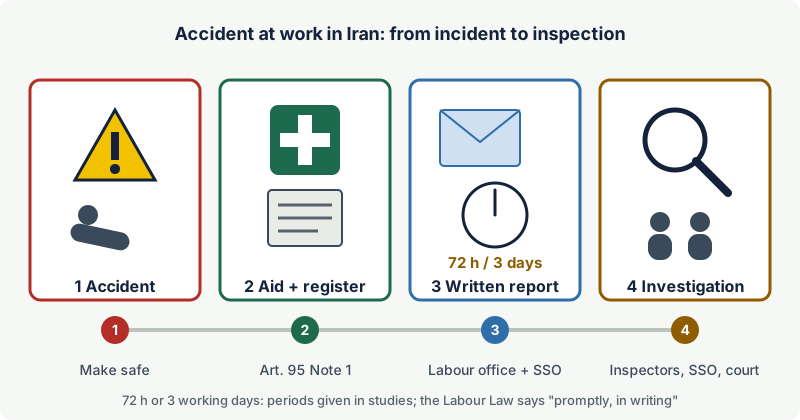
- Accidents must be recorded in a special register and reported promptly in writing to the local labour office (Article 95, Note 1); the law sets no hour limit, and published studies describe 72 hours or three working days.
- Fines are set as multiples of the worker minimum daily wage, which the Supreme Labour Council fixes every year, so the amounts change annually; repeated offences can lead to imprisonment.
- Iran ratified the ILO Occupational Safety and Health Convention, 1981 (No. 155) and its 2002 Protocol on 7 February 2023, in force for Iran from 7 February 2024.
The legal framework: the Labour Law and its regulations
The Labour Law applies to all employers, workers and productive, industrial, service and agricultural establishments (Article 1). Chapter 4 sets the general duties and the inspection system, and leaves the technical detail to regulations (آییننامه) and instructions. Article 106 says the executive regulations for the chapter are approved by the Cabinet on the joint proposal of the two ministries.
| Instrument | Local name | What it covers |
|---|---|---|
| Labour Law 1990, Chapter 4, Arts. 85 to 106 | قانون کار، فصل چهارم: حفاظت فنی و بهداشت کار | General OSH duties, committees, accident register, labour inspection, closure of dangerous workplaces |
| Labour Law, Chapter 3 (Arts. 52, 61, 75, 77, 79 to 84) | شرایط کار | Hours in hazardous work, women, pregnancy, young workers |
| Labour Law, Chapter 11, Arts. 171 to 186 | مجازاتها | Fines and imprisonment |
| Protective regulations of the High Council for Technical Protection | آییننامههای حفاظتی | Sector and hazard rules; current list held by the Ministry of Labour |
| Ministry of Health occupational health rules and exposure limits | حدود تماس شغلی | Medical examinations, workplace measurements, exposure limits |
| Social Security Law, 1975 | قانون تأمین اجتماعی | Employment injury insurance and benefits |
| ILO C155 and Protocol of 2002 | Ratified 2023, in force 2024 |
The High Council for Technical Protection (شورای عالی حفاظت فنی) prepares the technical protection rules (Article 86). It is chaired by the Minister of Labour or a deputy and includes representatives of other ministries, two university professors, two industrial managers and two worker representatives, with the Director-General of Labour Inspection as secretary. Its proposals take effect when the Minister of Labour approves them.
Occupational exposure limits are set by the Ministry of Health's environmental and occupational health centre, which has based them on the ACGIH threshold limit values according to a 2022 review in a peer-reviewed journal. Iranian national health rules use 85 dB(A) over an 8-hour shift as the noise exposure limit, as reported in a 2026 study of industrial workers.
Who enforces: two ministries, inspectors and the courts
The Ministry of Cooperatives, Labour and Social Welfare (وزارت تعاون، کار و رفاه اجتماعی) runs the General Directorate of Labour Inspection (بازرسی کار). Under Article 96 the inspectorate supervises working conditions and the technical protection rules, trains workers and employers, studies problems with the rules and investigates occupational accidents and their statistics. Article 87 also makes the Ministry of Labour the first stop for new or expanded workplaces: plans must be submitted for safety and health review, and the ministry must give its view within one month.
The Ministry of Health and Medical Education (وزارت بهداشت، درمان و آموزش پزشکی) is responsible for the control, evaluation and inspection of occupational health and occupational medicine (Article 96, Note 1). Its occupational health inspectors work through the provincial health networks; for a national survey published in 2025, 2,317 of them recorded data on about 821,000 workplaces between March 2019 and March 2020.
Both kinds of inspector may:
- Enter covered workplaces without prior notice and inspect registers and documents (Article 98); entering a home workplace needs the written permission of the local public prosecutor (Article 98, Note).
- Take samples of materials, against a receipt, for testing (Article 99).
- Issue reports that carry the weight of reports by judicial officers (Article 101).
- Report a likely accident or dangerous condition at once, in writing, to the employer and to their own superior. At the ministry's request, the local public prosecutor (or the public court where there is no prosecutor's office) must immediately order all or part of the workplace closed and sealed until an inspector or court expert confirms the defects are removed; wages must be paid during the closure (Article 105). Objections go to the competent court, which decides with priority and finally.
Penalties are imposed by the criminal courts, which must give these cases priority (Article 185). The Social Security Organization (سازمان تأمین اجتماعی) handles employment injury insurance and investigates accidents for which benefits are claimed.
Employer and worker duties
Article 91 is the general duty. Employers and managers must provide the means and resources needed to secure the safety and health of workers, put them at the workers' disposal, teach workers how to use them and supervise compliance. Article 95 makes the employer responsible for applying the technical and health rules. If an accident happens because the rules were not followed, the employer or responsible manager is criminally and civilly liable.
Other employer duties in Chapter 4:
- Submit plans for new or expanded workplaces for approval before use (Article 87).
- Make sure machines built, imported or sold meet safety requirements (Article 88), and have machinery shown to be harmful tested by approved laboratories, keeping the records (Article 89).
- Produce or import safety and health equipment, including PPE, only after the specifications and samples are approved by both ministries (Article 90).
- Keep medical files and arrange examinations for exposed workers (Article 92).
Workers must use and look after the personal protective equipment and follow the workplace instructions (Article 91). Any worker who foresees an accident or occupational disease can raise it with the committee or the person responsible for safety, and it must be recorded in a register kept for that purpose (Article 94). If the employer disagrees that a risk exists, they must quickly send their reasons to the local labour office, which investigates through labour inspectors.
The Labour Law gives workers no express right to leave a place of serious danger, which C155 protects. At ratification in 2023 the Minister of Labour said regulations on the right to be informed and to refuse hazardous work were being studied; check whether they have been adopted.
Article 95, Note 2 sets out a defence. The employer is not liable if they provided the necessary safety means and the worker ignored them despite training and earlier warnings. If the parties disagree, the labour dispute resolution board decides. Training records and written warnings therefore matter in practice.
Chapter 3 adds protections that the penalty articles treat together with Article 91:
- Hazardous, difficult or underground work is limited to 6 hours a day and 36 hours a week (Article 52), and overtime in such work is banned (Article 61).
- Women may not do dangerous, difficult or hazardous work or carry loads above the permitted limit without mechanical aids (Article 75). A pregnant worker must be moved to lighter work without loss of pay if a Social Security Organization doctor finds her job dangerous (Article 77).
- Employment under 15 is forbidden (Article 79). Workers aged 15 to 18 need a medical examination when hired and at least once a year after that (Articles 80 and 81), and may not do hazardous work, night work, overtime or manual lifting above the permitted limit (Article 83). For jobs that are hazardous to a young worker's physical or mental health, the minimum age is 18 (Article 84).
OSH services, committees and medical surveillance
Article 93 requires a technical protection and occupational health committee (کمیته حفاظت فنی و بهداشت کار) in workplaces that the two ministries designate. Its members include people qualified in technical protection and occupational health. Published Iranian studies describe the committee as required in workplaces with 25 or more workers, meeting at least monthly, with members from management, workers and OSH specialists.
The Ministry of Health organises in-house occupational health units by workforce size. Peer-reviewed studies from 2016 and 2025 describe the structure as follows:
| Workers | Required in-house structure (as described in published studies) |
|---|---|
| Fewer than 20 | No in-house unit required; covered by health network inspectors |
| 20 to 49 | Behgar station (ایستگاه بهگر), a basic post run by a trained worker or technician |
| 50 to 499 | Worker health house (خانه بهداشت کارگری): first aid, screening, workplace measurements |
| 500 or more | Occupational health centre (مرکز بهداشت کار) with an occupational physician, nurse and hygienist |
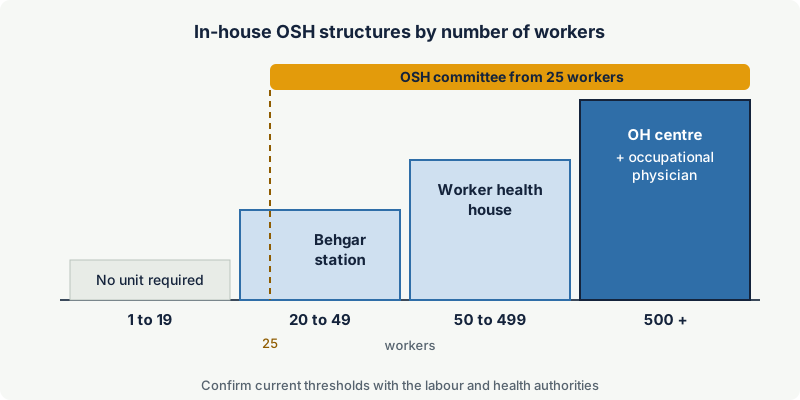
Many larger employers also appoint a safety officer (مسئول ایمنی). The 2025 national study links Article 93 to a requirement for workplaces with more than 25 workers to employ an OSH expert. The ministry instructions that set thresholds and qualifications could not be checked, so confirm them with the provincial labour office.
Medical surveillance rests on Article 92. Every worker exposed to occupational disease risks must have a medical file and be examined at least once a year, with the results recorded. If the medical board finds an occupational disease, or a risk of one, the worker must be moved to suitable work without loss of pay (Note 1). The Ministry of Labour must then re-inspect the workplace (Note 2).
Risk assessment and training
The Labour Law does not use the term "risk assessment". Its duties still require hazards to be identified and controlled. These include providing safety means (Article 91), testing harmful machinery (Article 89), monitoring exposed workers (Article 92) and the Ministry of Health's workplace measurements. A general statutory duty to keep a written risk assessment document, like the EU or Türkiye duty, could not be verified in an official Iranian text. Sector rules and client contracts, especially in oil, gas and petrochemicals, commonly require written hazard identification and HSE management systems. Writing the assessment down is good practice and helps an employer show compliance.
The training duty is in Article 91: workers must be taught how to use the safety and health means. The labour inspectorate also trains workers and employers (Article 96 (c)). No verified national table of training hours, like Türkiye's hours per hazard class, was found. Records of induction, task training and warnings support the Article 95, Note 2 defence.
Accident and occupational disease reporting
Article 95, Note 1 requires the employer to record every work accident in a special register in the format set by the Ministry of Labour. The employer must also inform the local labour office (اداره کار و امور اجتماعی) promptly and in writing. The Labour Law sets no number of hours. Studies differ slightly: a 2015 study based on Ministry of Labour data describes notice within three working days on special forms, and a 2025 study describes reporting to the Ministry of Labour or the Social Security Organization within 72 hours, using the Social Security Organization accident form for insured workers. Treat 72 hours as the outer limit. Labour inspectors, and often Social Security Organization teams, then investigate serious accidents.
Example: On a Sunday morning a fitter at a 60-worker workshop in Isfahan falls from a platform and fractures a wrist. The supervisor arranges first aid and hospital transfer, makes the platform safe and keeps the scene as it is. The OSH lead records the accident in the special register the same day and completes the Social Security Organization accident form. Written notice goes to the local labour office on Monday, well inside the 72 hours described in studies, and the committee (the workshop has more than 25 workers) reviews the root cause at its next meeting.
For occupational diseases the trigger is the medical finding under Article 92. The worker must be moved to other work, and the Ministry of Labour must re-inspect the workplace.
Penalties and liability
Fines are expressed as multiples of the worker minimum daily wage on the date of the judgment. The Supreme Labour Council sets the minimum wage every year (Article 41), so cash amounts change annually, and no current figure is given here. The court also sets a deadline to correct the breach. The table follows the Persian text of the law.
| Breach | Article | Fine (times the minimum daily wage) | Repeat offence |
|---|---|---|---|
| Safety means, training and supervision (Art. 91), hours in hazardous work, women and young workers (Arts. 52, 61, 75, 77, 79, 83, 84) | 176 | Per worker: 200 to 500 for the first 10; 20 to 50 for each from 11 to 100; 10 to 20 for each above 100 | Imprisonment 91 to 180 days |
| Medical files and annual examinations (Art. 92), young worker examinations (Arts. 80 to 82) | 175 | Per worker: 30 to 100 for the first 10; 10 to 30 for each from 11 to 100; 5 to 10 for each above 100 | 1.1 to 1.5 times the maximum fine, or 91 to 120 days |
| Plans for new workplaces, testing harmful machinery, approval of safety equipment (Arts. 87, 89, 90) | 177 | 91 to 120 days imprisonment or a fine of 300 to 1,500 times, by workplace size | Imprisonment 121 to 180 days |
| Obstructing inspectors or withholding information | 179 | 100 to 300 | Imprisonment 91 to 120 days |
When the employer is a company, compensation is paid from its assets, but the criminal penalty falls on the managing director or the manager who ordered the breach (Article 184). If a breach causes loss of a limb or death, the court must also decide the employer's other legal obligations (Article 171), in addition to liability under the general criminal law, including the Islamic Penal Code.
Chemicals, explosive atmospheres, major hazards and PPE
Chemicals and GHS. No national regulation adopting the UN Globally Harmonized System (GHS) could be verified from an official Iranian source. Chemical exposure falls under the Ministry of Health's exposure limits and measurement programme, and safety data sheets and GHS labels are widely requested in industrial supply. Importers should confirm current labelling rules with the Ministry of Health and the national standards body.
Explosive atmospheres and Ex equipment. No Iranian regulation like the EU ATEX directives, with zoning duties for employers and a separate conformity scheme for Ex equipment, could be verified. The general duties still apply: plan approval (Article 87), machine safety (Article 88) and the employer's duty to provide safe means (Article 91). National standards are issued by the Iranian National Standards Organization (سازمان ملی استاندارد ایران). Oil, gas and petrochemical projects usually set their hazardous-area classification and Ex certification requirements, often based on IEC 60079, in the project specification. Iran is listed as an IECEx member country, with the Iranian National Standards Organization as its member body. Which IEC 60079 parts are adopted as Iranian national standards, and whether a given client accepts IECEx certificates, could not be confirmed; suppliers should check the project specification.
Major-hazard sites. No regulation like Seveso III could be verified. According to the ILO's 2023 announcement, C155 was the first ILO OSH standard Iran ratified, so the Prevention of Major Industrial Accidents Convention, 1993 (No. 174) was not among its ratifications at that date. Plant safety is governed by the plan approval duty (Article 87), the protective regulations, inspector powers to close dangerous workplaces (Article 105) and sector rules for petroleum and petrochemical sites.
PPE. There is no CE-type conformity mark. Under Article 90, anyone who produces or imports safety and health equipment must first have its specifications and samples approved by the Ministry of Labour and the Ministry of Health.
Comparison with the EU and Türkiye
| Topic | Iran | EU | Türkiye |
|---|---|---|---|
| Main law | Labour Law 1990, Chapter 4 | Framework Directive 89/391/EEC, national laws | OSH Law No. 6331 (2012) |
| Enforcement | Ministry of Labour and Ministry of Health inspectors; criminal courts | National inspectorates | Ministry of Labour and Social Security inspectors |
| Written risk assessment | Not verified as a general statutory duty | Required for all employers | Required for all employers |
| OSH professional and physician | By workforce size (see table above) | Competent services required, details national | Required (Law 6331 Art. 6): own staff, an external OSH service, or in some small workplaces the qualified employer |
| Committee | Designated workplaces; described from 25 workers | National rules | 50 or more workers and continuous work lasting more than 6 months (Law 6331 Art. 22) |
| Accident reporting | Register plus prompt written notice; 72 h or 3 working days described in studies | National deadlines | Social Security Institution within 3 working days (Law 6331 Art. 14) |
| Ex atmospheres | No ATEX-type rules verified | Directives 1999/92/EC and 2014/34/EU | Regulations transposing both directives |
| Major hazards | No Seveso-type rules verified | Seveso III, 2012/18/EU | Regulation on major industrial accidents (BEKRA), 2019 |
Common mistakes
- Assuming an EU-style risk assessment document is all that inspectors check. Iranian inspectors focus on Article 91 means, medical files under Article 92, the accident register and committee records; keep all of them ready.
- Treating the 72-hour figure as written in the Labour Law. The law says "promptly, in writing"; studies quote 72 hours or three working days. Report at once and confirm the current form and deadline with the local labour office.
- Quoting fines from old articles. Fines are multiples of a minimum wage reset every year; work out the amount from the current wage decision.
- Bringing in PPE or safety devices without Article 90 approval. Imported protective equipment needs approval by both ministries, whatever certificates it holds abroad.
- Forgetting home workplaces and young workers. Chapter 4 covers home workplaces, and workers aged 15 to 18 need examinations at hiring and every year.
Frequently asked questions
Which ministry is the OSH regulator in Iran?
Two ministries share the role. The Ministry of Cooperatives, Labour and Social Welfare writes the technical protection rules through the High Council for Technical Protection and runs the labour inspectorate. The Ministry of Health and Medical Education is responsible for occupational health, medical surveillance and exposure limits.
Does Iran follow ILO Convention 155?
Yes. Iran ratified C155 and its 2002 Protocol on 7 February 2023, and both entered into force for Iran on 7 February 2024. According to the ILO, these were the first ILO OSH standards Iran ratified.
Can a labour inspector stop work in Iran?
Not by their own order. The inspector reports the danger in writing to the employer and to their superior, and at the ministry's request the local public prosecutor (or the public court) must immediately order all or part of the workplace closed and sealed until the hazard is removed (Article 105). Workers must be paid during the closure.
Are foreign contractors covered by the same rules?
Yes. The Labour Law applies to employers, workers and workplaces in general (Article 1), and foreign workers also need a work permit under Chapter 5. Foreign contractors should set up the register, medical files, committee and reporting channel from the first day on site.
Is there an Iranian equivalent of the CE mark for PPE?
No CE-type mark was identified. Producers and importers of safety and health equipment need prior approval of specifications and samples from the Ministry of Labour and the Ministry of Health (Article 90).
Related on excodex
- What is the main OSH law in Iran and who enforces it?
- How and within what time must a workplace accident be reported in Iran?
- What are the penalties for breaking occupational safety rules in Iran?
- How are explosive atmospheres and Ex equipment regulated in Iran?
- ILO OSH conventions, ratification and fundamental status
- OSH law comparison: appointments and reporting deadlines
Standards and further reading
- Labour Law of the Islamic Republic of Iran (قانون کار جمهوری اسلامی ایران), finally approved by the Expediency Council in November 1990 (Aban 1369), Chapters 3, 4 and 11. English translation and Persian original: Iran Data Portal, Syracuse University, Chapter 4, Chapter 11, Persian text (PDF).
- FAO legal database record of the Law on Labour, 1990: FAOLEX.
- ILO Occupational Safety and Health Convention, 1981 (No. 155) and Protocol of 2002; ratification news: ILO, 2023.
- National profile of OSH services in Iran (IRANOSH), BMC Public Health, 2025: PMC11995502.
- Reporting of occupational incidents in Iranian industries, BMC Public Health, 2025: PMC12754953.
- Occupational accident fatalities and injuries in Iran 2008 to 2012, Iranian Red Crescent Medical Journal, 2015: PMC4640057.
- Occupational health services in very small enterprises, Shiraz, Safety and Health at Work, 2016: PMC5127977.
- Occupational exposure limits for BTEX and styrene in West Asia, Archives of Industrial Hygiene and Toxicology, 2022: PMC9287831.
- Occupational hearing loss and job stress among industrial workers, Markazi Province, Scientific Reports, 2026: PMC13230754.
- IECEx member countries list (Iran: Iranian National Standards Organization): IECEx.
- Social Security Programs Throughout the World, Iran, 2018 (work injury: current law 1975, administered by the Social Security Organization): US Social Security Administration.
- IEC 60079 series, explosive atmospheres (equipment and installations); Iranian national adoption not verified.
- Could not be verified for this guide: the current Ministry of Labour safety officer instructions, the current accident report form and deadline, national GHS rules and Ex equipment approval practice. Official portals of the Ministry of Labour (mcls.gov.ir), the Ministry of Health and the Social Security Organization could not be reached.
This article is general occupational safety and health information prepared by the excodex editorial team. It does not replace the applicable legislation, standards, manufacturers' instructions or the assessment of a competent OSH professional or occupational physician.
Questions on this topic
- What is the main occupational safety and health law in Iran and who enforces it?
- Must an employer in Iran appoint a safety professional or an occupational physician?
- Is a written risk assessment mandatory in Iran, and how often must it be reviewed?
- How and within what time must a workplace accident be reported in Iran?
- What OSH training must employers provide to workers in Iran?
- Are pre-employment and periodic medical examinations required for workers in Iran?
- What are the penalties for breaking occupational safety rules in Iran?
- Is a safety committee or a worker safety representative required in Iran?
- How are explosive atmospheres and Ex equipment regulated in Iran?
- Which rules apply to major-hazard chemical sites in Iran?