Occupational safety International framework and country guides
Must an employer in Iran appoint a safety professional or an occupational physician?
Part of: Occupational safety and health in Iran: law, authorities and employer duties
Short answer
It depends on size. Iran requires a technical protection and occupational health committee with OSH specialists, described as from 25 workers. Health rules add in-house units by size, with an occupational health centre and physician from 500 workers.
Not in every workplace. In Iran the duty depends on the number of workers. The Labour Law requires a technical protection and occupational health committee, staffed with OSH specialists, in workplaces designated by the ministries, which published studies describe as those with 25 or more workers. Ministry of Health rules add in-house occupational health units by size, and an occupational physician is described as required from 500 workers.
Short answer
- Fewer than 20 workers: no in-house OSH unit is described as required. The employer still has all Article 91 duties and must arrange annual examinations for exposed workers (Article 92).
- 20 to 49 workers: a Behgar station (ایستگاه بهگر), a basic occupational health post run by a trained worker or technician.
- 25 or more workers: a technical protection and occupational health committee (کمیته حفاظت فنی و بهداشت کار) whose members include OSH specialists (Article 93).
- 50 to 499 workers: a worker health house (خانه بهداشت کارگری) for first aid, screening and workplace measurements.
- 500 or more workers: an occupational health centre (مرکز بهداشت کار) with an occupational physician, nurse and hygienist, plus a safety department.
- Safety officer: many employers appoint a safety officer (مسئول ایمنی) under Ministry of Labour instructions. The current thresholds could not be verified, so confirm them with the provincial labour office.
What the Labour Law itself requires
The Labour Law does not use the EU or Turkish model of a named "safety specialist" and "workplace physician" for every employer. Article 93 creates the technical protection and occupational health committee for workplaces that the Ministry of Labour and the Ministry of Health find need one. Its members are people qualified in technical protection, occupational health and the technical work of the site. Two of them, approved by the ministries, link the committee with the employer and the authorities. A 2025 national study and a 2019 study describe the committee as required in workplaces with 25 or more workers, and the 2025 study adds that it meets at least monthly. The 2025 study also reads Article 93 as requiring workplaces of that size to employ an OSH expert.
Medical examinations do not depend on size. Article 92 requires every workplace whose workers are exposed to occupational disease risks to keep a medical file for each of them and to have them examined at least once a year through health centres. In practice the Ministry of Health authorises general practitioners to carry out occupational examinations, and suspected cases go to occupational medicine specialists.
The size-based structure in Ministry of Health rules
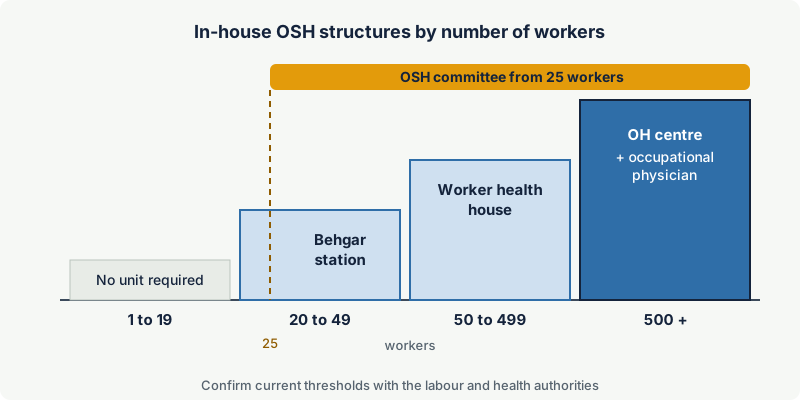
A 2016 peer-reviewed study describes the structure in the figure, and a 2025 national profile of OSH services confirms it. According to that profile, almost all workplaces with more than 25 workers had at least one OSH structure, and almost none of the smaller ones did. In those small workplaces, monitoring falls to Ministry of Health inspectors.
Example: A food plant with 120 workers on two shifts needs a worker health house, because it is in the 50 to 499 band, and a committee, because it has more than 25 workers. Workers exposed to noise or flour dust need a medical file and an annual examination. If the plant grows past 500 workers, it must plan for an occupational health centre with an occupational physician. Before relying on these bands, the employer confirms the current thresholds and staffing rules with the provincial health centre and the labour office.
Comparison with the EU and Türkiye
| Iran | EU (89/391/EEC) | Türkiye (Law 6331) | |
|---|---|---|---|
| Safety professional | Through the committee from 25 workers; safety officer under ministry instructions | Competent worker or external service | OSH specialist for every workplace (employee, joint OSH unit, or a qualified employer in some small workplaces; Law 6331 Art. 6) |
| Physician | Occupational health centre from 500 workers; authorised GPs examine | Health surveillance, national details | Workplace physician for every workplace, on the same terms (Law 6331 Art. 6) |
Common mistakes
- Assuming small workplaces need nothing. Below 20 workers there is no in-house unit, but the Article 91 duties and Article 92 annual examinations still apply.
- Using foreign qualifications without checking. Committee members and examining physicians must be acceptable to the Iranian ministries; confirm recognition early.
Related on excodex
- Occupational safety and health in Iran: law, authorities and employer duties
- Is a safety committee or a worker safety representative required in Iran?
- Are pre-employment and periodic medical examinations required for workers in Iran?
- OSH law comparison: appointments and reporting deadlines
Standards and further reading
- Labour Law of the Islamic Republic of Iran, 1990, Articles 91 to 93: English translation, Iran Data Portal.
- Occupational health services in self-employed enterprises, Shiraz, Safety and Health at Work, 2016: PMC5127977.
- National profile for OSH services in Iran (IRANOSH), BMC Public Health, 2025: PMC11995502.
- OSH conditions in small and medium enterprises, Shiraz, Annals of Global Health, 2019: PMC6634465.
This article is general occupational safety and health information prepared by the excodex editorial team. It does not replace the applicable legislation, standards, manufacturers' instructions or the assessment of a competent OSH professional or occupational physician.
More questions on this topic
- What is the main occupational safety and health law in Iran and who enforces it?
- Is a written risk assessment mandatory in Iran, and how often must it be reviewed?
- How and within what time must a workplace accident be reported in Iran?
- What OSH training must employers provide to workers in Iran?
- Are pre-employment and periodic medical examinations required for workers in Iran?
- What are the penalties for breaking occupational safety rules in Iran?
- Is a safety committee or a worker safety representative required in Iran?
- How are explosive atmospheres and Ex equipment regulated in Iran?
Part of: Occupational safety and health in Iran: law, authorities and employer duties