How do I know if my dust is combustible?
Abstract
You cannot tell from the product name or the safety data sheet. Treat any organic or metal dust as explosible until a laboratory screening test on a representative fine, dry sample shows otherwise; published data give an indication only.
You cannot tell from the name of the product, its appearance or its safety data sheet. Treat any dust of an organic material (food, wood, plastics, chemicals, coal) or of a metal as explosible until a laboratory screening test on a representative, fine and dry sample shows that it is not; published data are only an indication.
Short answer
- Almost all organic materials and many metals can form explosible dust clouds. Fully oxidised materials such as sand, limestone, cement and gypsum do not burn.
- The decisive test is a screening (go/no-go) test: a laboratory ignites a cloud of the dust and checks whether a flame spreads and the pressure rises.
- The sample must represent the worst case in your plant: dried fines from filters, ledges and transfer points, not only the bagged product.
- Databases such as GESTIS-DUST-EX give orientation, but each entry describes one tested sample.
- A safety data sheet that says nothing about explosion is not evidence of safety.
- A "not explosible" result applies to the sample tested; repeat the assessment when the product, grinding or drying changes.
Combustible and explosible are not the same thing
A dust can be combustible (it burns or glows when heated) without being explosible (able to carry a flame through a cloud and build up pressure). The German IFA, which runs the GESTIS-DUST-EX database, rates the burning behaviour of a heaped dust in burning classes and reports explosibility from a separate test.
For area classification the question is explosibility, because only an explosible dust forms an explosive atmosphere. A dust that only burns can still smoulder in layers and start fires, so housekeeping and hot surface limits still apply.
How a laboratory screens a dust
The screening test answers one question: does a cloud of this dust propagate a flame? Two apparatus are common:
| Apparatus | How it works | Result |
|---|---|---|
| Modified Hartmann tube (about 1.2 litres, open at the top) | Dust is blown up into a vertical tube past a continuous spark; if nothing happens, the test is repeated with a glowing wire coil | Flame propagation means explosible; no ignition is not proof of the opposite |
| 20 litre sphere (closed) | Dust is dispersed and ignited by chemical igniters at the centre; the pressure is recorded | A defined pressure rise means explosible |
The pass criteria come from the test method. The IFA's 20 litre explosibility test uses igniters of only 1 to 2 kJ and treats a pressure rise of 0.5 bar or more as explosible. ASTM E1226 (2012 edition) calls a dust explosible when it reaches a pressure ratio of 2.0 or more in any test, and the current edition warns that strong igniters can overdrive the small sphere, so marginal results are best confirmed in a 1 m³ vessel.
The IFA stresses a point that is often misunderstood: no ignition in the Hartmann tube only means no ignition under those conditions. It does not justify calling the dust non-explosible; a closed-vessel test is needed. The Irish Health and Safety Authority (HSA) calls the outcomes of this first step Group A (the cloud propagates flame) and Group B (it does not).
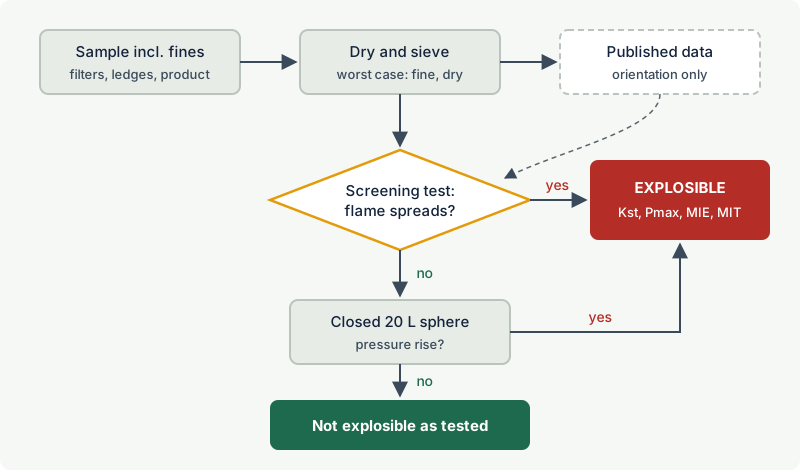
If the dust is explosible, the same laboratory can go on to measure Kst, Pmax, the minimum ignition energy and the minimum ignition temperatures, which you need for vent sizing and equipment selection. These are explained in Dust explosion parameters explained.
Getting a representative sample
Most wrong answers come from testing the wrong material. Plant dust is usually much finer than the product:
- Collect the fines. Take samples from filter hoppers, cyclone outlets, beams and ledges, sifters and transfer points, as well as the product itself.
- Prepare the worst case. ASTM E1226 (2012) recommends that the test sample be at least 95 % finer than 75 µm and contain no more than 5 % moisture. For ignition sensitivity, the HSA advises basing the assessment on the finest fraction, usually obtained by sieving through 63 µm.
- Do not rely on moisture. According to the IFA, water content plays hardly any role up to about 10 % by weight, and Pmax and Kst fall clearly only above about 20 to 30 %. Drying or warm storage can remove the water you counted on.
- Record what was tested: source, particle size distribution and moisture, so the result can be compared with your process later.
When published data are enough, and when they are not
Published values are a reasonable starting point when the material is a well-known explosible dust such as flour, sugar, starch, wood or aluminium powder: the answer "explosible" is not in doubt, and the next step is to classify areas and control ignition sources. The HSA notes that GESTIS-DUST-EX can serve for orientation, but where the properties of a powder are not known it will normally be necessary to have it tested.
Testing is needed when you want to conclude that a dust is not explosible, when the product is new or unusual, or when you need design values for vents, suppression or equipment temperatures. OSHA's guidance notes that dusts of the same chemical material can differ in explosibility, and cites a US Chemical Safety Board review in which 41 % of the safety data sheets examined did not warn of explosion hazards.
In Türkiye, the Regulation on the Protection of Workers from the Hazards of Explosive Atmospheres (Çalışanların Patlayıcı Ortamların Tehlikelerinden Korunması Hakkında Yönetmelik, Official Gazette 28633, 30 April 2013) requires the employer to assess explosion risks and prepare an explosion protection document. The Ministry of Labour and Social Security's implementation guide lists the dust properties that assessment needs, such as particle size, moisture, explosion limits, ignition energy and temperatures, and explosion class.
Common mistakes
- "It is a food product, so it cannot explode." Flour, sugar, starch and milk powder are classic explosible dusts.
- Testing the bagged product only. The fines in filters and on ledges are finer and drier, and they are what forms the cloud.
- Treating "no ignition" in an open tube as a final result. A closed-vessel test is needed before calling a dust non-explosible.
- Copying a value from a database for a different grade or supplier. Fineness and moisture can move a dust from one class to another.
Related on excodex
- What makes a dust explosive? Particle size, concentration and the dust explosion pentagon
- Dust explosion parameters explained: Kst, Pmax, St classes, MIE and minimum ignition temperatures
- Which dust test results do you need to select Ex equipment and size explosion vents?
- Are non-combustible dusts like cement or limestone an ATEX concern?
- Standards spaces: IEC 60079-10-2, Turkish explosive atmospheres regulation
Standards and further reading
- ISO/IEC 80079-20-2, combustible dusts test methods (ignition temperatures, minimum ignition energy, resistivity and screening).
- EN 14034 series, explosion characteristics of dust clouds (Pmax, Kst, lower explosion limit, limiting oxygen concentration).
- ASTM E1226, standard test method for explosibility of dust clouds, including the explosibility screening (current edition E1226-19, reapproved 2025): store.astm.org
- IFA, explanation of the GESTIS-DUST-EX characteristics and test methods: dguv.de (PDF); database: staubex.ifa.dguv.de
- Health and Safety Authority (Ireland), ATEX guide on combustible dust: hsa.ie
- OSHA 3371, Hazard communication guidance for combustible dusts (2009): osha.gov (PDF)
- Ministry of Labour and Social Security (Türkiye), implementation guide on protecting workers from explosive atmospheres: csgb.gov.tr (PDF)
This article is general technical information prepared by the excodex editorial team. It does not replace the applicable standards, the equipment certificates and instructions, national regulations or the assessment of a competent person.