Why can an St 1 dust still cause a devastating explosion?
Abstract
Because St 1 only means a Kst of up to 200 bar·m/s, a measure of how fast pressure rises. St 1 dusts such as flour, sugar and starch still reach about 7 to 10 bar in a closed vessel, far more than any building or ordinary plant can withstand.
Because the St class measures only how fast the pressure rises, not how high it goes or how much dust is involved. St 1 means a deflagration index Kst of more than 0 and up to 200 bar·m/s. St 1 dusts such as flour, sugar, starch, wood and coal still reach explosion pressures of about 7 to 10 bar in a closed vessel, while buildings and ordinary process equipment fail at a small fraction of 1 bar; the sugar dust that destroyed the Port Wentworth refinery in 2008 was an St 1 material.
Short answer
- St 1 is a severity class for venting design, not a risk rating. It sorts dusts by Kst: St 1 above 0 up to 200, St 2 above 200 up to 300, St 3 above 300 bar·m/s.
- Pressure is similar across the classes. Tested St 1 samples reach 8 to 10 bar (for example wheat flour 8.3 bar, maize starch 9.5 bar, lignite 10.0 bar); a fine St 3 aluminium powder reaches about 13 bar.
- Damage starts far lower. Published blast damage tables link about 0.07 bar with houses partly demolished and about 0.14 to 0.2 bar with unreinforced block walls shattering.
- Most of the damage comes from the amount of dust. Secondary explosions fed by settled dust in a building do the real destruction, whatever the St class.
- St 1 says nothing about ignition. Some St 1 dusts ignite with sparks of a few millijoules.
What the St class actually measures
Kst is the maximum rate of pressure rise measured in a closed test vessel, normalised to a volume of 1 m³ (in bar·m/s). The IFA, which runs the GESTIS-DUST-EX database, defines the dust explosion classes purely from this number. A higher Kst means a faster explosion, which needs a larger vent area or a faster suppression system. That is what the class is for: sizing explosion protection.
The class says nothing about the maximum explosion pressure Pmax. Some St 1 samples from GESTIS-DUST-EX:
| Material (one tested sample) | Pmax | Kst | Class |
|---|---|---|---|
| Beet sugar | 8.2 bar | 59 bar·m/s | St 1 |
| Wheat flour | 8.3 bar | 87 bar·m/s | St 1 |
| Maize starch | 9.5 bar | 141 bar·m/s | St 1 |
| Lignite | 10.0 bar | 151 bar·m/s | St 1 |
| Aluminium powder, for comparison | 13.0 bar | 600 bar·m/s | St 3 |
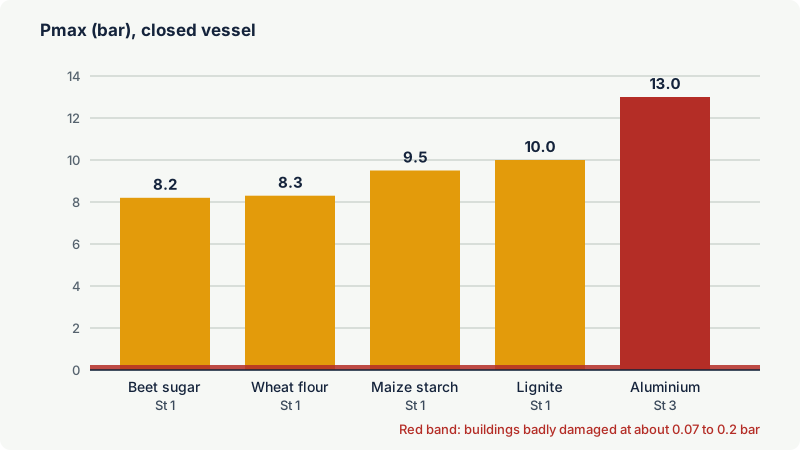
Pmax is measured in a closed vessel, so it is the pressure a fully enclosed volume would see. A real building or filter housing never holds that pressure: it bursts long before. The NOAA overpressure table, based on loss-prevention literature, associates about 1 psi (0.07 bar) with houses partly demolished and 2 to 3 psi (0.14 to 0.2 bar) with unreinforced concrete or cinder block walls shattering. An St 1 explosion therefore has tens of times more pressure available than a building can contain. Slower pressure rise only makes it somewhat easier to vent; it does not make an unprotected explosion survivable.
Why buildings are destroyed: the amount of fuel
The destructive dust explosions in industry are rarely limited to the equipment where they start. A primary explosion inside a conveyor, filter or mill shakes loose dust that has settled on floors, beams and equipment, and the following flame ignites this much larger cloud. OSHA describes such secondary explosions as potentially far more destructive than the primary one. The energy released depends on how much dust is raised, not on whether its Kst is 80 or 280.
Practical case: Port Wentworth, Georgia, 2008. The US Chemical Safety Board (CSB) concluded that the first explosion occurred in a steel belt conveyor under two sugar silos, where recently installed cover panels had let sugar dust build up to explosive concentrations, most likely ignited by an overheated bearing. It lofted sugar dust and spilled sugar in the packing buildings and triggered a cascade of secondary explosions that largely destroyed them; 14 workers died. CSB tests on the plant's powdered sugar gave a Kst of 139 bar·m/s, well inside St 1, and a maximum pressure of 7.5 bar. The CSB also noted that the sugar industry had known about dust explosion hazards since at least 1925.
Other reasons not to relax with St 1
- Kst belongs to one sample. Finer, drier material or the fines collected in a filter can have a higher Kst than the product data sheet suggests. HSE guidance reports wheat dust and flour samples from 53 to 137 bar·m/s, and GESTIS-DUST-EX lists the beet sugar sample above as St 1 from its Kst but adds a bracketed "(St 2)" from a screening test; a dust near 200 may be St 2 in another batch.
- Ignition can be easy. A lycopodium sample with Kst 119 (St 1) ignited between 5 and 10 mJ, a range reached by a spark from a charged person. Ignition sensitivity is described by the minimum ignition energy and ignition temperatures, not by the St class.
- Plant turbulence is not test turbulence. Kst is measured under standardised turbulence. In a building, a pressure wave and obstacles can accelerate the flame.
- Protection is still required. Vent, suppression and isolation designs for St 1 dusts are smaller, not absent. HSE guidance on bucket elevators, for example, gives a simple venting arrangement for dusts with Kst up to 150 and still requires vents.
Common mistakes
- Reading "St 1" as "weakly explosible, so low risk". Labels such as "weak explosion", which the CSB report's table attaches to St 1, describe the rate of pressure rise only.
- Skipping housekeeping because the dust is St 1. Settled St 1 dust fuels the same secondary explosions as any other dust.
- Using a supplier's St class for a different grade or for filter fines without checking that the sample is representative.
Related on excodex
- Dust explosion parameters explained: Kst, Pmax, St classes, MIE and minimum ignition temperatures
- Dust layers and housekeeping: how thick is too thick?
- What do Kst and Pmax tell you about a dust explosion?
- Why is a secondary dust explosion usually worse than the first?
- What caused the Port Wentworth sugar refinery explosion in 2008?
Standards and further reading
- EN 14034-1 and EN 14034-2, determination of the maximum explosion pressure and the maximum rate of pressure rise of dust clouds; ASTM E1226, the corresponding US method.
- EN 14491 and NFPA 68, explosion venting (vent area depends on Kst and Pmax).
- IFA, explanation of dust explosion classes in GESTIS-DUST-EX: staubex.ifa.dguv.de, and sample entries for wheat flour, beet sugar, maize starch and lignite (for example wheat flour)
- HSE, HSG103 Safe handling of combustible dusts (Kst data for wheat flour, bucket elevator venting): hse.gov.uk (PDF)
- NOAA, overpressure levels of concern (damage table): response.restoration.noaa.gov
- US Chemical Safety Board, Port Wentworth sugar refinery investigation report (sugar test data, Kst classes): csb.gov (PDF), and final report news release: csb.gov
- OSHA, combustible dust in industry (secondary explosions): osha.gov
This article is general technical information prepared by the excodex editorial team. It does not replace the applicable standards, the equipment certificates and instructions, national regulations or the assessment of a competent person.