What is the difference between dust cloud ignition temperature and layer ignition temperature?
Abstract
The cloud value is the lowest hot-surface temperature that ignites a dispersed dust cloud (furnace test); the layer value is the lowest hot-plate temperature that ignites a 5 mm deposit. The layer value is usually lower, and equipment must stay below both limits.
The cloud ignition temperature is the lowest temperature of a hot surface that ignites the most ignitable mixture of the dust dispersed in air, measured in a furnace in a few seconds of contact. The layer ignition temperature is the lowest temperature of a hot plate that ignites a 5 mm thick deposit of the same dust, observed for up to two hours. Because a layer insulates itself and has time to self-heat, its ignition temperature is usually lower, sometimes by 150 K or more, and equipment in dust areas must respect both: no more than two thirds of the cloud value and, where layers can form, no more than the 5 mm layer value minus 75 K.
Short answer
- Cloud value: furnace test, Godbert-Greenwald (G-G) vertical furnace or BAM oven, in ISO/IEC 80079-20-2. In the samples below, 380 to 600 °C.
- Layer value: 5 mm layer on a temperature-controlled hot plate, same standard; the result is also called the glowing temperature. In the samples below, about 225 to 310 °C for coal, lignite and wood, far lower than their cloud values.
- Not always lower. Some dusts melt or do not glow up to the test limit; reports then say "melts" or "no glowing up to ... °C".
- Thicker layers ignite lower. ASTM data for one bituminous coal: about 300 °C at 6.4 mm, about 210 °C at 25.4 mm.
- Both set the maximum surface temperature of equipment (IEC 60079-14); the lower of the two limits governs.
How the two tests work
Cloud. In the G-G furnace a small amount of dust, about 0.1 to 3.5 g according to the IFA, is blown down through an electrically heated vertical tube 36 mm wide and 400 mm long. The furnace temperature is lowered until no flame appears below the tube over a range of dust quantities. In the BAM oven the dust is blown against a heated impact plate in a horizontal oven; dust that settles there can smoulder, so the IFA notes that BAM values may be lower than G-G values. The dust touches the hot surface only briefly: ASTM points out that the cloud is exposed for a matter of seconds.
Layer. A ring of dust 5 mm deep is placed on a hot plate held at constant temperature. The IFA describes a plate 185 mm in diameter with a sample circle of 100 mm. The lowest plate temperature at which parts of the layer glow or burn within two hours is the result. A layer is a poor conductor of heat, so heat produced by slow oxidation inside it cannot escape; the temperature inside rises until it runs away. That is why the layer test usually gives a lower value, and why thicker layers, which insulate better, ignite at lower temperatures still.
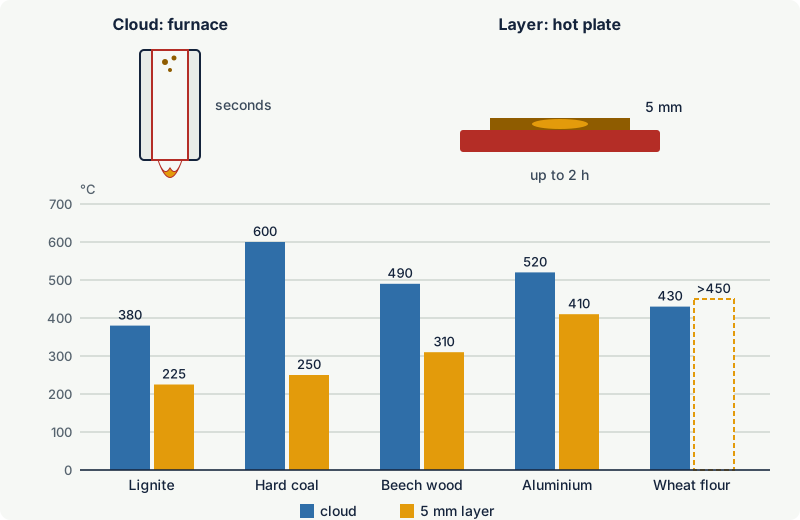
Typical values side by side
| Material (one tested sample, GESTIS-DUST-EX) | Cloud (G-G) | 5 mm layer |
|---|---|---|
| Lignite | 380 °C | 225 °C |
| Hard coal | 600 °C | 250 °C |
| Beech wood dust | 490 °C | 310 °C |
| Aluminium powder | 520 °C | 410 °C |
| Wheat flour | 430 °C | no glowing up to 450 °C |
| Beet sugar | 470 °C | melts |
HSE guidance gives the same picture as a rough indication: layer ignition temperatures of many natural products exceed 300 °C, and cloud ignition temperatures are usually higher. Values belong to the tested sample; fineness and moisture change them.
How the two values are used together
IEC 60079-14 limits the maximum surface temperature of equipment in explosive dust atmospheres in two ways, and the lower result applies:
- Cloud limit: at most two thirds of the cloud ignition temperature (in °C). The margin covers the idealised furnace test and longer contact in real plant.
- Layer limit: at most the 5 mm layer ignition temperature minus 75 K, where layers up to 5 mm can form. Thicker layers need a further reduction, and for very thick layers or equipment that can be buried in dust the limit must be found by testing.
Worked example (hard coal sample above).
- Cloud limit: 2/3 × 600 °C = 400 °C
- Layer limit: 250 °C - 75 K = 175 °C
- The layer limit governs: equipment must be marked with a maximum surface temperature of no more than 175 °C, for example
T135 °C. Looking only at the cloud value would have allowed equipment more than 200 K too hot.
For the wheat flour sample the opposite holds: the cloud limit, 2/3 × 430 = about 287 °C, is lower than any layer limit (the layer did not glow up to 450 °C, so its limit is at least 375 °C). For a melting dust such as sugar, the cloud limit is normally used, but deposits that melt and char on hot surfaces deserve a separate look.
Common mistakes
- Using only the cloud value, which is the one most often quoted on data sheets. For coals, lignite and wood the layer limit is much lower.
- Comparing G-G and BAM values as if they were the same test.
- Ignoring layers thicker than 5 mm, on top of motors and in corners that are rarely cleaned; the 75 K margin assumes no more than 5 mm.
- Choosing equipment by gas temperature class (T1 to T6) instead of the maximum surface temperature in °C marked for dust.
Related on excodex
- Dust explosion parameters explained: Kst, Pmax, St classes, MIE and minimum ignition temperatures
- Surface temperature limits for dust: the two-thirds cloud rule and the 75 K layer margin
- What does T135 °C on dust equipment mean and is it a temperature class?
- What if the dust layer on equipment is thicker than 5 mm?
- Standards space: IEC 60079-14
Standards and further reading
- ISO/IEC 80079-20-2:2016, combustible dusts test methods: definitions and tests for the cloud and layer minimum ignition temperatures (revision in progress): sample pages
- IEC 60079-14, electrical installations design, selection and erection, with the surface temperature limits for dust.
- ASTM E1491 (cloud) and ASTM E2021 (hot-surface ignition of dust layers; the linked 2009 summary gives the coal data, current edition E2021-15, reapproved 2023): E2021 summary, E1491 summary
- IFA, explanations of the cloud ignition temperature and the glowing temperature in GESTIS-DUST-EX: cloud, layer
- HSE, HSG103 Safe handling of combustible dusts (hot surfaces and layers): hse.gov.uk (PDF)
This article is general technical information prepared by the excodex editorial team. It does not replace the applicable standards, the equipment certificates and instructions, national regulations or the assessment of a competent person.