What is the difference between a DSEAR risk assessment and hazardous area classification?
Abstract
A DSEAR risk assessment (regulation 5) covers all fire and explosion risks from dangerous substances at work. Hazardous area classification (regulation 7) is one part of it: it zones the places where an explosive atmosphere may occur, to control ignition sources.
A DSEAR risk assessment is the whole assessment of fire and explosion risks from dangerous substances at work, required by regulation 5 of the Dangerous Substances and Explosive Atmospheres Regulations 2002. Hazardous area classification is one specific part of it, required by regulation 7: it divides the places where an explosive atmosphere may occur into zones. A zone drawing on its own is therefore not a DSEAR assessment, and a DSEAR assessment of a site with explosive atmospheres is incomplete without one.
Short answer
- DSEAR risk assessment (regulation 5): identifies the dangerous substances, how they are used, stored and moved, what could go wrong, the likely ignition sources, the scale of a fire or explosion, and the measures to eliminate or reduce the risk. It applies to fire as well as explosion.
- Hazardous area classification (regulation 7 and Schedule 2): answers one question for explosive atmospheres only: where, how often and for how long can a flammable gas, vapour, mist or dust cloud be present? The answer is a set of zones (0, 1, 2 for gas; 20, 21, 22 for dust).
- The zones then drive equipment selection (Schedule 3), warning signs (Schedule 4) and ignition source control. Regulation 5(4)(c) requires the zones to be included in the recorded findings.
- Some sites need a DSEAR assessment but no zones at all, for example where only flammable liquids well below their flash point, or substances that are hazardous only in a fire, are present.
- With five or more employees, the significant findings must be written down (regulation 5(4)).
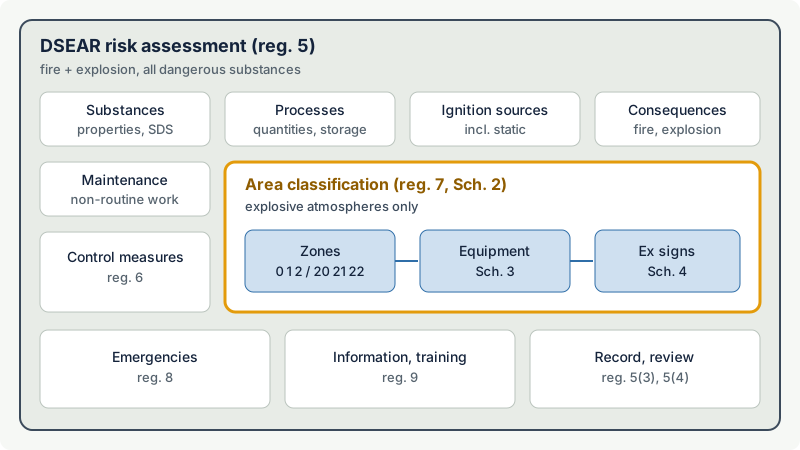
What a DSEAR risk assessment covers
Regulation 5(2) lists what the assessment must consider. In plain terms:
- the hazardous properties of each substance and the supplier's safety information, including the safety data sheet;
- the work processes, quantities, interactions between substances, and arrangements for handling, storage, transport and waste;
- activities with a potential for high risk, such as maintenance;
- the likelihood that an explosive atmosphere will occur and how long it will persist;
- the likelihood that ignition sources, including electrostatic discharges, will be present and active;
- the scale of the anticipated effects of a fire or explosion;
- places connected by openings to places where explosive atmospheres may occur;
- the effect of the control measures already taken or planned.
The assessment then feeds the other duties: elimination or reduction of risk (regulation 6, substitution first, then control and mitigation), arrangements for accidents, incidents and emergencies (regulation 8), information and training (regulation 9), identification of hazardous contents of containers and pipes (regulation 10) and coordination between employers sharing a workplace (regulation 11). Since 1 June 2015 DSEAR has also covered substances that are corrosive to metals and gases under pressure, which have nothing to do with zones.
What hazardous area classification covers
Classification is a technical study, normally done to IEC 60079-10-1 for gases and vapours and IEC 60079-10-2 for dusts, or to an industry code such as EI 15 or IGEM/SR/25. It lists the sources of release, grades them, assesses ventilation and estimates how far the flammable cloud extends. Its output is a drawing and schedule of zones.
It deliberately leaves things out. HSE notes that zone definitions take no account of the consequences of a release, and that catastrophic failures such as vessel or line rupture are not considered in an area classification study; they belong in a process hazard analysis such as a HAZOP. Classification also does not, on its own, deal with fire risks, runaway reactions, mechanical ignition sources outside the zones, emergency arrangements or training.
| Question | DSEAR risk assessment | Area classification |
|---|---|---|
| Legal basis | Regulation 5 (and 6, 8 to 11) | Regulation 7(1), Schedule 2 |
| Hazards | Fire, explosion, similar energetic events, corrosion to metals, gases under pressure | Explosive atmospheres of gas, vapour, mist or dust only |
| Events | Normal operation, maintenance, foreseeable failures and accidents | Normal operation and foreseeable secondary releases; not catastrophic failures |
| Output | Findings, control measures, emergency plans, training needs | Zone drawings and schedule of sources |
| Typical author | Duty holder with competent help | Competent area classification specialist |
How the two fit together in practice
The usual sequence is: inventory the dangerous substances; decide whether any can form an explosive atmosphere; classify those areas into zones; select and verify equipment for the zones; then assess remaining ignition sources, consequences and emergency measures for the whole site. Before a workplace containing hazardous places is first used, regulation 7(4) requires a competent person to verify its overall explosion safety.
Example: A small paint store holds solvent-based coatings in closed tins, and a mixing room decants solvents. The DSEAR assessment covers both rooms, fire spread, spill handling, waste rags, training and the fire plan. Area classification is needed only where vapour can form an explosive atmosphere: around the decanting point and inside the mixing vessels. The closed-tin store may end up with no zone at all, yet it still sits in the DSEAR assessment as a fire risk.
DSEAR implements two EU worker protection directives: 1999/92/EC on explosive atmospheres and 98/24/EC on chemical agents. The equipment directive 2014/34/EU is not part of DSEAR; Great Britain implements it through separate equipment regulations. In the EU, the counterpart of the recorded DSEAR findings is the Explosion Protection Document under Directive 1999/92/EC, which also contains the zone drawings as one part.
Common mistakes
- Treating a zone drawing as "the DSEAR assessment". Without the substance review, ignition source assessment, consequences and emergency measures it does not meet regulation 5.
- Treating a generic risk assessment as enough where explosive atmospheres exist. Regulation 5(4)(c) expects the zones to be recorded.
- Forgetting maintenance and non-routine work. Regulation 5(2) names high-risk activities such as maintenance; the zone drawing covers normal operation.
- Never revisiting either part. Regulation 5(3) requires review when there is a significant change or reason to think the assessment is no longer valid.
Related on excodex
- The Explosion Protection Document (EPD) and area classification drawings under ATEX 1999/92/EC
- ATEX explained: the two EU directives 2014/34/EU and 1999/92/EC in plain language
- What is the difference between ATEX and DSEAR in the UK?
- Who is legally responsible for hazardous area classification under ATEX?
- Standards space: IEC 60079-10-1, ATEX 1999/92/EC
Standards and further reading
- IEC 60079-10-1, Explosive atmospheres, classification of areas, explosive gas atmospheres; IEC 60079-10-2, the same for combustible dust atmospheres.
- Dangerous Substances and Explosive Atmospheres Regulations 2002, regulation 5 (risk assessment): legislation.gov.uk
- DSEAR regulation 7 (places where explosive atmospheres may occur): legislation.gov.uk
- DSEAR Schedule 2 (classification into zones): legislation.gov.uk
- HSE, DSEAR overview of employer duties: hse.gov.uk
- HSE, INDG370 Controlling fire and explosion risks in the workplace: hse.gov.uk
- HSE, Hazardous area classification and control of ignition sources: hse.gov.uk
- HSE, offshore notice on DSEAR and the two directives it implements: hse.gov.uk
This article is general technical information prepared by the excodex editorial team. It does not replace the applicable standards, the equipment certificates and instructions, national regulations or the assessment of a competent person.