Is an explosion-proof (Ex d) enclosure gas-tight?
Abstract
No. A flameproof (Ex d) enclosure is not gas-tight: gas enters through its joints and by breathing, so an explosion can happen inside. The enclosure is built to withstand that explosion, and its flamepaths cool the escaping gases so they cannot ignite the atmosphere outside.
No. A flameproof (Ex d) enclosure, often called explosion-proof, is not gas-tight and is not designed to be. Gas from the surrounding atmosphere gets in through the joints, entries and breathing, so an explosive mixture can form inside and be ignited by the equipment. The protection works because the enclosure withstands that internal explosion and its flamepaths stop the flame from reaching the atmosphere outside.
Short answer
- The IEC definition of a flameproof enclosure "d" assumes an internal explosion: the enclosure must withstand its pressure and prevent its transmission to the surrounding explosive atmosphere.
- Flamepaths (cover flanges, spigots, shaft passages, threads) are narrow, long gaps, not seals. Their maximum gap and minimum width are set by IEC 60079-1 for the gas group and are fixed on the certificate drawings.
- Gas enters by diffusion through these gaps and by "breathing": as the enclosure warms and cools, air and gas are pushed out and drawn back in.
- Gaskets or O-rings may be added against water and dust, but IEC 60079-1 treats them only as a supplement; they are not part of the flamepath and do not make the enclosure a sealed device.
- Concepts that do limit gas entry exist, such as restricted breathing (Ex nR, Zone 2 only), pressurisation (Ex p) and encapsulation (Ex m). Ex d is not one of them.
How a flameproof enclosure works if gas is inside
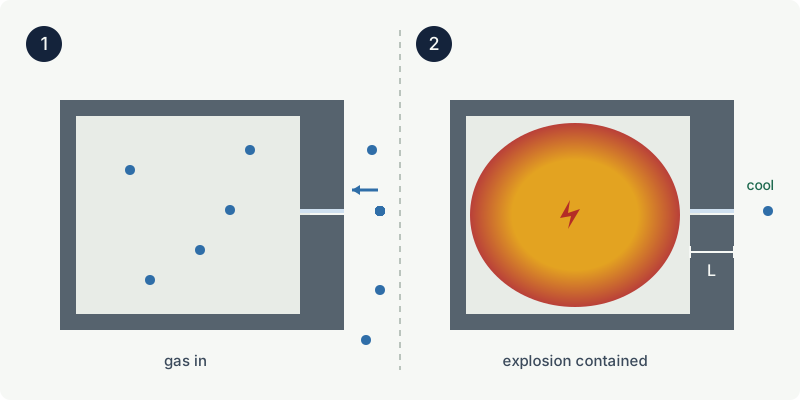
Inside the enclosure there are contactors, relays, terminals or a motor winding: normal industrial parts that spark or get hot. Ex d accepts this and adds two properties:
- Strength. The enclosure is tested with an internal explosion to find the reference pressure, then overpressure tested at 1.5 times that pressure (or 4 times if it is not routinely tested in production) without permanent deformation.
- Non-transmission. Every route to the outside is a flameproof joint. Hot gases forced through the gap lose heat to the metal walls of the joint, so what leaves the outer edge is too cool to ignite the atmosphere. The type test ignites a test mixture inside an enclosure placed in the same mixture, and the outside must not ignite.
The joint is deliberately left open to do this. If an internal explosion met a truly sealed box, the full pressure would have to be held by the walls. A flameproof joint lets a small amount of cooled gas escape while the flame stays inside.
What "not gas-tight" means in practice
- The inside atmosphere follows the outside one. A 2005 comparison report for the US Mine Safety and Health Administration put it plainly: explosion-proof enclosures are not necessarily gas-tight, methane can diffuse in through very small openings, and heating and cooling during operation make them breathe. Given time, the mixture inside can therefore approach the one outside.
- Condensation. Breathing also draws in humid air. Water collects inside, especially outdoors and offshore. Flameproof breathing and draining devices are certified flamepath elements for this purpose, and IEC 60079-17 asks inspectors to check that breathing, draining and heating devices work.
- Opening the cover removes the protection. With the cover off, the parts inside are directly exposed to any gas around them. Isolation before opening is therefore essential.
- An Ex d enclosure is not a gas container. It is not intended to hold process gas or to separate a process from the atmosphere. Where process fluids could reach an enclosure, for example through instrument connections or cable cores, a process seal is a separate design question.
Common mistakes
- Adding silicone or extra gaskets to "seal" the joints. This can hold the gap open or change its behaviour. It does not create a gas-tight enclosure and it is not covered by the certificate.
- Assuming IP66 or IP67 means gas-tight. An ingress protection rating describes protection against water and solid particles, not against gas.
- Treating "explosion-proof" as "explosion cannot happen inside". It means the explosion is contained, not prevented.
- Opening an enclosure in a hazardous area because it "was sealed". The gas inside may already be explosive.
Related on excodex
- Flameproof enclosures (Ex d): how flamepaths stop an internal explosion
- Ex protection concepts at a glance: d, e, i, p, m, o, q, n and t
- Are explosion-proof and flameproof the same thing?
- Is an IP67 enclosure the same as an explosion-proof enclosure?
- Standards space: IEC 60079-1
Standards and further reading
- International Electrotechnical Vocabulary 426-06-01, flameproof enclosure "d": electropedia.org; 426-06-02, flameproof joint: electropedia.org; 426-06-05, width of flameproof joint: electropedia.org; 426-13-11, restricted-breathing enclosure "nR": electropedia.org
- IEC 60079-1:2014 (edition 7), flameproof enclosures "d": gaskets as a supplement, breathing and draining devices, overpressure test; publicly available as incorporated by reference: law.resource.org. A 2026 edition has since been published.
- IEC 60079-17, inspection and maintenance (current edition 2023); the 2007 edition, adopted in India as IS/IEC 60079-17, includes the check of anti-condensation devices: law.resource.org
- Part 6 equivalency review and comparison of MSHA and IEC explosion-proof enclosure standards (December 2005, archived MSHA report): library.unt.edu
This article is general technical information prepared by the excodex editorial team. It does not replace the applicable standards, the equipment certificates and instructions, national regulations or the assessment of a competent person.