How close can a wall or pipe be to the flange of an Ex d enclosure?
Abstract
Unless the certificate states a smaller tested distance, keep solid objects that are not part of the equipment at least 10 mm from a flameproof flanged joint opening in IIA areas, 30 mm in IIB and 40 mm in IIC (IEC 60079-1, applied at installation by IEC 60079-14).
A flanged flamepath of a flameproof (Ex d) enclosure must not be installed closer to a solid object that is not part of the equipment than 10 mm in a IIA area, 30 mm in a IIB area and 40 mm in a IIC area. The only exception is equipment that was tested with a closer obstacle: its certificate, and possibly its nameplate, then gives the smaller permitted distance. The rule covers walls, steelwork, pipes, cable trays, brackets, weather shields and neighbouring equipment.
Short answer
- Minimum distances from a flanged joint opening: IIA 10 mm, IIB 30 mm, IIC 40 mm.
- Source: IEC 60079-1 (table of minimum distances of obstructions from flanged openings, values as in the 2014 edition, which IEC 60079-1:2026 replaced in October 2026); IEC 60079-14:2024 applies the same table at installation, related to the gas group of the hazardous area.
- Which joints: flanged (flat, plane) joints. Spigot, threaded and cylindrical joints are not covered by this table, but read the manufacturer's instructions.
- Exception: if the equipment passed its flame transmission tests with an obstacle closer than the table value, the certificate states that smaller distance and the equipment may carry an informative marking saying how far the flanged joints must be kept from solid objects.
- Measured from: the outer edge of the flange gap, where hot gas would leave the joint, to the nearest solid surface in front of it.
Why a nearby surface matters
When gas ignites inside a flameproof enclosure, hot burnt gas is pushed out through every flamepath. A flanged joint is designed so that the gas loses its heat to the metal faces and leaves the joint too cool to ignite the atmosphere outside. That design and its type tests assume the gas can leave freely and mix with the surrounding air.
A solid surface close to the gap changes this. The jet hits the obstacle, is deflected and can be held in a small pocket of hot gas next to the joint, where it ignites the outside mixture more easily than in free air. The effect is stronger for gases that ignite easily and burn fast, which is why the required distance grows from IIA to IIC.
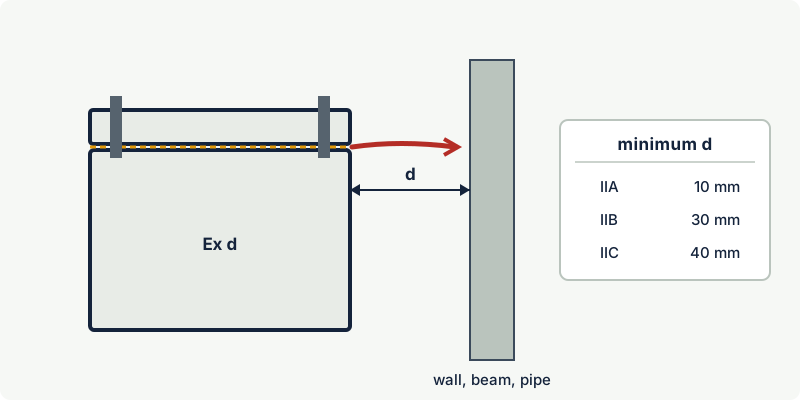
IEC 60079-1 builds this into certification: if the manufacturer wants a closer mounting, the flame transmission test is done with the obstacle at that distance, and the certificate records the tested minimum.
Applying the rule on site
| Gas group of the area | Minimum distance from flanged joint | Example gases |
|---|---|---|
| IIA | 10 mm | propane, methane, toluene |
| IIB | 30 mm | ethylene |
| IIC | 40 mm | hydrogen, acetylene |
- Use the gas group of the area, not only the group on the nameplate. A
IICenclosure installed in a IIA area needs 10 mm; the same enclosure in a hydrogen area needs 40 mm. - Check the certificate and instructions for a stated minimum distance or specific conditions of use (an "X" certificate).
- Check every side with a flange. Covers on the back or underside of an enclosure mounted on a wall or channel are the usual problem.
- Include later additions. Insulation, new pipework, cable trays, sun shades and weather canopies are often added after commissioning and end up against a flange.
- Record it. The inspection schedule of IEC 60079-17 for Ex d equipment includes a check that obstructions next to flameproof flanged joints comply with IEC 60079-14, at visual, close and detailed grades (2007 edition schedule), and IEC 60079-14:2024 now contains initial inspection schedules taken from IEC 60079-17 (informative Annex O). Note the measured distance where it is close to the limit.
Example: A flameproof junction box Ex db IIC T6 Gb is to be bolted to a steel column in a hydrogen compressor house (IIC). Its cover flange faces the column. The installer fits a stand-off bracket so that the flange edge is at least 40 mm from the steel. In a neighbouring IIA area, the same box on the same type of column needs only 10 mm, unless its certificate states otherwise.
Common mistakes
- Mounting the enclosure flat against a wall or beam. Even if the flange is not visibly blocked, the rear flange gap is then at zero distance.
- Counting only walls. Pipes, conduit, cable glands of neighbouring equipment and weather shields are solid objects too.
- Wrapping the flange with tape to keep water out. Codes restrict this to a single layer of non-hardening tape, generally only in IIA, and never in IIC; it does not replace the obstruction distance. See painting or sealing Ex d joints.
- Ignoring the certificate. Some products are tested for zero or reduced distances; others carry specific mounting conditions.
Related on excodex
- Flameproof enclosures (Ex d): how flamepaths stop an internal explosion
- Ex installation basics under IEC 60079-14
- How are flamepath gaps on an Ex d enclosure checked during inspection?
- Is a flameproof enclosure still safe if one cover bolt is missing?
- Standards spaces: IEC 60079-1, IEC 60079-14
Standards and further reading
- IEC 60079-1:2014, flameproof enclosures "d": table of minimum distances of obstructions from flanged openings, tested-distance rule and informative marking (replaced by IEC 60079-1:2026; 2014 text incorporated by reference in US federal regulations): law.resource.org
- IEC 60079-14:2024 (edition 6), electrical installations design, selection and installation; contains the table of minimum distances of obstruction from flameproof flange joints related to the gas group of the area (public preview of contents): standards.iteh.ai
- IEC 60079-17, inspection and maintenance of electrical installations; Table 1 of the 2007 edition (as adopted in India, IS/IEC 60079-17:2007) lists the obstruction check for Ex d: archive.org
This article is general technical information prepared by the excodex editorial team. It does not replace the applicable standards, the equipment certificates and instructions, national regulations or the assessment of a competent person.