How long must a pressurised enclosure be purged before switching on?
Abstract
For the minimum time at the minimum flow stated by the manufacturer on the label or certificate, set by test or, where IEC 60079-2 allows, as five enclosure volumes of protective gas. Add five volumes of any external ducting. The purge restarts if flow or pressure fails.
For the minimum purge time at the minimum purge flow that the manufacturer specifies for that enclosure. IEC 60079-2 has the manufacturer set these values by a purge test or, where the standard allows, on the basis of five enclosure volumes of protective gas. The user adds the time needed to pass at least five times the volume of any external ducts, and the purge must be completed again whenever the enclosure has been opened or its overpressure has dropped below the minimum.
Short answer
- The purge time and flow come from the equipment documentation, not from a general rule. For pyb and pzc they are written on a warning label ("purged for ... minutes at a flow rate of ...").
- Without a test, the basis is five enclosure volumes: allowed for pxb and pyb where judged adequate, and the default for pzc. It is not used for rotating machines or complex internal geometries.
- External supply and exhaust ducts that are not part of the certified equipment need extra time: at least five of their volumes at the minimum flow.
- For pxb a controller times the purge only while minimum flow and overpressure are both proved, and restarts from zero if either fails.
- With inert protective gas, IEC 60079-14 (2007 text) recommends always purging again after a pressure loss, to restore the low oxygen level.
Where the purge time comes from
The purge must flush out any flammable gas that may have entered while the enclosure was unpressurised. IEC 60079-2 leaves the figure to the manufacturer and gives two ways to set it.
By test. The enclosure is filled with a test gas to at least 70 % and then purged at the minimum flow, with samples taken where gas is most likely to linger. To cover all gases, the test is done with helium (light gases) and with argon or carbon dioxide (heavy gases), and the purge time is the time until no sample point exceeds 1 % helium or 0.25 % argon or carbon dioxide, roughly 25 % of the lower flammable limit (LFL) of light and heavy gases. With inert protective gas, the criterion is no more than 2 % oxygen.
By five enclosure volumes. Where a test is not made, the purge is based on a quantity of protective gas equal to five enclosure volumes. With ideal mixing, five volume changes leave about 0.7 % of the original concentration (e^-5). Real enclosures have corners and compartments that mix poorly, which is why the rule is not used for rotating machines or complex geometries and why IEC 60079-2 wants internal compartments vented to the main enclosure or purged separately.
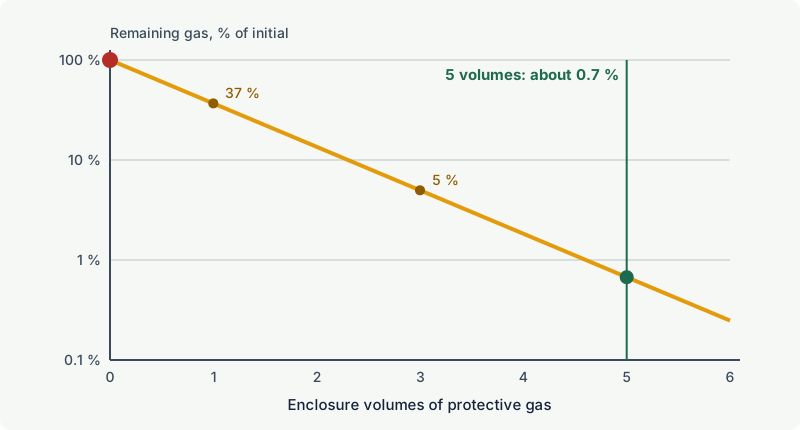
Where the enclosure has an internal source of release, such as an analyser, the purge is set by test and IEC 60079-2 adds margins (for example, 1.5 times the measured time in some inert gas cases).
How the purge is controlled in practice
| Level | Purge verification | What the operator does |
|---|---|---|
| pxb (Zone 1, ordinary equipment) | Timer plus monitoring of pressure and actual outlet flow; power is released automatically only after the full purge | Start the sequence; any failure resets it to the beginning |
| pyb (Zone 1, Zone 2 equipment inside) | Time and flow marked on the label | Purge for the marked time at the marked flow before switching on |
| pzc (Zone 2, ordinary equipment) | Time and flow marked on the label | As pyb |
For pyb and pzc the flow may be deduced from the enclosure pressure and a defined outlet orifice; for pxb the actual flow at the outlet must be monitored.
IEC 60079-14 (2007 edition, as published in AS/NZS 60079.14:2009) also allows the purge to be omitted for locations requiring EPL Gc if the concentration inside the enclosure and its ducts is shown to be well below the LFL, for example 25 % of the lower explosive limit, and notes that gas detectors may be used to check this. Check the edition that applies to your installation before relying on it.
Worked example: pzc cabinet with a supply duct
A pzc cabinet measures 0.8 m × 0.6 m × 0.3 m inside. Its label reads "purged for 24 minutes at a flow rate of 30 L/min", which matches five volumes. Air comes from the safe area through 6 m of 50 mm duct that is not part of the certified equipment.
- Cabinet: 0.8 × 0.6 × 0.3 = 0.144 m³ = 144 L; five volumes = 720 L; at 30 L/min, 24 min.
- Duct: π × 0.025² × 6 ≈ 0.0118 m³ ≈ 12 L; five volumes ≈ 60 L; at 30 L/min, 2 min.
- Purge before switching on: at least 26 min at 30 L/min or more, with doors closed.
A higher flow does not automatically allow a shorter time; follow the manufacturer's instructions on that point.
Common mistakes
- Starting the clock before the flow is established, or counting time while a door is still open.
- Ignoring the ducts. Long supply or exhaust ducts can add more volume than the enclosure itself.
- Skipping the purge after a short pressure dip. A drop below the minimum overpressure means a new purge, unless the conditions allowed by the installation standard are confirmed.
- Using the purge time of a similar enclosure instead of the one on its own label or certificate.
Related on excodex
- Pressurisation (Ex p): px, py and pz, purging and protective gas
- What happens if the purge pressure is lost in an Ex p enclosure?
- Can nitrogen or instrument air be used for Ex p pressurisation?
- Standards spaces: IEC 60079-2, IEC 60079-14
Standards and further reading
- IEC 60079-2, equipment protection by pressurised enclosure "p" (purging criteria, purge tests, user information on ducting); current edition 6.0 (2014).
- IEC 60079-14, design, selection and installation (purging, ducting, action on pressure failure).
- IEC 60079-2:2014 text: law.resource.org
- IEC 60079-14:2007 as AS/NZS 60079.14:2009: archive.org
- SafeWork NSW TestSafe, pressurisation levels: nsw.gov.au
This article is general technical information prepared by the excodex editorial team. It does not replace the applicable standards, the equipment certificates and instructions, national regulations or the assessment of a competent person.