What happens if the purge pressure is lost in an Ex p enclosure?
Abstract
A safety device detects the drop below the minimum overpressure. In Zone 1 an enclosure holding ordinary equipment must alarm and switch off automatically; in Zone 2, or with Zone 2 equipment inside, an alarm followed by immediate operator action is the minimum.
A safety device detects that the overpressure has fallen below its minimum (50 Pa for pxb and pyb, 25 Pa for pzc), and then the installation must act. Whether that action is an automatic switch-off or an alarm depends on the zone and on what is inside: in Zone 1, an enclosure holding ordinary (non-Ex) equipment must alarm and switch off automatically; in Zone 2, or where the contents already meet EPL Gc, an alarm followed by immediate action by the operator is the minimum.
Short answer
- The pressure sensor reads the enclosure directly, with no valve between them, and operates below the minimum overpressure set by IEC 60079-2. A pzc enclosure may instead use a pressure indicator combined with an alarm on the protective gas supply.
- IEC 60079-2 leaves the use of that signal (alarm or disconnection) to the user; IEC 60079-14 sets the minimum action.
- Zone 1 (EPL Gb) with ordinary equipment inside: alarm and automatic switch-off. Zone 1 with contents that meet EPL Gc on their own: alarm. Zone 2 (EPL Gc) with ordinary equipment: alarm. Zone 2 with EPL Gc contents: no action required.
- An alarm only counts if someone acts on it at once: restore the protective gas or switch the equipment off.
- Before power comes back, the enclosure is purged again as the manufacturer specifies; for pxb the controller does this automatically.
Why the response depends on the zone and the contents
Pressurisation keeps the outside atmosphere away from equipment that could ignite it. When the overpressure goes, that segregation goes too, and gas from the surroundings can drift in through leaks at doors and glands. How quickly this becomes dangerous depends on two things.
The zone. In Zone 1 an explosive atmosphere is expected from time to time in normal operation, so gas can reach a sparking contactor or a hot power supply soon after the pressure is lost. In Zone 2 gas is present only rarely and briefly, so an ignition needs a second, independent failure on top of the lost pressure.
The contents. A pyb enclosure, or any enclosure whose contents are already suitable for Zone 2 (for example Ex ec, Ex nR or Ex ic items), does not hold equipment that ignites gas in normal operation. Losing the pressure reduces its protection from EPL Gb to roughly EPL Gc, not to nothing.
Combining both gives the table of minimum actions in IEC 60079-14 for enclosures without an internal source of release:
| Location requires | Contents not meeting EPL Gc without pressurisation | Contents meeting EPL Gc without pressurisation |
|---|---|---|
| EPL Gb (Zone 1) | Alarm and automatic switch-off | Alarm |
| EPL Gc (Zone 2) | Alarm | No action required |
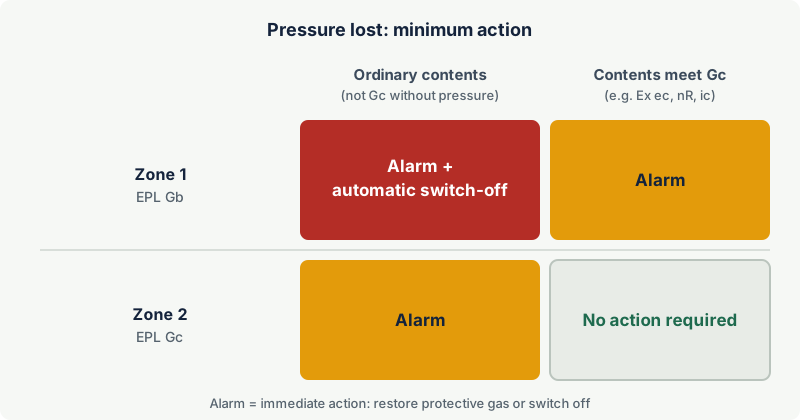
The table follows the IEC 60079-14 text as adopted in AS/NZS 60079.14:2009 (based on the 2007 edition). The 2024 edition still has a clause on the action to be taken on failure of pressurisation; check its wording for your project. In practice, a pxb enclosure is the "ordinary equipment" column and is usually installed in Zone 1, which is why pxb systems are normally wired to trip; pyb and pzc enclosures sit in the "alarm" cells.
What happens in practice
Automatic switch-off (typical pxb in Zone 1). The purge controller opens the supply contactor or breaker to the protected equipment. IEC 60079-14 notes that an extra alarm may not be needed for safety once the power is switched off automatically, but operators usually want one so they know why the plant stopped.
Alarm only (Zone 2, or Gc contents). The alarm goes to a place where it is seen. Someone must then restore the protective gas (check the supply, filters, regulator, door seals) or switch the equipment off. An alarm that rings in an empty control room for hours is not protection.
Equipment that stays live. Items that are not switched off with the rest, such as anti-condensation heaters, clocks or certain communication circuits, must themselves be suitable for the location outside the enclosure. IEC 60079-14 also warns about flammable material trapped inside enclosed components, and asks for a device that slows the entry of the outside atmosphere where internal parts would be hot enough to ignite it after a pressure failure.
When a trip is more dangerous than the gas. If switching off would create a greater hazard, for example stopping a control system the process depends on, IEC 60079-14 asks for other precautions instead, such as a duplicated protective gas supply.
Restart. IEC 60079-2 requires the manufacturer to state the purge conditions needed after the overpressure has dropped below the minimum. For pxb the controller enforces the full purge sequence automatically before power can return; for pyb and pzc a label tells the operator to purge for a stated time at a stated flow before restoring power.
Bypass keys and maintenance switches
Many purge controllers have an override that keeps the enclosure energised without pressure, for example with the door open during fault-finding. IEC 60079-14 allows this only while the specific location has been assessed as gas-free, in practice confirmed by gas detection under a permit. If gas is detected while the override is in use, the enclosure must be switched off at once and purged again before being put back into service.
Pressurised rooms and analyser houses follow the same idea under IEC 60079-13 with their own rules: for level pb, equipment without a suitable EPL is switched off automatically unless operation continues under defined administrative controls, and for pc power may stay on for a limited time.
Common mistakes
- Wiring a pxb trip to alarm only because "Zone 1 is rarely gassy". In Zone 1 ordinary equipment needs automatic switch-off.
- Proving pressure from the fan. A running fan motor does not prove enclosure pressure; a slipping belt or a reversed fan leaves the motor running with no overpressure.
- Leaving the bypass key in after maintenance, which turns the enclosure into an unprotected cabinet.
- Re-energising straight after the pressure returns without the purge the certificate requires.
Related on excodex
- Pressurisation (Ex p): px, py and pz, purging and protective gas
- Pressurised rooms and analyser houses: making an area non-hazardous by ventilation
- How long must a pressurised enclosure be purged before switching on?
- Can an ordinary electrical panel be made suitable for Zone 1 by pressurising it?
- Standards spaces: IEC 60079-2, IEC 60079-14, IEC 60079-13
Standards and further reading
- IEC 60079-2, equipment protection by pressurised enclosure "p" (safety devices, minimum overpressure, purge after loss of pressure).
- IEC 60079-14, design, selection and installation of electrical installations (action on failure of pressurisation).
- IEC 60079-13, equipment protection by pressurised room "p" and artificially ventilated room "v".
- IEC 60079-2:2014 text, incorporated by reference in US federal regulations: law.resource.org
- AS/NZS 60079.14:2009 (IEC 60079-14:2007 with national modifications), action on failure of pressurisation: archive.org
- IEC 60079-14:2024 preview with contents (clause on failure of pressurisation): standards.iteh.ai
- IEC 60079-13:2017 text: law.resource.org
- SafeWork NSW TestSafe, pressurisation levels pxb, pyb and pzc: nsw.gov.au
This article is general technical information prepared by the excodex editorial team. It does not replace the applicable standards, the equipment certificates and instructions, national regulations or the assessment of a competent person.