What is an ignition hazard assessment for non-electrical equipment?
Abstract
It is the documented analysis required by ISO 80079-36: the manufacturer lists every ignition source the equipment itself could create, checks it in normal operation and in expected and rare malfunctions, records the protective measures and derives the EPL.
An ignition hazard assessment is the formal, documented analysis that ISO 80079-36 requires for non-electrical equipment such as pumps, fans, gearboxes, couplings and mixers. The manufacturer identifies every ignition source the equipment itself could create, decides whether each one could become effective in normal operation, in expected malfunctions or in rare malfunctions, records the measures that prevent this, and derives the Equipment Protection Level (EPL) from the result. The report is the core of the technical file behind an Ex h marking.
Short answer
- Required by: ISO 80079-36:2016, the basic standard for non-electrical Ex equipment, for every item with its own potential ignition source. ISO 80079-37 (types "c", "b" and "k") applies only after this assessment.
- Done by: the equipment manufacturer, as part of the design. It is not the same as the employer's workplace risk assessment under Directive 1999/92/EC.
- What is checked: all ignition sources, from hot surfaces, mechanical sparks and static electricity to adiabatic compression and exothermic reactions, plus reasonably foreseeable misuse.
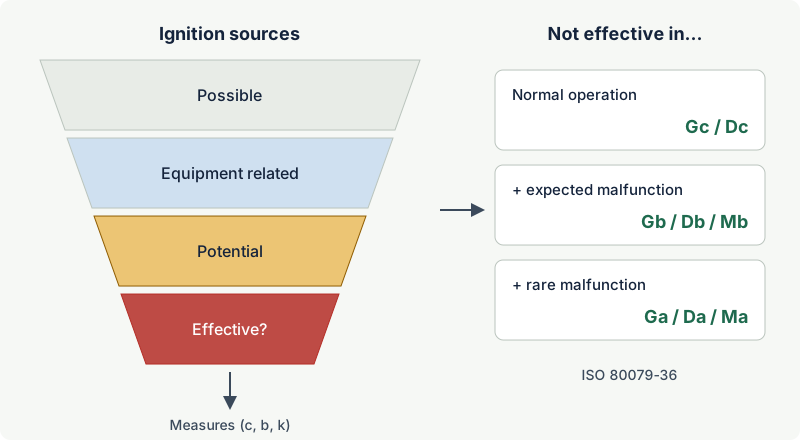
- Result: EPL Gc/Dc (no effective source in normal operation), Gb/Db/Mb (also safe in expected malfunctions) or Ga/Da/Ma (also safe in rare malfunctions).
- Output: a written report with the measures, the remaining hazards that the user must handle and any limits of use, carried into the instructions.
How the assessment works, step by step
ISO 80079-36 narrows the field in stages. A possible ignition source is any type that has to be considered. It is equipment related if this particular equipment could cause it, potential if it could actually ignite the explosive atmosphere, and effective if it can do so given when it occurs: in normal operation, in an expected malfunction (a disturbance that normally happens in practice) or in a rare malfunction (one that happens only seldom). Two independent expected malfunctions that only ignite together count as one rare malfunction.
The standard's informative Annex B describes four steps, with recommended table layouts for the report:
- Identify the ignition hazards and their causes for the equipment.
- Make a first assessment: in which condition (normal operation, expected or rare malfunction) could each source become effective?
- Define protective measures for the sources that need them.
- Make the concluding estimate and set the EPL and category.
Measures follow a fixed order of preference: first make the ignition source unlikely to arise, then make it unlikely to become effective, then keep the explosive atmosphere away from it, and only last contain an explosion and stop flame propagation. Where a measure relies on a sensor or control, such as a bearing temperature switch, it belongs to control of ignition sources "b" in ISO 80079-37; construction measures such as clearances, seals and lubrication belong to constructional safety "c".
What the report must contain
The assessment rests on basic information: a description of the equipment, its intended use, materials, drawings, assumptions (loads, safety factors, duty cycle), calculation and test results, and the installation, operation and maintenance requirements. The report itself then records:
- the hazards identified and their causes;
- the assessment of each one and the measures applied;
- the final result and the resulting EPL;
- remaining hazards that need action by the user;
- safety-related limits on intended use, such as maximum process temperature or speed.
Annex C of ISO 80079-36 includes worked examples, among them a pump and an agitator. Under the IECEx scheme, conformity is reported in a test report form that follows the standard clause by clause.
Worked example: a pump for Zone 1
A simplified illustration for a centrifugal pump intended for a IIB solvent in Zone 1 (target EPL Gb):
| Ignition source | When it could occur | Measure | Remains effective? |
|---|---|---|---|
| Hot bearing | Expected malfunction (lubrication loss) | Bearing design and lubrication interval (c); or temperature sensor with trip (b) | No |
| Impeller rubbing the casing | Expected malfunction (bearing wear) | Clearances and material pairing chosen to avoid friction sparks and hot spots (c) | No |
| Mechanical seal running dry | Expected malfunction | Seal type suited to dry running, or dry-running protection named in the instructions | No, if the user installs it |
| Hot surface from the pumped liquid | Normal operation | Maximum liquid temperature for each temperature class given in the instructions | No, within the stated limits |
| Static charge on plastic parts | Normal operation | Conductive materials or limited charging areas | No |
Two of the measures depend on the user (dry-running protection and the liquid temperature), so they go into the instructions as specific conditions of use, flagged by the symbol "X" after the certificate reference or by a warning marking. Because the surface temperature depends mainly on the pumped liquid, ISO 80079-36 does not let the manufacturer mark a single temperature class: the marking shows a range, for example II 2 G Ex h IIB T6...T4 Gb, and the instructions give the liquid temperature allowed for each class. For ATEX category 2 non-electrical equipment, the manufacturer uses internal production control and lodges the technical file with a notified body; no EU-type examination certificate is required.
Common mistakes
- Treating the assessment as a tick list of ignition source types. Every source must be linked to a cause, a condition (normal, expected, rare) and a measure.
- Forgetting process-related heat. A pump surface heated by the liquid it moves is part of the assessment, and each temperature class holds only up to the liquid temperature stated for it.
- Leaving user-dependent measures out of the instructions. A dry-running protection that exists only in the designer's head protects nobody.
- Confusing it with the workplace explosion risk assessment. The plant operator still classifies zones and assesses the installation; the manufacturer's report covers the equipment.
Related on excodex
- Non-electrical equipment in hazardous areas: Ex h, constructional safety c, control of ignition sources b and liquid immersion k
- Ignition sources in hazardous areas: the 13 ignition sources and how to control them
- Does the ATEX directive apply to non-electrical equipment such as pumps, fans and gearboxes?
- Do pumps, gearboxes and fans need ATEX certification?
- Standards spaces: ISO 80079-36, ISO 80079-37; tool: Ex marking check
Standards and further reading
- ISO 80079-36:2016, non-electrical equipment for explosive atmospheres, basic method and requirements (definitions of ignition sources and malfunctions, assessment procedure, report): public copy
- ISO 80079-37:2016, non-electrical types of protection: constructional safety "c", control of ignition source "b", liquid immersion "k": sample pages
- EN ISO 80079-36:2016 preview with European marking examples such as
Ex h IIB T4 Gb: normoff.gov.sk - IECEx test report form for ISO 80079-36:2016 (IECEx TRF 80079-36, 2022): IEC webstore
- European Commission, ATEX 2014/34/EU Guidelines, 6th edition (January 2026), sections on non-electrical equipment and own ignition sources: ec.europa.eu
This article is general technical information prepared by the excodex editorial team. It does not replace the applicable standards, the equipment certificates and instructions, national regulations or the assessment of a competent person.