What bonding resistance is needed to control static electricity in hazardous areas?
Abstract
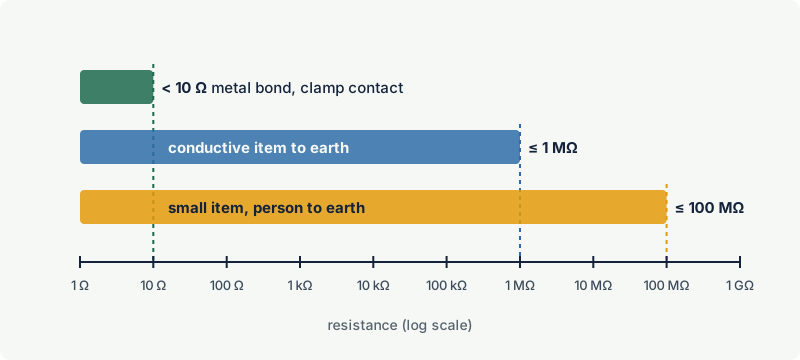
To drain static charge, a conductive item needs at most about 1 MΩ (10^6 Ω) to earth, up to 100 MΩ in favourable cases. Metal-to-metal bonds are normally tested to below 10 Ω, because a higher value reveals corrosion or a poor connection long before static control fails.
For static electricity alone, a conductive item is adequately earthed if its resistance to earth is no more than about 1 MΩ (10⁶ Ω), and up to 100 MΩ (10⁸ Ω) can be enough for small items with low charging currents. In practice, all-metal bonding and earthing connections are tested against a much lower figure, usually 10 Ω, because a sound metal joint measures only a few ohms and a higher reading signals corrosion, paint or a loose connection. The two numbers answer different questions and both are used.
Short answer
- Static drainage criterion: up to 10⁶ Ω (1 MΩ) to earth for conductive items, as given in IEC TS 60079-32-1 and German TRGS 727.
- Relaxed case: up to 10⁸ Ω where the charging current is below 1 µA and the item's capacitance below 100 pF (TRGS 727).
- Metal-to-metal bonds: normally below 10 Ω; a higher value should be investigated, even though it would still drain static.
- Temporary clamps (drums, road tankers, IBCs): clamps must bite through paint and rust to make an interface resistance below 10 Ω.
- People: TRGS 727 limits the resistance from a person to earth to 10⁸ Ω in Zones 0, 1 and 20 (and in Zone 21 for dusts with a minimum ignition energy of 10 mJ or less), achieved through dissipative footwear and floors.
- Not the same as power earthing: fault protection and lightning protection need far lower resistances; meeting them also satisfies static control.
Why 1 MΩ is enough for static
Static charge builds up when charge arrives on an isolated conductor faster than it can leak away. The voltage reached is roughly the charging current multiplied by the resistance to earth. Charging currents in industrial processes range from about 10 pA to 100 µA. Taking 100 V as a safe ceiling (in normal industrial operations an incendive discharge needs at least about 300 V), the highest current of 100 µA gives a maximum resistance of 1 MΩ. Most operations produce no more than 1 µA on items below 100 pF, which is why 100 MΩ can be acceptable there.
Why metal bonds are still tested to 10 Ω
Metal in good contact rarely measures more than a few ohms, so a reading of hundreds or thousands of ohms on a bolted flange or a bonding strap means something is wrong: a painted face, corrosion, a missing star washer or a broken braid. The joint may still drain static today, but it is likely to get worse. Guidance therefore separates two ideas:
| Value | What it represents | Typical use |
|---|---|---|
| Below 10 Ω | Integrity of a metal-to-metal connection | Bonding jumpers, flange bonds, tank and pipework bonding, clamp contact |
| Up to 1 MΩ | Upper limit to earth for draining static from a conductor | Conductive items not directly bolted to earthed metal, dissipative hoses and paths |
| Up to 100 MΩ | Upper limit for small items with low charging current; person to earth | Small parts below 100 pF; footwear and floor combination for people |
The UK HSE guidance on storage of flammable liquids in tanks recommends bonding all metal parts of the installation together and earthing them with a maximum resistance to earth of 10 Ω, with the earthing arranged so it can be disconnected for periodic testing.
Example: A drum filling station is checked before use. The earthing clamp on a painted steel drum reads 3 Ω to the earth bar after the clamp teeth bite through the paint: accepted. A stainless filling lance connected through a dissipative hose reads 400 kΩ to earth: below 1 MΩ, accepted for static. A flange bond on the supply line reads 150 Ω: it would still drain static, but it is investigated, the faces are cleaned and a new jumper is fitted, after which it reads 0.5 Ω.
Where bonding does not help
Bonding removes charge only from conductors. Insulating liquids, powders, plastic containers, liners and coated surfaces cannot be earthed by a clamp; their charge must be controlled by limiting flow velocity, allowing relaxation time, using dissipative materials or avoiding insulating items in the zone. These measures are covered in IEC TS 60079-32-1 and in the excodex guide on static electricity.
Common mistakes
- Using 10 Ω as the static criterion and condemning a 1 MΩ path. A dissipative hose or footwear path is meant to be in the kilo-ohm to mega-ohm range.
- Accepting a high reading on metal because "1 MΩ is fine". On a metal joint it shows a defect that will worsen.
- Testing with the clamp on a clean lug instead of the drum surface. The contact through paint and rust is what counts.
- Assuming the power earth covers mobile items. Drums, trolleys and tankers need their own bonding.
Related on excodex
- Earthing, bonding and equipotential bonding in hazardous areas
- Static electricity as an ignition source: charging, discharges and bonding
- Does every Ex enclosure need its external earth terminal connected?
- Standards space: IEC 60079-14
Standards and further reading
- IEC TS 60079-32-1:2013+AMD1:2017, explosive atmospheres, electrostatic hazards, guidance: IEC webstore
- TRGS 727 (Germany), avoidance of ignition hazards due to electrostatic charges, section 8 earthing and equipotential bonding: bgn-branchenwissen.de; section 7 on people (footwear, floors): bgn-branchenwissen.de
- Radu et al., "Aspects of earthing of installations in environments with potentially explosive atmospheres", Annals of the University of Petrosani, Electrical Engineering 26 (2024), summary of IEC TS 60079-32-1 and NFPA 77 values: paper
- HSE HSG176, the storage of flammable liquids in tanks (2nd edition, 2015), paragraph 152: hse.gov.uk
- IET Wiring Matters, "Earthing and bonding in hazardous locations" (quoting the former BS 5958-1): theiet.org
- J. Smallwood, "IEC 60079-32-1: the new standard on avoidance of electrostatic hazards", IChemE Hazards 25 (2015): icheme.org
- NFPA 77, recommended practice on static electricity
This article is general technical information prepared by the excodex editorial team. It does not replace the applicable standards, the equipment certificates and instructions, national regulations or the assessment of a competent person.