What does the 'R' marking on repaired Ex equipment mean?
Abstract
An R plate shows Ex equipment was repaired under IEC 60079-19 by a named facility. R in a square: repaired to the manufacturer's certified drawings or specification. R in an inverted triangle: repaired to the type of protection standard, without full proof against those drawings.
An "R" on a separate plate next to the nameplate means the Ex equipment has been repaired or overhauled under IEC 60079-19 by the service facility named on that plate. The frame around the R shows the basis of the repair: an R in a square means the work followed the manufacturer's certified (Schedule) drawings or specification; an R in an inverted triangle means the equipment was restored to the requirements of its type of protection standard, but the repairer did not have full evidence of compliance with the certificate drawings. Both symbols mean the equipment was released as fit for its original Ex use.
Short answer
- The symbols and the plate content are defined in the normative Annex A of IEC 60079-19 (Equipment repair, overhaul and reclamation), current edition 5.0 of July 2025.
- R in a square: repair to the Schedule Drawings, related drawings or manufacturer's specification. The 2025 edition makes this the first option and does not allow repair to the standard alone when Schedule Drawings are available.
- R in an inverted triangle: repair to the relevant type of protection standards, with the original certification label left in place.
- The repair plate supplements the original nameplate and certificate number; it never replaces them.
- Equipment that complies neither with its certificate documents nor with the type of protection standard is not released for Ex use: the 2006 text required its Ex marking to be removed or made clearly invalid, and the 2025 edition has its own Annex A provision for this case.
- The label points to a repair record (the user report). The inspector checks that record, not only the symbol.
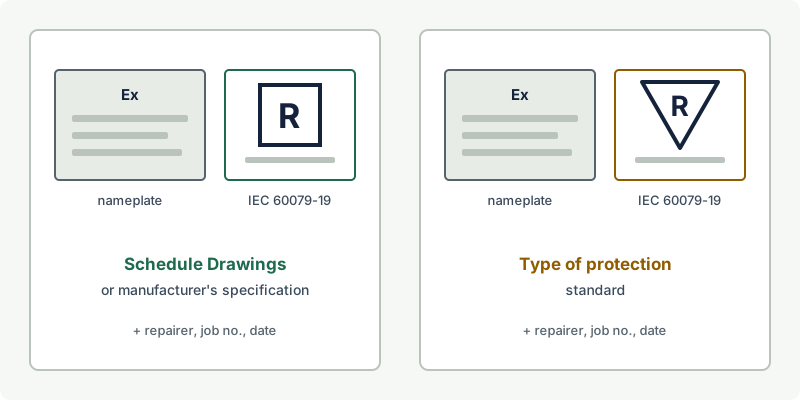
What each repair symbol tells you
The R does not mean "re-certified" and it does not lower or raise the protection level. The public text of the 2006 edition says in a note that the markings exist for the benefit of later repairers, and that the only difference between them is the method of compliance. In other words, the symbol tells the next workshop which documents the last one worked to.
| Symbol | Basis of the repair | Original Ex nameplate |
|---|---|---|
| R in a square | Manufacturer's Schedule Drawings, related drawings or specification; the repairer has evidence of full compliance | Stays, still valid |
| R in an inverted triangle | Type of protection standard the equipment was built to (or, if unknown, the current editions), without full evidence against the certificate drawings | Stays |
| Not compliant (2006 text: Ex marking removed or altered) | Equipment no longer meets its certificate or its type of protection standard | Removed or made clearly invalid; not for hazardous areas |
The 2025 edition reorganised the status of repaired equipment into five cases: repair to Schedule Drawings (the first option), repair to the relevant standards, repair with expert evaluation, legacy Group II and III equipment evaluated by the user under IEC 60079-17, and equipment not in compliance. Annex A gives the marking for each route and was amended "to clarify marking requirements". Where a plate uses a symbol or wording you do not recognise, take its meaning from the edition of IEC 60079-19 named on the plate and from the repair report.
What a repair plate must show
The public 2006 text of Annex A asks for a legible, durable marking on the main part of the equipment, in a visible place, giving:
- the repair symbol;
- the standard number "IEC 60079-19" or the national equivalent;
- the name or registered trade mark of the repairer, and its workshop certification if any;
- the repairer's reference number for the job;
- the date of the repair or overhaul.
At the next repair the old repair plate is replaced and its content recorded. A triangle is not upgraded to a square just because the equipment went back to a workshop: the 2006 text keeps the triangular symbol on later plates unless the repairer restores the whole item to full conformity with the certification documents.
How an inspector should treat an R label
Finding an R plate during an IEC 60079-17 inspection is normal and is not a defect. Check that:
- The original nameplate is still present and readable, and its marking suits the zone, gas group and temperature class.
- The repair plate identifies the facility, the job number and the date, and the user report for that job is on file in the installation's documents.
- Any X conditions of the original certificate, and any conditions stated in the repair report, are still met.
- For an inverted triangle, the report says what differs from the certificate drawings (for example a reclaimed dimension) so that later repairs and inspections can take it into account.
If an item carries a marking or report saying it is not suitable for hazardous areas, or its Ex marking has been removed, it must be taken out of the zone.
Common mistakes
- Reading the triangle as "uncertified". It means repaired to the standard, not to the drawings; the equipment was released for Ex use.
- Removing the original nameplate when fitting the repair plate. The certificate number and marking must stay with the equipment.
- Accepting a symbol without a report. The label is only the index; the record of what was done is the evidence.
Related on excodex
- Repair, overhaul and modification of Ex equipment (IEC 60079-19)
- Can a motor rewound by a general workshop still be used in a hazardous area?
- What should be done with Ex equipment that has no readable marking or certificate?
- How to read an Ex marking and the Ex marking check tool
- Standards space IEC 60079-19
Standards and further reading
- IEC 60079-19:2025 (edition 5.0), Explosive atmospheres, equipment repair, overhaul and reclamation; publisher preview with contents and list of changes: https://cdn.standards.iteh.ai/samples/iec/iec-60079-19-2025/d4ff902a79f94903879f5438a8e513c9/iec-60079-19-2025.pdf
- IS/IEC 60079-19:2006, public text of the 2006 edition including Annex A on repair marking (superseded; check the current edition): https://law.resource.org/pub/in/bis/S05/is.iec.60079.19.2006.pdf
- SIST EN IEC 60079-19:2020 (edition 4.0 of 2019), publisher preview whose contents list the two repair marking figures (Schedule Drawings; Type of Protection standards with insufficient evidence against the Schedule Drawings): https://cdn.standards.iteh.ai/samples/62832/61c0a41fa18840d9a3c9bb00cafd5c5f/SIST-EN-IEC-60079-19-2020.pdf
- European Commission, ATEX 2014/34/EU Guidelines, 6th edition (2026), section on instructions for repair, which notes that IEC 60079-19 separates repairs to the manufacturer's information from repairs to standard: https://webgate.ec.europa.eu/circabc-ewpp/d/d/workspace/SpacesStore/496c6b44-4224-468b-abee-cdb5617f3f90/download
- IEC 60079-17, inspection and maintenance of electrical installations in explosive atmospheres.
This article is general technical information prepared by the excodex editorial team. It does not replace the applicable standards, the equipment certificates and instructions, national regulations or the assessment of a competent person.