Is a grain silo or flour mill a dust explosion zone?
Abstract
Yes. Grain dust and flour are explosible, so the inside of silos, bucket elevators, mills and filters is usually Zone 20 or 21, small areas at transfer points Zone 21 or 22, and rooms with dust deposits Zone 22. The zones depend on filling times, dust release and housekeeping.
Yes. Grain dust and flour are combustible dusts that form explosible clouds, so grain silos and flour mills have dust zones. The inside of silos, bucket elevators, mills, cyclones and filters is usually Zone 20 or Zone 21, small areas around transfer points and openings where dust escapes are Zone 21 or Zone 22, and rooms where dust settles are Zone 22. The exact zones follow from how long dust clouds are present, how much dust escapes and how well the plant is cleaned.
Short answer
- Inside silos and bins: Zone 20 if a dust cloud is present for long periods (for example filling for more than about 6 hours a day), otherwise Zone 21 (cloud only during and shortly after filling).
- Inside elevators, mills, sifters, cyclones and filters: normally Zone 20, or Zone 21 where the cloud exists only briefly.
- At transfer points, intake pits, bagging and sack tipping: a small Zone 21 where dense clouds are visible (rarely more than about 1 m from the source), otherwise Zone 22.
- Rooms and galleries: Zone 22 where dust deposits form and can be raised; good housekeeping keeps the zone small.
- Whole grain alone is too coarse for more than a weak explosion, but the fines and dust carried with it are explosible.
Why grain and flour explode
Dust from wheat, maize, barley and other grains, and flour itself, burns rapidly when dispersed in air. HSE guidance reports tests on a range of wheat dusts and flours with Kst values of 53 to 137 bar m/s, all in explosion class St 1, and lists a wheat sample with a maximum explosion overpressure of 9.3 bar and a minimum explosible concentration of 60 g/m3. St 1 is the weakest class, but a confined St 1 explosion still destroys buildings.
Two features make silos and mills dangerous:
- Secondary explosions. A small primary explosion in an elevator or filter shakes dust off ledges and floors, and the resulting cloud explodes far more violently. HSE notes that a flour layer only 0.3 mm thick on the floor can in principle fill a room with an explosible cloud up to 3 m high.
- Connected plant. Elevators, conveyors and galleries link the silos, so a flame can travel through the whole installation. HSE describes an explosion that started in the dust collector of a grain storage facility at Blaye, France: both towers, the gallery and 28 of 44 silos were wrecked and 11 people died.
Coarse material and wet grain are less hazardous: HSE guidance says only weak explosions are likely where the mean particle size exceeds 200 micrometres or the moisture content exceeds 16 %. Grain handling always generates finer dust, so this is not a reason to skip classification.
Typical zones in a silo plant and a flour mill
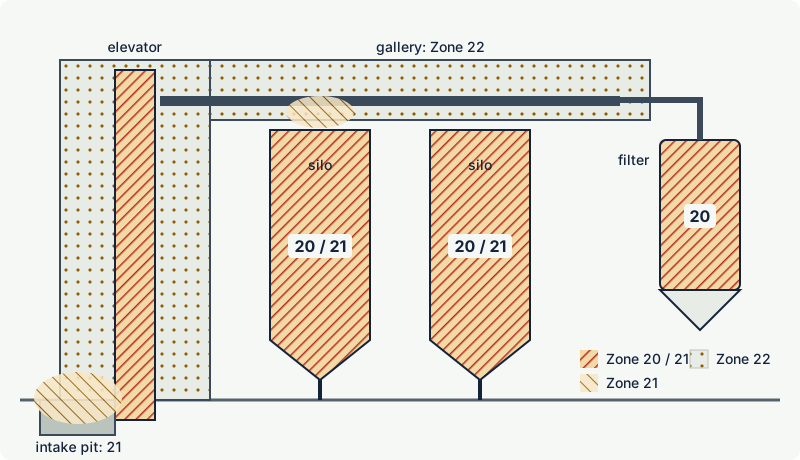
| Location | Typical zone | What decides |
|---|---|---|
| Silo or bin interior | 20 or 21 | duration of filling and emptying; one HSE example uses Zone 20 above about 6 h filling per day |
| Bucket elevator casing, mills, sifters, cyclones, dust filters (dirty side) | 20 (21 if the cloud is brief) | continuous dust cloud in normal operation |
| Intake pit, tipping points, bagging, open transfer points | small 21 near the source, 22 beyond | visible dense clouds, local exhaust ventilation |
| Galleries, elevator rooms, mill floors | 22 or not classified | dust deposits and how often they are cleaned |
| Open air around the plant | very limited | clouds disperse quickly outdoors |
These values come from HSE guidance on dust zoning (its detailed note was written for the rubber and plastics industries, but the principles are the same) and from the general HSE guide to handling combustible dusts. IEC 60079-10-2 sets the method, and each plant's documented assessment decides the final zones.
What follows from the zones
- Equipment: inside Zone 20 only category 1D (EPL Da); Zone 21 needs category 2D (Db) or better, Zone 22 category 3D (Dc), with surface temperatures well below the cloud and layer ignition temperatures of the dust.
- Protection of the plant: explosion venting, suppression or containment for elevators, filters and silos, and isolation between connected items so an explosion cannot spread.
- Mechanical ignition sources: bucket elevators are a known starting point. In the US, 29 CFR 1910.272 requires inside bucket elevators in grain elevators to have belt speed and alignment monitoring and bearing monitoring (with exemptions), and conductive belts where bought after March 1988.
- Housekeeping: the same US rule requires a written housekeeping programme in grain elevators, flour and feed mills, and in grain elevators immediate removal of dust above 1/8 inch (about 3 mm) in priority areas such as around bucket elevators. Housekeeping is what keeps rooms at Zone 22 instead of Zone 21.
Common mistakes
- "It is only flour, not a chemical." Food dusts caused some of the worst industrial explosions.
- Classifying the silo but not the elevator and gallery. The connected plant is where explosions spread.
- Ignoring layers. A thin layer on beams and ledges is fuel for a secondary explosion.
- Using compressed air to clean dusty rooms with equipment running. It creates the cloud the zones are meant to prevent.
Related on excodex
- Dust collectors, silos and bucket elevators: where dust explosions start
- Dust zones 20, 21 and 22 explained with practical examples
- Does a wood pellet or biomass store need CO detection and dust explosion protection?
- Standards space IEC 60079-10-2
Standards and further reading
- IEC 60079-10-2:2026 (edition 3.0), classification of areas, explosive dust atmospheres.
- HSE, HSG103 Safe handling of combustible dusts, precautions against explosions: https://www.hse.gov.uk/pubns/priced/hsg103.pdf
- HSE, hazardous area classification for explosible dusts (SIM 03/2009/08): https://www.hse.gov.uk/foi/internalops/sims/manuf/3_09_08/index.htm
- OSHA 29 CFR 1910.272, grain handling facilities: https://www.osha.gov/laws-regs/regulations/standardnumber/1910/1910.272
This article is general technical information prepared by the excodex editorial team. It does not replace the applicable standards, the equipment certificates and instructions, national regulations or the assessment of a competent person.