Occupational safety International framework and country guides
Occupational safety and health in United States: law, authorities and employer duties
Abstract
US workplace safety rests on the OSH Act of 1970, enforced by OSHA or an approved State Plan. Employers must remove recognised hazards, meet the 29 CFR standards, report deaths within 8 hours and amputations or hospitalisations within 24 hours, and keep injury records.
The main occupational safety and health law in the United States is the Occupational Safety and Health Act of 1970 (OSH Act). It is enforced by the Occupational Safety and Health Administration (OSHA) of the Department of Labor, or, in 21 states and Puerto Rico, by a State Plan that OSHA has approved. Employers must keep the workplace free from recognised serious hazards, comply with the OSHA standards in Title 29 of the Code of Federal Regulations (CFR), report work-related deaths within 8 hours and amputations, eye losses and in-patient hospitalisations within 24 hours, and keep injury and illness records.
This guide explains the legal framework, the authorities, what employers must appoint, assess, train, examine and report, how inspections and penalties work, and the US rules for chemicals, explosive atmospheres, major-hazard sites and PPE, with a comparison to the EU and Türkiye.
Key points
- The OSH Act (Public Law 91-596, enacted 29 December 1970) places two duties on employers: the General Duty Clause, Section 5(a)(1), and compliance with OSHA standards, Section 5(a)(2). Workers must follow the standards that apply to their own conduct, Section 5(b).
- There are 22 State Plans covering private and public employers and 7 covering only state and local government workers; every State Plan must be "at least as effective" as federal OSHA.
- Federal law does not require a general written risk assessment, a safety professional or an occupational physician. Written hazard assessments, programmes and medical examinations are required by specific standards (PPE, respirators, noise, lockout, process safety, silica and others).
- Report a work-related death within 8 hours, and an in-patient hospitalisation, amputation or loss of an eye within 24 hours, to OSHA by phone, in person or online. Employers that must keep records enter each case on the OSHA 300 log and 301 form within 7 calendar days.
- The maximum federal civil penalties that may be assessed after 15 January 2026 are $16,550 per serious or other-than-serious violation and $165,514 per wilful or repeated violation. They are normally adjusted for inflation every January, but the Department of Labor cancelled the 2026 adjustment, so the 2025 amounts still apply.
- Equipment in hazardous (classified) locations must be approved for the class, division or zone and gas or dust group, which in practice means listed by a Nationally Recognized Testing Laboratory (NRTL). ATEX or IECEx certificates are not accepted on their own.
Legal framework and authorities
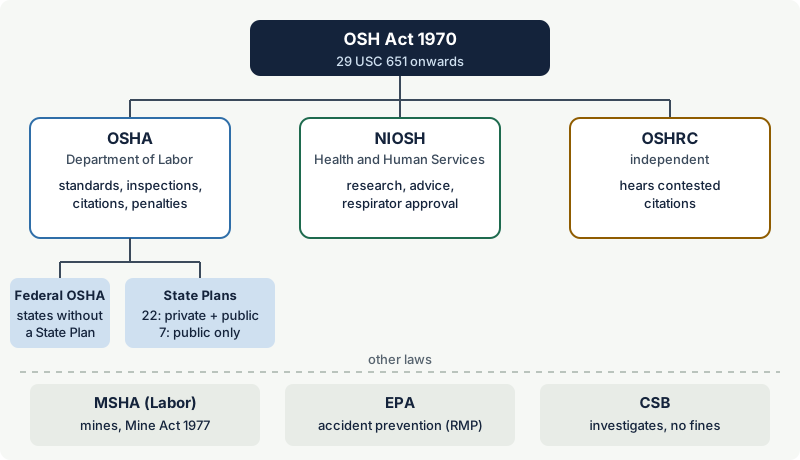
The OSH Act is codified at 29 USC 651 onwards. It covers most private-sector employers in the 50 states, the District of Columbia, Puerto Rico and other territories under federal jurisdiction. An "employer" under the Act is a person in business affecting commerce who has employees; the definition excludes the federal government (except the Postal Service) and the states and their political subdivisions. Self-employed people with no employees therefore have no OSH Act duties, and state and local government workers are protected only where a State Plan covers them.
Section 4(b)(1) leaves out working conditions regulated by another federal agency under its own law. The best known example is mining: the Mine Safety and Health Administration (MSHA), also in the Department of Labor, enforces the Federal Mine Safety and Health Act of 1977 (the Mine Act, amended by the MINER Act of 2006) in all US mines.
| Body | Parent | Role |
|---|---|---|
| OSHA | Department of Labor | Sets and enforces standards, inspects, cites, runs whistleblower protection and free on-site consultation for small businesses |
| State Plans | State governments, approved and monitored by OSHA | Enforce their own standards, which must be at least as effective as OSHA's |
| NIOSH (National Institute for Occupational Safety and Health) | Department of Health and Human Services (Section 22 of the Act) | Research, recommended exposure limits, health hazard evaluations, respirator certification; no enforcement power |
| OSHRC (Occupational Safety and Health Review Commission) | Independent agency | Administrative law judges hear employers' contests of citations |
| MSHA | Department of Labor | Mines, under the Mine Act |
| EPA (Environmental Protection Agency) | Independent agency | Chemical accident prevention under Clean Air Act Section 112(r) |
| CSB (Chemical Safety and Hazard Investigation Board) | Independent agency, operating since 1998 | Investigates chemical incidents and makes recommendations; issues no fines or rules |
The OSHA standards
OSHA standards are published in Title 29 CFR: Part 1910 for general industry, Part 1926 for construction, Parts 1915, 1917 and 1918 for shipyards, marine terminals and longshoring, and Part 1928 for agriculture. Part 1904 covers injury and illness recordkeeping and reporting. Where no standard addresses a hazard, OSHA can cite the General Duty Clause if the hazard is recognised and is causing or likely to cause death or serious physical harm.
The 22 State Plans covering both private and public workplaces are Alaska, Arizona, California, Hawaii, Indiana, Iowa, Kentucky, Maryland, Michigan, Minnesota, Nevada, New Mexico, North Carolina, Oregon, Puerto Rico, South Carolina, Tennessee, Utah, Vermont, Virginia, Washington and Wyoming. Connecticut, Illinois, Maine, Massachusetts, New Jersey, New York and the US Virgin Islands have plans for public employees only, so federal OSHA covers their private sector. State rules can be stricter or different, so a company working in several states must check each one.
Workers' compensation (no-fault insurance for injured workers) is run by the states. The OSH Act states expressly that it does not affect workers' compensation law (Section 4(b)(4)).
Employer duties: appointments, risk assessment, training and health surveillance
Safety professionals and physicians
Unlike the EU and Türkiye, federal law contains no general duty to appoint a safety professional, a safety service or an occupational physician, and no staffing ratio by workforce size. The duties are attached to tasks instead:
- 1910.151(a) requires the "ready availability of medical personnel for advice and consultation on matters of plant health"; where there is no infirmary, clinic or hospital in near proximity, a person must be adequately trained to render first aid.
- Many standards require a "competent person" or a "qualified person" (for example for construction site inspections, excavations and scaffolds), or a physician or other licensed health care professional (PLHCP) for medical evaluations.
- The respiratory protection standard requires a written programme run by a designated programme administrator.
In practice, larger employers employ safety professionals and contract occupational health clinics because the standards cannot be met without them.
Risk assessment and written programmes
There is no federal equivalent of the EU general written risk assessment. The nearest duties are:
- PPE hazard assessment (1910.132(d)): assess the workplace for hazards that need PPE and certify the assessment in writing, naming the workplace, the person certifying and the date.
- Hazard-specific written programmes: hazard communication, respiratory protection, energy control (lockout/tagout) procedures with at least annual periodic inspection, emergency action plans (written if the employer has more than 10 employees), the silica exposure control plan (reviewed at least annually) and the process hazard analysis under process safety management (revalidated at least every 5 years).
- Construction (1926.20(b)): accident prevention programmes and frequent and regular inspections of job sites, materials and equipment by competent persons.
OSHA's Recommended Practices for Safety and Health Programs are voluntary guidance built on seven core elements, including hazard identification and assessment. Some states go further: California requires every employer to have a written Injury and Illness Prevention Program (California Code of Regulations, Title 8, Section 3203), with periodic inspections to identify hazards.
Training
OSHA has no single training regulation. Training duties are spread across many standards, collected in OSHA's publication Training Requirements in OSHA Standards (OSHA 2254). Examples: hazard communication training at initial assignment and when a new chemical hazard is introduced; annual training for the hearing conservation and respiratory protection programmes; forklift operator evaluation at least every three years; process safety refresher training at least every three years; and 40 or 24 hours of initial training plus 8 hours of annual refresher training for hazardous waste operations (HAZWOPER). OSHA tells workers they have the right to training in a language they understand. The 10-hour and 30-hour Outreach courses are voluntary under federal law, although some states, municipalities and clients require them.
Medical examinations
Medical surveillance is required only by specific standards, listed in OSHA's guide Medical Screening and Surveillance Requirements in OSHA Standards (OSHA 3162). Examples include asbestos, benzene, cadmium, lead, chromium(VI), bloodborne pathogens (hepatitis B vaccination offered), noise (baseline audiogram within 6 months of first exposure at or above 85 dBA as an 8-hour average, then annually) and respirators (medical evaluation before fit testing or use). Under the silica standards, medical surveillance must be offered in general industry and maritime to workers exposed at or above the action level for 30 or more days a year, and in construction to workers required to wear a respirator for 30 or more days a year; the examinations are repeated at least every three years, and in general industry the first one is due within 30 days of initial assignment. Medical records must be kept for the duration of employment plus 30 years (1910.1020).
Accident reporting and recordkeeping
Under 29 CFR 1904.39, every employer covered by the Act, including small and partially exempt ones, must report:
| Event | Deadline | Only if it occurs |
|---|---|---|
| Work-related death | 8 hours after the death (or after learning of it) | within 30 days of the incident |
| In-patient hospitalisation, amputation, loss of an eye | 24 hours after the event (or after learning of it) | within 24 hours of the incident |
Reports go to the nearest OSHA area office by phone or in person, to the 24-hour line 1-800-321-OSHA (1-800-321-6742), or through the online form on osha.gov; a message left on an area office answering machine, fax or email does not count. Road traffic accidents on public roads are reportable only in a construction work zone, and events on commercial aircraft, trains, buses and similar transport are not reportable. State Plan states may have their own reporting rules.
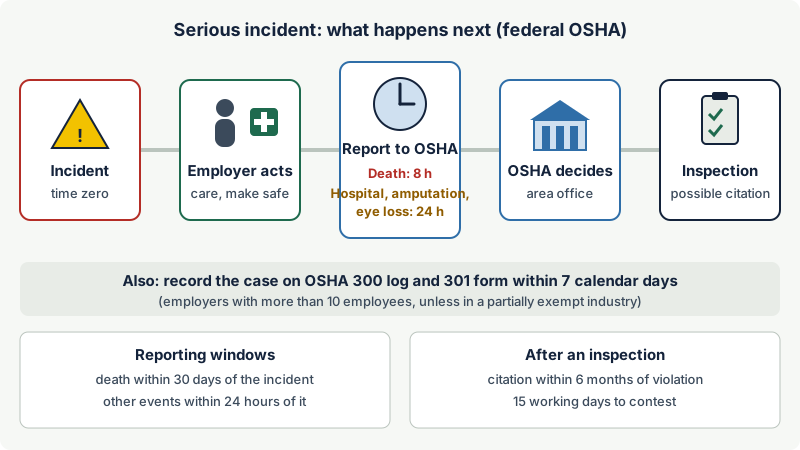
Employers with more than 10 employees at any time in the previous calendar year, outside the partially exempt industries, must also keep records: the OSHA 300 log and the 301 incident report (each case entered within 7 calendar days), and the 300A annual summary, certified by a company executive and posted from 1 February to 30 April. Records are kept for 5 years. Establishments with 250 or more employees, and those with 20 to 249 employees in the industries listed in Appendix A to Subpart E, submit the 300A electronically by 2 March each year; those with 100 or more employees in Appendix B industries also submit 300 and 301 data.
Example: A metal fabrication plant in Texas (federal OSHA, no State Plan) with 120 employees. At 14:00 on Tuesday a press operator loses a fingertip. The fingertip loss counts as an amputation, so the plant reports to OSHA by 14:00 on Wednesday, enters the case on the 300 log and completes a 301 form by the following Tuesday, includes it in next year's 300A posted by 1 February, and, if its industry is in Appendix B, submits the 300 and 301 data electronically by 2 March. If the operator had died within 30 days, the 8-hour clock would start when the employer learned of the death.
Workers' rights, committees and inspections
Federal law does not require safety committees or elected safety representatives. Workers and their representatives can file a confidential complaint and request an inspection, accompany the inspector, see injury records and exposure results, and are protected against retaliation: under Section 11(c) a worker must file a retaliation complaint within 30 days. Some State Plans require committees. Washington requires a safety committee where 11 or more employees work on the same shift at the same location, with employee-elected members at least equal in number to employer-selected members and minutes kept for one year (WAC 296-800-13020). Oregon has a rule on safety committees and safety meetings (OAR 437-001-0765). In California, a labour-management safety committee is one way to meet the communication element of the written programme.
OSHA inspections are normally unannounced. Priorities run from imminent danger, through severe injury reports, worker complaints and referrals, to targeted and follow-up inspections. An inspection has an opening conference, a walkaround and a closing conference; the employer may require a warrant. OSHA must issue a citation within six months of the violation. The employer has 15 working days from receipt to contest it before the OSHRC and must post the citation at or near the place of the violation for 3 working days or until it is corrected, whichever is longer.
Penalties
| Violation type | Maximum federal civil penalty, assessed after 15 January 2026 |
|---|---|
| Serious, other-than-serious, posting requirements | $16,550 per violation |
| Failure to abate | $16,550 per day beyond the abatement date |
| Wilful or repeated | $165,514 per violation |
The amounts are normally adjusted for inflation every year. The Department of Labor cancelled the 2026 adjustment (Federal Register notice of 27 May 2026) because the October 2025 consumer price data that the formula needs were never published, so the 2025 amounts above remain in force until the next adjustment. State Plans must adopt maximums at least as effective as OSHA's. OSHA policy reduces proposed penalties for small employers and good faith; a repeated violation is the same or a similar hazard cited again within five years. Criminal penalties are limited: under Section 17(e), a wilful violation of a standard that causes a worker's death is punishable by a fine of up to $10,000, up to six months' imprisonment or both, doubled for a second conviction (the amounts written in the Act; general federal sentencing law can allow higher fines). False statements in required records are also crimes (Section 17(g)).
Chemicals, explosive atmospheres, major hazards and PPE
Hazard communication and GHS
The Hazard Communication Standard (29 CFR 1910.1200) implements the UN Globally Harmonized System (GHS). The 2024 final rule, published on 20 May 2024 and effective on 19 July 2024, aligned it primarily with GHS Revision 7. The compliance dates, as extended in January 2026, are 19 May 2026 for suppliers classifying substances and 20 November 2026 for employers to update workplace labels, the written programme and training for substances, then 19 November 2027 and 19 May 2028 for mixtures. Employers must keep labels and safety data sheets (16-section format) and train workers. Exposure limits are OSHA permissible exposure limits (PELs); NIOSH recommended exposure limits are advisory.
Explosive atmospheres and Ex equipment
The US has no product directive like ATEX. OSHA's rule for electrical equipment in hazardous (classified) locations is 1910.307, which recognises Class I (gases and vapours), Class II (dusts) and Class III (fibres) locations, each with Divisions 1 and 2, and allows the Zone 0, 1 and 2 system for Class I. Zone classifications, and division classifications made after 13 August 2007, must be documented, and zone classification must be supervised by a qualified registered professional engineer. Equipment must be approved for the class, the gas or dust group and the temperature (zone equipment is marked, for example, "Class I, Zone 0, AEx ia IIC T6"). "Approved" means acceptable to OSHA, which in practice means listed or labelled by an NRTL recognised under 1910.7. Installation follows the National Electrical Code (NFPA 70, Articles 500 to 506), adopted through state and local law. There is no single combustible dust standard: OSHA uses the General Duty Clause and specific rules such as grain handling (1910.272), housekeeping and hazardous locations. Underground mines follow MSHA's own equipment approval rules.
Major-hazard sites
Process Safety Management (PSM, 29 CFR 1910.119) applies to processes with a listed highly hazardous chemical at or above its threshold, or 10,000 pounds (4,535.9 kg) or more in one location of a Category 1 flammable gas or a flammable liquid with a flash point below 100 °F (37.8 °C), with exclusions such as retail facilities, oil and gas well drilling and servicing, and normally unoccupied remote facilities. It has 14 elements, including process hazard analysis, management of change, mechanical integrity and pre-startup safety review. In parallel, the EPA Risk Management Program (40 CFR Part 68) requires facilities above threshold quantities of regulated substances to submit a risk management plan, resubmitted every five years. EPA amended the rule in 2024 and published a further proposed rule on 24 February 2026, so check the current text.
PPE conformity
There is no CE-type mark. OSHA standards incorporate consensus standards by reference, for example ANSI/ISEA Z87.1 for eye and face protection, ANSI Z89.1 for head protection and ASTM F2413 for footwear, or accept equipment the employer shows is at least as effective. Respirators must be NIOSH-certified. The employer pays for required PPE, with limited exceptions such as non-specialty safety-toe footwear and prescription safety glasses that may be worn off the job (1910.132(h)).
Comparison with the EU and Türkiye
| Topic | United States (federal) | EU (Framework Directive 89/391/EEC) | Türkiye (Law No. 6331) |
|---|---|---|---|
| Main law | OSH Act 1970 | Directive 89/391/EEC and daughter directives, transposed nationally | Occupational Health and Safety Law No. 6331 (İş Sağlığı ve Güvenliği Kanunu), 2012 |
| General risk assessment | Not required federally; hazard-specific assessments | Required for all risks | Required (Art. 10) |
| Safety professional, physician | No general duty | Designated workers or protective services | İş güvenliği uzmanı and işyeri hekimi in every workplace, or a trained employer in some small firms (Art. 6) |
| Committee, representative | None federally; some states | Consultation and participation of workers | Representatives from 2 workers (Art. 20); committee at 50+ workers with work over 6 months (Art. 22) |
| Accident report | Death 8 h; hospitalisation, amputation, eye 24 h, to OSHA | Set by each member state | Within 3 working days to SGK (Art. 14) |
| Medical examinations | Only under specific standards | Health surveillance under national systems | Pre-employment and periodic (Art. 15) |
Common mistakes
- Assuming federal OSHA applies everywhere. In 22 jurisdictions a State Plan enforces its own rules; check reporting, committees and programme duties for each state.
- Reporting only deaths. A fingertip amputation or an overnight admission for treatment must be reported within 24 hours.
- Treating the 300A posting as the only record. The 300 log and 301 forms must be completed within 7 days of each case, and kept for 5 years.
- Shipping ATEX or IECEx certified equipment for a US hazardous location. It must be approved for the US class, division or zone, normally by NRTL listing.
- Believing that no written risk assessment means nothing to document. The PPE hazard assessment certification, energy control procedures, the HazCom programme and others must be in writing.
Frequently asked questions
Does OSHA cover state and local government workers?
Not directly. Federal OSHA does not cover public employers, so state and local government workers are protected only in states with a State Plan, either one covering all workers or one of the seven plans for public employees only.
Is a written safety programme mandatory in the United States?
Not under federal law as a general rule, but many standards require specific written programmes. California requires every employer to keep a written Injury and Illness Prevention Program, and other states have their own rules.
Who investigates major chemical accidents?
OSHA, a State Plan or the EPA can inspect and cite. The CSB investigates chemical incidents independently and makes recommendations, but it does not issue fines or citations.
Can an employer refuse an OSHA inspector?
The employer can require the inspector to obtain a warrant, and OSHA can then inspect under the warrant. Inspections are normally unannounced, and advance notice without authorisation is itself an offence under the Act.
Are NIOSH recommendations binding?
No. NIOSH is a research institute with no enforcement power. Its recommended exposure limits are advisory, while OSHA PELs are enforceable; NIOSH certification of respirators is required because the OSHA respirator standard demands it.
Related on excodex
- The US OSH Act, OSHA, the General Duty Clause and state plans
- OSHA recordkeeping and reporting under 29 CFR 1904
- How is workplace accident reporting done in the United States?
- What are the penalties for breaking safety rules in the United States?
- OSH law compared: appointments, committees and reporting deadlines
- North American hazardous location approvals: NEC 500/505/506
Standards and further reading
- Occupational Safety and Health Act of 1970, Public Law 91-596, 84 Stat. 1590, 29 USC 651 onwards: https://www.osha.gov/laws-regs/oshact/completeoshact
- 29 CFR Part 1904 (recordkeeping and reporting), Part 1910 (general industry), Part 1926 (construction): https://www.osha.gov/laws-regs/regulations/standardnumber/1904/1904.39
- 29 CFR 1910.119 Process safety management; 1910.307 Hazardous (classified) locations; 1910.132 PPE general requirements; 1910.1200 Hazard communication
- 40 CFR Part 68, EPA Risk Management Program: https://www.epa.gov/rmp
- NFPA 70, National Electrical Code (hazardous locations articles)
- OSHA State Plans: https://www.osha.gov/stateplans
- OSHA penalties: https://www.osha.gov/penalties
- Federal Register, Department of Labor notice on the 2026 civil penalty inflation adjustment, 27 May 2026: https://www.govinfo.gov/content/pkg/FR-2026-05-27/html/2026-10456.htm
- OSHA 3000, Employer Rights and Responsibilities Following a Federal OSHA Inspection: https://www.osha.gov/sites/default/files/publications/osha3000.pdf
- OSHA 2254, Training Requirements in OSHA Standards: https://www.osha.gov/sites/default/files/publications/osha2254.pdf
- OSHA 3162, Medical Screening and Surveillance Requirements in OSHA Standards: https://www.osha.gov/sites/default/files/publications/osha3162.pdf
- Federal Register, Hazard Communication Standard final rule, 20 May 2024: https://www.govinfo.gov/content/pkg/FR-2024-05-20/html/2024-08568.htm
- California Code of Regulations, Title 8, Section 3203: https://www.dir.ca.gov/title8/3203.html
- Washington Administrative Code 296-800-13020: https://app.leg.wa.gov/wac/default.aspx?cite=296-800-13020
- ILO NORMLEX country profile (ratifications) and LEGOSH: https://normlex.ilo.org
This article is general occupational safety and health information prepared by the excodex editorial team. It does not replace the applicable legislation, standards, manufacturers' instructions or the assessment of a competent OSH professional or occupational physician.
Questions on this topic
- What is the main occupational safety and health law in the United States and who enforces it?
- Must an employer in the United States appoint a safety professional or an occupational physician?
- Is a written risk assessment mandatory in the United States, and how often must it be reviewed?
- How and within what time must a workplace accident be reported in the United States?
- What OSH training must employers provide to workers in the United States?
- Are pre-employment and periodic medical examinations required for workers in the United States?
- What are the penalties for breaking occupational safety rules in the United States?
- Is a safety committee or a worker safety representative required in the United States?
- How are explosive atmospheres and Ex equipment regulated in the United States?
- Which rules apply to major-hazard chemical sites in the United States?