Occupational safety International framework and country guides
How are explosive atmospheres and Ex equipment regulated in the United States?
Part of: Occupational safety and health in United States: law, authorities and employer duties
Short answer
There is no ATEX-style directive. OSHA rule 1910.307 requires hazardous locations to be classified by Class, Division or Zone and equipment to be approved for them, in practice by NRTL listing, installed to the National Electrical Code. ATEX or IECEx alone is not enough.
The United States has no equivalent of the EU ATEX directives. The workplace rule is OSHA's standard for hazardous (classified) locations, 29 CFR 1910.307: the employer must classify locations where flammable gases, vapours, combustible dusts or fibres may be present, document the classification, and install equipment that is approved for the class, division or zone, group and temperature (or, as a narrower alternative, equipment the employer itself demonstrates to be safe for the location). "Approved" in practice means certified (listed or labelled) by a Nationally Recognized Testing Laboratory (NRTL) recognised by OSHA. Installation follows the National Electrical Code (NEC, NFPA 70).
Short answer
- Classification: Class I (gases and vapours), Class II (dusts), Class III (fibres and flyings), each in Division 1 or 2. Class I may instead use Zones 0, 1 and 2. Under 1910.307, Class II and III must use divisions.
- Documentation: zone classifications, and division classifications made after 13 August 2007, must be documented and available to those who design, install, inspect, maintain or operate the equipment. Under the zone system, the classification and the selection of equipment and wiring methods must be supervised by a qualified registered professional engineer.
- Equipment: approved for the class, the gas or dust group and the operating temperature (based on a 40 °C ambient); the temperature marking may not exceed the ignition temperature of the substance.
- Approval: acceptable to OSHA, normally through NRTL certification; ATEX or IECEx certificates alone do not satisfy OSHA.
- Dust: no single combustible dust standard; OSHA applies several standards and the General Duty Clause.
Divisions, zones and groups
Division 1 covers places where ignitable concentrations can exist in normal operation; Division 2 covers places where they occur only in abnormal conditions. The zone system for Class I mirrors IEC practice. US equipment certified for zones carries the "AEx" marking.
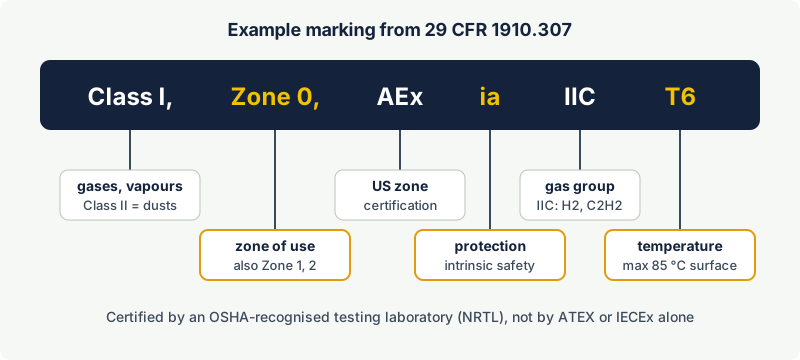
| Item | Division system (NEC Article 500) | Zone system (NEC Article 505, Class I) |
|---|---|---|
| Gas groups | A (acetylene), B (hydrogen), C (ethylene), D (propane) | IIC (covers A and B), IIB (C), IIA (D) |
| Typical protection | Explosionproof, purged and pressurised, intrinsically safe, nonincendive (Division 2), hermetically sealed | Flameproof "d", increased safety "e", intrinsic safety "i", pressurisation, encapsulation "m", powder filling "q", oil immersion "o", type "n" (Zone 2) |
| Use in a lower-risk area | Division 1 equipment may be used in Division 2 of the same class and group (1910.307(e)) | Zone 0 equipment may be used in Zones 1 and 2, Zone 1 equipment in Zone 2, for the same gas or vapour (1910.307(g)(5)) |
The gas cards on excodex give the group and temperature class: hydrogen and acetylene are IIC, ethylene IIB, propane IIA. The NEC also has a zone system for dusts (Zones 20, 21 and 22, Article 506), but the 1910.307 text recognises zones only for Class I, so confirm with the enforcing authority before relying on dust zones.
General-purpose equipment may be used in Division 2 only if the employer can show it is not a source of ignition in normal operation. Equipment "safe for the location" without approval is allowed only where the employer can demonstrate the protection (1910.307(c)(3)); the employer then carries the burden of proof.
Equipment approval: NRTLs, not ATEX
OSHA does not certify products. It recognises private testing laboratories as NRTLs (29 CFR 1910.7), each for a defined scope of test standards and with its own registered mark. Under 1910.399, equipment is "acceptable" when it is accepted, certified, listed or labelled by an NRTL, and "approved" means acceptable to OSHA. Electrical equipment, and industrial trucks used in hazardous atmospheres, are among the products that need NRTL approval.
Equipment certified only under ATEX or IECEx must therefore also be certified by an NRTL for the US class, division or zone before installation. Underground mines are different again: MSHA approves equipment for mines under its own rules.
Example: A Turkish manufacturer sells an ATEX and IECEx certified gas detector (Ex db IIC T6 Gb) to a refinery in Texas for a Class I, Division 1, Group B area. The refinery's engineers reject it: they need NRTL listing for Class I, Division 1, Group B (or a Zone 1 AEx IIC marking if the area is classified by zones). The manufacturer has to obtain NRTL certification first.
Workplace duties beyond equipment
OSHA has no direct equivalent of the EU workplace directive 1999/92/EC and its explosion protection document. The duties sit in several places: classification and documentation (1910.307), process safety management for flammables above 10,000 pounds in one location (1910.119, including hot work permits and management of change), hazard communication, and the General Duty Clause for recognised hazards such as combustible dust.
Common mistakes
- Shipping ATEX-only equipment to a US site. NRTL certification for the US marking is needed.
- Mixing division and zone markings. Equipment must match the system used to classify the area.
- Leaving the classification undocumented. Zone classifications and post-2007 division classifications must be on paper.
Related on excodex
- Occupational safety and health in United States: law, authorities and employer duties
- North American hazardous location approvals: NEC 500/505/506
- Zones vs Divisions: IEC and ATEX zones compared with NEC
- Which rules apply to major-hazard chemical sites in the United States?
- Ex equipment explorer
Standards and further reading
- 29 CFR 1910.307 Hazardous (classified) locations: https://www.osha.gov/laws-regs/regulations/standardnumber/1910/1910.307
- 29 CFR 1910.399 Definitions (acceptable, approved): https://www.osha.gov/laws-regs/regulations/standardnumber/1910/1910.399
- 29 CFR 1910.7 and the OSHA NRTL Program: https://www.osha.gov/nationally-recognized-testing-laboratory-program
- NFPA 70, National Electrical Code, Articles 500 to 506 (hazardous locations)
- OSHA combustible dust standards page: https://www.osha.gov/combustible-dust/standards
This article is general occupational safety and health information prepared by the excodex editorial team. It does not replace the applicable legislation, standards, manufacturers' instructions or the assessment of a competent OSH professional or occupational physician.
More questions on this topic
- What is the main occupational safety and health law in the United States and who enforces it?
- Must an employer in the United States appoint a safety professional or an occupational physician?
- Is a written risk assessment mandatory in the United States, and how often must it be reviewed?
- How and within what time must a workplace accident be reported in the United States?
- What OSH training must employers provide to workers in the United States?
- Are pre-employment and periodic medical examinations required for workers in the United States?
- What are the penalties for breaking occupational safety rules in the United States?
- Is a safety committee or a worker safety representative required in the United States?
Part of: Occupational safety and health in United States: law, authorities and employer duties