Occupational safety International framework and country guides
Occupational safety and health in Egypt: law, authorities and employer duties
Abstract
Egypt regulates OSH in Book Four of Labour Law No. 14 of 2025 (in force 1 September 2025), enforced by the Ministry of Labour's OSH inspectorate. Employers must control hazards, assess risks, train workers, arrange medical checks and report serious accidents within 24 hours.
Occupational safety and health (OSH) in Egypt is governed by Book Four of the Labour Law issued by Law No. 14 of 2025, which replaced Labour Law No. 12 of 2003 on 1 September 2025. The Ministry of Labour enforces it through a specialised OSH inspection body and the OSH offices of its labour directorates, which can order corrections and close a workplace or stop a machine when there is imminent danger; breaches are criminal offences punished with fines. The detailed technical rules are still mostly in ministerial decrees from 2003, which stay in force until the ministry replaces them.
This guide covers the law, the authorities, employer and worker duties, OSH staffing, reporting, penalties and hazardous industries, with a comparison to the EU and Türkiye.
Key points
- The main OSH law is Book Four, "Occupational Safety and Health and Securing the Work Environment", of the Labour Law issued by Law No. 14 of 2025 (Articles 242 to 274), published in the Official Gazette on 3 May 2025 and in force from 1 September 2025.
- Book Four applies to all work sites and establishments, public or private, on land, at sea or in the air, including waterways and means of transport (Art. 244).
- Every establishment must assess risks and foreseeable industrial and natural disasters, prepare and test emergency plans, train workers on them and notify the labour authority of the plans and of hazardous substances stored or used (Art. 253).
- A serious accident, or the appearance of symptoms of an occupational disease, must be notified to the labour authority within 24 hours; establishments with 30 or more workers also send half-yearly accident and illness statistics (Art. 260).
- Under Ministerial Decree No. 134 of 2003, establishments with 50 or more workers must set up an OSH unit and a joint OSH committee that meets at least monthly and within 48 hours of a serious accident.
- Breaching the OSH articles, including the workers' own duties in Article 268, is punished with a fine of EGP 5,000 to 100,000, doubled for a repeat offence (Art. 296); harsher penalties under the Penal Code or other laws still apply (Art. 280).
The legal framework: Law No. 14 of 2025 and the 2003 decrees
The Labour Law (قانون العمل, Qanun al-Amal) was issued by Law No. 14 of 2025 and published in the Official Gazette (الجريدة الرسمية) No. 18 (supplement) on 3 May 2025. It entered into force on the first day of the month after 90 days from publication, which was 1 September 2025, and it repealed Law No. 12 of 2003. The issuing law also states that, apart from special provisions, the Labour Law does not apply to employees of state bodies, local administration units and public authorities, or to domestic workers. Book Four on OSH is different: Articles 243 and 244 extend it to every establishment owned or managed by a public or private person.
Book Four is short and sets principles. The technical detail comes from decrees of the minister responsible for labour. Article 11 of the issuing law asked the minister to issue implementing decrees within 90 days and keeps existing decrees in force, so far as they do not conflict with the new law, until replaced. Ministerial Decree No. 260 of 2025 has since named the office responsible under each article (see the next section), but by November 2026 we found no decree replacing the two technical OSH decrees of 2003, so they remain the practical reference:
| Instrument | Arabic title (short) | What it covers |
|---|---|---|
| Labour Law, Law No. 14 of 2025, Book Four (Arts. 242 to 274) | الكتاب الرابع: السلامة والصحة المهنية وتأمين بيئة العمل | Duties, inspection, OSH units, reporting, training licences, medical checks, first aid |
| Labour Law, Book Five (Arts. 275 to 298) | تفتيش العمل والعقوبات | Inspectors' powers and penalties |
| Ministerial Decree No. 211 of 2003 | حدود الأمان والاشتراطات والاحتياطات اللازمة لدرء المخاطر | Technical limits and precautions: physical, mechanical, electrical, biological, chemical risks, fire, emergency plans, explosives |
| Ministerial Decree No. 134 of 2003 | تحديد المنشآت التي تلتزم بإنشاء أجهزة وظيفية ولجان للسلامة والصحة المهنية | Which establishments need an OSH unit and committee, staffing table, training levels (training article amended by Decree No. 216 of 2016) |
| Social Insurance and Pensions Law No. 148 of 2019 | قانون التأمينات الاجتماعية والمعاشات | Definition of work injury, occupational disease list, injury notification and benefits |
Note: English names of Egyptian laws and decrees are translations. In contracts and audits, quote the number and year, which are unambiguous.
Who enforces OSH in Egypt
The "competent administrative authority" in the Labour Law is the ministry responsible for labour, with its directorates and departments across the country (Art. 1). In 2003 this was the Ministry of Manpower and Migration; today it is the Ministry of Labour (وزارة العمل). The main bodies are:
- OSH inspectorate. Article 256 requires the ministry to form a specialised body called the Occupational Safety and Health and Work Environment Inspection Body, staffed by people qualified in medicine, veterinary science, pharmacy, engineering and science, and environment and waste management. Inspection of establishments linked to national security is done by a body named by the Prime Minister.
- Who does what under Decree 260 of 2025. Ministerial Decree No. 260 of 2025 names the competent office for each article: the Central Administration for OSH at the ministry forms the inspection body (Art. 256); the OSH offices of the labour directorates receive emergency plans and their changes (Art. 253) and the half-yearly statistics (Art. 260); and the competent labour directorate orders closure on the inspectors' report (Art. 257).
- Labour inspectors with judicial police powers. Under Articles 275 and 276, inspectors named by a decree of the Minister of Justice may enter and inspect any workplace, examine records and demand documents. Employers must cooperate and answer summonses (Arts. 277 and 278).
- National Centre for OSH Studies. The National Centre for Occupational Safety and Health and Work Environment Studies, reorganised by Presidential Decree No. 333 of 2003, plans research based on accident statistics and gives training (Arts. 261 and 263).
- Supreme Council for OSH. A tripartite council chaired by the minister sets general OSH policy (Art. 264), with a subcommittee in each governorate chaired by the governor (Art. 265).
- Other authorities. Fire precautions follow the requirements of the competent department of the Ministry of the Interior (Art. 251). Work injuries are notified to the National Organisation for Social Insurance (NOSI), and periodic medical examinations are coordinated with the Health Insurance Organisation (Art. 269).
The 2025 law also allows the minister to license private "compliance offices" that check OSH conditions and give technical advice (Art. 245), and requires a ministry licence for anyone who practises OSH consultancy or expert work (Art. 262).
What employers and workers must do
Employer duties in Book Four
The establishment and its branches must provide the means of OSH protection against:
- physical risks (Art. 246): heat and cold, noise and vibration, lighting, ionising and non-ionising radiation, changes in atmospheric pressure and explosion risks, in line with exposure standards and threshold limits;
- engineering risks (Art. 247): lifting, hauling and transport equipment, construction, excavation, collapse and falls, static and dynamic electricity, and poor fit between the worker's body, the machines and the workplace;
- biological risks (Art. 248), for example in healthcare, work with animals and handling of medical or veterinary waste;
- chemical risks (Art. 249), see the chemicals section below;
- indirect risks (Art. 250): rescue and first-aid means, cleanliness and order, and health certificates for food handlers;
- work in confined and enclosed spaces (Art. 252);
- violence, bullying and harassment (Art. 254).
The employer must also train each worker in the safe basics of the job, inform him of the hazards before work starts, provide suitable personal protective equipment (PPE) and train him in its use, at no cost to the worker (Art. 267). Work areas, especially dangerous ones, must be inspected daily in every shift, with a paper or electronic record (Art. 269).
Risk assessment and emergency plans
Article 253 requires every establishment to assess and analyse risks and expected industrial and natural disasters and disasters arising from operation, to prepare emergency plans, to test them by practical drills and to train workers. The establishment must notify the competent authority of its emergency plans, of any changes and of the storage or use of hazardous substances. Decree 211 of 2003 adds that the analysis must follow approved national and international standards, start at the design and commissioning stage and be reviewed periodically according to the hazardous materials and technology used. Neither text sets a fixed review interval.
Workers' rights and duties
Workers must use the protective equipment, look after it, follow safety instructions and not misuse or damage safety devices (Art. 268); breaching these duties is itself an offence under Article 296. A worker who foresees an imminent and serious danger to life or health may leave the workplace for a safe place without permission and must inform the direct supervisor; no disciplinary consequence may follow, and the employer must not send workers back until the danger is removed (Art. 253).
OSH units, committees, training and health services
OSH unit and committee from 50 workers
Article 259 lets the minister decide which establishments must create an internal OSH unit (جهاز وظيفي) and committees. Decree 134 of 2003 sets the threshold at 50 workers or more on one site, or across the branches of one establishment in the same governorate. Below 50 workers, the employer or a delegate is personally responsible for OSH. The unit reports directly to the employer or the managing director and carries out hazard identification, measurements, daily inspections, accident investigation, permits to work and emergency planning.
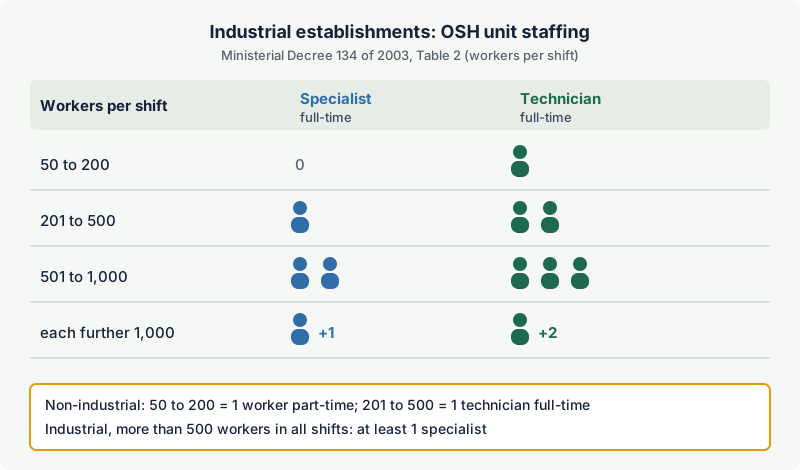
The OSH committee of an establishment with 50 or more workers is chaired by the employer or the managing director. It includes department heads, the civil defence and fire officer, the establishment doctor if there is one, the chief OSH officer as rapporteur, and an equal number of worker members chosen by the trade union committee (where there is none, chosen through the establishment and approved by the competent general union). It must meet at least once a month and within 48 hours of a serious accident or a confirmed occupational disease, and its decisions bind the establishment (Art. 259 of the law; Decree 134).
Training
Book Four requires training of OSH unit staff, committee members and managers at all levels in line with their responsibilities (Art. 259). Basic, advanced and specialised courses are given by the ministry, the National Centre and licensed providers (Art. 261). The 2003 text of Decree 134 allowed at most three years between basic and advanced training; its training article was amended in 2016 (Decree No. 216), so confirm the current interval with the directorate.
Medical examinations, first aid and the doctor
The employer must arrange a pre-employment medical examination and an aptitude examination of physical, mental and psychological capacity (Art. 266), and coordinate with the Health Insurance Organisation for periodic examinations of all workers and an examination at the end of service (Art. 269). The fitness standards are set by decree in agreement with the Minister of Health (Art. 266), and periodic examinations follow the health insurance rules (Art. 269). First-aid means are required in every workplace. When more than 50 workers are employed in one place, one town or within a 15 km radius, the employer must employ at least one qualified nurse in each shift, engage a doctor to see them in a designated place and provide medicines free of charge (Art. 270).
Accident reporting, inspection and penalties
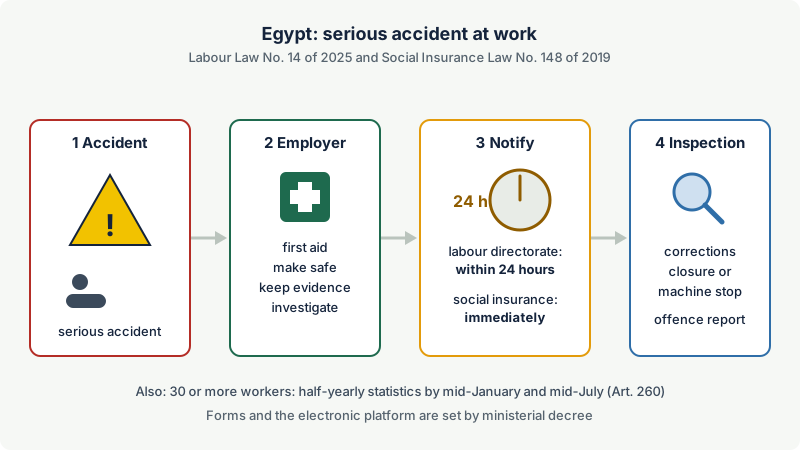
Two reporting channels run in parallel:
- Labour authority (OSH). Every serious accident in the establishment, and the appearance of symptoms of an occupational disease, must be notified to the competent labour directorate within 24 hours, on forms set by ministerial decree (Art. 260). Data must also be submitted on the ministry's electronic platform.
- Social insurance (compensation). NOSI states that the employer must notify it of every injury among its workers immediately when it happens; if the employer fails, the worker or his representatives may notify. The file needs the injury notification form of the executive regulations of Law No. 148 of 2019, a police report or an internal administrative investigation report, and the initial medical report.
Establishments with 30 or more workers must also send half-yearly statistics on illnesses, serious accidents and injuries by the middle of January and July (Art. 260).
Inspectors may examine workers, take samples, photograph, review emergency plans, risk analyses, reports of major accidents and stocks of hazardous substances (Art. 257). Where there is imminent danger, the authority must order full or partial closure or the stopping of a machine until the danger is removed; wages continue to be paid, and the authority may remove the danger itself at the establishment's cost (Arts. 253 and 257).
| Breach (Labour Law No. 14 of 2025) | Penalty |
|---|---|
| OSH duties of Arts. 245 to 255, 259 to 262, 266 to 272, including the workers' duties in Art. 268 | Fine EGP 5,000 to 100,000, doubled for a repeat (Art. 296) |
| Obstructing inspection or ignoring a summons (Arts. 277, 278) | Fine EGP 5,000 to 20,000, doubled for a repeat (Art. 297) |
| Offence by a company | The de facto manager is liable if he knew and his breach of duty contributed; the company is jointly liable for fines and compensation (Art. 298) |
The law treats these breaches as offences (Art. 280), so the fines are imposed by a court after inspectors with judicial police status record the offence (Art. 275). The amounts are set in the 2025 law itself and change only by amendment; there is no annual re-valuation. A death or injury caused by negligence can also lead to criminal prosecution under the Penal Code (Art. 280).
Example: A food factory near Alexandria has 180 workers on day shift and 60 on night shift, all on one site. It needs an OSH unit and committee (50 or more workers). Food manufacturing counts as industrial under Table 1 of Decree 134, and Table 2 is read per shift: both the day shift (180) and the night shift (60) fall in the 50 to 200 band, which calls for one full-time OSH technician and no specialist, so the factory should make sure a technician covers each shift. The total across shifts is 240, so the "at least one specialist above 500 workers" rule does not apply. With more than 50 workers in one place it must have a qualified nurse in each shift and a contracted doctor (Art. 270). With 30 or more workers it sends half-yearly statistics in January and July, and any serious accident is reported to the labour directorate within 24 hours and to NOSI immediately.
Chemicals, explosive atmospheres and major-hazard sites
Chemicals. Article 249 requires establishments to keep exposures below maximum permitted concentrations, including for carcinogens, to keep stocks of hazardous chemicals below their threshold quantities, to keep a register of hazardous chemicals and of workplace pollutant monitoring, to keep hazardous waste records under the Waste Management Law No. 202 of 2020, to label every chemical with its scientific and trade name, composition, hazard degree, precautions and emergency measures (obtaining the data from the maker or supplier), and to train workers. We could not verify a national instrument that formally adopts the United Nations Globally Harmonized System (GHS); in practice suppliers' GHS labels and safety data sheets are used to meet these duties.
Explosive atmospheres. Egypt has no stand-alone equivalent of the EU ATEX directives that we could verify. "Explosion risks" are one of the physical risks of Article 246, and Decree 211 of 2003 requires, in areas where flammable or explosive petroleum and chemical substances are stored, handled or used, protective earthing and lightning protection, local and general ventilation, measures to prevent explosive mixtures in furnaces, and electrical equipment of a non-sparking and explosion-proof type. It does not define zones or name a certification scheme for Ex equipment, so projects normally specify area classification and certified equipment to IEC 60079 standards. Confirm sector rules with the client and the authority, especially in oil and gas.
Major-hazard sites. Decree 211 defines a "threshold quantity" and a "major-hazard installation": one that permanently or temporarily produces, processes, handles, uses, stores or disposes of hazardous substances above the threshold quantity. Its Annex 1, headed as the European table (the 1982 EU Seveso I list), gives named substances with threshold quantities, for example chlorine 25 t, hydrogen sulphide 50 t and hydrogen cyanide 20 t. The law says stocks of hazardous chemicals must not exceed their threshold quantities (Art. 249), requires risk and disaster analysis with tested emergency plans notified to the authority (Art. 253), and gives inspectors access to major-accident reports and hazardous stocks (Art. 257). Industrial licensing (Law No. 15 of 2017), environmental and civil protection rules also apply.
Egypt compared with the EU and Türkiye
| Topic | Egypt | EU (Directive 89/391/EEC) | Türkiye (Law No. 6331) |
|---|---|---|---|
| Main OSH law | Labour Law No. 14 of 2025, Book Four | Framework Directive plus national laws | Law No. 6331 (2012) |
| OSH staff | OSH unit from 50 workers (Decree 134/2003) | Competent workers or services, size set nationally | OSH specialist and workplace physician for all employers, in-house or by contract; limited self-provision in small workplaces (Art. 6) |
| Committee | 50 or more workers, monthly | Consultation required, committees set nationally | 50 or more workers and work lasting over six months (Art. 22) |
| Risk assessment | Risk and disaster analysis with emergency plans (Art. 253) | Written assessment required | Written assessment, renewal intervals by hazard class |
| Accident report | Labour authority 24 h for serious accidents; NOSI immediately | Set nationally | Social Security Institution (SGK) within 3 working days (Art. 14) |
| Penalties | Fines EGP 5,000 to 100,000 (2025 law) | Set nationally | Administrative fines re-valued every year |
For foreign employers the main difference is structural: duties hang on headcount thresholds, and the technical detail sits in 2003 decrees that may be replaced.
Common mistakes
- Citing Law No. 12 of 2003 as current. It was repealed on 1 September 2025; quote Law No. 14 of 2025, while the 2003 decrees remain in force until replaced.
- Reporting only to social insurance. A serious accident must also go to the labour directorate within 24 hours (Art. 260).
- Counting workers per site only. Decree 134 adds branches in the same governorate, and Article 270 counts workers within a 15 km radius.
- Charging workers for PPE. Article 267 forbids any deduction or cost to the worker for protective equipment.
- Assuming an EU certificate is a legal requirement in Egypt. No Egyptian Ex certification scheme was verified; the contract specification usually decides whether IECEx or ATEX evidence is required.
Frequently asked questions
Does the 2025 labour law apply to foreign companies in Egypt?
Yes. The Labour Law covers private establishments operating in Egypt, including foreign-owned ones, and its provisions apply to foreign workers in Egypt unless a contract or collective agreement contains special provisions. Book Four on OSH applies to every establishment, public or private.
Are there prison sentences for OSH breaches?
The OSH articles of Book Four are punished with fines in the 2025 law (Art. 296). Article 280 keeps any harsher penalty in the Penal Code or other laws, so a fatal accident caused by negligence can still lead to criminal proceedings.
Is an occupational physician mandatory?
The law does not use the term "occupational physician". It requires a contracted doctor and a nurse in each shift when more than 50 workers are employed in one place or within 15 km (Art. 270), and pre-employment and periodic examinations through the health insurance system (Arts. 266 and 269).
Who can work as an OSH consultant?
Article 262 requires a licence from the Ministry of Labour to practise OSH expertise and consultancy. The licence conditions, duration and fee are set by ministerial decree, with the fee capped at EGP 50,000.
Can a worker refuse dangerous work?
Yes. A worker who foresees imminent and serious danger may leave for a safe place without permission and must inform the supervisor, with no disciplinary consequence (Art. 253).
Related on excodex
- What is the main OSH law in Egypt and who enforces it?
- Must an employer in Egypt appoint a safety professional or physician?
- How a workplace accident is reported in Egypt
- Explosive atmospheres and Ex equipment in Egypt
- OSH law comparison: appointments and reporting deadlines
- Ex certification in other markets
Standards and further reading
- Law No. 14 of 2025 issuing the Labour Law (قانون رقم 14 لسنة 2025 بإصدار قانون العمل), Official Gazette No. 18 (supplement), 3 May 2025; Book Four, Articles 242 to 274; Book Five, Articles 275 to 298. Gazette scan: https://manshurat.org/content/qnwn-lml-ljdyd-rqm-14-lsn-2025
- Minister of Manpower and Migration Decree No. 134 of 2003 on establishments required to set up OSH units and committees, training bodies and rules, Al-Waqa'i' al-Misriya No. 172 (supplement), 2 August 2003: https://manshurat.org/node/12136
- Minister of Manpower and Migration Decree No. 211 of 2003 on safety limits, conditions and precautions against physical, mechanical, biological, chemical and indirect risks, Al-Waqa'i' al-Misriya No. 227 (supplement b), 5 October 2003: https://manshurat.org/node/12155
- Social Insurance and Pensions Law No. 148 of 2019; NOSI service page on notifying a work injury: https://www.nosi.gov.eg/ar/Services/Pages/Info/إخطار-الصندوق-بإصابة-العمل-وموافاته-بالمستندات-اللازمة.aspx
- Council Directive 89/391/EEC (EU OSH Framework Directive); Turkish Law No. 6331 on Occupational Health and Safety (İş Sağlığı ve Güvenliği Kanunu), Official Gazette 30 June 2012, No. 28339.
- Minister of Labour Decree No. 260 of 2025 naming the competent administrative office for each article of the Labour Law (issued December 2025).
- Minister of Manpower Decree No. 216 of 2016 amending the training article (Art. 18) of Decree No. 134 of 2003.
- IEC 60079 series: explosive atmospheres (equipment, area classification, installation).
This article is general occupational safety and health information prepared by the excodex editorial team. It does not replace the applicable legislation, standards, manufacturers' instructions or the assessment of a competent OSH professional or occupational physician.
Questions on this topic
- What is the main occupational safety and health law in Egypt and who enforces it?
- Must an employer in Egypt appoint a safety professional or an occupational physician?
- Is a written risk assessment mandatory in Egypt, and how often must it be reviewed?
- How and within what time must a workplace accident be reported in Egypt?
- What OSH training must employers provide to workers in Egypt?
- Are pre-employment and periodic medical examinations required for workers in Egypt?
- What are the penalties for breaking occupational safety rules in Egypt?
- Is a safety committee or a worker safety representative required in Egypt?
- How are explosive atmospheres and Ex equipment regulated in Egypt?
- Which rules apply to major-hazard chemical sites in Egypt?