Occupational safety International framework and country guides
Occupational safety and health in Spain: law, authorities and employer duties
Abstract
Spain's core OSH law is Law 31/1995 on the Prevention of Occupational Risks (LPRL) with the Prevention Services Regulation (RD 39/1997). The Labour and Social Security Inspectorate enforces it; serious accidents go to the labour authority within 24 hours.
In Spain, occupational safety and health (OSH) is governed by Law 31/1995 of 8 November on the Prevention of Occupational Risks (Ley 31/1995, de Prevención de Riesgos Laborales, LPRL), which transposes the EU framework directive 89/391/EEC, and by the Prevention Services Regulation (Reglamento de los Servicios de Prevención, Royal Decree 39/1997). The Labour and Social Security Inspectorate (Inspección de Trabajo y Seguridad Social, ITSS) enforces the rules, the labour authorities of the autonomous communities impose most penalties, and the National Institute for Safety and Health at Work (Instituto Nacional de Seguridad y Salud en el Trabajo, INSST) provides technical guidance.
This guide covers the legal framework, the authorities, how an employer must organise prevention (from the owner-manager doing it personally to an in-house prevention service), risk assessment, training, health surveillance, accident and disease reporting, worker representation, inspections and penalties, and the special regimes for chemicals, explosive atmospheres, major-hazard sites and PPE, with a comparison against the EU framework and Türkiye. Legal texts were checked in their consolidated versions on the Official State Gazette (Boletín Oficial del Estado, BOE) in November 2026.
Key points
- The general duty is in LPRL Art. 14: the employer must guarantee the safety and health of workers in every aspect related to work, integrating prevention into the company through a written prevention plan, a risk assessment and planned preventive activity (Art. 16).
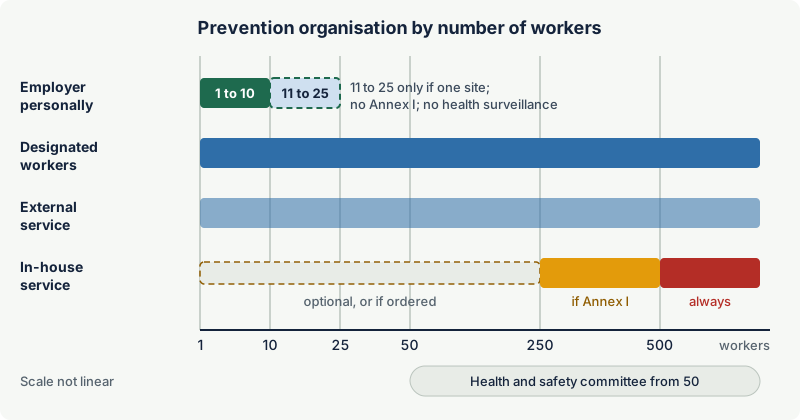
- Every employer must organise prevention in one of four ways (RSP Art. 10): doing it personally (only up to 10 workers, or up to 25 with a single workplace, and never health surveillance), designating workers, setting up an in-house prevention service, or contracting an accredited external prevention service.
- An in-house prevention service (servicio de prevención propio) is mandatory above 500 workers, and from 250 to 500 workers when the company carries out an activity listed in Annex I of RD 39/1997 (for example mining, construction with risk of falls or burial, explosives, high-voltage electrical work).
- An accident causing at least one day of medical leave is notified with the accident report (parte de accidente de trabajo) through the electronic Delt@ system within five working days; a fatal, serious or very serious accident, or one affecting more than four workers, must also be communicated to the provincial labour authority within 24 hours.
- A health and safety committee (Comité de Seguridad y Salud) is required in every company or workplace with 50 or more workers and meets at least quarterly; prevention delegates (Delegados de Prevención), chosen from the elected workers' representatives, range from 1 to 8 according to headcount.
- OSH administrative fines are set by the Law on Social Order Offences and Penalties (LISOS, Royal Legislative Decree 5/2000): from 45 euros for a minor offence up to 983,736 euros for a very serious one (amounts in force since 1 October 2021, unchanged in the consolidated text consulted in November 2026).
- Criminal liability applies when an employer who is legally obliged fails to provide the means for safe work and so puts workers in serious danger: six months to three years in prison and a day-fine of six to twelve months (Penal Code Art. 316).
The legal framework and the authorities
Main texts
Spanish OSH law is built around one framework act, the LPRL, with royal decrees (reales decretos) for each topic, most of them transposing EU daughter directives. The LPRL was published in the BOE on 10 November 1995 and entered into force on 10 February 1996. Law 54/2003 reformed it to stress the integration of prevention into management and to add the duty of on-site preventive resources (recurso preventivo, Art. 32 bis). The consolidated text was last amended in April 2026.
| Text (Spanish name) | English meaning | What it covers |
|---|---|---|
| Ley 31/1995, de Prevención de Riesgos Laborales (LPRL) | Law on the Prevention of Occupational Risks | General duties, rights, prevention services, representation |
| Real Decreto 39/1997, Reglamento de los Servicios de Prevención (RSP) | Prevention Services Regulation | Prevention plan, risk assessment, the four organisation models, audits, qualification levels, health surveillance |
| Real Decreto Legislativo 5/2000 (LISOS) | Law on Social Order Offences and Penalties | Minor, serious and very serious OSH offences and fines |
| Real Decreto 171/2004 | Coordination of business activities | Contractors and several employers on one site |
| Real Decreto 1627/1997 | Construction sites | Safety coordinators, health and safety plan |
| Real Decreto 486/1997 | Workplaces | Minimum workplace conditions, including outdoor work in extreme weather |
| Real Decreto 374/2001 | Chemical agents | Chemical risk assessment and exposure limits |
| Real Decreto 681/2003 | Explosive atmospheres at work | Zoning and the explosion protection document |
| Real Decreto 840/2015 | Major accidents with dangerous substances | Seveso III |
The General Social Security Act (Real Decreto Legislativo 8/2015, Ley General de la Seguridad Social, LGSS) adds the benefit surcharge for safety failures and the pre-employment medical examination for posts with occupational disease risk. Directly applicable EU regulations apply without transposition: CLP (EC) No 1272/2008, REACH (EC) No 1907/2006 and the PPE Regulation (EU) 2016/425. Internationally, Spain has ratified the core ILO occupational safety and inspection instruments, including Convention No. 81 on labour inspection (published in the BOE in 1961), Convention No. 155 on occupational safety and health (ratified 26 July 1985, BOE 11 November 1985) and Convention No. 187 on the promotional framework for occupational safety and health (BOE 4 August 2009).
Authorities
| Body | Role in OSH |
|---|---|
| Ministerio de Trabajo y Economía Social | Ministry of Labour and Social Economy: national OSH policy and rules |
| Organismo Estatal Inspección de Trabajo y Seguridad Social (ITSS) | Inspects workplaces, requires corrections, stops dangerous work, proposes penalties (LPRL Art. 9, Law 23/2015) |
| Labour authority of the autonomous community (autoridad laboral) | Receives accident notifications and workplace opening notices, imposes most penalties, accredits prevention services |
| INSST | National scientific and technical body: technical guides, exposure limit lists, EU-OSHA focal point (LPRL Art. 8) |
| Technical OSH bodies of the autonomous communities | Advice, campaigns and technical checks; their technicians can issue requirements and report to the ITSS (LPRL Art. 9.2 and 9.3) |
| Mutuas colaboradoras con la Seguridad Social | Insurers of occupational risks on behalf of Social Security; receive accident reports; barred from acting as external prevention services (LPRL Art. 32) |
| Comisión Nacional de Seguridad y Salud en el Trabajo | Tripartite national advisory body (LPRL Art. 13) |
Spain is decentralised: the State makes labour law, but the autonomous communities execute it. In practice the "labour authority" in accident notification and penalty procedures is usually a department of the regional government. Inspections in mines, quarries, tunnels using mining technique, explosives and nuclear energy remain with the specialised bodies under their own rules (LPRL Art. 7.2).
How an employer must organise prevention
General duty and principles
LPRL Art. 15 lists the nine general principles of prevention of the EU framework directive: avoid risks, evaluate risks that cannot be avoided, combat risks at source, adapt work to the person, take account of technical progress, replace the dangerous by the less dangerous, plan prevention, give collective protection priority over individual protection, and give instructions. Measures must allow for non-reckless distraction or carelessness by workers (Art. 15.4), and their cost may never fall on workers (Art. 14.5).
Workers must use machines, substances and PPE correctly, not disable safety devices, report risks immediately to their supervisor and cooperate with the employer (Art. 29). A breach is a labour disciplinary matter. Workers may stop work and leave the workplace when they consider the activity involves a serious and imminent risk to life or health (Art. 21.2).
The four organisation models
| Model | When it can or must be used | Conditions |
|---|---|---|
| Employer personally (asunción personal) | Up to 10 workers, or up to 25 with a single workplace; no Annex I activity | Works habitually at the workplace and holds the required training level; health surveillance and anything else not covered must be contracted (LPRL Art. 30.5, RSP Art. 11) |
| Designated workers (trabajadores designados) | Any size, where sufficient | Required training level, time and means; protected like worker representatives (LPRL Art. 30) |
| In-house service (servicio de prevención propio) | Mandatory above 500 workers; from 250 to 500 with Annex I activities; or when the labour authority orders it (unless an external service is contracted instead) | Specific unit, members working exclusively for it, at least two of the four specialities, annual report (RSP Arts. 14 and 15) |
| Joint service (servicio de prevención mancomunado) | Companies sharing a site, industrial estate, sector or group | Counts as an in-house service; at least three specialities (RSP Art. 21) |
| External service (servicio de prevención ajeno) | Whenever internal resources are not enough | Accredited by the labour authority, valid throughout Spain (LPRL Art. 31) |
The four specialities are occupational safety, industrial hygiene, ergonomics and applied psychosociology, and occupational medicine (RSP Art. 34). Employers often combine models, for example an in-house service for safety and hygiene with an external service for health surveillance.
Qualification levels
The RSP defines three levels of prevention functions. Basic level requires at least 50 hours of training in companies with Annex I activities or 30 hours otherwise (Art. 35); intermediate level at least 300 hours (Art. 36); higher level a university degree plus at least 600 hours of university-accredited training in one speciality (Art. 37). Health surveillance must be carried out by a service with a physician specialised in occupational medicine and an occupational health nurse (Art. 37.3).
Audit of the prevention system
An employer that has not contracted all its prevention to an external service must have its system audited by an authorised auditor: the first audit within 12 months of having the planning of preventive activity, then every four years, or every two years for Annex I activities, with two extra years where the organisation model was agreed with the workers' representatives (RSP Art. 30.4). A company of up to 50 workers without Annex I activities that does prevention with its own resources can instead send the labour authority a notification on the official model (RSP Art. 29.3).
Risk assessment, training and health surveillance
Prevention plan and risk assessment
The employer must prepare a prevention plan (plan de prevención de riesgos laborales) approved by management, covering the organisation, responsibilities, procedures and resources (LPRL Art. 16.1, RSP Art. 2). It must carry out an initial risk assessment of every job that has risks, update it when working conditions change, and review it after damage to health (Art. 16.2). The RSP adds review when new equipment, substances or technology are introduced, when an especially sensitive worker joins, and at intervals agreed with the workers' representatives (RSP Arts. 4 and 6). Spanish law sets no single fixed review interval: specific regulations or the agreement with the representatives fix it.
The planning of preventive activity must name, for each measure, the deadline, the person responsible and the resources (Art. 16.2.b). Companies of up to 50 workers without Annex I activities may combine the plan, assessment and planning in one short document (RSP Art. 2.4). All of this must be kept available to the labour authority (LPRL Art. 23).
Training and information
Each worker must receive sufficient, appropriate theoretical and practical training focused on the job, at hiring whatever the type or length of contract, when duties change and when new technology or equipment is introduced, repeated periodically if necessary (LPRL Art. 19). It must be given within working hours where possible, or the time must be deducted from working hours, at no cost to the worker. The law sets no general minimum number of hours for workers; sector collective agreements, notably in construction and the metal industry, add structured courses. Workers must also receive information on the risks of their job and the protective measures (Art. 18).
Health surveillance
The employer must guarantee periodic health surveillance appropriate to the risks (LPRL Art. 22). It is voluntary for the worker, except, following a prior report from the workers' representatives, where it is essential to assess the effects of working conditions, to check whether the worker's health could endanger the worker or others, or where a specific regulation requires it. The service performs an initial examination after hiring or a new task, an examination after prolonged absence for health reasons and periodic examinations under specific medical protocols (RSP Art. 37.3). Employers covering posts with a risk of occupational disease must arrange a pre-employment examination, compulsory for the worker, and may not hire a worker found unfit (LGSS Art. 243). Medical data are confidential: the employer only receives conclusions on fitness and on protective measures needed (LPRL Art. 22.4).
Reporting accidents and occupational diseases
Spain uses electronic notification through Delt@ (Declaración Electrónica de Accidentes de Trabajo), introduced by Order TAS/2926/2002, while the accident deadlines come from the Order of 16 December 1987 and occupational diseases follow Royal Decree 1299/2006 and Order TAS/1/2007.
| Event | What the employer does | To whom | Deadline |
|---|---|---|---|
| Accident with at least one day of medical leave (not counting the day of the accident) | Accident report (parte de accidente de trabajo) via Delt@ | Mutua or Social Security managing entity, which forwards it to the labour authority within 10 working days | 5 working days from the accident or the medical leave |
| Accident without medical leave | Monthly list (relación de accidentes sin baja médica) via Delt@ | Same | First 5 working days of the following month |
| Fatal, serious or very serious accident, or one affecting more than 4 workers | Urgent communication, in addition to the report | Labour authority of the province where it happened | 24 hours |
| Occupational disease | Supplies the information requested; investigates | The mutua or managing entity files the disease report through CEPROSS | Entity: 10 working days from diagnosis, full data within 5 more working days |
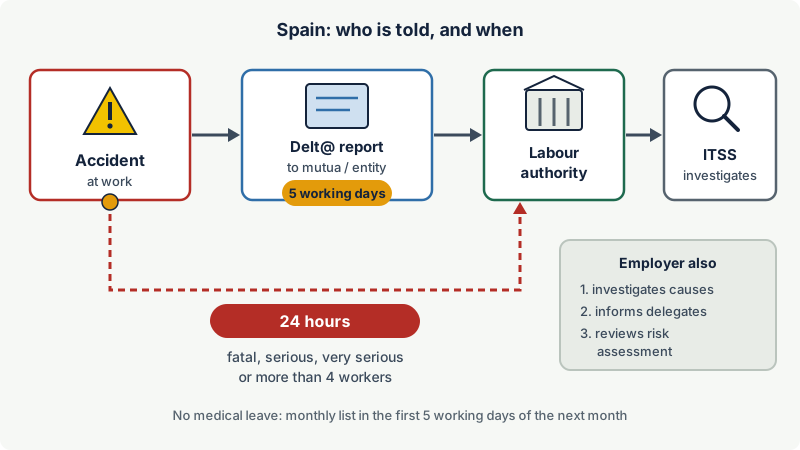
The urgent communication must state the company name, address and telephone, the name of the injured worker, the exact place and a brief description (Order of 16 December 1987, Art. 6). The labour authority passes it to the ITSS, which investigates how and why the accident happened. The employer must itself investigate every incident that damages health (LPRL Art. 16.3), keep a list of accidents and diseases causing more than one day of incapacity (Art. 23.1.e) and inform the prevention delegates, who may visit the scene even outside working hours (Art. 36.2.c).
Example: A worker in a 120-worker food plant in Valencia falls from a platform on Thursday at 11:00 and is admitted to hospital with a fracture that the doctor classes as serious. The employer communicates the accident to the provincial labour authority by Friday 11:00, completes the parte de accidente de trabajo in Delt@ within five working days, investigates the causes with its prevention service, informs the prevention delegates and the health and safety committee, and reviews the risk assessment of the platform task. The labour authority passes the communication to the ITSS, which investigates.
Worker representatives and the health and safety committee
Prevention delegates (Delegados de Prevención) are appointed by and from the workers' representatives (LPRL Art. 35). In companies of up to 30 workers the staff delegate (delegado de personal) is the prevention delegate; from 31 to 49 workers one is chosen among the staff delegates. The scale then rises: 2 delegates from 50 to 100 workers, 3 from 101 to 500, 4 from 501 to 1,000, 5 from 1,001 to 2,000, 6 from 2,001 to 3,000, 7 from 3,001 to 4,000 and 8 from 4,001. Staff delegates exist in companies with more than 10 and fewer than 50 workers, and in those with 6 to 10 if the workers so decide (Workers' Statute Art. 62).
Delegates are consulted before decisions on OSH, may accompany inspectors and technicians, visit workplaces, access OSH documentation and propose measures; a refusal of their proposals must be reasoned (Arts. 33 and 36). Committee meetings and visits after accidents count as working time.
A Comité de Seguridad y Salud must be set up in every company or workplace with 50 or more workers (Art. 38). It is joint: the prevention delegates on one side and the employer's representatives in equal number on the other, with trade union delegates and the prevention technicians attending without a vote. It meets every quarter and whenever one side asks, and it debates the choice of prevention model, the plans and the training programme (Art. 39).
Inspections, enforcement and penalties
ITSS inspectors may require the employer to correct a breach within a set time (LPRL Art. 43) or order the immediate stoppage of work that involves a serious and imminent risk; the company must comply at once and may appeal to the labour authority within three working days (Art. 44). In cases of exceptional gravity the Government or the autonomous community can suspend activities or close the workplace (Art. 53).
| Offence class (LISOS) | Examples | Fine (LISOS Art. 40.2) |
|---|---|---|
| Minor (leve, Art. 11) | Not reporting a minor accident in time; formal or documentary breaches | 45 to 2,450 euros |
| Serious (grave, Art. 12) | No risk assessment or planning; no medical examinations; no training; not reporting a serious or fatal accident; no prevention organisation; no audit | 2,451 to 49,180 euros |
| Very serious (muy grave, Art. 13) | Breaching rules protecting pregnant workers or minors; ignoring a stop-work order; breaches causing serious and imminent risk; breaching medical confidentiality | 49,181 to 983,736 euros |
Each class has minimum, medium and maximum grades chosen according to criteria such as the danger of the activity, the number of workers affected, the damage caused and failure to follow earlier requirements (LISOS Art. 39.3). Final penalties for very serious offences are published. Repeating an offence of the same type and classification within 365 days from notification of a penalty decision that has become final allows the fine to be increased up to double the grade, without exceeding the maximum for that offence class (Art. 41). OSH offences time out after one year (minor), three years (serious) and five years (very serious) (Art. 4.3).
Two further consequences matter in practice. Social Security benefits for an accident or disease caused by missing or defective protection are increased by 30 to 50 per cent, paid directly by the employer and not insurable (LGSS Art. 164). And a person legally obliged who fails to provide the means for safe work, putting workers in serious danger, commits a crime punishable with six months to three years in prison and a fine of six to twelve months under the day-fine system (Penal Code Art. 316), with a lower penalty for gross negligence (Art. 317) and liability of the managers responsible where the employer is a company (Art. 318).
Chemicals, explosive atmospheres, major hazards and PPE
Chemicals and GHS
CLP applies directly and provides the GHS-based labels and pictograms. RD 374/2001 governs chemical risk assessment and control at work. Where it sets no limit value, the reference limits are those published by the INSST in its document on occupational exposure limits for chemical agents in Spain ("Límites de exposición profesional para agentes químicos en España") recommended by the national commission (RD 374/2001 Art. 3). Carcinogens, mutagens and reprotoxic agents are governed by RD 665/1997, updated together with RD 374/2001 in October 2026 by RD 846/2026 (which revised the limits for lead and added binding limits for diisocyanates). Asbestos work is governed by RD 847/2026 (in force since 24 October 2026, repealing RD 396/2006), which sets an eight-hour daily exposure limit (VLA-ED) of 0.01 fibres/cm³, requires prior registration in the Registry of Companies with Asbestos Risk (RERA) and requires exposure, training and medical records to be kept for at least 40 years after exposure ends.
Explosive atmospheres and Ex equipment
RD 681/2003 transposes Directive 1999/92/EC. The employer assesses explosion risks, classifies zones and prepares an explosion protection document (documento de protección contra explosiones) before work starts and revises it after important changes to the workplace, equipment or organisation (Art. 8). The INSST publishes a non-binding technical guide on it. Equipment for potentially explosive atmospheres must comply with RD 144/2016, which transposes Directive 2014/34/EU: CE marking, Ex marking and conformity assessment by an EU notified body where the category requires it; the autonomous communities, together with the industry ministry, carry out market surveillance. Spain has no separate national Ex certification scheme, and it is a member country of the IECEx international scheme.
Electrical installations in hazardous areas follow instruction ITC-BT-29 of the Low Voltage Electrotechnical Regulation (RD 842/2002), which classes gas, vapour and mist areas as Class I (zones 0, 1, 2) and flammable dust areas as Class II (zones 20, 21, 22). Only low-voltage installer companies of the specialist category may execute and maintain these installations (ITC-BT-03), an authorised inspection body (organismo de control) inspects Class I premises before commissioning and every five years thereafter except car parks with fewer than 25 spaces (ITC-BT-05), and inspection and maintenance follow UNE-EN 60079-17. See the two ATEX directives explained.
Major-hazard (Seveso) sites
RD 840/2015 implements the Seveso III Directive 2012/18/EU with the EU lower-tier and upper-tier thresholds (for example 50 and 200 tonnes for liquefied flammable gases including LPG, 10 and 25 tonnes for chlorine). The competent bodies of the autonomous communities receive notifications and safety reports, inspect and prepare external emergency plans; the Directorate General for Civil Protection and Emergencies of the Ministry of the Interior coordinates nationally. Upper-tier operators review the safety report at least every five years (Art. 10.7), internal emergency plans are updated at least every three years (Art. 12), site visits take place at least yearly for upper-tier and every three years for lower-tier sites unless a risk-based programme applies (Art. 21), and any accident capable of becoming a major accident must be reported immediately to the regional civil protection body (Art. 17).
Personal protective equipment
PPE must carry the CE marking under Regulation (EU) 2016/425. RD 773/1997 sets the employer's duties on choosing, providing and maintaining PPE and ensuring its use, which applies only where risks cannot be avoided or sufficiently limited by collective or organisational means (LPRL Art. 17.2).
Other national specifics
Since May 2023 the workplace decree requires measures for outdoor work against extreme weather, and when the State Meteorological Agency (AEMET) or a regional service issues an orange or red warning and other measures are not enough, working conditions, including hours, must be adapted (RD 486/1997, additional provision). Where several companies work on one site, RD 171/2004 requires coordination, and preventive resources must be present on site for hazardous operations or concurrent activities that need supervision (LPRL Art. 32 bis).
Spain compared with the EU framework and Türkiye
| Topic | EU framework (89/391/EEC) | Spain | Türkiye (Law No. 6331) |
|---|---|---|---|
| Main law | Directive, transposed nationally | LPRL (Law 31/1995) and RSP (RD 39/1997) | Law No. 6331 on Occupational Safety and Health (İş Sağlığı ve Güvenliği Kanunu, 2012) and its regulations |
| Prevention staff | Designated workers or competent external services | Four models; in-house service above 500 workers or 250 with Annex I activities | OSH specialist and workplace physician (plus other health personnel in very hazardous sites with 10 or more workers) by hazard class and headcount; employers of less hazardous sites under 50 workers may handle non-medical tasks after training (Art. 6) |
| Risk assessment | Required | Required with prevention plan; review when conditions change or as agreed with representatives | Required; renewed at least every 2, 4 or 6 years by hazard class |
| Accident reporting | National rules | Delt@ within 5 working days; serious, fatal or multiple: labour authority within 24 hours | Social Security Institution (SGK) within three working days after the accident (Art. 14) |
| Committee | Consultation required | Health and safety committee from 50 workers | OSH committee with 50 or more workers and continuous work lasting more than six months (Art. 22) |
| Worker training | Required | At hiring and on change; periodic if necessary; no general hour minimum | At least 2 hours of induction before starting work, plus basic training of 8, 12 or 16 lesson hours by hazard class, repeated at least every 3, 2 or 1 years (regulation of 2 April 2026) |
| Fines | National | Fixed bands in LISOS (45 to 983,736 euros) | Set in Art. 26, scaled by headcount and hazard class, and revalued every year |
Spain gives employers more choice in how to organise prevention, while Türkiye fixes appointments and minutes of service per worker by hazard class. See the international comparison of appointments and reporting deadlines.
Common mistakes
- Treating the external prevention service as the party responsible. Contracting an external service complements but never removes the employer's duty (LPRL Art. 14.4); the employer remains liable for the plan, the measures and their follow-up.
- Sending only the Delt@ report after a serious accident. Fatal, serious, very serious and multiple accidents also need the urgent 24-hour communication to the provincial labour authority.
- Making all medical examinations compulsory. Health surveillance is voluntary unless one of the legal exceptions applies following a prior report from the workers' representatives; pre-employment examinations are compulsory only for posts with occupational disease risk or where a specific rule requires them.
- Doing prevention personally as owner-manager and forgetting health surveillance. The employer may never carry out health surveillance personally; it must be contracted.
- Running an in-house service without the audit. Companies not fully covered by an external service must have their system audited, every two or four years, or send the small-company notification where it applies.
Frequently asked questions
Is the LPRL the only OSH law in Spain?
No. The LPRL is the framework act. The Prevention Services Regulation (RD 39/1997) and topic-specific royal decrees, most of them transposing EU directives, contain the detailed duties, and LISOS sets the penalties.
Do foreign companies working in Spain have to follow Spanish OSH rules?
Yes. Work carried out in Spain is subject to Spanish OSH law, and on shared sites the host company and every contractor must cooperate and coordinate under LPRL Art. 24 and RD 171/2004, including exchanging information on risks and emergency measures.
Who receives the workplace accident report in Spain?
The parte de accidente de trabajo goes electronically through Delt@ to the mutua or Social Security managing entity that covers occupational risks, which passes it to the labour authority. Fatal, serious, very serious or multiple accidents must also be communicated directly to the provincial labour authority within 24 hours.
Are Spanish OSH fines updated every year?
No. The bands in LISOS Art. 40.2 are fixed in the law; the Government may update them in line with consumer prices, and the current amounts have applied since 1 October 2021. Check the consolidated text on the BOE before quoting them.
Does Spain have its own Ex certification mark?
No. Ex equipment is placed on the market with CE marking under RD 144/2016 (Directive 2014/34/EU). An IECEx certificate alone does not replace the EU conformity assessment and CE marking.
Related on excodex
- What is the main occupational safety and health law in Spain and who enforces it?
- How and within what time must a workplace accident be reported in Spain?
- Must an employer in Spain appoint a safety professional or an occupational physician?
- The EU framework directive 89/391/EEC explained
- Seveso III major-accident prevention: tiers and duties
- The explosion protection document and area classification
Standards and further reading
- Ley 31/1995, de 8 de noviembre, de Prevención de Riesgos Laborales, consolidated text: BOE-A-1995-24292
- Real Decreto 39/1997, de 17 de enero, Reglamento de los Servicios de Prevención: BOE-A-1997-1853
- Real Decreto Legislativo 5/2000, de 4 de agosto, Ley sobre Infracciones y Sanciones en el Orden Social (LISOS): BOE-A-2000-15060
- Ley 23/2015, de 21 de julio, Ordenadora del Sistema de Inspección de Trabajo y Seguridad Social: BOE-A-2015-8168
- Orden de 16 de diciembre de 1987 (accident notification models and deadlines): BOE-A-1987-28546
- Orden TAS/2926/2002, de 19 de noviembre (Delt@): BOE-A-2002-22650
- Real Decreto 1299/2006 (list of occupational diseases): BOE-A-2006-22169; Orden TAS/1/2007, de 2 de enero (occupational disease report, CEPROSS): BOE-A-2007-186
- Real Decreto 374/2001 (chemical agents): BOE-A-2001-8436; Real Decreto 665/1997 (carcinogens, mutagens and reprotoxic agents): BOE-A-1997-11145; Real Decreto 846/2026 (October 2026 update to RD 665/1997 and RD 374/2001): BOE-A-2026-22080; Real Decreto 847/2026 (asbestos, repealing RD 396/2006): BOE-A-2026-22081
- Real Decreto 681/2003 (explosive atmospheres at work): BOE-A-2003-12099; Real Decreto 144/2016 (ATEX equipment): BOE-A-2016-3539; Real Decreto 842/2002, ITC-BT-03, ITC-BT-05 and ITC-BT-29: BOE-A-2002-18099
- Real Decreto 840/2015 (Seveso III): BOE-A-2015-11268
- Real Decreto Legislativo 8/2015 (LGSS), Arts. 164, 243 and 244: BOE-A-2015-11724; Ley Orgánica 10/1995 (Penal Code), Arts. 316 to 318: BOE-A-1995-25444
- Ratifications of ILO Conventions in Spain: Convention No. 81 (BOE-A-1961-45), Convention No. 155 (BOE-A-1985-23158) and Convention No. 187 (BOE-A-2009-12933)
- Ministerio de Trabajo y Economía Social: mites.gob.es; Organismo Estatal Inspección de Trabajo y Seguridad Social: oeitss.gob.es; Instituto Nacional de Seguridad y Salud en el Trabajo: insst.es
- UNE-EN 60079-17 (inspection and maintenance of electrical installations in explosive atmospheres), referenced by ITC-BT-29
This article is general occupational safety and health information prepared by the excodex editorial team. It does not replace the applicable legislation, standards, manufacturers' instructions or the assessment of a competent OSH professional or occupational physician.