Occupational safety International framework and country guides
How and within what time must a workplace accident be reported in Australia?
Part of: Occupational safety and health in Australia: law, authorities and employer duties
Short answer
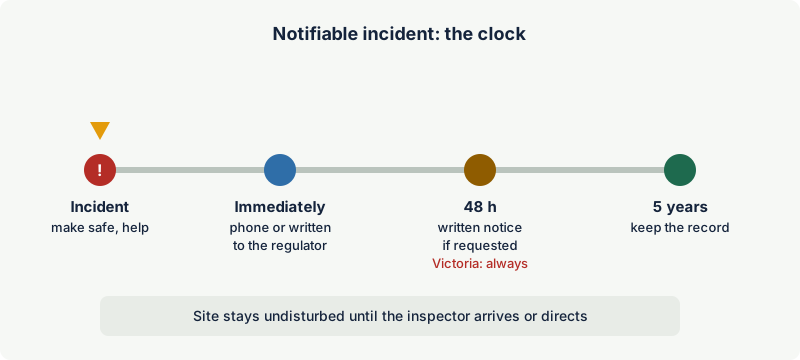
Immediately. The PCBU must notify the WHS regulator of a death, serious injury or illness or dangerous incident immediately after becoming aware, by phone or in writing, give a written notice within 48 hours if asked (in Victoria always), and keep the record 5 years.
Immediately. When a notifiable incident occurs, the person conducting the business or undertaking (PCBU) must notify the work health and safety regulator of its jurisdiction immediately after becoming aware of it, by the fastest possible means, by telephone or in writing. A written notice follows within 48 hours if the regulator asks for it (in Victoria in every case), and the record is kept for at least 5 years.
Short answer
- What: a death, a serious injury or illness, or a dangerous incident arising from the business or undertaking (model WHS Act, sections 35 to 37).
- Who: the PCBU; in practice the site manager or whoever the procedure names.
- To whom: the regulator of the state, territory or Commonwealth where the work is done (not Safe Work Australia).
- When and how: immediately, by phone or in writing; written notice within 48 hours of the regulator's request; keep the record at least 5 years (section 38).
- Site: leave it undisturbed until an inspector arrives or directs otherwise, except to help the injured, make it safe or assist police (section 39).
- Victoria: call WorkSafe on 13 23 60 immediately, give a written record on the approved form within 48 hours and keep a copy for at least 5 years (OHS Act 2004, section 38). Victoria's list of notifiable incidents (section 37) is similar but not identical.
What counts as notifiable
A serious injury or illness means one requiring immediate treatment as a hospital inpatient; immediate treatment for an amputation, serious head or eye injury, serious burn, degloving or scalping, spinal injury, loss of a bodily function or serious lacerations; or medical treatment within 48 hours of exposure to a substance (section 36). A dangerous incident exposes someone to a serious risk from an immediate or imminent exposure to, for example, an uncontrolled escape of a substance, gas or steam, an uncontrolled fire or explosion, electric shock, a falling object, the collapse of a structure or excavation, or the failure of plant that must be authorised (section 37). The dangerous incident must be notified even if nobody was hurt.
How to notify step by step
- Deal with the emergency: rescue, first aid, call emergency services, make the area safe.
- Decide quickly whether the event is notifiable using the definitions above. If in doubt, notify.
- Phone the regulator's notification line or use its online form. Give the details the regulator asks for.
- If the regulator asks for a written notice, send it within 48 hours on the form or with the details it approves.
- Preserve the site, including plant, substances and things involved, until the inspector arrives or releases it.
- Keep the notification record for at least 5 years from the day the notice was given, then review the controls that failed (WHS Regulations, regulation 38).
Workers' compensation claims are a separate process with the insurer or scheme of each jurisdiction and do not replace notification to the regulator.
Example: At a Sydney warehouse a racking upright buckles and a loaded pallet falls into an aisle; nobody is injured. Falling objects and plant failure can make this a dangerous incident, so the warehouse manager calls SafeWork NSW straight away, cordons off the aisle without moving the racking, sends the written notice when asked, and files the record. The same event in Melbourne would also need a written report within 48 hours, whether or not WorkSafe Victoria asks.
Changes to watch
In December 2025 Safe Work Australia published amendments to the model Act that add more notifiable categories, such as dangerous incidents involving mobile plant and falls, violent incidents including sexual assault, work-related suicide and attempted suicide, and worker absences of 15 or more calendar days. These apply only after each jurisdiction adopts them in its own law, so check the regulator's current guidance before updating your procedure.
Comparison with Türkiye and the EU
In Türkiye, Article 14 of Law No. 6331 requires the employer to notify the Social Security Institution (SGK) of a work accident within 3 working days after it happens, and of an occupational disease within 3 working days of learning of it. EU member states set their own deadlines under their national laws. Australia's "immediately" rule is stricter in time, but the list of notifiable events is narrower.
Common mistakes
- Notifying only injuries. Dangerous incidents with no injury are notifiable.
- Waiting for the hospital to confirm admission. Notify once you become aware; details can follow.
- Reporting to Safe Work Australia or only to the insurer.
Related on excodex
- Occupational safety and health in Australia: law, authorities and employer duties
- What are the penalties for breaking occupational safety rules in Australia?
- What is the main OSH law in Australia and who enforces it?
- OSH law comparison: appointments and reporting deadlines
Standards and further reading
- Work Health and Safety Act 2011 (Cth), Part 3 (sections 35 to 39): https://www.legislation.gov.au/C2011A00137/latest/text
- Safe Work Australia, incident reporting: https://www.safeworkaustralia.gov.au/safety-topic/managing-health-and-safety/incident-reporting
- WorkSafe Victoria, report an incident: https://www.worksafe.vic.gov.au/report-incident
- Occupational Health and Safety Act 2004 (Vic), sections 37 to 39: https://www.legislation.vic.gov.au/in-force/acts/occupational-health-and-safety-act-2004
- Law No. 6331 on Occupational Health and Safety (Türkiye), Article 14
This article is general occupational safety and health information prepared by the excodex editorial team. It does not replace the applicable legislation, standards, manufacturers' instructions or the assessment of a competent OSH professional or occupational physician.
More questions on this topic
- What is the main occupational safety and health law in Australia and who enforces it?
- Must an employer in Australia appoint a safety professional or an occupational physician?
- Is a written risk assessment mandatory in Australia, and how often must it be reviewed?
- What OSH training must employers provide to workers in Australia?
- Are pre-employment and periodic medical examinations required for workers in Australia?
- What are the penalties for breaking occupational safety rules in Australia?
- Is a safety committee or a worker safety representative required in Australia?
- How are explosive atmospheres and Ex equipment regulated in Australia?
Part of: Occupational safety and health in Australia: law, authorities and employer duties