Occupational safety International framework and country guides
Occupational safety and health in Australia: law, authorities and employer duties
Abstract
Australia has no single national OSH law. Eight jurisdictions apply a WHS Act based on the model WHS laws, Victoria keeps its OHS Act 2004, and each has its own regulator. The PCBU must ensure health and safety so far as is reasonably practicable and notify serious incidents immediately.
Australia has no single national occupational safety and health (OSH) law. Safe Work Australia, a national policy body, writes the model Work Health and Safety (WHS) laws, and every jurisdiction except Victoria has passed its own WHS Act and Regulations based on that model. Victoria keeps the Occupational Health and Safety Act 2004. Enforcement belongs to the regulator of each state, territory or the Commonwealth, not to Safe Work Australia.
This guide explains the legal framework, who enforces it, the duties of the "person conducting a business or undertaking" (PCBU), representation, incident notification, penalties, chemicals, explosive atmospheres and major hazard facilities, and compares the Australian model with the EU framework and Türkiye.
Key points
- The model WHS laws (Act, Regulations and Codes of Practice) are in force in the Commonwealth, New South Wales, Queensland, the Australian Capital Territory and the Northern Territory from 1 January 2012, South Australia and Tasmania from 1 January 2013 and Western Australia from 31 March 2022. Victoria has not adopted them.
- The main duty holder is the PCBU, who must ensure the health and safety of workers and others "so far as is reasonably practicable"; officers must exercise due diligence and workers must take reasonable care.
- There is no general legal duty to appoint a safety professional or an occupational physician, and no general duty to write every risk assessment down. Specific regulations require written documents, such as safe work method statements for high risk construction work.
- A death, a serious injury or illness, or a dangerous incident must be notified to the regulator immediately after the PCBU becomes aware of it; a written notice follows within 48 hours of the regulator's request (in Victoria always), and the record is kept for at least 5 years.
- Workers may ask for health and safety representatives (HSRs); a health and safety committee must be set up within 2 months of a request by an HSR or by 5 or more workers.
- Penalties are criminal. Under the Commonwealth WHS Act, industrial manslaughter carries up to 25 years' imprisonment for an individual and $18,000,000 for a body corporate (in force from 1 July 2024).
The legal framework: model WHS laws and the Victorian exception
Safe Work Australia develops national policy and the model WHS laws, but it does not inspect or prosecute. The model package has three layers: the model WHS Act, the model WHS Regulations (detailed duties, licensing and records) and model Codes of Practice. A code has legal effect only when a jurisdiction approves it; an approved code is not law, but a court may admit it as evidence of what is known about a hazard and how to control it.
Section and regulation numbers in this guide follow the Commonwealth Work Health and Safety Act 2011 (compilation in force from 1 July 2024) and Work Health and Safety Regulations 2011 (compilation of 25 March 2025). State Acts follow the same structure with local variations, so check your own jurisdiction's version.
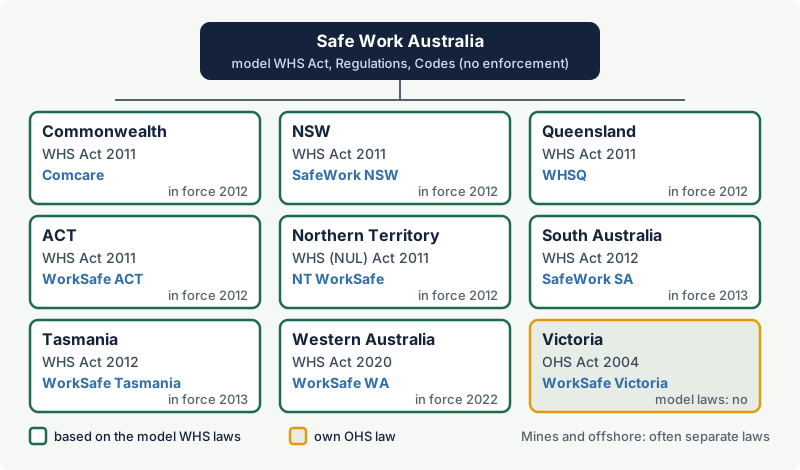
| Jurisdiction | Main law | Regulator (general workplaces) |
|---|---|---|
| Commonwealth (federal agencies, some national employers) | Work Health and Safety Act 2011 | Comcare |
| New South Wales | Work Health and Safety Act 2011 (NSW) | SafeWork NSW |
| Victoria | Occupational Health and Safety Act 2004 and OHS Regulations 2017 | WorkSafe Victoria |
| Queensland | Work Health and Safety Act 2011 (Qld) | Workplace Health and Safety Queensland |
| South Australia | Work Health and Safety Act 2012 (SA) | SafeWork SA |
| Western Australia | Work Health and Safety Act 2020 (WA) | WorkSafe WA |
| Tasmania | Work Health and Safety Act 2012 (Tas) | WorkSafe Tasmania |
| Australian Capital Territory | Work Health and Safety Act 2011 (ACT) | WorkSafe ACT |
| Northern Territory | Work Health and Safety (National Uniform Legislation) Act 2011 | NT WorkSafe |
Mines, petroleum sites and offshore facilities often have their own laws and regulators: the Commonwealth Act does not apply to facilities under Schedule 3 to the Offshore Petroleum and Greenhouse Gas Storage Act 2006 (section 12A), and New South Wales mines fall under the Work Health and Safety (Mines and Petroleum Sites) Regulation 2022. Workers' compensation is a separate scheme in each jurisdiction.
Duties of the PCBU, officers and workers
The model Act deliberately uses "person conducting a business or undertaking" instead of "employer", so the duty follows control, not the employment contract. Under section 19, the PCBU must ensure, so far as is reasonably practicable, the health and safety of workers it engages or directs (including contractors and labour hire workers) and of other people affected by the work. Section 19(3) lists what this includes: a safe work environment, safe plant and structures, safe systems of work, safe handling and storage of plant and substances, adequate welfare facilities, the information, training, instruction and supervision needed, and monitoring of workers' health and workplace conditions.
"Reasonably practicable" (section 18) means what can reasonably be done after weighing the likelihood of harm, its severity, what the duty holder knows or ought to know, the availability and suitability of controls, and finally cost, which only excuses a control if it is grossly disproportionate to the risk. Section 17 requires risks to be eliminated first and, where that is not reasonably practicable, minimised.
Further duties apply to those who control workplaces and to designers, manufacturers, importers, suppliers and installers (sections 20 to 26). Officers (directors and senior managers) must exercise due diligence (section 27): keep their WHS knowledge current, understand the operations and hazards, and verify that resources and processes are provided and used. Workers must take reasonable care, follow reasonable instructions and cooperate with policies (section 28). In Victoria, the OHS Act 2004 places the main duty on the "employer", with similar "reasonably practicable" wording.
OSH services, risk management, training and health monitoring
Safety professionals and physicians
Unlike Türkiye or several EU states, Australian WHS law does not oblige a PCBU of any size to appoint a safety professional or an occupational physician. The PCBU needs the competence to meet its duties, and specific regulations call for "competent persons" (for example, a confined space risk assessment must be done by a competent person). Health monitoring for listed hazardous chemicals must be carried out by or under the supervision of a registered medical practitioner with experience in health monitoring (regulation 371). Mining and petroleum laws in several states prescribe statutory positions with defined qualifications; check the mining regulator.
Risk management
Part 3.1 of the Regulations sets the method: identify reasonably foreseeable hazards (regulation 34), eliminate or minimise risks (35), apply the hierarchy of controls: substitution, isolation, engineering, then administrative controls, then personal protective equipment (36), maintain controls (37) and review them (38). There is no fixed review interval: review is required when a control does not work (for example after a notifiable incident), before a workplace change, when a new hazard is found, when consultation shows a need, or when an HSR asks.
A written record is required for specific activities, for example a safe work method statement (SWMS) before high risk construction work (regulation 299), a confined space risk assessment recorded in writing (regulation 66), a silica risk control plan for high-risk processing of crystalline silica substances (regulation 529CB), and the safety case of a major hazard facility. Every workplace also needs an emergency plan that is maintained, tested and explained to workers (regulation 43); the regulation does not spell out the format, but in practice it is written down.
Training
Section 19(3)(f) and regulation 39 require information, training and instruction that are suitable for the work, its risks and the controls, and readily understandable. No national minimum hours apply to general OSH training. Specific rules add: general construction induction training before any construction work (regulation 317), a high risk work licence for classes of work such as scaffolding, rigging, crane and forklift operation (regulation 81 and Schedule 3), and, for elected HSRs, an entitlement on request to an approved initial 5-day course and 1 day of refresher training each year, with time off on normal pay and fees paid by the PCBU (section 72 and regulation 21).
Health monitoring
There is no general requirement for pre-employment or periodic medical examinations. Health monitoring is required where workers doing ongoing work have a significant risk of exposure to hazardous chemicals listed in Schedule 14 (such as benzene, crystalline silica, isocyanates and inorganic mercury) or to other chemicals for which a valid monitoring method exists (regulation 368), for lead risk work (before starting, 1 month later, then at intervals set by blood lead level) and for asbestos removal work. Health monitoring reports are confidential and kept for at least 30 years (regulation 378). Air monitoring results must also be kept for 30 years (regulation 50).
Consultation, health and safety representatives and committees
The PCBU must consult workers on hazards, risk controls, welfare facilities, changes and procedures (sections 47 to 49). Any worker may ask the PCBU to facilitate the election of one or more HSRs for agreed work groups (section 50). Trained HSRs can issue provisional improvement notices and, after consultation (or at once if the risk is immediate), direct workers to cease unsafe work (sections 85 and 90). Every worker may refuse work that would expose them to a serious risk from an immediate or imminent hazard (section 84).
A health and safety committee must be established within 2 months of a request by an HSR or by 5 or more workers at the workplace (section 75). At least half of its members must be workers not nominated by the PCBU, and it meets at least once every 3 months (sections 76 and 78). Victoria has comparable HSR and committee provisions in the OHS Act 2004.
Incident notification, inspection and penalties
What must be notified
A notifiable incident is the death of a person, a serious injury or illness, or a dangerous incident (sections 35 to 37). Serious injury or illness includes immediate treatment as a hospital inpatient, immediate treatment for amputation, serious head, eye or burn injuries, degloving or scalping, spinal injury, loss of a bodily function or serious lacerations, and medical treatment within 48 hours of exposure to a substance. Dangerous incidents include uncontrolled escapes of substances, gas, steam or pressurised substances, uncontrolled fire or explosion, electric shock, falling objects, collapse of structures, excavations or licensed plant, and inrush or ventilation failure underground.
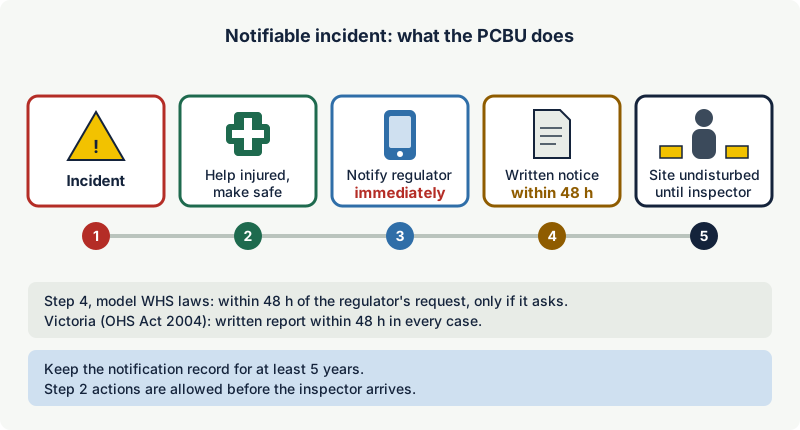
The PCBU must notify the regulator immediately after becoming aware, by the fastest means, by telephone or in writing (section 38). If notified by phone, a written notice is required within 48 hours of the regulator asking for it. The record must be kept for at least 5 years. The person with management or control must preserve the site until an inspector arrives or directs otherwise, except to help the injured, remove a deceased person, make the site safe, assist police or with permission (section 39). In Victoria, WorkSafe asks for an immediate call on 13 23 60 and a written report within 48 hours in every case.
Safe Work Australia has amended the model Act to add further notifiable categories (dangerous incidents involving mobile plant and falls, violent incidents including sexual assault, work-related suicide and attempted suicide, and worker absences of 15 or more calendar days), but these take legal effect only when each jurisdiction adopts them into its own law. Check your regulator before changing procedures.
Inspections and enforcement
Inspectors may enter workplaces, require documents and answers, and issue improvement, prohibition and non-disturbance notices (sections 160 to 201). Regulators may accept enforceable undertakings instead of prosecution (section 216). Prosecutions must generally start within 2 years of the offence coming to the regulator's notice; there is no limitation period for industrial manslaughter (section 232). Insurance or indemnity against WHS penalties is prohibited (section 272A).
Penalty levels (Commonwealth base amounts)
| Offence (Commonwealth WHS Act) | Individual as PCBU or officer | Other individual (for example a worker) | Body corporate |
|---|---|---|---|
| Industrial manslaughter (s 30A, PCBUs and officers only) | 25 years' imprisonment | Not applicable | $18,000,000 |
| Category 1: reckless or negligent exposure to risk of death or serious harm (s 31) | $3,000,000 or 15 years' imprisonment or both | $1,500,000 or 15 years' imprisonment or both | $15,000,000 |
| Category 2: breach exposing a person to risk of death or serious harm (s 32) | $418,000 | $209,000 | $2,090,000 |
| Category 3: breach of a duty (s 33) | $140,000 | $70,000 | $700,000 |
Category 1 to 3 fines are the Schedule 4 base amounts, indexed to the consumer price index every year from 1 July 2024; Comcare publishes the adjusted figures, so today's amounts are higher. The industrial manslaughter fine is fixed in section 30A. Each state sets its own amounts, often in penalty units. Victoria introduced workplace manslaughter from 1 July 2020, with up to 25 years' imprisonment for individuals and a fine of up to $16.5 million for bodies corporate (figures as at 1 July 2020).
Example: At a Queensland chemical plant a forklift strikes a pipe and ammonia escapes; one worker is admitted to hospital. This is both a dangerous incident (uncontrolled escape of a substance) and a serious injury (inpatient treatment). The area is isolated (allowed), the site manager phones the regulator at once, a written notice follows within 48 hours of the regulator's request, the pipe and forklift stay in place until the inspector releases them, and the record is kept for 5 years. Regulation 38 also requires a review of the traffic and pipe-protection controls. In Victoria, the written report within 48 hours would be due without a request.
Chemicals, explosive atmospheres, major hazard facilities and PPE
Hazardous chemicals and GHS
Manufacturers and importers must classify hazardous chemicals and prepare safety data sheets (regulations 329 and 330). Classification follows the seventh revised edition of the UN Globally Harmonized System (GHS), as modified by Schedule 6. PCBUs must not exceed the published exposure standards and must carry out air monitoring where they cannot be sure the standard is met, keeping the results for 30 years (regulations 49 and 50). From 1 December 2026 the Workplace Exposure Standards list is replaced by the Workplace Exposure Limits (WEL) list; Victoria adopts it on the same date with transition periods for some substances, and some revised limits (such as benzene) start later. Since 1 July 2024 the Commonwealth regulations prohibit work with engineered stone benchtops, panels and slabs (regulation 529D), with matching bans in the other jurisdictions.
Explosive atmospheres and Ex equipment
The WHS Regulations treat as a hazardous atmosphere one where flammable gas, vapour, mist or fume exceeds 5% of the lower explosive limit, where combustible dust may create a hazardous area, or where oxygen is unsafe or increases fire risk (regulation 51). Ignition sources in such atmospheres must be managed (regulation 52). There is no ATEX-style national product directive; in practice, area classification, equipment selection and installation follow the AS/NZS 60079 series, and equipment carries a certificate of conformity, usually under the IECEx scheme or the Australian and New Zealand ANZEx scheme. State electrical safety laws add specific rules: in Queensland, section 221 of the Electrical Safety Regulation 2013 requires an accredited auditor to inspect hazardous-area installations before first connection. In NSW underground coal mines, explosion-protected plant needs a valid certificate of conformity or approvals-list entry, and equipment holding only an old mines department approval may not be used in hazardous zones after 1 September 2028.
Major hazard facilities
Chapter 9 of the model Regulations covers facilities storing or handling Schedule 15 chemicals above threshold quantities (for example 25 tonnes of chlorine, 200 tonnes of LP gases or anhydrous ammonia, 50 tonnes of hydrogen). An operator must notify the regulator within 3 months once quantities exceed 10% of the threshold. A facility above the threshold is determined a major hazard facility; the regulator may also determine one between 10% and 100%. The operator then provides a safety case outline within 3 months and a safety case within 24 months, and needs a licence of up to 5 years. Victoria regulates major hazard facilities through WorkSafe Victoria under its OHS Regulations 2017, and Western Australia under the Dangerous Goods Safety (Major Hazard Facilities) Regulations 2007.
Personal protective equipment
The PCBU must provide PPE where it is required under the hierarchy of controls, and ensure it is suitable, maintained and used (regulation 44). There is no single mandatory PPE conformity mark comparable to the EU CE marking. Purchasers usually specify compliance with the relevant Australian or joint Australian/New Zealand standard, often with third-party certification.
Notable national specifics
- Psychosocial hazards have their own regulations (55A to 55D in the Commonwealth Regulations): PCBUs must manage them like any other risk.
- Industrial manslaughter offences exist in the Commonwealth Act, Victoria and several other jurisdictions, with different elements and penalties.
- Several PCBUs on one site (principal contractor, labour hire, host) must consult, cooperate and coordinate (section 46), and unions holding WHS entry permits may enter to inquire into suspected contraventions (Part 7).
Australia, the EU framework and Türkiye compared
| Topic | Australia (model WHS laws) | EU framework (Directive 89/391/EEC) | Türkiye (Law No. 6331) |
|---|---|---|---|
| Main duty holder | PCBU, "so far as is reasonably practicable" | Employer, in every aspect related to work | Employer (işveren) |
| Safety professional and physician | No general duty to appoint | Employer designates competent workers or uses external services | Must appoint an occupational safety specialist (iş güvenliği uzmanı) and occupational physician (işyeri hekimi), in-house or through a joint health and safety unit (OSGB); limited exceptions for small workplaces |
| Written risk assessment | General duty to manage risk; writing required for listed activities | Employer must have an assessment | Written risk assessment mandatory, renewed at intervals set by hazard class |
| Accident reporting | Regulator immediately; written notice within 48 h if asked (Victoria always) | Set by national law | Social Security Institution (SGK) within 3 working days |
| Committee | Within 2 months of request by an HSR or 5+ workers | Balanced participation of workers | OSH committee where 50 or more workers and work lasts over 6 months |
| Penalties | Criminal offences, industrial manslaughter | Set nationally | Administrative fines re-valued yearly, plus criminal liability |
Common mistakes
- Treating Safe Work Australia as the regulator. Notifications and complaints go to the state, territory or Commonwealth regulator.
- Applying the model WHS Act in Victoria. Victoria uses the OHS Act 2004 and OHS Regulations 2017, with different section numbers and notification rules.
- Waiting for a diagnosis before notifying. Notify immediately; details can follow.
- Cleaning up the scene to restart production. Only rescue, making safe, police needs or the inspector's permission justify disturbing the site.
- Assuming one risk assessment form fits all. The law prescribes writing only for specific activities, and an SWMS or confined space assessment must meet its own content rules.
- Quoting old penalty figures. Commonwealth amounts are indexed each year, and the states set their own.
Frequently asked questions
Is there one national OSH law in Australia?
No. Each state, territory and the Commonwealth has its own Act. Eight of them are based on the model WHS Act, so the duties are similar, while Victoria uses the Occupational Health and Safety Act 2004.
What is a PCBU?
A person conducting a business or undertaking: a company, partnership, sole trader, government agency or self-employed person. The duty depends on control over the work, not on whether there is an employment contract.
Must an employer in Australia appoint a safety officer?
No general rule requires it. The PCBU must have access to the competence needed, and specific regulations require competent persons, licensed workers or a registered medical practitioner for health monitoring.
How fast must a serious accident be reported?
Immediately after becoming aware, by phone or in writing, to the regulator of the jurisdiction. Under the model laws a written notice follows within 48 hours if the regulator requests it; in Victoria a written report within 48 hours is always required. Keep the record for at least 5 years and leave the site undisturbed until an inspector arrives.
Related on excodex
- What is the main OSH law in Australia and who enforces it?
- How and within what time must a workplace accident be reported in Australia?
- What are the penalties for breaking occupational safety rules in Australia?
- OSH law comparison: appointments and reporting deadlines
- The IECEx scheme explained
- Seveso III and major-accident prevention
Standards and further reading
- Work Health and Safety Act 2011 (Cth), No. 137, 2011, compilation in force from 1 July 2024: https://www.legislation.gov.au/C2011A00137/latest/text
- Work Health and Safety Regulations 2011 (Cth), compilation dated 25 March 2025: https://www.legislation.gov.au/F2011L02664/latest/text
- Occupational Health and Safety Act 2004 (Vic), No. 107/2004, version in force from 6 August 2025: https://www.legislation.vic.gov.au/in-force/acts/occupational-health-and-safety-act-2004
- Safe Work Australia, model WHS laws: https://www.safeworkaustralia.gov.au/law-and-regulation/model-whs-laws
- Safe Work Australia, incident reporting: https://www.safeworkaustralia.gov.au/safety-topic/managing-health-and-safety/incident-reporting
- WorkSafe Victoria, report an incident: https://www.worksafe.vic.gov.au/report-incident
- WorkSafe Victoria, workplace manslaughter: https://www.worksafe.vic.gov.au/victorias-new-workplace-manslaughter-offences
- Workplace Health and Safety Queensland, hazardous area installations: https://www.worksafe.qld.gov.au/laws-and-compliance/compliance-and-enforcement/audits-and-inspections/electrical-safety-audits/hazardous-area-installations-audits
- NSW Resources Regulator, explosion-protected plant: https://www.resources.nsw.gov.au/resources-regulator/safety/health-and-safety-management/electrical-engineering/explosion-protected
- WorkSafe WA, dangerous goods sites and major hazard facilities: https://worksafe.wa.gov.au/when-dangerous-goods-site-also-major-hazard-facility-mhf
- AS/NZS 60079 series: explosive atmospheres (Australian and New Zealand adoption of IEC 60079)
- Safe Work Australia, history of the model WHS laws (implementation dates): https://www.safeworkaustralia.gov.au/law-and-regulation/history-model-whs-laws
- Comcare, transition from workplace exposure standards to workplace exposure limits: https://www.comcare.gov.au/about/news-events/news/transition-from-workplace-exposure-standards-to-workplace-exposure-limits-for-airborne-contaminants
- WorkSafe Victoria, workplace exposure limits FAQ: https://www.worksafe.vic.gov.au/workplace-exposure-limits-frequently-asked-questions
This article is general occupational safety and health information prepared by the excodex editorial team. It does not replace the applicable legislation, standards, manufacturers' instructions or the assessment of a competent OSH professional or occupational physician.
Questions on this topic
- What is the main occupational safety and health law in Australia and who enforces it?
- Must an employer in Australia appoint a safety professional or an occupational physician?
- Is a written risk assessment mandatory in Australia, and how often must it be reviewed?
- How and within what time must a workplace accident be reported in Australia?
- What OSH training must employers provide to workers in Australia?
- Are pre-employment and periodic medical examinations required for workers in Australia?
- What are the penalties for breaking occupational safety rules in Australia?
- Is a safety committee or a worker safety representative required in Australia?
- How are explosive atmospheres and Ex equipment regulated in Australia?
- Which rules apply to major-hazard chemical sites in Australia?