Occupational safety International framework and country guides
Which rules apply to major-hazard chemical sites in Australia?
Part of: Occupational safety and health in Australia: law, authorities and employer duties
Short answer
Chapter 9 of the model WHS Regulations. Operators storing Schedule 15 chemicals above 10% of the threshold must notify the regulator within 3 months; facilities above the threshold are major hazard facilities needing a safety case and a licence of up to 5 years.
Major hazard facilities (MHFs) are regulated under Chapter 9 of the model Work Health and Safety (WHS) Regulations in the jurisdictions that adopted it, under the Occupational Health and Safety Regulations 2017 in Victoria, and under dangerous goods law in Western Australia. The trigger is the quantity of listed hazardous chemicals; above the threshold the operator must prepare a safety case and hold a licence.
Short answer
- Trigger: Schedule 15 chemicals present or likely to be present above their threshold quantity (for example 25 tonnes of chlorine, 50 tonnes of hydrogen, 200 tonnes of LP gases or anhydrous ammonia).
- Notification: above 10% of the threshold, notify the regulator as soon as practicable and within 3 months (regulation 536).
- Determination: above 100% the regulator must confirm the site as an MHF; between 10% and 100% it may do so after an inquiry if a major incident could occur (regulations 539 to 542).
- After determination: safety case outline within 3 months, completed safety case within 24 months, licence application within 24 months (regulations 549, 551, 560); licence for up to 5 years (regulation 585).
- Victoria: WorkSafe Victoria licenses MHFs under Part 5.2 of its OHS Regulations 2017 on the basis of a safety case and reassesses licences for renewal at least every 5 years. Western Australia: Dangerous Goods Safety (Major Hazard Facilities) Regulations 2007; the Chief Dangerous Goods Officer determines MHFs, and operators notify when a "critical quantity" (10% of the threshold) of Schedule 1 substances will be exceeded.
- Offshore petroleum facilities fall under Commonwealth offshore law, not these rules.
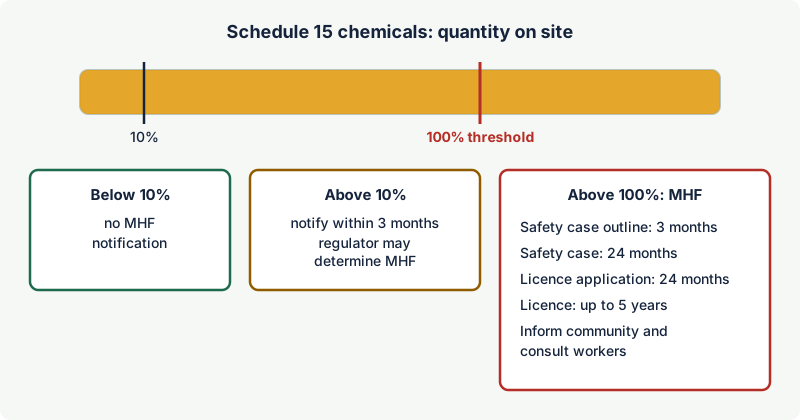
How a site becomes an MHF
A "major incident" is an uncontrolled event involving Schedule 15 chemicals, such as an escape, spillage, leakage, implosion, explosion or fire, that exposes a person to a serious and immediate risk (regulation 531). Threshold quantities in Schedule 15 are given per chemical and per hazard category. Where several chemicals are present, the regulations aggregate them, so a site can exceed the threshold through a combination of smaller stocks.
| Stage | Operator duty | Commonwealth WHS Regulations 2011 |
|---|---|---|
| Above 10% of threshold | Notify the regulator (facility, operator, chemicals, contact person) within 3 months | 536, 538 |
| Proposed facility | May notify in advance | 537 |
| Determination | Regulator confirms (above 100%) or, after an inquiry, may determine (10% to 100%) | 539 to 542 |
| Determined MHF | Safety case outline within 3 months; identify major incidents, safety assessment, controls, emergency plan, safety management system | 551 to 559 |
| Licence | Safety case within 24 months; apply for licence; licence up to 5 years, then renewal | 549, 560, 585, 595 |
| Licensed MHF | Review risk management and safety case; inform visitors, local community and local authority; consult workers | 569 to 575 |
What goes into the safety case
The safety case shows how the operator has identified every foreseeable major incident and the hazards that could cause it, assessed the consequences and likelihood, put controls in place to eliminate or minimise the risk so far as is reasonably practicable, prepared an on-site emergency plan, and built a safety management system to keep those controls working. Workers must be consulted and given a role in safety. The local community and local authority must receive information about the facility and what to do in a major incident.
Example: A water treatment chemical depot in Queensland plans to raise its chlorine stock from 2 to 4 tonnes. The Schedule 15 threshold for chlorine is 25 tonnes, so 10% is 2.5 tonnes. Once stock above 2.5 tonnes is likely, the operator must notify Workplace Health and Safety Queensland within 3 months. Because the stock stays below 25 tonnes, the regulator decides whether the depot should be determined an MHF, looking at the quantity, the activity and the land use around it.
Comparison with the EU and Türkiye
The EU Seveso III Directive (2012/18/EU) uses lower-tier and upper-tier thresholds with a major-accident prevention policy and, for upper-tier sites, a safety report. Türkiye transposes it in its regulation on the prevention of major industrial accidents (Büyük Endüstriyel Kazaların Önlenmesi ve Etkilerinin Azaltılması Hakkında Yönetmelik). Australia uses a single threshold with a regulator determination in between, and adds a licence that must be renewed at least every 5 years.
Common mistakes
- Counting only the largest tank. The quantity "present or likely to be present" includes all stock the site can hold and aggregates related chemicals.
- Applying Chapter 9 in Victoria or Western Australia, which have their own MHF regimes.
- Treating the safety case as a one-off submission. It must be reviewed and revised with the risk management reviews.
Related on excodex
- Occupational safety and health in Australia: law, authorities and employer duties
- Seveso III and major-accident prevention: tiers and duties
- How are explosive atmospheres and Ex equipment regulated in Australia?
Standards and further reading
- Work Health and Safety Regulations 2011 (Cth), Chapter 9 and Schedule 15: https://www.legislation.gov.au/F2011L02664/latest/text
- WorkSafe WA, when a dangerous goods site is also a major hazard facility: https://worksafe.wa.gov.au/when-dangerous-goods-site-also-major-hazard-facility-mhf
- WorkSafe Victoria, what is a major hazard facility: https://www.worksafe.vic.gov.au/what-major-hazard-facility
This article is general occupational safety and health information prepared by the excodex editorial team. It does not replace the applicable legislation, standards, manufacturers' instructions or the assessment of a competent OSH professional or occupational physician.
More questions on this topic
- What is the main occupational safety and health law in Australia and who enforces it?
- Must an employer in Australia appoint a safety professional or an occupational physician?
- Is a written risk assessment mandatory in Australia, and how often must it be reviewed?
- How and within what time must a workplace accident be reported in Australia?
- What OSH training must employers provide to workers in Australia?
- Are pre-employment and periodic medical examinations required for workers in Australia?
- What are the penalties for breaking occupational safety rules in Australia?
- Is a safety committee or a worker safety representative required in Australia?
Part of: Occupational safety and health in Australia: law, authorities and employer duties